


Occupiers were aware of distribution of humanitarian aid and deliberately struck shelter in Komyshuvakha with aerial bombs, - DIU
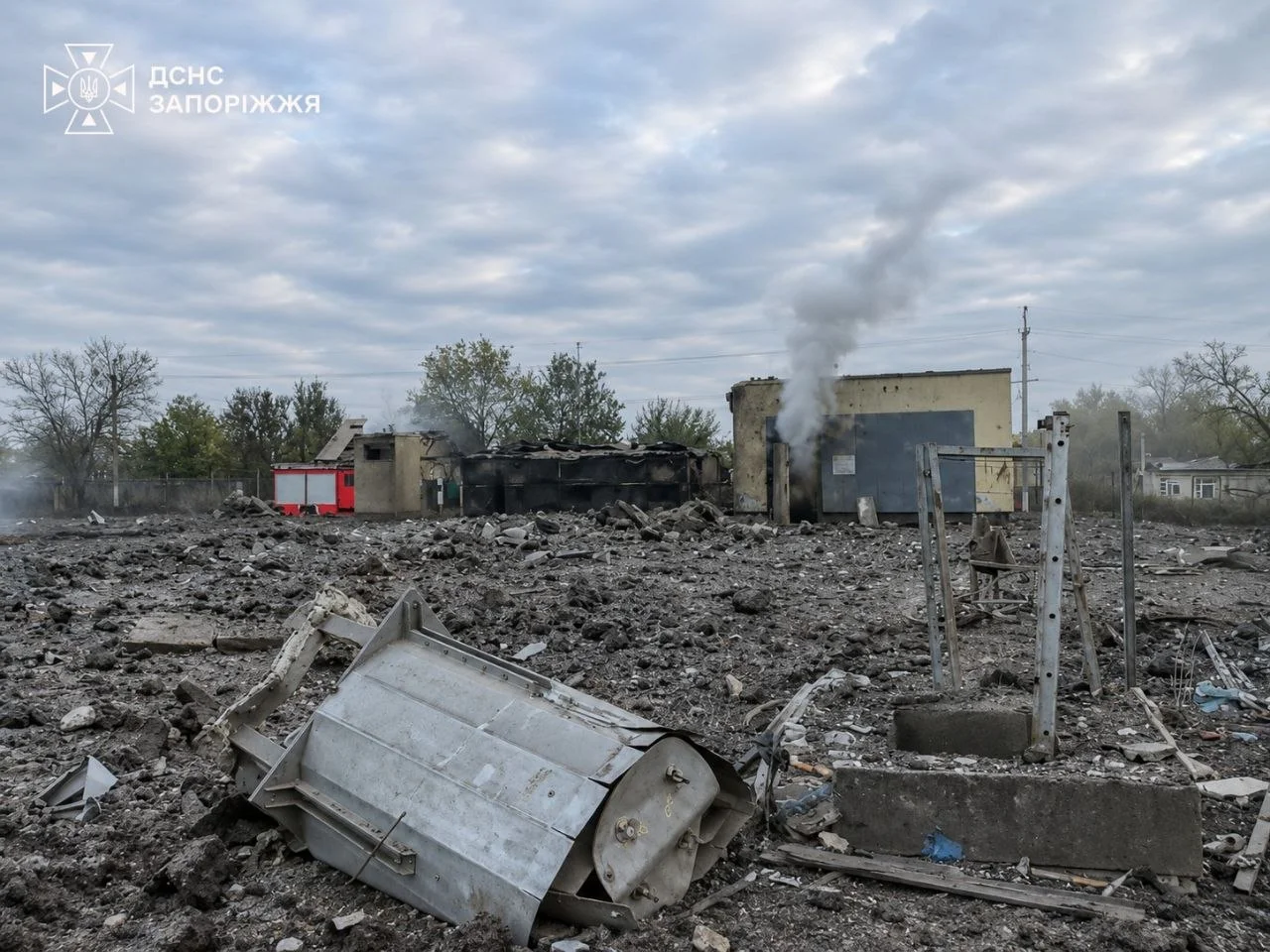
The Russian aggressor deliberately attacked a civilian aid center in Zaporizhzhia region with aerial bombs.
This was reported by Censor.NET, citing the press center of the DIU of the Ministry of Defense.
Details of the bloody strike
As noted, on November 2, 2026, the aggressor state of Russia committed yet another war crime—it carried out targeted airstrikes on the resilience center in the village of Komyshuvakha, Zaporizhzhia Oblast, while humanitarian aid was being distributed to civilians.
Initially, two enemy aerial bombs struck the grounds of the local high school, where the center is located. The Russians then launched a follow-up strike with a high-yield FAB-3000 bomb directly at the underground shelter where people were receiving aid. Six additional airstrikes were recorded afterward.
"The repeated strikes and the use of a three-tonne aerial bomb—designed to attack complex engineering structures, including underground ones—resulted in widespread destruction and numerous casualties," the Main Intelligence Directorate emphasized.
The Russians knew that humanitarian aid was being distributed
It is also noted that Russia’s occupying army was conducting reconnaissance over the frontline settlement—the invaders knew that humanitarian aid is distributed every Monday at the Komyshuvakha Resilience Center. Residents of the community come here for food, medicine, essential supplies, and support. Therefore, this is a deliberate genocidal attack by Russia against the civilian population.
The war crime committed by the aggressor state in Komyshuvakha is one of the largest tragedies in the Zaporizhzhia region since the war began. As of November 3, 2026, 31 people are known to have been killed, including four police officers and two State Emergency Service rescuers. Five people were wounded, including two rescuers. Nearly fifty more Ukrainians are considered missing.
"The targeted killing of civilians at humanitarian aid distribution sites and in underground shelters is a common practice of the Russian occupation army," the Main Intelligence Directorate emphasizes.
Other Russian crimes
- The Russians acted in the same way, for example, in Mariupol in 2022, when they destroyed the drama theater with an aerial bomb while hundreds of civilians were seeking shelter in the building’s basement.
- In September 2026, the Russians launched a precision strike on an underground humanitarian aid distribution center for civilians in Balabyne, Kushuhum Community—similar to the one in Komyshuvakha.
These underground facilities were built in 2025 as radiation shelters. Initially, they housed underground schools, and in 2026, the facilities began to be used as community resilience centers.
"The enemy’s use of heavy bombs capable of destroying complex reinforced concrete structures and shelters—specifically targeting civilian facilities—as well as repeated strikes at short intervals to kill as many people as possible, is yet another proof of the genocidal nature of Russia’s war against Ukraine. The pressure from the civilized world on the Russian killers must increase—only strength and international solidarity can stop the aggressor and force it to answer for the war crimes it has committed," the Main Intelligence Directorate concludes.
Background
On November 2, Russian aircraft carried out precision strikes with three-ton guided bombs (including FAB-3000s) on the center of the village of Komyshuvakha. The main strike destroyed a local school that was being used as an underground humanitarian hub. Every Monday, bread and food packages were distributed there.
The shelling began in the morning (between 10:00 a.m. and 11:00 a.m.) when people arrived to receive aid. When civilians, employees of the Administrative Services Center, police officers, and rescue workers descended into the underground shelter, the enemy dropped at least nine more aerial bombs directly onto the shelter, blocking and destroying it. According to President Volodymyr Zelenskyy, the occupiers knew full well that civilians were present at that location.
Thirty-one people were killed in the strike. Most of the victims were local residents (including residents of nearby villages) and people who were helping them evacuate after the first airstrike. The following people were killed under the rubble:
- Four police officers: community officers and operatives — Majors Mykhailo Buzhenko and Mykola Balanda, and Captains Mykhailo Romanov and Dmytro Besedin. They helped civilians take cover during the shelling.
- Two State Emergency Service rescuers: 44-year-olds Denys Konovalenko and Oleksii Sushchevskyi. They arrived to eliminate the consequences of the first strike and were caught in a second strike. Two other rescuers were wounded.


