"Khartiia" for Kharkiv, but Terekhov is against it? How city council is doing self-promotion and blocking placement of advertising for brigade holding front line
In May 2024, Russia launched a new offensive in Kharkiv region. Since then, the 13th Khartiia Brigade of the National Guard of Ukraine has taken up defensive positions north of Kharkiv, stopping the new offensive by the occupiers and pushing them back from the regional capital. Like other brigades, Khartiia is interested in placing advertisements in the city – primarily to support mobilization efforts and replenish its ranks. There are no problems with ad placement in any other city or town in Ukraine. However, in Kharkiv, the brigade that is holding the enemy back on a strategically important section of the front is not only being denied access to social (free) advertising, but advertising companies are also being pressured not to cooperate with the Khartiia charitable foundation on the sale of advertising space in the city.
Recently, Khartiia launched a new mobilization campaign, but you will not see it on billboards or citylights in Kharkiv. Instead, many of these ad structures are occupied by political campaigning from Kharkiv mayor Ihor Terekhov. At the same time, the city council is sparing no taxpayers’ money on multi-million improvement projects in a city located just 20 kilometres from the front line.
Censor.NET looked into the situation.
Bureaucratic trap
At the end of July 2025, representatives of Khartiia sent a request to Kharkiv mayor Ihor Terekhov regarding the placement in Kharkiv of advertisements for the brigade’s new mobilization campaign. Khartiia only received a reply in September. In its letter, the Kharkiv City Council stated that, allegedly, the request fell outside its powers.

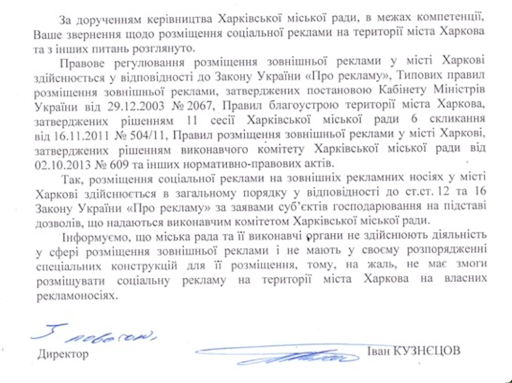
Serhii Kalmus, a serviceman of the brigade who handles organizational issues related to advertising placement, says that Kharkiv is almost the only city in Ukraine that does not assist the brigade in providing structures for advertising.
"As the person responsible for communication with advertising contractors, I send requests to city and regional councils asking to place social advertising on outdoor advertising media," Kalmus explains the procedure.
"In Kharkiv, we follow the same standard procedure as in other cities – a request to the city council asking, where possible, to provide public service placement on outdoor advertising media.
City councils in other cities always actively support the placement of social advertising, engaging operators on the advertising market. Only in Kharkiv do they refuse to meet us halfway."
The brigade’s representative provided us with examples of responses to similar advertising placement requests from other municipalities. They contain not only approvals, but also concrete outcomes with a list of the advertising structures where the brigade’s materials were placed.
The situation with commercial outdoor advertising placement in Kharkiv has turned out to be just as discouraging for Khartiia. Our sources in companies that own advertising spaces in Kharkiv report that advertisers have received an unofficial ban from Mayor Terekhov on placing Khartiia’s advertising in the city, under the pretext that Khartiia is allegedly not only a military entity, but also a future local political platform – and therefore a rival to Terekhov.

Against this backdrop, servicemembers have repeatedly stated that the Kharkiv city authorities do not provide sufficient support to the military and to Khartiia in particular. At the same time, Mayor Ihor Terekhov believes that the municipality allocates enough budget funds to support the military.
Responding to a remark by journalist Tetiana Danylenko in an interview with Ukrainska Pravda that mayors of cities far from the war – such as Khmelnytskyi and Cherkasy – allocate more funds to support the military than the million-strong city of Kharkiv, Terekhov suggested that they simply have the necessary budgets because they are not frontline cities.
"Let Lviv help as well," he added.
According to Gwara Media, as of August 2025, since the start of the full-scale war, the amount that the Kharkiv City Council has allocated to Khartiia stood at 33.1 million hryvnias. However, the total cost of image-building projects implemented by the Kharkiv City Council during the war is much higher.
Blacklisted by the city council
Another piece of evidence that the blocking of Khartiia’s advertising is no coincidence can be seen in the following example.
During the previous advertising campaign, Khartiia says, providing a copy of the relevant reply letter, the Kharkiv City Council likewise did not assist the brigade with ad placement. This triggered a wave of support for the unit. OSB boards used to seal up buildings in the city that had been damaged by the Russians began to be covered en masse with graffiti against the backdrop of the Ukrainian flag bearing the slogan "Khartiia for Kharkiv".
However, in the end, these graffiti too began to be painted over by unknown individuals. Khartiia "was shocked to learn that expressions of support for the unit [graffiti with the slogan ‘Khartiia for Kharkiv’] started to be suppressed":
"They began to be destroyed or painted over by municipal utility workers – this was captured on video that is circulating online. This is reminiscent of the events of 2014, when images with state symbols were likewise painted over in the city and memorials to Ukrainian scholars, writers and activists were destroyed. Khartiia expresses its disappointment with such actions by the city authorities. [...]. Such actions undermine this unity and erode our resilience in the struggle against our common enemy."
Our sources in the city council told us that Ihor Terekhov personally instructed the heads of municipal enterprises at a meeting to have the name "Khartiia" in the graffiti painted over. The city council at the time neither confirmed nor denied that employees of municipal services had received such an instruction.

Painted-over Khartiia graffiti. Photo: Vakhtang Kipiani / Facebook
Ultimately, after the issue gained nationwide publicity and provoked outrage among residents, the painting over of the graffiti was stopped, the brigade says. Moreover, Kharkiv residents are increasingly showing their support for the unit. Street artist Hamlet Zinkivskyi has also joined in.
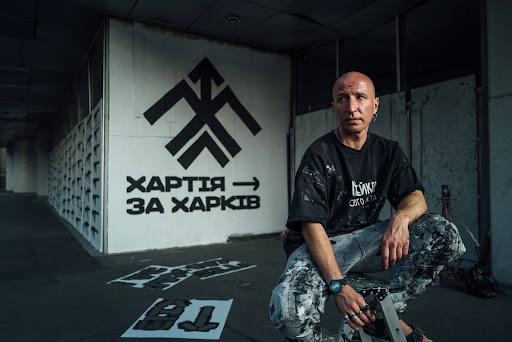
Hamlet and his work in support of Khartiia. Photo: Pavlo Itkin for Khartiia

Graffiti in support of Khartiia in Kharkiv
However, the situation with official ad placement at the city level has still not improved.
"Time is passing, but nothing is changing," says Kalmus.
By contrast, representatives of other Defence Forces units have no such problems and are successfully placing mobilization ads on billboards and citylights in Kharkiv.
Our source in the city council reports that Ihor Terekhov is interested in creating obstacles to the placement of Khartiia’s advertising because he does not want representatives of the brigade to take part in future elections, which are not being held for the time being due to martial law.
Campaigning and PR during the war
While the Kharkiv City Council is, to put it mildly, not facilitating the placement of Khartiia’s public service ads, the urban space is saturated with political advertising, including that of Mayor Ihor Terekhov.
In some small areas, you can see several such billboards at once, for example, on a short stretch of Klochkivska Street, potential voters are enticed by six mayoral campaign billboards in a row: three on each side of the road.
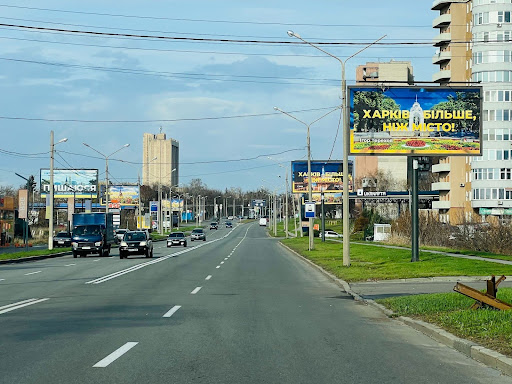
A stretch with six Terekhov billboards on Klochkivska Street
In recent months, four types of billboards with Terekhov’s name and five different slogans have appeared in Kharkiv: one emphasizing local identity – "Proud to be a Kharkiv resident"; the thematic "Two holidays – one strength" for Independence Day and City Day; "Thank you for a Ukrainian Kharkiv" for Defenders Day; "Kharkiv lives and works", which echoes his predecessor Hennadii Kernes’ favourite slogan "Love Kharkiv – work for the people", adapted to the frontline reality; and the abstract "Kharkiv is more than a city!"
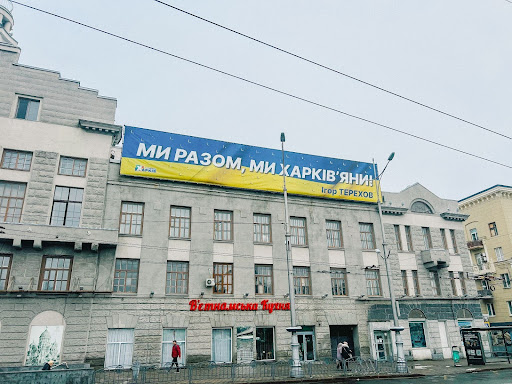
A banner promoting Terekhov in central Kharkiv
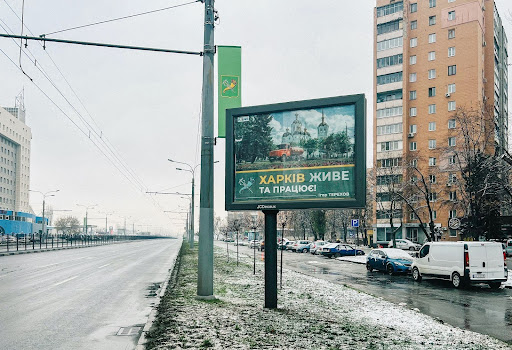
One of Terekhov’s billboards on Aerokosmichnyi Avenue
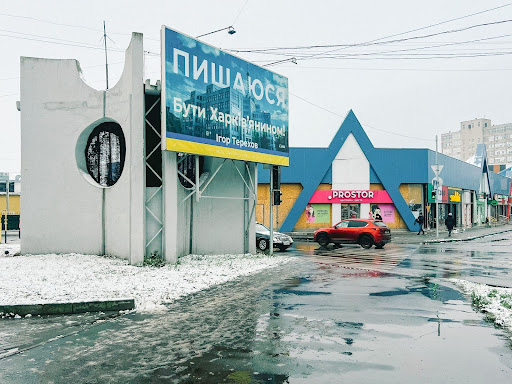
Terekhov’s campaign on Aerokosmichnyi Avenue
During the full-scale war, public transport in Kharkiv has remained free of charge, as Ihor Terekhov has repeatedly stressed, although in reality this "free" travel is compensated from the city budget: this year, spending on such compensation amounted to 11.2% of the city’s budget, co-founder of the Kharkiv Anti-Corruption Centre Yevhen Lisichkin has pointed out.
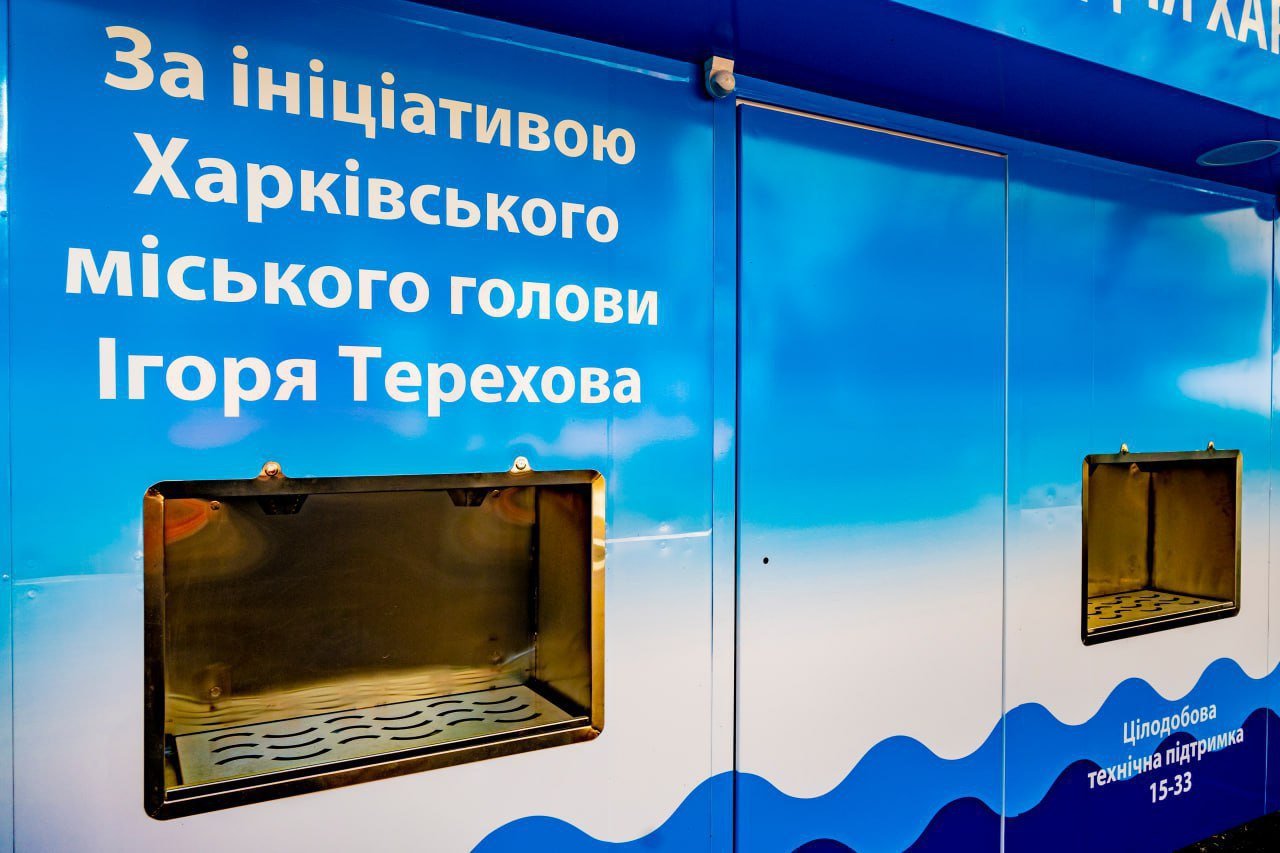
In addition, Kharkiv has public water kiosks providing free water with the support of international partners UNICEF and "on the initiative of Kharkiv mayor Ihor Terekhov", as the signage on them clearly states, highlighting the mayor’s patronage. However, this "free service" costs the city budget millions of hryvnias: in April, the municipal enterprise Kharkivvodokanal signed a contract with Southern Industrial Company LLC to purchase 29 kiosks for 11,551,673 hryvnias for these needs, and in July – with the private enterprise Nereks for another 45 kiosks for 17,550,000 hryvnias.
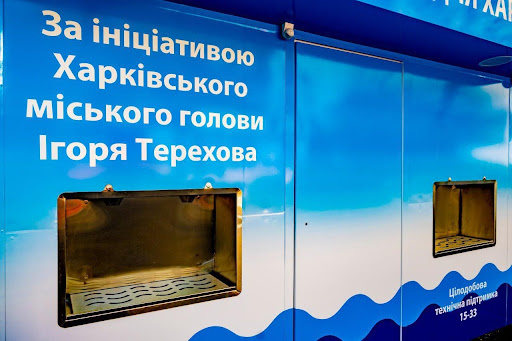
A kiosk providing free water under the mayor’s patronage
At the same time, the municipality continues to implement costly projects whose appropriateness during wartime is being questioned by members of the community and sparks heated discussion on social media.
On 18 November, the Kharkiv City Council announced another tender for the reconstruction of the Lopan Embankment and Lopan Lane, including the creation of a pedestrian zone. The expected value of the contract is 36.37 million hryvnias.
These are not the first millions allocated from the city budget for this reconstruction. Earlier, the Kharkiv Anti-Corruption Centre (HACC) reported that on 11 November 2025, the municipal enterprise Kharkivzelenbud, subordinated to the Kharkiv City Council, signed a contract worth 5.2 million hryvnias with Energy-Saving Technologies Scientific and Production Company LLC for major repairs to the Lopan Embankment on the section between Hostynyi Dvir Street and Poltavskyi Shliakh Street.
According to the Kharkiv Anti-Corruption Centre, the total amount allocated from the city budget for this project in 2025 is more than a quarter of a billion hryvnias — 255 million hryvnias.
It is noteworthy that as of the end of October, the city's budget planned expenditures exceeded revenues by UAH 1 billion (UAH 26.19 billion versus UAH 25.18 billion).
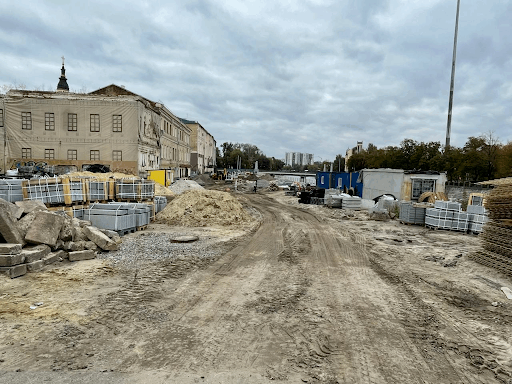
Repair work on the Lopan Embankment in October 2025. Photo: HACC
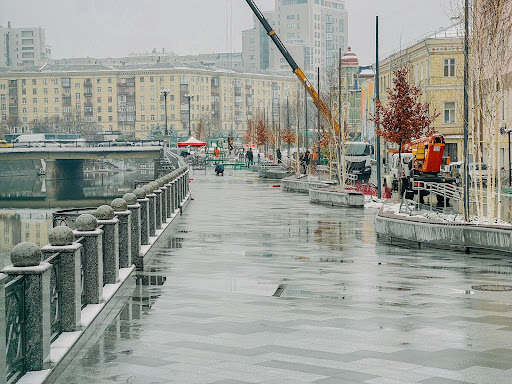
This is what the 255-million-hryvnia project looks like in mid-December 2025
Earlier, at least 35 million hryvnias from the city budget were spent on the reconstruction of the square near the Eternal Flame in central Kharkiv, and almost another 1.5 million hryvnias went on project documentation. The client in that case was also the municipal enterprise Kharkivzelenbud. The documentation was prepared by RS Engineering LLC, and the work was carried out by Energy-Saving Technologies Scientific and Production Company LLC.
During the reconstruction, the square was not only rebuilt, but an observation deck was created, with a six-metre-high installation in the form of a campfire placed on it. Although the general designer claims that the art object itself was donated to the city by patrons, many Kharkiv residents were offended that it was installed without consulting the community, spoiling the panorama of the Annunciation Cathedral. Local historian Andrii Paramonov called the installation "a disgrace" and criticised the supposed historical symbolism it is meant to reflect. The structure itself was copied from an American one: similar objects had previously been installed in Washington and Florida.
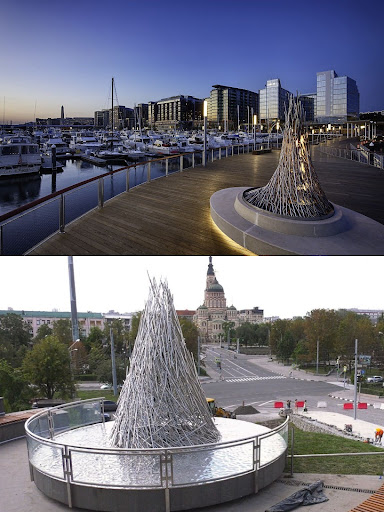
Top: installation in Washington. Photo: Courtesy of Hoffman-Madison Waterfront (HMW)
and Bottom: installation in Kharkiv. Photo: Kharkiv City Council
"Once again, things are far from fine in our kingdom; once again we, the community, have been deceived and spat in the face: they’ve foisted on us, without asking, yet another monstrosity, and right in the historic centre, in the heart of the city, a symbolic campfire that is supposedly meant to recall those that were allegedly lit on Cossack fortresses," journalist and historian Filip Dykan said indignantly.
At the same time, while the city council is rolling out dubious image-building projects, the city’s landmark historic buildings continue to deteriorate, not only because of the aggressor state, but also due to neglect. But that is a topic for a separate article.
***
Recently, it emerged that the Kharkiv city authorities have launched another round of multimillion-hryvnia urban improvement projects.
Among them is the renewal of the green area near the "thermometer" in the city centre, which the municipal enterprise Kharkivzelenbud commissioned from Kuznetsov Landscape Studio for 1.47 million hryvnias. As the Kharkiv HACC notes, rolled turf for the flower bed was purchased at 306 hryvnias per square metre, which is significantly higher than turf prices online: 120 hryvnias per square metre.
"HACC believes that during the full-scale war, spending on repairs and construction should be minimised, and the freed-up funds should be directed to the needs of the Defence Forces of Ukraine. Such work is not appropriate at this time," HACC stresses.

The result of the costly reconstruction of the area near the "thermometer" – a traditional meeting place for Kharkiv residents
The Department of Housing and Communal Services of the Kharkiv City Council has also announced a tender worth 5.25 million hryvnias for the reconstruction of external lighting networks, including the installation of connection points for decorative lighting on central Sumska Street. Anti-corruption activists suggest that the lighting will become "Starry Sky-2": the first "Starry Sky" – the illumination on the same street – was installed during Hennadii Kernes’ mayoralty.
It is worth recalling that at the end of 2020, Terekhov, who took over as mayor after Kernes’ death, promised that Kharkiv would no longer "buy ‘Starry Sky’ for such incredible sums".
Thus, it gives the impression that Kharkiv’s officials are interested not in solving the city’s real problems and supporting the soldiers who defend it, but in increasing their own political capital through showcase projects that can hypothetically be "sold" to their electorate in order to reap dividends in potential elections.
The city authorities are increasingly focused on potential future elections and preparations for them, forgetting that the only guarantee of the safety of the city and its residents is not the "Starry Sky", but the work of the brave soldiers holding the front line in cold trenches 25 kilometres from the centre of Kharkiv.
Serhii Bondarenko