



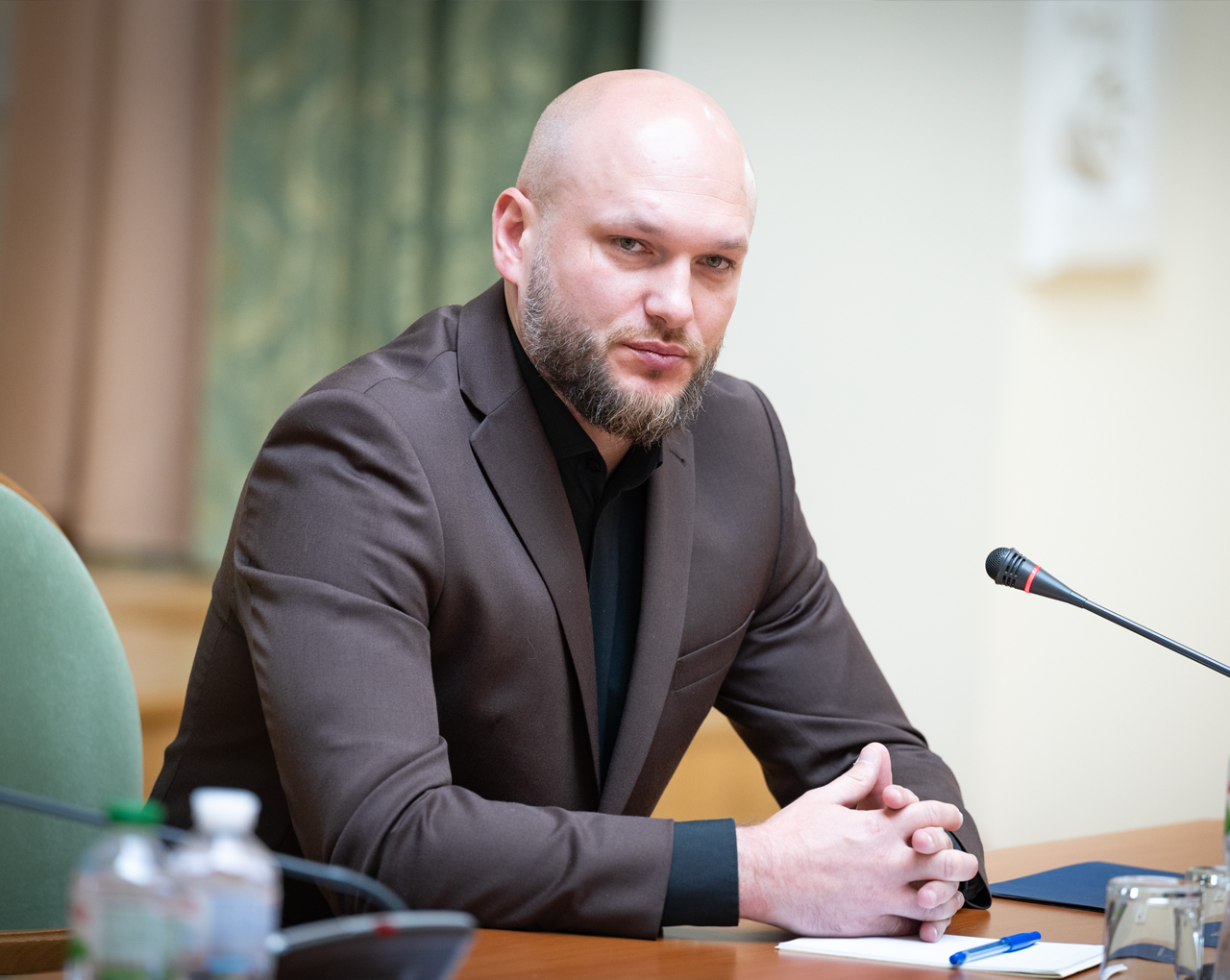
"From punitive system to system of fair decisions." Article by ESBU Director Oleksandr Tsyvinskyi on new mechanism for pre-trial settlement of economic offences
The reboot of the ESBU is not only about changing the team, but also about new approaches to work that give the state money, businesses clear and transparent rules, and society a sense of justice.
Therefore, the Economic Security Bureau is initiating a public discussion of a new mechanism that would allow businesses to avoid years of litigation and criminal prosecution. Similar mechanisms are used by law enforcement agencies in a number of other countries. I saw how this works in practice in France, when our team investigated one of the high-profile international cases as part of a joint investigation team.
Discussing this topic with journalists from "Censor.NET," we decided to take it beyond the scope of our recent interview.
I will share my arguments with you and hope to hear your thoughts, reservations, questions, and advice so that we can work together on such a mechanism.
WHY IS THIS NECESSARY?
At a certain stage in the development of criminal justice, every state reaches a point where it is no longer enough to change people or methods — the very logic of the system needs to be changed. Ukraine is at that point. We are used to the classic triad of economic crime investigations: pre-trial investigation, suspicion, trial. But has anyone calculated how much this "full circle" costs the state? The salaries of investigators and prosecutors, years of court hearings, the cost of expert examinations — and often the result is a decision that returns neither money nor justice. In some cases, the system resembles Sisyphean labour, where the state pushes the boulder of procedures, and those who have "made a deal" win.
And this is where the most dangerous part begins — the "sphere of decision-making" as a parallel market of justice. It is not an official procedure, but it works. It works because the system does not give businesses any other legal alternative. If you are a business and you are caught in a tax scheme, you have two options: fight to the end or "resolve the issue." And "resolving" means bribes, agreements, backroom deals, where it is not those who are right who win, but those who have access. As a result, everyone loses: the state — because it does not receive funds and loses authority; business — because it lives in fear and spends resources on "shadow taxes"; society — because it stops trusting the law.
But there is another, deeper aspect. Where the law does not give a person or company an honest way out, a "shadow market of justice" emerges. This is where corruption appears — not so much as a crime, but as a system of survival, primarily for business, in a legal vacuum. Business has only two scenarios: fight for years or "come to an agreement." And an "agreement" is the moment when the state loses not only money but also its moral advantage.
In addition, we often encounter situations where reputation is more important to a business than paying a fine: that is, when a business is willing to compensate for the damage caused, pay the fine, and transfer the corresponding funds to the Armed Forces of Ukraine. At the same time, the inevitable announcement of suspicion destroys business reputation and sometimes makes it impossible to pay the corresponding funds to the country's budget.
We ourselves have created an environment where dishonesty is often more effective than the law.
Such a system cannot be overcome by repressive methods or rhetoric of struggle. It can only be destroyed structurally — by creating legitimate, rapid and predictable mechanisms for resolving legal conflicts between the state and business.
To this end, the state must offer a legal alternative that is transparent, understandable and economically rational for all parties: settlement instruments that make corrupt "agreements" economically unprofitable and deprive them of any practical meaning.
And this is where the ESBU can and must become a driver.
The world has already gone down this path. When I worked at NABU, we investigated a global international case where a Ukrainian official demanded a bribe from a French company for contract renewal. We set up a joint investigation team with France and Estonia, each of which investigated actions within its own jurisdiction. As a result, a French court fined the French company €18 million and ordered it to compensate Ukraine €3.37 million. Without years of legal battles, the company admitted the violation, paid the fine and compensated Ukraine. The money has already been transferred to Ukraine's budget. But the key is not in the amount, but in the mechanism: the decision was made not after years of litigation, but thanks to the CJIP procedure — Convention judiciaire d'intérêt public.
This is a legal alternative to lengthy legal battles with losses of resources and uncertain outcomes for both sides. For the state, this means a quick return of funds and a transparent decision without backroom deals. For business, it means clear rules of the game, predictability, and the ability to continue working after correcting violations, rather than after years of legal battles.
In other words, for the company, it is a controlled and legal way to get out of a crisis situation without a criminal conviction and without being branded a criminal. Under the CJIP, the company acknowledges the violation, pays a fine and compensates for the damage, and its owners, managers or employees do not have a criminal record or other consequences typical of criminal prosecution.
This allows the company to maintain its legal status and continue operating, have access to international markets, financing and partners, while avoiding serious reputational damage, automatic sanctions and years of uncertainty. At the same time, it publicly undertakes specific commitments to change its compliance system, the implementation of which is subject to strict supervision by the competent authorities.
It is precisely this tool that is systematically lacking in Ukrainian law enforcement practice today.
HOW COULD THIS WORK?
At ESBU, we propose to do what has long been overdue — to launch a pre-trial tax settlement procedure based on transparent mediation between the state and business. This idea did not come about abstractly or "from books." It grew out of practical experience — from the investigation I mentioned. This case exposed a systemic problem: even when the state has arguments, the very logic of the criminal process pushes the parties not to restore justice, but to delay, bargain and seek informal solutions. In fact, the system leaves no room for honest compromise.
It was thanks to the combination of the experience of this case, which showed the dead end of the punitive model, and the French practice of CJIP, which demonstrated an effective alternative, that the idea of pre-trial settlement for Ukraine was formed.
The model is simple and fair. If a company acknowledges non-payment, reimburses taxes, pays a fine and makes an additional contribution — for example, to the Armed Forces of Ukraine fund — the proceedings are closed upon reaching a tax compromise. This is not an amnesty, it is economic restoration of justice. But it can only be done once — the "right of first mistake". Repeat it and you will face full criminal liability. This approach gives the state quick financial results, businesses - a legal way out, and society - a signal that honesty is finally more profitable than corruption.
This approach differs significantly from the provisions of Part 4 of Article 212 of the Criminal Code of Ukraine, as it does not carry a criminal aspect and does not provide for a change in the status of participants in criminal proceedings from witness to suspect. This is not about exemption from criminal liability — we are not reaching that stage, but rather proposing a reasonable and pragmatic compromise for both the state and business.
In Europe, the effectiveness of the system is assessed not by the number of suspicions, but by the amount of damages recovered and trust in institutions. Ukraine has a chance to create its own model — one that is fair and anti-corruption. Every hryvnia returned to the budget today is a weapon. Therefore, the idea of pre-trial settlement, when the amount of compensation goes to the state budget and the fine goes to a special fund of the Armed Forces of Ukraine, has not only economic but also moral significance.
The ESBU has the potential to become a laboratory for new legal solutions that will break old corrupt practices. We must move from a state that punishes to a state that corrects and restores. This is not about leniency — it is about intelligence. And if we build a system where a legal solution is more profitable than a bribe, then the words "make a deal" or "resolve the issue" will disappear, not because they will be banned, but because they will lose their meaning.
This is not a "softening" of the law — it is economic and institutional strength. We are bringing the problem out of the shadows and into the public arena, making it economically unprofitable for those who still use the "shadow market of justice."
From the editors. Recognising how socially significant this discussion is, "Censor.NET" is ready to serve as a platform for it. We invite representatives of the business community, lawyers, auditors, mediators, academics, and international experts to join the discussion of the idea voiced by the director of the ESBU. Because this is not only about changes in legislation, but also about a change in philosophy — the state's attitude towards businesses that continue to operate in the country during this terrible war.
Please send your suggestions to the following email address: [email protected]


