



Brigade commander Dmytro Rohoziuk: "AWOL cases on our end have dropped severalfold. People keep coming back"
Today, Dmytro Rohoziuk commands the 60th Separate Mechanized Brigade, which is part of the 3rd Army Corps. As a child, he dreamed of becoming a firefighter. To him, the profession embodied real public benefit, everyday courage, and responsibility.
Sports training, education at specialized institutions, and a drive for discipline gradually led him to the realization that to be effective, military training was necessary. Therefore, in January 2014, Dmytro signed a contract and began service in a transport aviation brigade — at a time when Russia was already preparing for a war against Ukraine.
- In one of your interviews, you recalled the beginning of your service as follows: "It was our airfield that received aircraft evacuating from the peninsula. We spoke with officers who were leaving Crimea, so I had a clear understanding of what was happening there." What did they tell you?
- In addition to direct communication with flight personnel who arrived at our airfield together with the evacuated aircraft, I also stayed in contact with colleagues from Air Force training centers for enlisted and NCO personnel who were directly present in Crimea during those events.
This is a separate topic for an interview altogether, and it would probably be better to speak to those who served there. But I will say this: the occupation of the peninsula was prepared by Russia well in advance, over the course of several years. The provisioning of Russian soldiers and officers serving in Crimea was several times better than ours. Given that they were effectively neighbors (separated by a fence) and often even maintained family friendships, this inevitably sparked negative emotions among servicemembers of the Armed Forces of Ukraine. Many factors put us at a disadvantage, not only technically, but above all morally. The Russian army appeared successful: high salaries, a large number of flight hours, and better-quality support for servicemembers’ families. Meanwhile, the Ukrainian military in Crimea was in a losing position.
For a long time, Russia’s propaganda machine was also turning its "gears": "We are a success! Come join us!" So it did not come as a surprise to me that, under its influence, quite a few officers and servicemembers switched sides. Although, most Ukrainian servicemembers in Crimea at the time were ready on the spot to defend their land and their military units. But the question of why that did not happen is definitely not one for me. It is not within my remit. I only have my own understanding of the situation, based on conversations with personnel who were serving there during that period.
- At the time, did you consider that Russia might start a war against Ukraine?
- At that point, such thoughts did not arise. But it was the time of the Maidan, when many of my friends were at the epicenter of those events. I stayed in touch with them and genuinely believed that things would change for the better. Frankly, I did not expect what followed. The revolution was clearly not in the interests of the Russian Federation. At that time, I did not yet realize that territorial annexation could take place. However, when Russian troops moved into Crimea, I realized that this would not be the end of it.
- During the ATO, you were mainly involved in rear-area support for the troops fighting in the Donbas. So you did not really see the war then and did not take part in combat?
- At that time, I was not involved in infantry firefights. Not because I did not want to. It was simply that my duties were to ensure the airfield’s operational readiness, and the airfield carried out missions during the Anti-Terrorist Operation, including combat missions. Of course, I wanted to join my friends in volunteer battalions. But I was already in the military, and an inter-agency transfer was an extremely complicated process. That was one of the reasons I ended my military service when my contract expired; I did not see myself in rear-area roles. Moreover, by 2017, the intensity of fighting in the Donbas was declining. Everything was sliding into a kind of dead end. There was no sense for me to stay in the military.

- In truth, back then, there was no awareness that something larger-scale was possible, such as Russia’s attack on February 24, 2022. You were at home in Vinnytsia at the time. How did you learn about the invasion?
- My grandmother called and told me.
- How did you take the news? Were you prepared for that turn of events?
- Given my previous experience and the fact that my friends and I trained, by the time of the full-scale invasion, I had a certain basic level of preparation. I held the military rank of sergeant. So, of course, I understood how to lead a squad, conduct live-fire training, and so on.
I took my grandmother’s message calmly. To be honest, at first I did not believe her, because she likes watching the news and worries about every word she hears there. So I thought it was just another piece of information from the media. But after the call, I checked the news myself and realized that a full-scale offensive had begun. My friends and I gathered that day to assess the situation, including in the region where we lived. When we saw that Russian troops were not heading there, I decided to move on. I was a fit young man with the appropriate training and did not want to continue working in rear-area support. So I went to the capital to join my friends, who at that time were with the Azov-Kyiv Territorial Defense Forces (TDF) unit. This is where I encountered my first battles.
- Why did you join a volunteer formation rather than the Armed Forces of Ukraine?
- I am the kind of officer who does not really accept the army traditions that existed before 2022. The attitude toward personnel, toward soldiers and sergeants, to put it mildly, left much to be desired back then. I had observed this for years during my contract service. That is why I did not want to have anything to do with the army of that model. I knew that there were like-minded people in Kyiv who were taking part in real combat, rather than simply sitting things out, and who would not intimidate me with threats of being sent somewhere if I misbehaved. That is why I made this decision. It was better to help not with words of support or by transporting supplies, but to be the one who actually needs them and to devote myself exclusively to the battlefield. As a man, that was morally easier for me.
- You served as an infantryman. Tell us about your first combat deployment.
- It was Moshchun, one of the hottest points near Kyiv. At that time, the enemy realized that it could not reach the capital so easily. All bridges had been blown up, and the only way to enter the city was via Moshchun, because there the riverbed was narrower, the smallest "bend." Numerous documentary chronicles have already been made about this village. Many people besides me experienced real fighting there. It changed hands several times, at times, the Defense Forces of Ukraine regained control, and at other times, the enemy managed to seize it partially. Nevertheless, we conducted successful defensive operations there, as a result of which the enemy, realizing it could not break through, decided to withdraw from Kyiv.
The first fight was driven by adrenaline. Where there is less skill, there are more emotions. Later, it becomes the opposite: more skill, fewer emotions. Back then, emotions probably dominated. Although not knowing is also a certain element of courage and bravery. When you do not know what may happen, it is easier to move forward and act.
- Many servicemembers who were civilians before the full-scale war note that who was beside you in those first battles matters greatly. Your comrade-in-arms, deputy commander of the Kraken 1654 Unmanned Systems Regiment, Yevhenii Yeremenko, callsign Teacher, told me in an interview that at the beginning, experienced fighters, Azov veterans, explained and showed what to do and how. That makes things simpler and easier, right?
- Of course! On my first combat deployment, there were four of us. I was with three experienced fighters, so I did not have any inner anxiety or fear at all. You just try to keep up with them. I fully integrated alongside them, which made everything extremely straightforward for me.

- When the enemy retreated from the Kyiv region, you were supposed to break through toward Mariupol. Why did it not work out?
- Usually, desire alone is not enough to carry out what is planned. A proper set of measures is required. Unfortunately, not everything worked out, especially with adjacent units, to create a corridor we could enter. Without it, with limited forces, we simply ran into the first line of defense. A fight broke out, and we got stuck there. Yes, there was a plan and an intention to break through to our guys, because each of us had friends who remained in Mariupol. Accordingly, every one of us wanted to get there, either to help them get out or to fight alongside them in the already encircled city.
- By the way, do any of your friends who came out of Azovstal remain in Russian captivity?
- None of my close friends do anymore. The last one was exchanged a few months ago. The rest were killed either in Mariupol or after returning from captivity.
- So they returned to the war after captivity?
- Of course! All of my friends who came back rejoined their units or joined other ones. The war does not end. Unfortunately, we have losses even after captivity.
- After the attempt to break through to Mariupol, you fought in Zaporizhzhia Oblast and Kherson Oblast. Events unfolded quite dynamically and with a sense of hope. I still remember how residents of Kherson joyfully welcomed Ukrainian troops after the city’s liberation. What did you feel when you were reclaiming our territories?
- You know, after the liberation of Kherson Oblast, my close friends and I discussed those events. We had a strong sense of grief for the people we lost. They also fought, went into battle bravely, and gave everything they had, but unfortunately died along the way and did not live to see us liberate these territories or the warmth with which local residents welcomed us. There was a lingering note of sadness.
- You also took part in the defense of Bakhmut, of which, as you aptly noted, "only the name remains." What does this chapter of our history mean to you?
- You know, it is like training an athlete or a soldier: you cannot assess their level without putting them through a serious exam. Bakhmut became such a real exam for many units, both ours and the enemy’s. Not everyone passed it. At that time, I was serving in the 3rd Assault Brigade, which, in my view, passed that test successfully. Toward the end, after effective defense, we even transitioned to offensive operations. The final liberated settlement on the outskirts of Bakhmut was Andriivka. We created all the conditions necessary to continue offensive actions.
- In Bakhmut, fighters from the Wagner Group were operating, a difficult opponent, even considering that they included not only professional mercenaries but also convicts. Was it hard?
- Look, I think this is often assessed incorrectly. A convict with a weapon in his hands is a servicemember. Of course, compared with Wagner fighters who had taken part in the war in Syria and other combat engagements, they were not well-trained. But a convict is someone accustomed to restrictions and confrontation. Such a person is morally resilient and capable of action, and that matters in warfare. I would never compare a convict to some forcibly mobilized "mama’s boy" who lived like a houseplant in a greenhouse: no wind, no harsh sun, always watered, growing up in sheltered conditions. A former inmate, by contrast, has lived in captivity and therefore has a readiness for whatever may happen on the battlefield. The key was how to employ them properly. Wagner did this skillfully when necessary relying on mass, and at other times on quality. Some units of the Defense Forces of Ukraine were not ready for that level of mass or for sudden shifts in tempo. But there were formations that resisted successfully there, were just not many of them at the time.
- The fact that convicts, compared with "mama’s boys," had nothing to lose also played a role…
- I would note that we also have former inmates on our side. I fought shoulder to shoulder with them and, to some extent, even commanded such units. There are very decent people among them.
In reality, every person has something to lose. When someone ends up in prison and serves a sentence for certain actions, they still have a family, and they are still fighting for something. They may even have patriotic convictions. Unfortunately, there is no such unit in the 60th Separate Mechanized Brigade at the moment. However, I am working with senior leadership and hope to receive permission to recruit and form such a unit from former inmates.
- I remember military commanders, including yours, Dmytro Kukharchuk, traveling to places of detention to recruit inmates for service in the military.
- I will tell you that one of the most successful uses of former inmates was precisely within the 3rd Assault Brigade. I believe this experience will also be expanded within the 3rd Army Corps. For now, unfortunately, mechanized brigades do not have the capacity to recruit such people. Not every unit can handle them, you see? These are people with a heightened sense not so much of justice as of one’s word. There are officers who can give their word quickly and just as quickly take it back. In that environment, however, a given word carries great weight. We value that principle in our unit as well, which makes it easier for us to work with them. We have clearly defined tasks that everyone carries out. That is why it was easier to employ them, and they genuinely demonstrated their effectiveness on the battlefield.
- I was initially referring to the enemy’s former inmates. They seem different to me. Servicemembers who spoke with captured Russians said that their motivation for going to war was not patriotism or, for example, a desire to restore their name, but purely financial compensation…
- You see, as adversaries, I place both their former inmates and residents of remote parts of Russia recruited purely for material incentives in the same category. At the same time, the latter group is an order of magnitude weaker on the battlefield than convicts, because, as I said, the latter are prepared for any hardships and challenges. They are more dangerous.
- Did Wagner Group fight against you in Avdiivka?
- No, it had already been disbanded. But as we can see, it taught everyone how to fight, even us, in terms of countering the enemy. The adversary is now using the same tactics that Wagner employed during the fighting for Bakhmut. Accordingly, these tactics are more focused on infiltration. In general, since then, the battlefield has continued to see the use of small, separate assault groups.
- I know that the Avdiivka campaign was extremely difficult for the 3rd Assault Brigade. Teacher, whom I mentioned earlier in our conversation, told me that he considers Avdiivka the hardest episode for the unit. What stands out the most for you from that period?
- I agree with my comrade and brother-in-arms, Teacher. But I will say that wherever we went, it was difficult in its own way every time. Each time, we thought it could not get any harder. Yet even today, in the Lyman direction, we face serious challenges, in some places even tougher than those we encountered in Avdiivka. Speaking of that direction, the enemy’s aviation was extremely active there. On some days, more than a hundred guided aerial bombs (KABs) were dropped. Entire districts were leveled solely by these strikes. They converted their aerial bombs into guided ones and immediately expanded their capabilities, scaling up. At that time, our main focus was countering their KABs, because they were simply sweeping everything away.
- What are the Russians currently focusing on most in your direction? UAVs?
- Look, as a commander, I understand that in some areas the enemy has achieved certain successes in countering the center of gravity of our defense. But if I disclose these elements now, I would be doing them a favor. So I will put it this way: today, the main burden indeed comes from the enemy’s unmanned component, which has scaled up enormously and has not only reached parity with us in the use of UAVs but, in some cases, has even gained an advantage. However, the 3rd Army Corps has surprises in store for them, which we demonstrate on the battlefield every day. Others are currently in development. So things are not as straightforward for them as they would like.
- Let’s also talk about command matters. In September last year, the commander of the 3rd Army Corps, Andrii Biletskyi, speaking about AWOL cases, gave the following example: "People are returning to the 60th Separate Mechanized Brigade who went AWOL long before the corps was formed — four to nine months earlier. Now they are falling back into formation." A month later, in October, you took command of this brigade…
- In September.
- But this information appeared in the news in October.
- Those details simply could not be disclosed immediately.
- So, essentially, you were stepping into brigade command at that point. What situation did you see then regarding AWOL cases?
- First and foremost, for me as a commander, the real challenge was to raise the NCO corps, which, unfortunately, existed in the brigade de jure rather than de facto.
We are now making every effort to revive it as the primary combat backbone of the unit. These are the people who know everything about their soldiers. They carry out our orders and lead personnel directly on the battlefield. The NCO corps is an extremely important component of the structure of the Armed Forces of Ukraine. We are equally focused on raising the authority of sergeants, including among the officer corps and elevating them to a new level of authority within the brigade, as they bring their own experience and expertise.
When it comes specifically to the problem of AWOL, people usually left, most likely, because of how they were treated. This is reflected in many factors, from logistical support to a servicemember’s personal issues. For example, a soldier may suffer a moderate battlefield injury, be hospitalized, and then be forgotten by the unit. This is where the patronage service deployed within the 3rd Army Corps plays an important role, we try to stay in contact with servicemembers and help them accompany the wounded through treatment facilities. A person then sees that they have not been left to fend for themselves. They are contacted and assisted with bureaucratic matters, which are extremely complex in our army. In other words, there is ongoing support that gives a clear understanding: a soldier is part of our family, both on the battlefield and beyond it.
We also strive to fully eliminate disparities in supply and to create identical conditions for everyone, so that it is not worse in one place and better in another.
Another important factor is the leadership tier. People who took up command positions alongside me are those who themselves went through the battlefield as part of infantry groups and served in command roles at the platoon, company, or battalion level. Personnel trust such servicemembers, because, like them, they once were in the trenches and took part in combat. Accordingly, they understand the real needs and hardships very well.
In addition, fighters also face family problems that may push them to leave their unit without authorization. To resolve certain personal matters, they may need to go home for three to five days. The brigade’s leadership now accommodates such cases and allows them to do so. When servicemembers see that conditions of service have improved and that there is real support both on the battlefield and beyond it, they naturally choose to return to their unit.
- So how are things with AWOL cases now?
- The number of such cases has dropped severalfold. People keep coming back. I speak with commanders, and they tell me that the guys who left in 2024–2025 are regularly getting back in touch, returning, and continuing their service with us.
- People who went AWOL and previously served in other units are also coming to you, right?
- Of course. They see that the brigade, as part of the 3rd Army Corps, is building up capabilities and is now holding a very strong defensive posture, despite the fact that our sector is one of the most heavily attacked in this area, because the enemy has concentrated extraordinary forces here. Our successes are already reflected in how our colleagues assess us. Word spreads, and as a result, many people want to join us.
I would note that AWOL is a broader military-wide problem. It stems, among other things, from fear and from a person not knowing where they will end up, and so on. Within the corps, our recruiting centers function well and bring in fighters, working alongside HR specialists. We try to place each person where they can be effective and deliver the highest performance. If a position is chosen, that is where they will be assigned, rather than having it changed during training, as sometimes happens. This, in particular, is one of the reasons our AWOL rate is significantly lower.
- In addition to AWOL, we also have a major problem with mobilization, which has failed. Men of conscription age often avoid the TCR. Two years ago, in one interview, you said: "Every healthy man who has two legs and two arms should be preparing. Don’t disgrace yourself, take up a rifle and go get ready." You also noted that TCRs should be going into gyms as well. Am I right in understanding that your views have not changed?
- You missed the key point in that interview. I also said: "Go and prepare while we are still here." At the time, I could see and feel that the war would not end quickly. My views, of course, have not changed, even though many people did not understand them back then. Perhaps they thought that F-16s would arrive, HIMARS would be delivered, and they would do all the work for us. They believed that the infantryman was something from the First and Second World Wars, already part of history. But I understood that there is no Wunderwaffe that will simply help us turn the tide on the battlefield. That is why every army must have reserves, while we still have strength. But new ones need to be trained. I believe that mobilization in our country has been unsuccessful in part because of poor soldier training. Everyone talks about this, commanders and civilians alike. When a person ends up at a TCR, they do not understand where they will go or what they will do, and they fear they will not be properly trained or prepared. We offer an alternative: our recruiting centers are spread across almost the entire country. People can come there, join us in a chosen specialty, and undergo basic military training using our own capacities. I hope this will scale up quickly in the near future. Our army is long overdue for such changes and for improving the system of training and recruiting servicemembers. When a person understands that they will be professionally trained and placed into a combat team with real commanders, not yesterday’s correspondence-course military department students who understand warfare about as well as I understand ballet, they will absorb the spirit of a professional military unit and deliver far better results. When they later call home and say, "Everything’s fine. I’m in a good team here. We’re all beasts and ready for battle," public attitudes will change as well. But if they say they were taught nothing and ended up somewhere completely different, what kind of feedback do we expect from people? All of this is compounded by enemy propaganda, which amplifies these messages in our media and that does not work in our favor.
- As a result, we now have two million Ukrainians listed as wanted, as reported by newly appointed Defense Minister Mykhailo Fedorov. What does this figure mean to you?
- I think this figure will go down. There is also the problem of outdated records of citizens liable for military service. Some of them have changed their registered address or no longer live in Ukraine at all. From 2014 to 2022, the state did not pay sufficient attention to this issue. The result is the figure that was announced.
I also listened to Fedorov’s address in the Verkhovna Rada. He also mentioned 200,000 AWOL cases, which is another serious issue. I believe that most of these people are ready to rejoin the military but in the units where they want to serve, including our 60th Separate Mechanized Brigade. I hope the new leadership of the Ministry of Defense of Ukraine will find a mechanism for an easy return to military units, so that this number decreases and our formations are reinforced by brothers-in-arms who, for various reasons, once decided to leave their previous places of service.
- But there are still those who genuinely do not want to go to war. Some even continue to find ways to leave the country illegally. What would you say to such men? Is there any point in talking to them?
- What kind of appeal could I even make to them? He chooses not to stand up for the land God gave him, where he was born and lived with his family. He does not want to defend the country that, in one way or another, gave him everything on the basis of which he is now realizing himself elsewhere. If fear or self-justification has completely drowned out even a person’s love for their neighbor, what is there for me to talk about with such people?
These are exactly the times when a man can consciously and fully call himself a man. Real, genuinely masculine challenges stand before us. One must take up arms and remember the rights and duties we have to the state — first and foremost, the duty to defend the country from an enemy that is advancing on us.
- The enemy is advancing and, in my view, shows no desire whatsoever to achieve the peace that has been talked about so much worldwide lately, as if negotiations are about to end with the signing of some peace deal. At the same time, the situation at the front is escalating, and brutal shelling of civilian cities continues, with all the consequences that entails. This hardly suggests that everything will stop anytime soon. Judging by the interviews of yours that I have watched, you also believe we need to prepare for a difficult and prolonged war. Do you see Ukrainian society realizing this?
- I would like to specifically draw attention to statements by Western politicians claiming that we are close to peace. They do not have a positive impact on the combat effectiveness of our military or on the morale of society, which, in reality, needs to mobilize. We need reserves and reinforcements for units after losses. When I speak about losses, civilians may assume this means those killed. But there are also wounded servicemembers or those who end their service for other reasons, for example, due to an increase in the number of children in their family or because of health issues. That is why mobilization during wartime is a continuous process, and we must sustain it in order to replace those fighters who leave the Armed Forces of Ukraine. These are exactly the messages that should be central, both patriotic and focused on demonstrating courage. There should be accounts of events in which our people display extraordinary strength and resilience of character. Infantrymen, including those of my brigade, behave with exceptional bravery in defensive combat and carry out heroic actions. They inspire me as a commander to keep working relentlessly and are my primary source of motivation. This is what we need to show our people. Yes, war is frightening. But it is also a moment when Ukrainians demonstrate extraordinary courage and resilience. I believe we need to change the way information is presented.
- Finally, a rhetorical question: what has to happen for Russia to finally leave us alone?
- I will not say anything new. It is all described very clearly in military textbooks. The primary goal of defense is to compel the enemy to abandon its plans for an offensive. To do that, we must create the appropriate conditions at the front. And then we ourselves must go on the offensive. That is why we need to keep working and scale up what is working for us. It is no secret that the 3rd Army Corps is one of the most successful corps in the country. There is a systems-based approach here, planning and decision-making processes, and modern technologies that simply have to be expanded across the entire force. Let me emphasize: we need to create conditions at the front under which the enemy abandons offensive actions. Then we will be able to impose our will.
You know, I am one of those officers who believe that our army is still capable of achieving certain tactical successes. I am not talking about deep operational breakthroughs as of now, but we are fully ready for tactical gains in certain sectors of the front. We simply need to make some changes in training and in the approach to how personnel serve, raise the overall standard, conduct a proper assessment of the command of certain units, and slightly adjust priorities in sustainment and in the allocation of resources. We have the capabilities. I can see it even from the enemy’s side, they are running out of steam. Things are not going as well for them as their propaganda claims.
- However, a lot depends on public support. The front cannot be successful without reliable rear support, can it?
- Nowadays, people don't treat the military the way they did in 2022-2023. This has an impact. Personally, it doesn't affect me. I have developed certain mechanisms within myself, so I don't need additional support in communication. Yes, society and the state as a whole need to support the army's vitality and combat capability. But I don't need separate verbal gratitude from this or that person. I know what I'm doing and why. But not all military personnel are like that. Sometimes they need human gratitude. I would like people's current attitude to change, and for them to see the military primarily as defenders again. But, unfortunately, the reality is different. There are more and more incidents involving representatives of the TCR on the streets. However, I want to remind you that most of them are soldiers who have been wounded. I treat them with great respect. They certainly do not deserve such treatment from society. But despite everything, I continue to hope that we are moving towards change for the better.
Olha Moskaliuk, Censor.NET
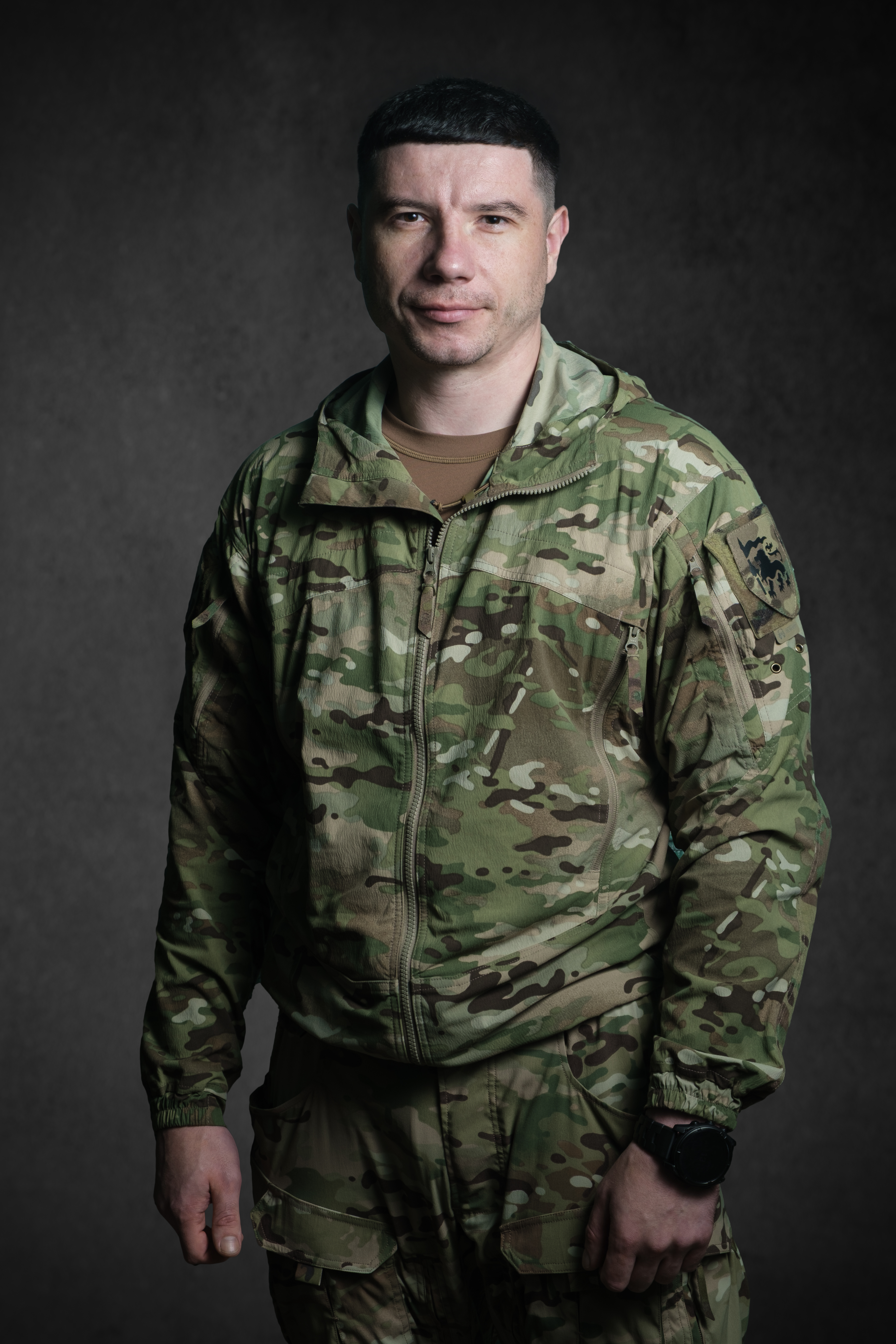
Photo from Dmytro Rohoziuk's personal archive


