



It all comes down to exports: What does Ukraine’s defense industry need in 2026?
Drone Industry
Ukraine’s defense industrial complex has demonstrated an unprecedented surge during the full-scale war with the Russian Federation. According to the Ministry of Defense, the capacity of the domestic defense industry has grown from $1 billion to $35 billion.
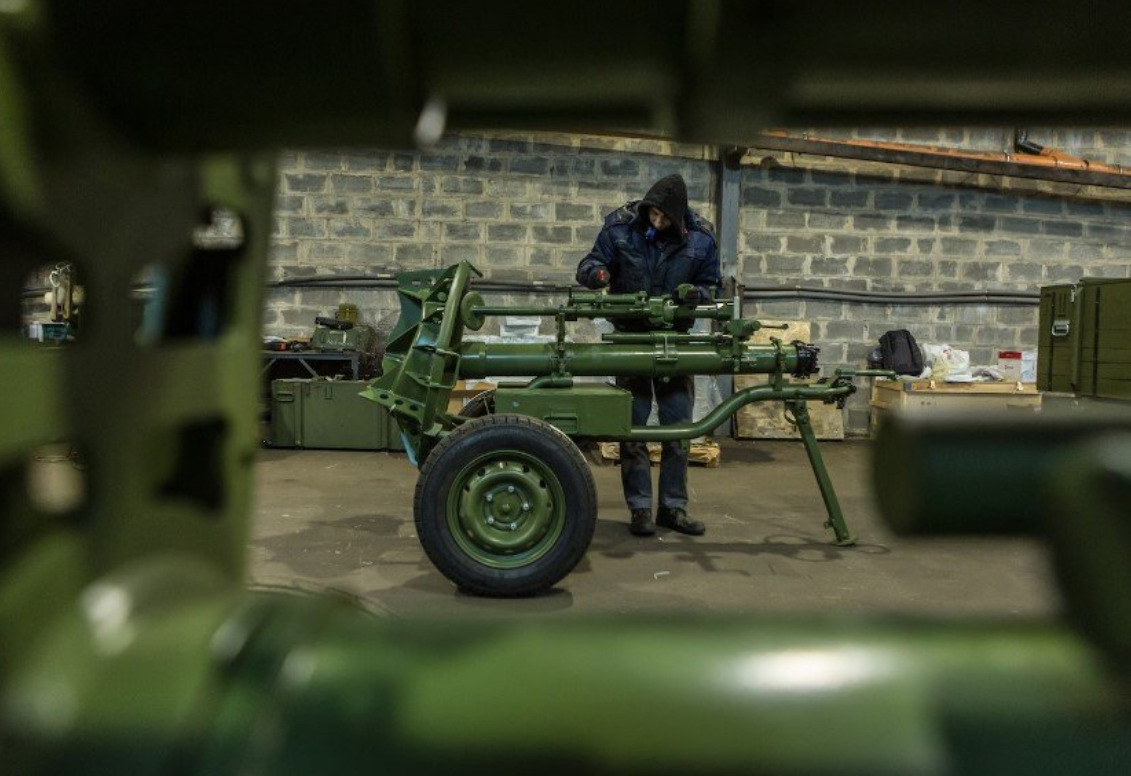
This growth is attributed to a systematic state policy, optimization of the regulatory framework, investment inflows, and the scaling up of domestic production.
In addition, a special legal regime, Defence City, was launched in early January 2026 as a state support instrument for defense industry enterprises. Its residents are set to receive tax incentives, simplified customs procedures, and other benefits.
Read more: Defence City: Boost for defence industry or closed club for chosen few?
At the same time, the defense industrial complex is facing serious challenges, primarily related to state policy, particularly regarding arms exports. These issues were discussed in detail by industry representatives and experts during a panel discussion on February 4. The event was organized by the National Association of Ukrainian Defense Industries (NAUDI) together with Radio NV.
Journalists from the "Drone Industry" project also attended the event. Here are the key takeaways.
Data is the new oil
According to war veteran Mariia Berlinska, a member of the U.S.-based team advocating for weapons for Ukraine and head of the Aerial Reconnaissance Support Center, there is more money in the sector today than ever before, yet it is still not enough.
"In order for it to be enough, because money is the engine that drives the sector’s development, we need to resolve a number of issues. First and foremost, this is about exports. Exports are artificially restricted right now. De jure, they are open; de facto, products are not being allowed out. And then, in the internet era, when engineers can connect via Zoom, when you can call it redevelopment, companies begin to leak out, along with people’s brains. Western companies start playing this game on their own terms. Does that work for us? No," she said.
According to Berlinska, it is important to have a transparent, clearly understood process in which it is clear what our real value added is, our experience and expertise, for which the highest price has been paid.
"Only we, Ukrainians, are paying with the lives and health of our people. Next comes a clear state policy on how we sell this knowledge, or what we trade it for. This is an issue of geopolitical weight. Data is the new oil. No country in the world has this much data. If we label the data properly, we can train artificial intelligence. And, essentially, we will have data on Russian equipment, and AI will be able to recognize it. That may be the ‘card’ Trump told Zelenskyy we don’t have. This is one of our golden cards and it can be used wisely," the expert said.
Mariia Berlinska also added that in 2026, the focus should remain on people, as the sector is facing an acute personnel shortage.
Read more: Lack of specialists affecting country’s defence capability. What to do?
"We recently spoke with newly appointed Defense Minister Mykhailo Fedorov, and he said there would be some changes in policy on mobilization, exemptions from mobilization, and TCR (Territorial Centers of Recruitment). Of course, I can’t share any details; the minister will announce them himself when the time comes. But from what I heard, it’s good news for the sector. It’s an opportunity to look at our human resources differently and use them more wisely," she said.
Berlinska stresses that the situation is worse now than it was at the start of the full-scale war, as the human resource has begun to run out rapidly. That is why Ukraine urgently needs asymmetric solutions. The lives of troops at the front must be protected, with people removed from the kill zone as much as possible. In her view, the answer lies in unmanned technologies, and it is manufacturers who must supply the front with them.
Mariia Berlinska noted that formations of the Unmanned Systems Forces account for only 2% of the Armed Forces’ total personnel, yet deliver more than 30% of the results in terms of hits against enemy personnel and equipment.
Exports will happen, but the risks must be mitigated
Deputy Secretary of the National Security and Defense Council (NSDC), Davyd Aloian, is convinced that exports must exist, and that Ukraine will ultimately get there. In fact, he said, it may happen in the near term, as a number of decisions have already been taken; the president has specifically announced controlled exports.
Aloian said the concept behind this controlled export approach is currently being developed. In parallel, work is underway to restore the Interagency Commission on Military-Technical Cooperation Policy and Export Control. However, when speaking about arms exports, the risks must be kept in mind.
"All these technologies that have developed during the full-scale invasion became possible not only because of major financial injections, including from the state budget but even more because of the work of people at the front, their dedication and self-sacrifice. That is why the issue of preserving the technology itself and protecting intellectual property, and working with partners on mechanisms for all of these aspects, to mitigate the risk of a potential loss of this technology and the threat of technology transfer to third parties, which could lead to national security risks, must be addressed," the deputy NSDC secretary explained.
Davyd Aloian stresses that the enemy will not disappear, regardless of the outcomes of the negotiation tracks. And the defense industrial complex is one of the key pillars of national security in the medium and long term.
"Defense industry enterprises must develop in an environment that is better suited to operating in the highly competitive external markets. The companies that were formed and created at the start of the full-scale invasion worked under conditions of urgent demand. Major countries that spend money on weapons and military equipment direct resources toward their own domestic production. Both the United States and European countries such as France and Germany generally buy their own. The competitiveness of our products is clear, they prove their effectiveness on the battlefield every day. This effectiveness must be translated into broader overall capacity. And all of this needs to be positioned to our partners in a way that delivers maximum benefit, for enterprises, for the state, and for the battlefield," Aloian said.
According to his own "rough calculations" regarding returning financial resources to the state and replenishing an additional or existing fund or the budget, the core principle for restoring exports should be how much money will be returned to the front, how many additional assets can be procured from the manufacturers that are proving their effectiveness.
Money, people, time
To scale up and develop, the defense industrial complex needs money, people, and time, says NAUDI Executive Director Serhii Honcharov.
"What is money? It is, among other things, the state’s resources because our primary customer is, first and foremost, the state. The second is civil society. In practice, weapons and military equipment are purchased by civic organizations for the needs of the Security and Defense Forces. That is a large share. And the financial resources must be increased. This can be done, in particular, by attracting foreign financing or entering export markets. Since all taxes go to the Security and Defense Forces, any additional money earned translates, among other things, into increased defense spending. It also means keeping enterprises loaded and developing Ukraine’s domestic defense industry," he explained.
Another aspect of financing, Honcharov noted, is having resources for development. He recalled that a program of concessional lending for defense industry enterprises was launched last year.
"We hope it will continue to be implemented this year, and that lending limits, primarily for working capital, will be increased, to support production development and to make it possible to keep existing products in stock," Serhii Honcharov said.
He also pointed to the personnel shortage and the need to restore the prestige of technical and engineering professions, as well as to revive education in these fields.
"Ukraine as a whole is competing with our partner countries for people. And it is an extremely tough fight, a huge problem, how to encourage people to stay in Ukraine and work here," the NAUDI executive director stressed.
The third element needed for the sector’s development, Serhii Honcharov said, is time, first and foremost, the time enterprises spend dealing with unnecessary steps and decisions by state authorities.
He stressed that for Ukrainian manufacturers, exports are rarely about profit; they are about expanding and filling their production capacity, and for some companies, about survival.
"When we are confined within Ukraine’s bubble, even with a large budget compared to previous years, if the Ministry of Defense decides that it will no longer buy this, that’s it, the enterprise has to shut down, and people have to be thanked and sent home. Because you simply have no other customers. Meanwhile, while Ukrainian companies are not entering foreign markets, our partners are successfully doing so with the same message, ‘Battle Proven in Ukraine’, and are capturing those markets instead of us," Honcharov said.
Total corporatization of Ukroboronprom
Vadym Ivchenko, a member of the Verkhovna Rada Committee on National Security, Defense and Intelligence (Batkivshchyna), stressed that Ukraine’s defense industry consists of two parts. On the one hand, there is Ukroboronprom, which includes around 100 enterprises involved in aircraft manufacturing, munitions, chemicals, wheeled vehicles, and more. On the other hand, there is the private sector, represented by more than 900 companies producing munitions, UAVs, unmanned ground vehicles (UGV), electronic warfare (EW) systems, and more.
"What is needed for one side, and what for the other? If we are talking about Ukroboronprom, I would say it requires total corporatization of enterprises by clusters," Ivchenko said.
He also raised the export issue, for example, whether domestic ammunition manufacturers can take part in global trading systems.
"If the Armed Forces are currently supplied with the relevant caliber, why not allow enterprises that are capable of exporting it to do so and bring in foreign currency revenue? It’s a straightforward matter. All it takes is a political decision. There is no export because there is no political decision," the lawmaker said.
At the same time, he said, international partners do not want to buy just a drone — they want an ecosystem: R&D, engineering teams, and testing and training systems. In the United States, for example, there is a blanket ban on procuring foreign equipment, but if it is a joint venture with 51% based in the U.S., they can purchase such equipment without issue.
"I don’t think anyone is going to buy a drone today. A drone that flew last year and a drone that flies now are completely different drones. We are constantly improving. Drones that are not being improved are not needed. The drone story is an ecosystem," Vadym Ivchenko concluded.
Brave1 and production scaling
When it comes to scaling up production, the first requirement is having a product that is worth scaling, says Andrii Hrytseniuk, director of the Brave1 defense cluster. The second thing every manufacturer must factor in is the start of sales, not every engineering team can handle it.
"If the product succeeds and things develop in a way that volumes will grow, then when building the business, you should immediately understand how the team will cope with doing R&D while simultaneously improving the product, how service and maintenance will work, and how to ensure quality support for the military. Unfortunately, not everyone is capable of that," Hrytseniuk stressed.
Understanding how to run a business is also crucial. One mechanism is working capital and bank lending programs. At the same time, Hrytseniuk said, scaling needs are affected by changes in procurement approaches.
"When successful products emerge and start proving themselves, how do you ensure the army gets them quickly and in large quantities? Both Brave1 Market and DOT-Chain Defence are decentralized procurement approaches. Military units can instantly choose what they need from the catalog and order it quickly. And we see that many effective items, where centralized orders were insufficient, received up to ten times more orders thanks to Brave1 Market and DOT-Chain Defence because brigades like them. And of course, it was difficult for those companies to cope with how quickly they needed to expand production capacity," Andrii Hrytseniuk said.
He added that throughout 2024–2025, Brave1 did not have the authority to work directly on scaling up production, and its influence was indirect. Primarily, Brave1 supported manufacturers in finding partners and investment.
"This is an important element, because companies whose business is growing are looking for additional funding. Investors also constantly approach Brave1, asking us to select companies that match their criteria for successful investment. Right now, Brave1 has about 2,500 companies at different levels of maturity and a little over 400 investors, both Ukrainian and international. Then there are banks, because banks do not understand the defense industry. Many manufacturers come in seeking loans, and banks, of course, turn to us to verify whether a company actually has effective products, confirmed hits, and so on. We provided that kind of informational support to banks," Hrytseniuk said.
He said Brave1 has now launched an experiment by organizing a competition focused on explosive substances. Funding for launching production is provided on a 70/30 basis, 70% from the state and 30% from the manufacturer. The goal is for Ukraine to develop its own large-scale production of hexogen, octogen, TNT, and other explosives, to reduce dependence on imports used in munitions.
"I am confident that going forward we will become increasingly involved in issues related to scaling up, because the maturity level of Ukraine’s defense industry has already outgrown its infancy," the Brave1 chief concluded.
Exporting factories
According to MP Halyna Yanchenko (Servant of the People), a member of the parliamentary Committee on Economic Development and head of the working group on investment in the defense industrial complex, practice shows that the law providing for temporary 45-day exemption from mobilization for new defense industry employees, those with issues related to military registration documents or who are wanted, is not working in practice.
"Because there’s no secondary legislation and it hasn’t been implemented. It is expected that this instrument will be launched through Diia by mid-March," she said.
Yanchenko says concessional lending is, above all, a financing issue. The 5-7-9% affordable loans program was funded primarily with foreign money. Partners do not work with arms manufacturers, and the budget did not provide funds to cover market interest rates. Launching a concessional lending program at 5% annual interest for arms manufacturers, funded from the state budget, was a decisive step by the working group headed by Halyna Yanchenko.
She also spoke about the export of weapons and dual-use goods. This area is primarily handled by the State Export Control Service (SECS). The SECS is currently deciding on licenses for the export of dual-use goods. There are not many such requests, but they do exist, as do positive decisions.
"Manufacturers of such goods have a chance to expand their market," the lawmaker stressed.
However, during the full-scale war, Yanchenko says the SECS does not make sensitive decisions related to weapons, and instead forwards them to the Interagency Commission on Military-Technical Cooperation Policy (MTCP). But the commission has not been formed. At a minimum, it lacks a representative from the Ministry of Defense due to another round of staffing reshuffles. Yanchenko said the nominee has been selected and is being submitted to the President’s Office, as the MTCP’s composition is approved by presidential decree.
"When manufacturers’ capacity significantly exceeds the state’s procurement capacity, we either allow manufacturers to export what the state does not buy, or we face a very high risk of a domino-style collapse of the sector. Production lines cannot sit idle, because regardless of whether contracts are in place, they have ongoing costs. They will simply go bankrupt," Yanchenko stressed.
She said that once the MTCP is formed, some export licenses are expected to be issued, but these will mostly be "exporting factories," rather than exporting weapons.
"That is, it means transferring technologies and enabling our manufacturers to build factories abroad. This will be partially financed by international partners; international partners will also buy out the output there and supply it to Ukraine. Is this a good solution? I believe it is a catastrophic solution, it’s a nightmare. Because when we already have production facilities here, when products are being manufactured, people are working, and enterprises are underutilized, we must export the finished product rather than allow the same product we make here in Ukraine to be created abroad," the lawmaker explained.
At the same time, other export licenses are expected to be issued as well, in particular for goods where there is a serious surplus, or where there is a consensus with partners. Specifically, Halyna Yanchenko says this includes armored vehicles and maritime drones.
Ukrainian Armor CEO Vladyslav Belbas added that if Ukraine wants the economy to function and private companies to invest in production, such businesses must be free to choose customers and the markets to which they supply their products.
"Unfortunately, artificial restrictions, such as creating an overly controlled environment for sales, lead manufacturers to move abroad. And once such production relocates, it will not return to Ukraine. These will then be foreign companies supplying products to Ukraine. That is why it is important not to lose such assets. We have the ability to adapt quickly to battlefield conditions, develop equipment, and test it. This is what sets us apart from the rest of the world. The world wants to take advantage of what we know, application tactics, the specifics of how weapons are used, and so on. And believe me, they will. But if we create a proper regulatory environment inside the country, foreign companies will come here and build production, develop it, and scale it up," Belbas stressed.
What to expect from international financing
MP Yehor Cherniev, deputy head of the parliamentary Committee on National Security, Defense and Intelligence and head of Ukraine’s permanent delegation to the NATO Parliamentary Assembly, recalled that international partner financing for Ukraine’s defense industry began with the Danish model, which provides funding for the Defense Procurement Agency (DPA). The DPA, in turn, already procures certain items domestically.
There is also the Dutch model. The Kingdom selected manufacturers itself and finances them directly. What they produce goes to Ukraine’s military. To do so, the Netherlands received a kind of "white list" of companies producing prioritized items for Ukraine’s Armed Forces.
"By our estimates, the capacity of our domestic production is around $35 billion, although I think we are already approaching $40 billion. This is a volume that can be produced but is not under contract. Today, our task is to finance roughly half of it from the budget, and for the other half, to secure funding from our partners," Yehor Cherniev said.
He said partners are involved in financing Ukraine’s defense industry in different ways. The No. 1 country ready to invest in our production inside Ukraine is Germany, followed by the Netherlands and Norway. Cherniev says the Nordic countries are more willing to engage in the process.
"In December, my colleagues and I visited the Dutch parliament and spoke with the newly elected lawmakers. They had not yet formed a coalition, but they agreed on an additional $2 billion in funding for 2026 to support production inside our country. This is in addition to the European Parliament’s vote on extending loans to Ukraine. So, in principle, there should be enough money to finance our production inside the country," the lawmaker said.
At the same time, Yehor Cherniev pointed out that political considerations shape the decisions of countries willing to finance Ukraine’s defense sector, because for every country, investing in its own domestic production is the priority.
"In order to encourage them to finance our production, the idea of establishing joint ventures on their territory was proposed. This was a compromise solution aimed at securing that financing, not at draining companies that produce here out of Ukraine. It is, in a way, a gesture of gratitude to our partners: OK, you need this too, let’s do it on your territory. At the same time, when we launch such enterprises, we tell our partners: until martial law ends, 100% of everything produced must go to Ukraine. This is financed by the countries that set up these joint ventures on their territory," he said.
"There are already positive examples of joint production, the Netherlands, for instance. The major corporation VDL has partnered with Ukraine’s Greentech, and fairly soon, they will be producing certain types of drones that will also be supplied to Ukraine. The United Kingdom, Canada, and Germany are taking a similar path. But for now, all of this is still in progress. This is a major body of work, not just in terms of licensing exports, but licensing technology transfers. And it has to be made to work properly," Cherniev said.
Brave1 defense cluster director Andrii Hrytseniuk added that the risks must now be clearly understood. There are three of them in particular.
"Ukraine has a temporary advantage in understanding what is happening on the battlefield. In six months, others will understand it as well. We have a temporary technological lead that foreigners are catching up with very quickly. We also have a temporary price gap. Surprisingly, the Germans have already started making interceptors that cost 1,200 euros, with a solid-fuel engine. That is cheaper than the cheapest Ukrainian interceptors. So, it seems to me that once we recognize these problems, it should become one of the state’s key tasks: opening exports and, moreover, enabling our business to make industrial inroads into other countries so that as much dependence on Ukraine as possible is created, should become our task number two.
Task number one is victory in the war and bring it to a halt. And pushing our technologies everywhere so that Ukraine and domestic businesses can earn as much as possible. As a state, we must be as proactive as possible on this issue, he stressed.


