



Ukrainian Armor CEO Vladyslav Belbas: Excessive bureaucratization of procurement process in defense industry market adversely affects army supplies
Drone Industry
Ukraine’s defense industry is currently at its peak, accounting for a third of domestic GDP growth. However, the sector faces enormous challenges, primarily linked to a lack of funding.

As part of the "Drone Industry" project, Censor.NET spoke with Ukrainian Armor CEO Vladyslav Belbas about challenges facing Ukraine’s defense industry, market competition, export prospects, and why low-cost, combat-tested military engineering solutions have proved more effective than Western developments that have absorbed trillions of dollars.
– Ukrainian Armor recently successfully tested the Protector unmanned ground vehicle (UGV) with the integrated Tavriia-12.7 remotely operated combat module. Could you tell us more about the tests?
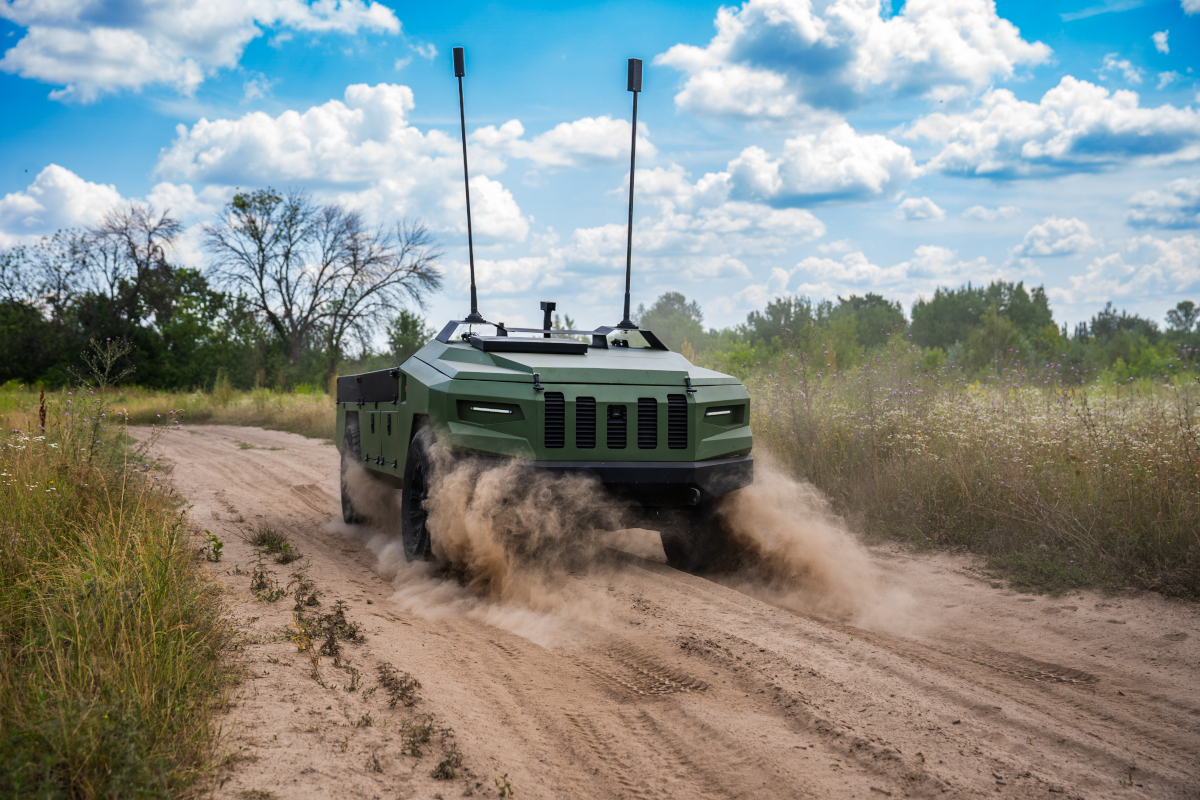
– The Protector with a combat module is one of this UGV’s configurations. Overall, it was developed at the request of the Unmanned Systems Forces (USF) as a heavy unmanned logistics platform. Its operating range is over 10 km, which allows it to be controlled from a safe area. In addition, it has a one-ton payload capacity, which makes it quite unique, almost the only system in its class.
Precisely because of this payload capacity, one of the Protector’s tasks can be transporting other, smaller UGVs closer to the line of contact to carry out specific missions. It can also be fitted with laser-based counter-UAV systems, remotely operated machine-gun combat modules, and other unmanned systems, for example, interceptors. Our platform has a fairly broad range of tasks it can be used for.
Using the system as a combat unit, thanks to the integration of combat modules, is one such task. That’s why we ran these tests: a combat module requires platform stability is critical to keep dispersion down during firing. In practice, it’s the machine gun being tested, but it is mounted on the vehicle, so it’s important to see how it performs under those conditions and whether it will hit the target. We are also working on other weapon systems; the machine gun is just one of them.
– You say your Protector can operate at over 10 km. That’s quite a lot for a UGV. How is the communications link?
– It uses three redundant communications links. That is precisely its strength, and what makes it unique.
The Protector actually supports multiple communications options. With different link types, our UGVs’ operating range can reach up to 20 km. But that also depends on operating conditions. If we took it somewhere into the desert, where there is a clear line of sight, the system might even reach 40 km.
But we operate within the market we are in. Unfortunately, exports are closed, and we are stuck operating only inside the country. And that isn’t very good. I am a supporter of an open market, where everyone competes against everyone else. That’s when the technical and economic components get balanced out. In a single environment, you can become insulated, compete only with yourself, and consider yourself the best. It’s good when we can prove our leadership in external markets. But I don’t support the idea that once export restrictions are lifted, we will tear up the entire global market.
– Let’s talk a bit more about drones. You entered the FPV segment relatively recently, late 2024 to early 2025. Why did you decide to move into this niche, and did you consider other types of systems, deep strikes, mid strikes?
– Historically, we are a manufacturer of mortar ammunition, and we have been supplying it since 2018, before it became mainstream, to use youth slang. The state began some ammunition procurement back in 2015, but it is not comparable in any way to the volumes being purchased now.
Previously, for example, Bulgarian plants considered an order of 10,000–20,000 122mm or 152mm artillery rounds a huge contract. Now we do those volumes "over a weekend."
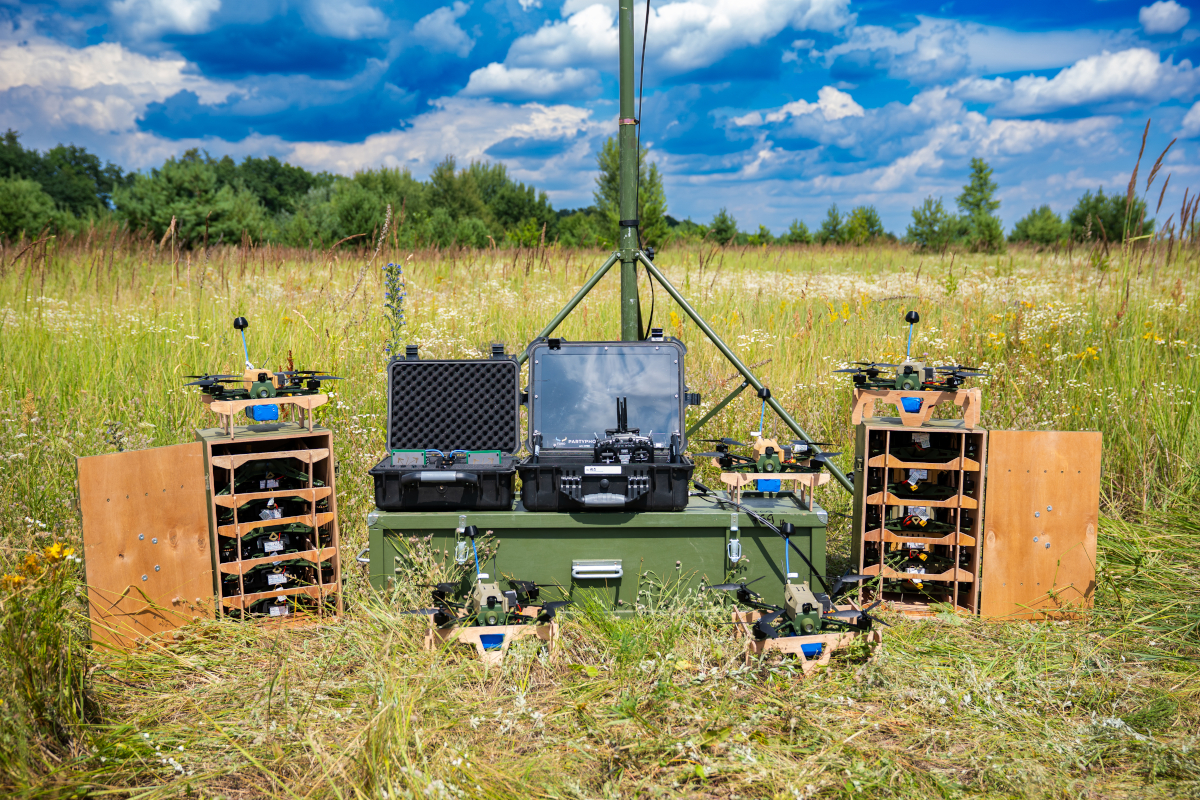
After establishing serial supply and production, we began expanding our ammunition lineup. It’s not that we got into drones. A drone is a delivery platform. A mortar fires using a propellant charge, and here, instead of a propellant charge, we make an FPV. In other words, our company produces an ammunition round with an FPV-type delivery system.
We have significant capacity to produce the 60mm mortar round. It is a standardized NATO-caliber round in terms of its effect. And we integrated it into an FPV drone. That means it is a fully fledged military munition that has received quite good feedback from end users.
We developed it jointly with the Unmanned Systems Forces. They provided recommendations, for example, on frequencies. And we reached the point where, during tests for the National Guard, we confirmed a 20-km operating range, which is quite solid for a small 8-inch FPV drone.
That’s how we are expanding our ammunition lineup. And we keep the cost relatively low. Our FPV with a mortar round costs the same as a standard FPV on the market (without a munition). That is our advantage.
– In the summer, in an interview with The New York Times, you said Ukraine has industrial capacity to produce military equipment worth $35 billion a year, but output is only around $15 billion. Have the figures changed? What does it depend on?
– No, there have been no changes. But it is important to understand that I was referring to data from the Ministry for Strategic Industries, which compiled all of these figures. As a manufacturer, we regularly submit information to the ministry on the status of contracts, their implementation, production capacity, and so on. Everyone did that. After doing the calculations, the ministry produced the final figures.
The disbanding of the Ministry for Strategic Industries, by the way, is a highly controversial issue. At least someone was looking after defense-industry enterprises. So personally, I cannot say I view the decision to dissolve it positively.
To recall that on July 21, 2025, as a new government headed by Yuliia Svyrydenko was being formed, the Cabinet of Ministers decided to dissolve the Ministry of Agrarian Policy and Food and the Ministry of Environmental Protection and Natural Resources, transferring their functions to the Ministry of Economy, Environment and Agriculture of Ukraine. The Ministry for Strategic Industries was also dissolved. Its functions were transferred to the Ministry of Defense. The last head of the Ministry for Strategic Industries was Herman Smetanin, who was later appointed head of Ukroboronprom.
Overall, there is a problem with orders. For example, we produced all the mortars back in the summer and completed the annual program in June. We finished producing armored vehicles more than a month ago, and now there are no contracts. The only contracts still ongoing are for ammunition.
– And what does this situation mean for the industry?
– It means we are falling short; we are not supplying the front sufficiently. The state is falling short as well, above all in attracting external funding, it is failing catastrophically. First, when it comes to bringing in Western funds, it is unacceptable to close off communication channels to ourselves, that is, to affiliated companies. In the current situation, everyone should be working to resolve the financial problems, from government officials, politicians, and diplomats to the military and manufacturers.
Second, the allocation of funding must be transparent and understandable both for market participants and for representatives of Western institutions. It is a matter of competence and trust.
Read more: Arms exports "for our own"? What lies behind president’s statements and what industry really expects
There is plenty of money in the West, and plenty of underutilized capacity in Ukraine. But… Let me give a simple example. We are told: "We can’t allow your products to be exported because there is a need for armored vehicles. There is demand for everything you produce, but there is no funding for it." And my response is: "Then please give me a list of international funding programs you have submitted us to so we can get financing." And that’s when the silence begins.
This situation does not lead to market expansion or to higher output across the board for all manufacturers.
– Would lifting the export restrictions fix this situation?
– There is no vacuum in the market. If we remove export barriers, nothing dramatic will happen in Ukraine in terms of supplying the army.
Take armored vehicle production, for example, where people are employed. At a certain point, all the vehicles have been produced. So we either have to lay off staff or cut specialists who will then be mobilized immediately.

On the other hand, NATO Secretary General Mark Rutte says Russia produces three times more weapons and at four times lower cost than the entire Alliance. That means what we produce is still not enough even to match Russia’s output.
So we should be ramping up capacity, not the other way around. But we are being told there is no money. That is why cooperation with Western partners is needed.
A good example is the Come Back Alive foundation, to which we supplied a lot of products. They have a tender-based procurement procedure that is transparent for reporting. This is exactly what motivates foreign partners to provide them with funds. If the entire state worked this way, we would easily receive more international funding.
– How confident do defense companies feel in the market today overall? What are relations like between state-owned and private companies, or is competition strong?
– It’s everyone competing with everyone, not state-owned versus private companies.
– Let me clarify the question. As far as I know, state-owned defense companies received UAH 90 billion to develop the sector, but essentially nothing was done. Private companies did not receive a single penny. Doesn’t that affect competition?
– This is one of the state’s flaws when we try to build capitalism using socialist methods. This manual, hands-on control. The course of the war is largely influenced by private enterprises.
At the start of the full-scale war, FPVs began to be produced on a mass scale. These were mostly private companies, and were financed with their own funds. In particular, this was driven by a government resolution drafted by Mykhailo Fedorov (First Deputy Prime Minister and Minister of Digital Transformation - ed.) that allowed a 25% profit margin on drone supplies. That resolution gave momentum to the entire defense industry, because it was followed by Resolution No. 1275, which covers weapons, ammunition, and everything else manufactured in Ukraine. This enabled manufacturers to make a profit. Before that, it was 1% on purchased items and 30% on works. On average, depending on the product, it came to 3–5%.
When companies can earn a profit, of course, they put their heart and soul into it. In state-owned enterprises, people do not own anything. They understand it is not theirs, that they are temporary managers, so there are temptations to make money here and now. I’m not accusing anyone, these are obvious things because that’s how the world works. Unlike a private business, where the owner will not act against their own interests and will not steal from themselves.
That is why any investment programs targeting private business are far more effective. Unfortunately, state managers with a Soviet-era mindset believe the state becomes richer by paying state-owned enterprises. But the state becomes richer from taxes, from efficient and transparent business practices, when there is no tax optimization and no inflated costs. The state does not become richer simply by having many state-owned enterprises. It becomes richer when those enterprises generate revenue, profit, and GDP.
– The domestic defence industry has grown significantly, primarily due to hundreds of companies that started producing drones. What about manufacturers of more traditional weapons? How much has the number of players increased and has it increased at all?
– Today, every segment already has several competitors. For example, in mortar rounds, it used to be only us, but now there are five or six more plants. Competitors have also emerged in mortars, in artillery ammunition, and there are already many competitors in armored vehicles. And this is good for the state. It may be a bit harder for us, but for the state overall, it is positive. Competition lowers prices and improves quality. That is an axiom. So the greater the competition, the better the quality.
– What is happening with the procurement of Ukrainian-made weapons overall right now? How has the procedure changed since 2022? Were these positive changes?
– The procedure has stabilized and become more transparent. But times have changed too, haven’t they? The fourth year of the full-scale war is already nearing its end. At the beginning, it was a frantic, urgent procurement, bring it in. Everyone started making promises and importing, including us, but now the situation has stabilized.
It had already stabilized in 2024, but the Defense Procurement Agency (DPA) was acting in a way that was illogical, inefficient, and non-transparent. Now that has changed, but there is one major downside that can outweigh all the positives: the process is heavily bureaucratized. And that is a problem.
If some enemy agent wanted to sabotage our procurement, they wouldn’t need to influence a single contract, they would need to over-bureaucratize the system so that the system would break itself.
Yes, there are tenders and all that. But when a tender drags on for six months, nine months, and then at the end of the year they say, "You need to deliver the products within a month," no one will fulfill such an order. This process should not take an unlimited amount of time.
That is why there is one huge drawback in the procurement procedure today: an overly complex, over-bureaucratized process that, frankly, does not significantly affect the final cost or delivery timelines, but does significantly affect the provision of the Armed Forces of Ukraine.
– How can this issue be addressed?
– Simplify it. I send everyone to Come Back Alive because I believe they, as an institution, do everything right. All that is needed is the will to do it.
– Can DOT-Chain be considered an example of positive change?
– This system is not particularly suitable for ammunition, but it is a good example of decentralization, an anti-bureaucratic practice.
Read more: How DOT-Chain Defence is changing rules of game for Ukraine’s drone industry
However, I don’t have a clear-cut view on this. Because, for now, we are still operating within a paradigm where each unit has its own manufacturer. And it doesn’t matter whether it goes through the DOT-Chain or they pick it up directly. So I still don’t fully understand how effective this will be.
I think the people best placed to speak about this are the commanders of Armed Forces units such as Achilles, K-2, and the 3rd Separate Assault Brigade. They have built very effective units, so they have the right and the ability to judge whether the mechanism is effective or not: how weapons are supplied in their view, whether the quality is good, whether everything is delivered quickly or, conversely, not, whether it’s cheap, and so on.
I’ll cite Come Back Alive again as an example. Their expenditures and income are fully transparent. We can’t do that during the war, but when the military talks about how they run their work, we can see that, within the same legal framework, some can develop while others cannot. Positive examples should be adopted and scaled up.
– Which defense products are in the highest demand right now? Obviously, drones and shells. What else?
– Everything is needed. For example, mortars are necessary at the front, but there is no money for them. So demand here is not retail trade. Our Armed Forces need weapons and ammunition worth billions upon billions of hryvnias, but the available funding is, say, a billion. The DPA’s procurement budget is UAH 320 billion, and the State Operator for Non-Lethal Acquisition’s budget is another roughly UAH 300 billion. That is about €12.5 billion in total. That’s what we can allocate, but far more is needed—€60 billion a year.
Russia is allocating more than $150 billion to the war. And how are we supposed to stop the enemy by force? We won’t stop them while spending ten times less and having four times less manpower.
– A study was recently presented claiming that Ukrainian defense companies register patents in the United States and the EU due to ineffective protection of intellectual property rights in the defense technology sector. Could you comment?
– I haven’t come across this, so I don’t know. I don’t see a problem with registering patents here in Ukraine. If someone is using this as a way to export technologies, the Security Service of Ukraine may pay them a visit as well. Because it resembles Article 333 of the Criminal Code—"Violation of the procedure for international transfers of goods subject to state export control."
There is no problem with patenting in Ukraine, because our patents are recognized worldwide. So this may be a concealed outflow of funds when patents are registered abroad, and then royalties are paid abroad.
In general, it sounds like a mechanism.
One of Ukraine’s biggest problems is that we do not allow exports, while at the same time, manufacturers already have duplicate production facilities abroad, have long since transferred documentation there, and are rolling out their production.
– They called it the nice-sounding term "relocation of enterprises."
– The state prohibits this, it is an illegal transfer of technologies.
And if we don’t give these enterprises the opportunity to export, they will all leave. And once they experience how much easier it is to work abroad than here, they will never want to come back. Because working abroad is genuinely easier, objectively easier.
– What is the situation with innovation in Ukraine’s defense sector right now? Some say Europeans and Americans are chasing our technologies, including drone technologies, while others say Ukraine produces nothing high-tech that other countries don’t already make. Where is the truth?
– The truth is in the middle, as always. But we have experience fighting a high-intensity, high-tech war with the most modern weapons. That is, we have used both cutting-edge weapons and the simplest ones, and we also produce some things ourselves.
In the first two years of the full-scale war, the most effective means of suppressing infantry were mortars. It’s the simplest thing that has worked since World War I. And now distances have blurred: the line of contact, drones. Still, the drones we use are not particularly high-tech; they’re simply cheap. Everything we do is based on low-cost military engineering solutions. That is one side of the coin.
On the other hand, there are advanced Western solutions that we received from the United States back at the start of the full-scale invasion. In the end, they did not meet expectations.
Why? Because the United States has not recently fought wars against regular armies. There have been very few conflicts in the world where the opponent was a serious military, with electronic warfare, armored vehicles, fighter jets, radars, missile systems, drones, and so on.
Afghanistan, where the weapons were machine guns and RPGs, is one kind of warfare. But if there had been electronic warfare assets there, cruise missiles, or ballistic missiles, the overall picture of combat operations would have been completely different.
So yes, they have many developments that have absorbed trillions of dollars in investment, but these weapons and systems have never been used in full-scale military conflicts where the other side had an army at the same level of development.
This is where we need to find synergy with them and share experience.


