



"We need to work on gentle militarisation of our society": How state is preparing national resistance
"Ukrainians must always be ready for war," "We must be like Israel," "Our children must not forget their parents’ experience." For these slogans to become reality, systematic work is needed starting from the school bench, and basic military skills must become routine.
Since 2014, and particularly since 2022, Ukraine has gradually aligned various sectors with this reality: a military reserve has been established, regional national resistance centers are operational, and the "Defense of Ukraine" subject is taught in schools and vocational institutions. However, this process has at times lacked consistency, ideological foundation, personnel, or funding.
Finally, Volodymyr Zelenskyy signed a new law regarding specific issues of preparing citizens for national resistance. It refines the population training mechanisms originally proposed by the 2021 law. As a reminder, national resistance was defined then as a combination of territorial defense, the resistance movement, and preparation for national resistance.
"THE STATE IS PROTECTED NOT ONLY BY THE ARMY, BUT BY SOCIETY AS WELL"
The fundamental idea behind these changes is that not only the Defense Forces but society as a whole must be prepared for war and defense, notes the initiator of the changes, Iryna Vereshchuk:
"Preparation for national resistance is one of the tools to ensure this. We must move from isolated and fragmented initiatives by enthusiasts to large-scale state efforts, from volunteering to systematic professional work.
It will yield a real effect only if we can ensure the appropriate scale, where tens and hundreds of thousands of people per year undergo training over many years and even decades."

She notes that during the preparation of the law, the experience of Israel and other countries with exemplary militarized population training was taken into account. However, Ukraine is a pioneer in many respects:
"In terms of practical experience, Ukraine currently possesses advanced developments. From other countries, we primarily adopt doctrinal and regulatory experience.
First and foremost, we considered the experience of nations with a well-developed total defense doctrine. These include the Nordic countries, the Baltic states, as well as Israel and Switzerland.
The philosophy of total defense is that the country's defense is the responsibility not only of the military but of society as a whole. This includes state institutions, local authorities, citizens, as well as business and civil society.
Specifically, this means that citizens are obligated to possess certain basic knowledge and skills that allow them to be useful for the state's defense. In other words, citizens do not distance themselves or simply wait for the war to end, but participate in the country's defense to the best of their ability. At the very least, they must be prepared for this.
Thus, from the total defense doctrine, we take the idea of creating such a defense ecosystem within society, with a prepared citizen at its center."
Despite the spirited reaction to certain adopted norms, many of them were already operational in one form or another. The most significant innovation of the law is the abolition of basic general military training for men aged 18-25 in higher education institutions and the requirement of military service for civil service candidates (this norm will take effect one year after the war ends).
In addition, it is worth noting:
- the introduction of a legal definition for the resistance movement and protection for its participants from mobilization;
- the implementation of the "Foundations of National Resistance" subject in higher education institutions and, equally importantly, the designation of the infrastructure required for its instruction, namely, the creation of specialized training centers;
- the provision for mandatory Basic General Military Training (BGMT) for men, which will last for several months and effectively replace conscript service;
NATIONAL RESISTANCE AND THE RESISTANCE MOVEMENT: WHAT IS THE DIFFERENCE?
After a brief review of excerpts from the new law, complaints can be heard suggesting that confusion has been reintroduced by conflating two terms: national resistance and the resistance movement.
However, the 2021 Law "On the Foundations of National Resistance" also regulated the resistance movement, and now individuals who join it receive protection from mobilization.
MP Solomiia Bobrovska pointed out the difference: "There is nationwide population training, similar to what the Lithuanians or Estonians do. We learned a lot from them, but in 2021, we still didn't do it the way they do. We created the TDF, which integrated into the AFU and became a full-fledged part of the Armed Forces."
There is another direction which, in many countries, particularly the Baltic states, is responsible for individuals engaged in armed resistance who remain in place under conditions of occupation. The concept of such training is entirely different from national resistance. First, it involves a defined status for the individuals involved or confidential informants. They are protected by law, or as is currently the case here, semi-protected. Many such people have died here as well. This is essentially an agent network that remains under occupation. In other words, this is not about tying yellow ribbons. It involves intelligence, kinetic actions, sabotage attacks, and so on. Such combat and preparatory work is already ongoing today. It was also conducted prior to 2022, but the effect was not what was expected. Usually, these must be non-public individuals capable of bold actions."

The resistance movement is organized by the SOF; the new law has accordingly expanded the powers of the Special Operations Forces Command of the AFU.
FROM PRELIMINARY MILITARY TRAINING OF YOUTH TO THE DEFENSE OF UKRAINE: A SUCCESSFUL EXPERIMENT
The new changes continue the transition from the Soviet-era preliminary military training of youth format in schools to preparing youth in a way that corresponds to real-world challenges. Since 2024, the "Defense of Ukraine" subject has been updated in an experimental format, and its curriculum has already been developed. Instruction is divided into six blocks, and to reinforce skills, students will participate for one full day once a month instead of weekly lessons. Not all schools operate perfectly; specifically, a veteran of the current war is not always available to teach in every community. However, there are fewer issues at this level.
In contrast, student training in most higher education institutions failed for a variety of reasons, leading to radical changes here. The start of mandatory training in the new format is set for October 1, 2026. The programs are to be developed in coordination with both the Ministry of Education and Science and the Ministry of Defense.
Solomiia Bobrovska considers the abolition of BGMT in universities and its transformation into the "Foundations of National Resistance" subject to be the most important aspect of the law. For obvious reasons, students who maintain a connection with Ukraine while living in the TOT are exempt from this requirement.
"As of April, universities are barely managing this training," she notes. "They are achieving very little because they lack a material base and instructors. This has not been launched in all universities by far. Training grounds are refusing them because they already have a heavy workload, and students are not their focus. So now we have effectively nullified it by introducing a new subject."
Both school lessons and university training will be taught without gender discrimination. This means that, as is the case now, girls will continue to undergo training on equal footing with men.
The question of the possible mobilization of women is on everyone's mind. "No one is touching this issue, and no one will," Bobrovska emphasizes. "And I am not ashamed to say that all gender equality is measured by these discussions. Is a woman afraid to go and serve for three to five months? But if she is not going to be mandatorily drafted into the war, then why be afraid of joining a military department? Imagine, God forbid, that parts of Chernihiv, Rivne, or Volyn regions were to fall under a wave of hostilities. One should at least know how to apply a tourniquet or handle a rifle."
There is an important nuance: BGMT is being abolished in universities. However, basic military service remains, which will be mandatory for men—5 months in peacetime and 3 months during wartime. This is the functional equivalent of conscript service.
STUDENT TRAINING: WHO, WHERE, AND HOW?
Therefore, the most critical priority right now is the accelerated deployment of a network of training centers across the country, Vereshchuk agrees. The law regulates the status of these training centers, their funding, and the authority and responsibility of local governments for their operation.
"We must also quickly integrate national resistance training into the education system—from schools to universities. The introduction of the 'Foundations of National Resistance' discipline and the updating of the 'Defense of Ukraine' subject effectively shape a new culture of defense awareness and basic skills among the youth. All of this is also addressed in the new law.
The new law expands the range of entities involved in training. In addition to state institutions, veterans, non-governmental organizations, educational institutions, and even the private sector are involved in this process. Such an approach aligns with the modern logic of total defense.
The law emphasizes the practical component of training, ranging from medical aid to weapons handling and crisis response. In other words, this is not about theory, but about real survival and resistance skills," she adds.
As for the challenges, the primary one is, of course, funding, Vereshchuk notes. A significant portion of the costs falls on local budgets, and not all communities have the same resources. This will require effective state support, as well as collaboration with international and other donors.
The second challenge is the instructional staff. We need people with combat experience, but combined with pedagogical skills. And we must pay them more or less competitive salaries.
"But all problems and difficulties can be overcome if all involved institutions act in close coordination: the Ministry of Defense, the Ministry of Education, regional and local authorities, as well as the public sector and international partners. The main thing is to advance the cause every day, step by step, relentlessly," the MP is convinced.
"THERE WILL BE NO HIGH-QUALITY FIREARMS TRAINING IN THE COMING YEAR"
The law envisions the creation of regional Centers for the Preparation of Civilians for National Resistance, where the population, including students, will undergo firearms training. Whether the goal of total population training is realized depends on how effectively this is done.
Regarding the realities of implementing military training in universities and other higher education institutions, Censor.NET spoke with Mykola Kuznietsov, a veteran and tactical medicine instructor. He participated in the successful organization of the BGMT educational process at the National University of Kyiv-Mohyla Academy (since April 2025 on a volunteer basis) and the Kyiv School of Economics (KSE) (since December 2025).
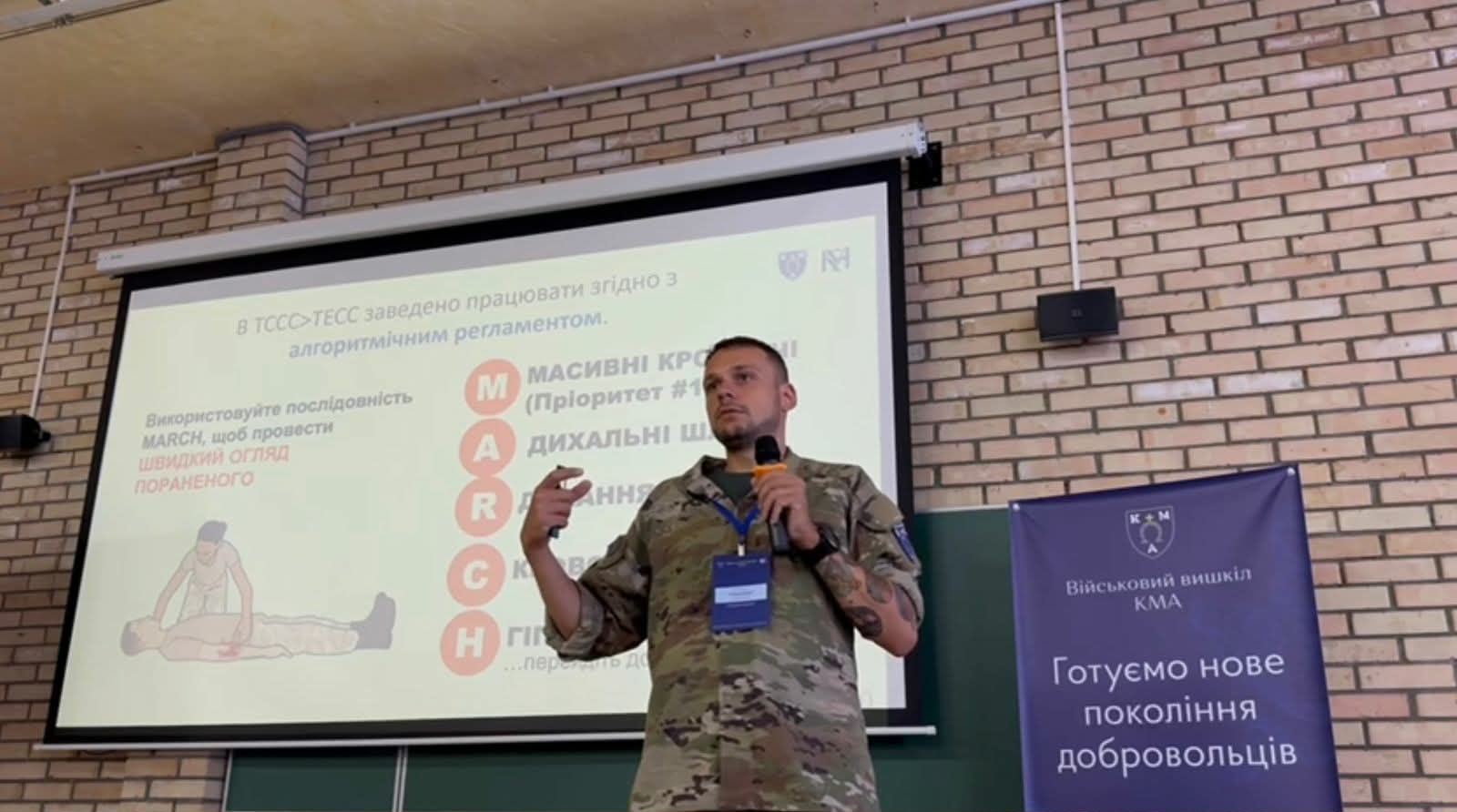
"We must understand that the instructors must be veterans of the war in Ukraine," he notes. "But it is impossible to say that a single instructor can teach firearms training, tactics, topography, and medical aid. For example, at KSE, I teach tactical medicine, survival, and pre-medical care. The Kyiv-Mohyla Academy is also developing national resistance, but more in the format of a practical military training camp, because this is the most relevant and priority aspect for me—the slogan is 'preparing a new generation of volunteers.'"
He names the key factors in the implementation of the "Foundations of National Resistance":
"First, the material component. This requires significant expenditures because finding a complete set of everything necessary is very difficult. KMA managed by attracting benefactors. For example, the Sich company provided tourniquets for practicing practical skills. Over time, when the first funds were allocated, KMA purchased wound packing mannequins and airsoft rifles for firearms training. Funding was better at KSE, and course development was easier; they even purchased controllers, simulators, and small drones (tiny whoops) so that students could try their hand at being FPV pilots.
We must understand that equipment (such as tourniquets) will wear out after a certain number of applications. Wound packing mannequins are not eternal; they need to be repurchased, and this is a rather significant financial expense. One must understand depreciation and develop a plan for replenishing consumables.
A rational approach is necessary. The standard curriculum includes a list of items to purchase. For example, 30 CBRN defense suits. Is it worth continuing the Soviet tradition where people put on suits for speed and essentially looked like 'elephants'? I don't think so. Accordingly, simply do the math, let's say a suit costs 1,500-2,000 hryvnias, 30 suits equal 60,000 hryvnias. Hypothetically, for this same money, one could purchase approximately 11-12 controllers so that people can acquire initial skills in an FPV simulator.
If every university purchases the entire set of equipment, it will be quite a substantial financial burden."

National resistance centers are municipal institutions that operate under every Regional Military Administration in every region. This municipal enterprise has hired employees who teach a more or less standardized national resistance curriculum (for 48 hours and 108 hours). There are veterans who teach there.
Obviously, it is impossible to send all universities into national resistance training in the format in which it exists today. And obviously, enormous attention must be paid to the practical side, rather than just theory from a manual.
Kuznietsov is also skeptical of the idea of conducting firearms training at military academies. Therefore, there is great hope for the creation of an entire network of updated national resistance centers.
"Regarding firearms training, universities cannot conduct it on their own, and signing a contract with the TDF or a military unit means exposing students to increased danger. Not all people are sufficiently motivated to defend their homeland, which is why we must work toward the gentle militarization of our society.
I am convinced that there will be no high-quality firearms training in the coming year, because last year we were just engaging in empty talk about the training ground. You have to get ammunition and weapons from somewhere, and provide transportation to the training ground, which costs money," Kuznietsov comments, adding that one should not prioritize speed when quality will suffer.
The question regarding the timeframes of the "Foundations of National Resistance" will inevitably arise. The 150 academic hours allocated to it constitute a fairly significant course. Kuznietsov categorically disagrees with the proposal to stretch the course over a year and a half to two years for the sake of consolidating skills:
"There is no sense in stretching the course out over time. It is an absolutely illogical idea. Because this course, like the BGMT in military units, is a short intensive. It must fit into an academic semester or a trimester. 150 hours is not that much. It includes theoretical and practical parts, as well as a section for independent study. A person must undergo and complete this program.
And repetition is an entirely different story. There are many different methods for conducting volunteer training camps. Some brigades invite people where they run around for 2-3 days, honing their skills."
The final cornerstone is the question of where to find instructors with combat experience.
"I, actually, do not want to upset anyone, but financial motivation is a major factor, among other things. Imagine: veterans return after military service. They could go into MilTech and earn, say, a thousand plus dollars in this field. At the same time, they will be actively involved in the defense process. Or they could go work for 15-18 thousand hryvnias right here in Kyiv. So, this is not a scenario that can retain instructors for a long time.
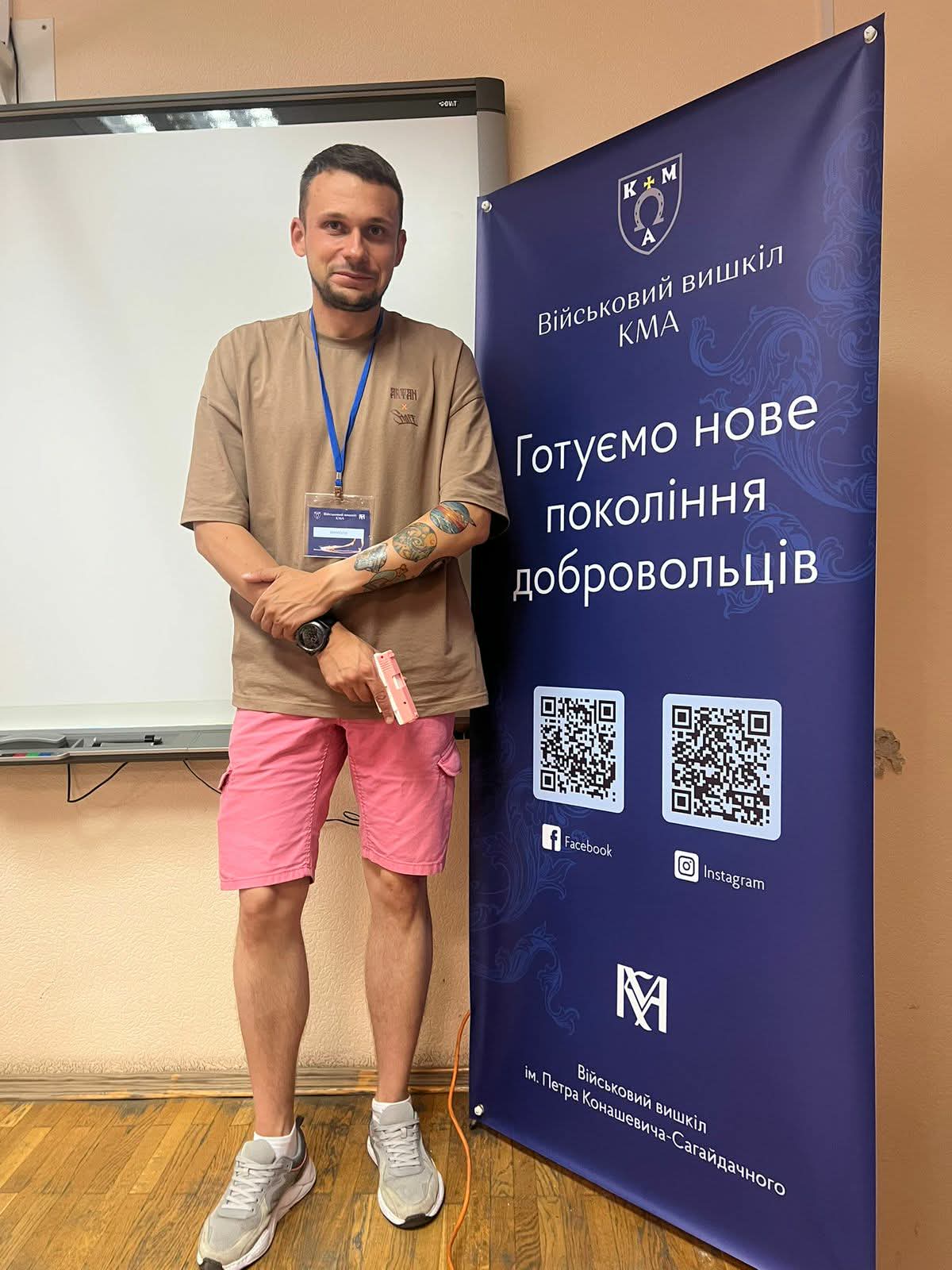
For example, the Kyiv-Mohyla Academy is a large volunteer project run by veterans who engage in this not for money, but to educate a new generation. Accordingly, we must understand where to find people. First, they need to be trained.
Even with actual military experience, you cannot immediately teach CBRN defense, cartography, pre-medical care, the basics of UAVs, reconnaissance, and everything else all at once. These must be certified courses from the Ministry of Education.
For instance, when I invited some of my acquaintances to join, they came, took a look, and said: "With my current workload in civilian life, I am not ready to dedicate that much time to this right now."
Or there are veterans with disabilities who receive an appropriate pension; they are interested in the possibility of teaching, but at the same time, they honestly say, "I will go solder drones in Miltec, and in principle, I will have much more money." The issue here is not with the universities, but rather with the reintegration of veterans and their preparation for this.
National resistance centers receive funding from regional administrations. Can a Regional city administration or District administration simply devise additional bonuses or premiums to be issued to veterans for the first years of the BGMT? That is, hypothetically, they would receive 8,000 hryvnias in a school, plus some premium, and then they could be involved in this.
Again, one must understand the workload. It sounds simple—a 150-hour program, seemingly nothing terrible. If, say, 100 people are studying in a cohort, we will divide them into three groups. If we have 5 practical classes in one discipline, that corresponds to 5 classes of 1 hour and 20 minutes each. And to conduct them three times for just one subject. In other words, the workload is quite heavy. Therefore, if 2 veterans are sufficient for a school to handle the entire process, then for a university where 1,200 or 650 people study in a course per year, a different number of instructors will be required."
CIVIL SERVICE: ONLY AFTER MILITARY SERVICE
The law stipulates that one year after the end of martial law, only men who have completed military service may apply for civil service positions.
This requirement, again, existed previously. The new law defines the exact form in which a civil service candidate can fulfill it.
"The logic is the same as in the 2023 mobilization law: we are preparing for constant war. Regardless, sooner or later, the duty will arise. Therefore, we specified that any military service counts, not just BGMT," Bobrovska explains.
An official can meet the eligibility criteria by having completed military service, that is, being a veteran of the Russian-Ukrainian war, service in the military reserve, service in the security and defense sector agencies, or by completing military training under the reserve officer training program.
"The purpose of this provision of the law is to radically change the culture of our civil service. There is a public demand for a new type of person who will enter the civil service. This norm is fair concerning the military. It also increases the social responsibility of civil servants and contributes to rooting defense awareness in society," Vereshchuk believes.
At the same time, the restoration of competitions for the civil service is a key EU requirement for the continuation of funding to Ukraine under the Ukraine Facility Plan. The Cabinet of Ministers has already approved the corresponding draft law. How will this requirement correlate with the norm of the Law?
"The legal norm regarding military service as one of the requirements for entering the civil service essentially does not contradict the EU requirement regarding the necessity of competitions," notes Iryna Vereshchuk.
"Competitions are not canceled or replaced by military service. The fact of military service does not mean an appointment without competition. The Government must regulate all this in detail in the relevant bylaws," she explains.
During the discussion, the question is raised as to why wait until the end of the war. At the same time, introducing this norm during martial law will put an additional burden on the bureaucratic system.
There is a risk of abuse (for example, registering fake disabilities) or, conversely, a risk of a shortage of candidates for the civil service (given low salaries).
"Regarding the risk of abuse, it always exists and is not a reason to avoid introducing new norms, especially when it comes to such fundamental things," Vereshchuk insists.
"Regarding the shortage of personnel for the civil service, I do not think we will have such a problem. I will note once again: this innovation is not meant to complicate access to the civil service. We are doing this to radically change the culture of the civil service and fill it with defense awareness. A civil servant must be an example in their readiness to defend the state," the MP believes.
Bobrovska also does not see a problem. According to her, in a country fighting an aggressive neighbor, officials' connection to the military must become commonplace:
"First, it would be strange if a person who is, for example, 21 years old or older, did not want to have at least some connection to the military. Going for three months of basic military service is an elementary thing.
If we talk so often about Israel, then why are we so afraid of having the population, especially the male population, constantly ready? I saw these comments (among them a lot of bots and their typical comments), and I do not understand why everyone is so afraid of this. The state says to undergo five months of training in peacetime. So what is the problem?"
As the successful practice of teaching military training in schools has shown, everything is possible with desire, resources, and proper organization.
After the publication of the article, Censor.NET received a response regarding this law from the Ministry of Defense:
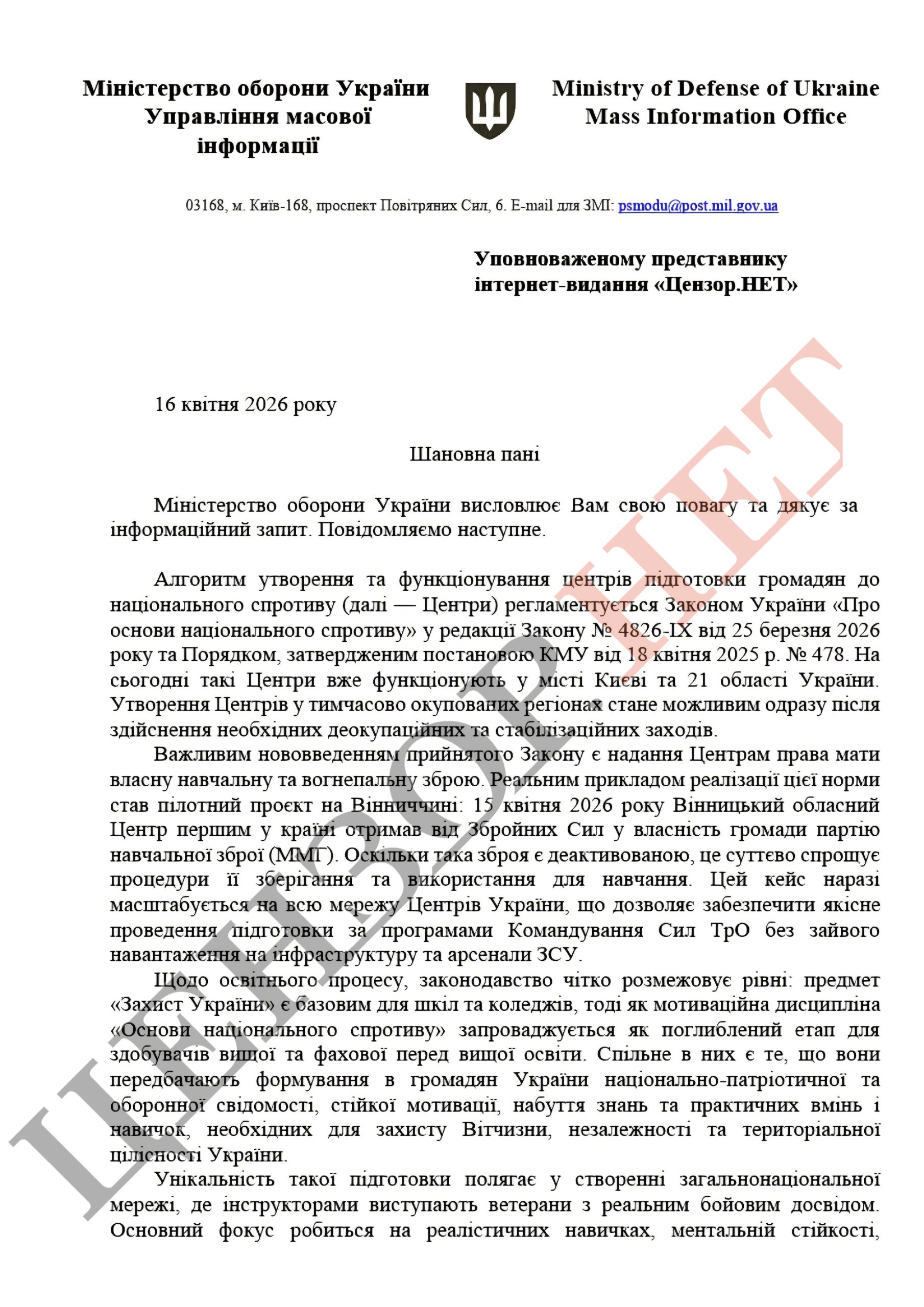

Olha Skorokhod, Censor.NET


