



Increasing fines and strengthening criminal liability. How MPs propose to tackle offending drivers
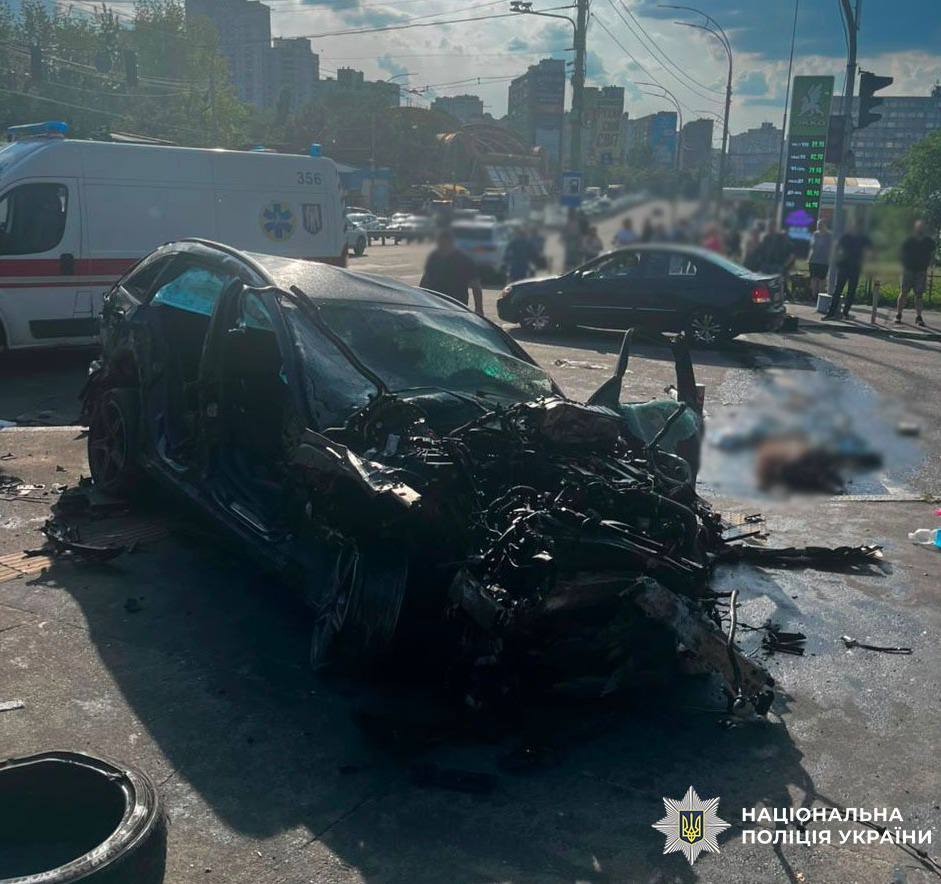
Soldier Oleksii Hlushych, whose 12-year-old son was killed in a horrific traffic accident in Karavaevy Dachi in Kyiv, called on lawmakers to vote in favor of bills that would increase penalties for traffic violations in order to prevent further casualties. The Verkhovna Rada is scheduled to consider these bills on September 3.
A journalist from ‘Censor.NET’ investigated just how radically the proposed changes might influence the behaviour of drivers who, despite having paid dozens of fines, continue to break the rules of the road.
PAY AND BREAK THE RULES
In fact, this is not the first attempt to amend the legislation and increase penalties for road offences, but it was only after a Mercedes-Benz driver lost control of his car whilst speeding and crashed into an underpass where people were present – including Hryhorii Hlushych – that road fatalities began to be discussed as a problem requiring a comprehensive solution, rather than merely increasing fines and introducing a penalty points system.
Firstly, it emerged that the Mercedes driver has been subject to the administrative penalties on multiple occasions for speeding; he had paid the fines and continued to drive. This information caused a public outcry and sparked a debate about the penalty system in cases involving repeated offences.
Meanwhile, the parents of Hryhorii Hlushych and other families who have lost children in road traffic accidents, with the support of civil society organisations, have held several public events where they explained why road deaths and injuries should be treated as a matter of national security and presented comprehensive solutions to reduce fatalities in line with the international Vision Zero approach. They insist that simply increasing fines – a measure initiated by Yulia Svyrydenko when she was Prime Minister – is not enough.

"Drivers like Pavlo Pleshyvtsev, who had 39 recorded offences alone, will still pay the increased fines, and they will still put their foot down on the accelerator, and they will still kill our children. It is not enough to increase fines," said Oleksii Hlushych at a press conference. He had registered a petition on the President’s website and called on Volodymyr Zelenskyy to introduce a state policy in Ukraine aimed at minimising road deaths, following the example of EU countries, as well as to raise the issue of road deaths at a meeting of the National Security and Defence Council and to draw up a comprehensive action plan to prevent such tragic incidents in the future.

Explaining the reason for submitting the petition, he emphasised that repeat offenders should have their driving licences revoked. If a person drives without a licence, their car should be confiscated and they should be sent to prison.
When Hryhorii's mother Oleksandra Terletska took the floor, she spoke candidly about how, in the comments on social media pages, people write to her not only words of support but also share their own grief.
"People write about how their loved ones – their mothers, their children, their husbands and wives – died, not as a result of Russian aggression (not even because of that), but in avoidable road accidents," she noted, adding that she believes such tragedies can be prevented in the future. - These are horrific stories; they are stories of drink-drivers, of people who fled the scene after causing an accident and who have still not been found. In other words, offenders who have gone unpunished – as far as I understand, they aren’t even being actively sought. These are unacceptable stories; this is something that should not happen; this is something I do not see happening around us in the future.
Over four years of full-scale war, Ukraine has lost more than 12,000 people in road traffic accidents. If you look at this slide, you can see that the civilian casualties of the war amount to 15,012 people. The number of road traffic accident fatalities over the same period stands at 12,295, whilst the number of those injured is staggering.
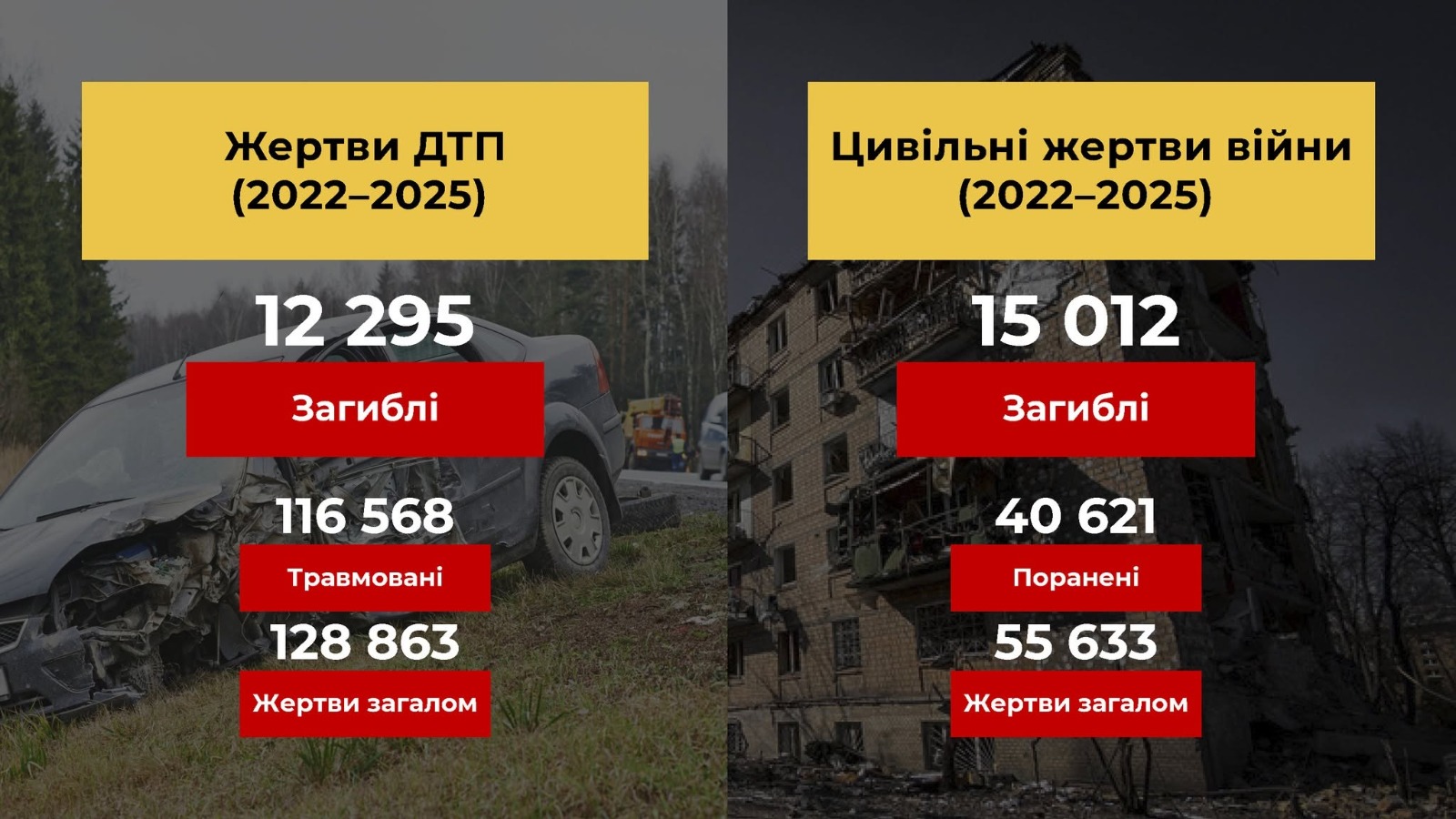
The number of people injured in road traffic accidents is almost three times higher than the number injured by civilian air strikes or by the ‘mad Russians’. So, I believe this is reason enough for everyone on whom this decision depends to find the strength within themselves, to find the resolve, to find the truth that ordinary people are now finding in the comments. Take action; do at least something. If everyone does at least something, we will achieve the result we deserve, the result we are striving for, and then, perhaps, next year more people will return home from the streets."
Oleksii Hlushych’s petition, which – although it took three attempts – was eventually registered on the President’s website, quickly gathered the required number of votes, and the Head of State responded to it. He instructed the Secretary of the National Security and Defence Council and the Prime Minister to consider the proposals set out in the petition.
STRENGTHENING ACCOUNTABILITY AND SAFE INFRASTRUCTURE
Ihor Klymenko, Secretary of the National Security and Defence Council of Ukraine, held a coordination meeting on road safety attended by members of parliament, Minister of Internal Affairs Ivan Vyhivskyi, Head of the Ukrainian Patrol Police Oleksii Biloshytskyi, as well as representatives of civil society organisations and experts in the field of road safety. Oleksii Hlushych also joined the discussion.
"Tightening the penalties for traffic offences is something that needs to be done without delay," said NSDC Secretary Ihor Klymenko in a comment to "Censor.NET". "The President has instructed me to look into this matter; we have already held a meeting with Members of Parliament, the Ministry of Internal Affairs, the National Police and representatives of the public.
In fact, everyone has a clear understanding of what needs to be implemented urgently to reduce the number of deaths and injuries on the roads. And decisions need to be taken more quickly.
And another important point is that this should not be a single decision, but a comprehensive approach. It is not just a matter of increasing fines, although this will certainly have an impact on those who break the speed limit. However, in my opinion, tougher sanctions are needed for repeat and habitual offenders. I personally support the disqualification from driving for repeat offences.
A penalty points system would certainly be effective – it’s a good option. But whether the relevant authorities are ready to implement it, particularly from a technical standpoint, remains an open question.
At the same time, drivers themselves must be mindful of their behaviour on the road, as speeding is purely a human factor."
We also spoke to Oleksii Biloshytskyi, Head of the Patrol Police Department of Ukraine.
— Mr Biloshytskyi, following the tragic incident in Kyiv, where a car crashed into an underpass and killed people, there has been a great deal of discussion about road fatalities. But this problem did not just emerge this year. Or am I mistaken, and have there been more accidents with serious consequences?
— In fact, this year we’ve actually seen a 10 per cent decrease in the number of people injured in August, as well as a reduction in the number of fatalities. We’ll do everything we can to maintain these figures until the end of the year.
However, what the Ministry of Internal Affairs and the police are doing to ensure road safety is known as a regulatory function. But road safety is not limited to this; it is a complex issue.
Experience from other countries and analytical data show that one of the key factors is safe infrastructure. In other words, the construction and reconstruction of roads must, from the outset, be carried out in such a way that safety measures are incorporated from the very beginning.
The second issue is, of course, tackling the problems we face on our roads. These include U-turns on international routes without slip roads. They also include various other issues that are not about safety, but rather pose a safety risk.
The third issue is fines that do not reflect today’s realities. Let me give an example. The most common cause of road traffic accidents resulting in injuries and fatalities is speeding. This accounts for 42 per cent of all such accidents.
Yet the law stipulates a fine of 340 hryvnias for exceeding the speed limit by more than 20 km per hour. If the offence is recorded by an automatic camera and the fine is paid within the first 10 days, the fine is 170 hryvnias.
Essentially, we are talking about the cost of a few litres of fuel. And this is the fine for the most common cause of road traffic accidents resulting in injuries and fatalities. Or, for example, exceeding the speed limit by more than 50 km per hour – this is when drivers travel at over 100 km per hour in built-up areas. In such cases, the fine is 1,700 hryvnias. If the offence is recorded automatically and paid within the first 10 days, the fine is 850 hryvnias.
The level of public danger does not correspond to the level of liability. And if the liability is too low, it has no educational effect. Let me remind you that the aim of any liability is not to punish the offender, but to educate them in the spirit of the law, so that they do not commit offences in the future. A fine that is too low encourages offences, because the offender knows that even if they are caught and the offence is recorded, they will pay roughly the same amount as they spend on filling up their car.
This counterproductive effect leads to the emergence of repeat offenders who rack up 30, 40, and sometimes even 100 fines a year. Each time, such an offender pays 170 or 850 hryvnias and carries on driving. Therefore, a crucial issue that needs to be addressed at the legislative level is the level of fines and the penalties for systematic offences.
We have been saying for years that there is no need to reinvent the wheel. Do it the way it works in leading countries – introduce penalty points. In other words, if, for example, you’ve committed five offences, you must now prove to other road users that you’re fit to drive alongside them. Because such an offender endangers not only themselves but also others.
— So, they’d have to retake their test?
— Yes. Once they’ve accumulated a certain number of penalty points, their driving licence is suspended and they have to retake their test. This is the system in place in other countries.
Equally important is fostering respect for the law. And here we have a serious shortfall. First the COVID-19 pandemic, and then a full-scale war, have significantly weakened the entire education system. It is not only the quality of teaching that has suffered, but also the educational aspect — in particular, the development of a culture of lawfulness and an understanding of why it is important to obey the law.
Therefore, objectively speaking, the function of enforcement is just one component amongst others that must be present in the field of road safety.
However, as I have already said, we are implementing measures aimed at improving the situation. In particular, we are increasing the number of cameras that record offences, and we have relaunched the ‘Phantoms’, although this was very challenging, as they were last in operation in 2022 and, in the meantime, the technical aspects and operating conditions have changed.
Ukraine has also become a member of ROADPOL – an organisation of traffic police forces from European countries that aims to reduce the number of deaths and serious injuries on the roads. And we are carrying out enforcement measures in conjunction with European countries.
Let me give you some figures. As of 30 August, 3,221,640 fines totalling 633 million hryvnias were issued through automated enforcement alone. A further half a million instances of speeding were recorded manually using TruCAM devices. In my view, enforcement is currently the top priority. However, all other aspects are lagging behind.
— What period does that cover?
— Over the first eight months of this year.
— Will the ‘phantom’ cameras only be on international routes?
— Not only there; in the city as well.
— What problem are they currently designed to tackle?
— First and foremost, it’s about preventing offences. Creating a sense amongst drivers that a ‘Phantom’ could appear anywhere to record an offence has a significant deterrent effect. Drivers become more cautious and think twice before breaking the rules.
— When cars collide with minibuses or drive into public transport stops where people are standing, is it always down to speeding and a certain feeling that they’ll get away with it? Or are there more serious issues with people’s mental health during the war?
— I believe this is the result of a complex set of causes, some of which we have discussed today. In particular, the level of accountability.
In other words, to reiterate, a driver is driving along and knows that even if they are held to account, the consequences for them will be minimal.
But, of course, there is a category of people who test their limits on the roads. They exist both here and abroad. And here, too, low fines and the lack of accountability for repeated offences play a significant role. If we go back to the road traffic accident at the pedestrian crossing, the driver in that case had over 30 fines. He simply paid them and carried on driving.
So you can’t say there’s just one reason; it’s always a combination of factors.
— I spoke to an American who told me that in some US states, there is a practice of impounding vehicles for repeated offences, including confiscation. Do you think we should introduce something similar?
— This is quite a harsh measure, and I would only consider it once other measures have failed. Although, when it comes to systematic and brazen offences, such as drink-driving, we already have sanctions in place. A third drink-driving offence within a year results in the vehicle being confiscated.
— There are fewer police on the roads now, as patrol officers are also fighting in the war. And many of those who have remained at the rear are focused on mobilisation efforts. Does this affect the enforcement of traffic regulations and, consequently, the overall situation?
— Yes, there are fewer of us, but we have become more efficient, and we’ve also introduced more automated enforcement systems. Consequently, the number of fines issued to offenders has not decreased.
Of course, we are greatly affected by staff shortages and having to carry out other duties not directly related to policing, but we are currently at war and it is our duty, amongst other things, to defend our country. That is why the ‘Khyzhak’ brigade of the Patrol Police Department, the ‘Liut’ brigade and other units of the National Police are carrying out combat missions side by side with the Defence Forces.
— In which regions is the road safety situation most challenging?
— Lviv, Dnipropetrovsk and Kyiv regions, and the city of Kyiv.
These have the highest volume of traffic, the heaviest traffic flows and, statistically speaking, the highest number of road traffic accidents resulting in injuries and fatalities.
— You mentioned that infrastructure is very important. Following the meeting at the National Security and Defence Council, has there been any communication with local authorities? Perhaps someone has approached you and said: ‘Let’s work on this issue together’?
— There have been no such requests so far, but it must be understood that the issue here is one of funding. All of this requires considerable resources. At the same time, I would like to emphasise that this is a very important issue and I hope that local authorities will take this into account.
— There are currently two draft laws that are set to affect the level of accountability we’re discussing. Do you support the main one or the alternative?
— I support the main one, which we worked on together with the parliamentary group. However, the alternative one also has many positive aspects that can be taken into account during the preparations for the second reading. We are therefore awaiting the vote.
WHAT LIES AHEAD FOR DRIVERS?
The authors of Bill No. 15348 also point out the disproportion between the severity of offences and the level of fines. The explanatory note cites the following figures: "Over the past 12 months in Ukraine, 2,878 people have been prosecuted more than 50 times for road safety offences recorded by automated systems, 12,529 people – more than 20 times, and 35,693 people – more than 10 times, which indicates that the current levels of fines are insufficient to ensure drivers’ discipline on the road. In other words, in Ukraine, in the perception of Ukrainian drivers, the fine for exceeding the speed limit by more than 20 km/h – given the information provided above – is effectively a licence to breach the speed limit dozens of times for a negligible fee, thereby regularly endangering other road users."
The authors of the document propose increasing the fines and leaving it at that. The draft bill makes no mention of more stringent measures.
For their part, the parents of children who have died in road accidents and representatives of over 20 civil society organisations have published an open letter calling for draft laws No. 15348 and the alternative draft No. 15348-1 to be considered without delay at a plenary session, which substantially alter the approach to punishing those who habitually engage in reckless driving. They also insist that the final version of the law must include provisions for:
✓ a substantial increase in and a graduated scale of fines for speeding offences;
✓ disqualification from driving for repeated speeding offences and other particularly dangerous offences;
✓ increased penalties for driving whilst disqualified;
✓ lowering the threshold for unpunished speeding from the ‘Russian standard’ of 20 km/h to at least 10 km/h.
"Twelve MPs have tabled Bill No. 15348, which provides for an increase in and a tiered system of fines depending on the extent to which the speed limit has been exceeded. Such changes are an important and necessary step, but they are insufficient – after all, the bill does not provide for either the revocation of driving licences for repeated speeding offences, nor does it increase penalties for driving without a licence or other dangerous offences. Instead, all these changes are set out in an alternative bill No. 15348-1, drafted by 51 MPs from various parliamentary factions and groups, including the Speaker and Deputy Speaker of the Verkhovna Rada and six chairs of parliamentary committees, according to a joint statement. - Unfortunately, the Law Enforcement Committee, without waiting for expert opinions, without holding a serious and comprehensive discussion, and without inviting representatives of expert civil society organisations to the meeting, hastily and without sound justification decided to reject this comprehensive draft law. The members of the Committee did not vote to apply the procedural rules which would have made it practically possible, whilst preparing Bill No. 15348 for its second reading, to incorporate important provisions from the alternative bill into it.
The discussion at the committee meeting and the general attitude towards the consideration of this extremely serious issue demonstrated that a significant proportion of MPs, whose duty it is to protect people’s lives and safety, are far more concerned with the convenience and comfort of offenders, which cannot fail to provoke outrage."
The authors of Bill No. 15348-1 also propose increasing fines for repeated instances of speeding, but unlike their colleagues, they do not stop there. In particular, they propose a provision stipulating that a fine of 17,000 UAH (1,000 non-taxable minimum incomes) shall be imposed for exceeding the speed limit by 40 km/h or more by a person who, within the course of a year, has been held administratively liable four or more times for exceeding the speed limit by 40 km/h or more. If, after this, the person commits such an offence again within a year, they will be required to pay the same fine again and will have their driving licence suspended for a period of between six months and one year.
Furthermore, the ‘impunity threshold’ for speeding offences is being lowered from 20 to 10 km/h (in line with practice in EU countries, where this threshold ranges from 3 to 10 km/h depending on the country).
"Article 122 is supplemented by two new paragraphs which increase the penalties for breaches of the rules governing the use of pedestrian crossings, junctions, overtaking and giving way to oncoming traffic, driving through a red traffic light or disregarding a traffic warden’s signal, and failing to give way to pedestrians at unregulated pedestrian crossings, committed by a person who has been subject to an administrative penalty for the same offences within the past year. Such offences will carry an administrative penalty in the form of a fine of 3,400 UAH (two hundred non-taxable minimum incomes).
Similar actions committed by a person who has been subject to administrative penalties twice within a year for these offences will carry a fine of 5,100 UAH (three hundred non-taxable minimum incomes) and the disqualification from driving for a period of between six months and one year", the explanatory note emphasises.
And that is not all. In particular, the amendments to Article 126 provide for stricter liability for driving by persons who have been disqualified from doing so.
Furthermore, the authors of the document explain that the amendments to the Criminal Code of Ukraine provide for stricter penalties for breaches of road safety rules that result in the death of a victim or cause grievous bodily harm. Thus, under the amendments to Article 286, for such offences, in addition to the principal penalty of imprisonment, a mandatory additional penalty is imposed in the form of disqualification from driving for a period of 3 to 8 years, and in the event of the death of several persons – from 8 to 12 years.
Article 286 is supplemented by a new Part 4, which provides that a repeat breach of road safety rules resulting in the death of a victim shall be punishable by imprisonment for a term of between 8 and 12 years, accompanied by a disqualification from driving for a period of between 12 and 15 years.
Will MPs be willing to support this version of the legislative amendments? It is difficult to say, given the reaction to the problem of road deaths and injuries even within the relevant parliamentary committee.
Addressing MPs on 1 September, Hryhorii Hlushych’s father wrote: "1 September. Happy holiday to everyone who went to school today.
Hrisha didn’t go. He was killed by a taxi travelling at 150 km/h. It wasn’t the first or even the tenth time the driver had driven at such speed.
Because in Ukraine, you can do this ten times, a hundred times, or a thousand times — there is no punishment.
But the Verkhovna Rada of Ukraine can prevent further victims."

Undoubtedly, it can. The question is whether MPs will be willing to plug the loopholes in the law that allow people to be killed. But we’ll see that tomorrow.
Tetiana Bodnia, "Censor.NET"


