



Year of open borders: What is actually known about 18–22-year-olds leaving Ukraine and how many taxpayers economy has lost
On 28 August 2025, men aged 18 to 22 were allowed to travel abroad freely. How many have left, which months saw the most departures, and what this means for Ukraine’s economy – a year on, these questions remain unanswered.

Business Censor has received information from the Romanian Border Police regarding the cross-border movement of young Ukrainians, as well as data from the Pension Fund of Ukraine concerning changes in the number of VAT payers in this age group. It turned out that over the year, the official labor market lost almost a third of taxpayers aged 18–22, with Kyiv and the west of the country finding themselves at opposite poles.
Even the Minister cannot confirm the figure
In response to an inquiry from Business Censor, the State Border Guard Service reported that they do not keep detailed statistics on the departure of men aged 18–22 abroad. The agency's spokesperson, Andrii Demchenko, said the same thing in October 2025, commenting on The Telegraph's publication about 100,000 young Ukrainians who had left.
Despite this, a specific figure was still voiced at the highest level. It was mentioned in April 2026 in an interview with Forbes Ukraine by the Minister of Social Policy, Denys Uliutin.
"According to the Europeans, it is about 400,000. I cannot confirm or deny this because we do not keep statistics. This probably exerts a certain pressure on EU countries and causes concerns," he stated.
Thus, even the figure publicly announced by the Ukrainian Minister is not Ukrainian statistics, but an estimate by European partners, which Uliutin himself, however, did not undertake to confirm.
What they say in Poland, Romania, and Hungary
Since the Ukrainian side does not count border crossings by age, the editorial board contacted the border agencies of the countries through which Ukrainians of this age group depart most frequently: Poland, Hungary, Slovakia, Romania, and Moldova. The idea was to collect data from the other side of the border and compare it.
At the time of the article's publication, three agencies had provided comments on the topic. For instance, the National Police Headquarters of Hungary reported that police authorities do not keep statistical records of the requested nature.
In its response, the Polish Border Guard explained that it keeps statistics on the volume of traffic at border crossing points, and the data collected relates to the number of border clearances – meaning that the same person may be processed several times over a given period.
The Polish agency also explained the nature of movements of this age group:
"According to our analyses, the movement of Ukrainian citizens aged 18 to 22 has a circular nature. Multiple border crossings by the same individuals are a characteristic feature for this region."
The Polish response specifically noted:
"The Border Guard does not verify the purpose of foreigners' trips with regard to the domestic legislation of third countries, in particular, the norms related to military duty. Therefore, the competent authorities to be contacted on this issue are the Ukrainian state authorities."
What is visible from the Romanian figures
The General Inspectorate of the Romanian Border Police provided monthly statistics on Romanian-Ukrainian border crossings by male Ukrainian citizens aged 18–22 — from August 2025 to August 2026 inclusive, separately for entry and exit.
The Romanian side makes two clarifications in its response. First: the agency-level databases are not configured in such detail as to allow extracting data on specific individuals who crossed the border during the specified period. Second:
"We note that the statistical data refers to the number of border crossings, while one person has the ability to make multiple trips through border crossing points during the relevant period of time."
Over thirteen months, Romanian border guards recorded 58,760 entries into Romania and 46,076 exits. The difference between the two flows is 12,684 crossings.
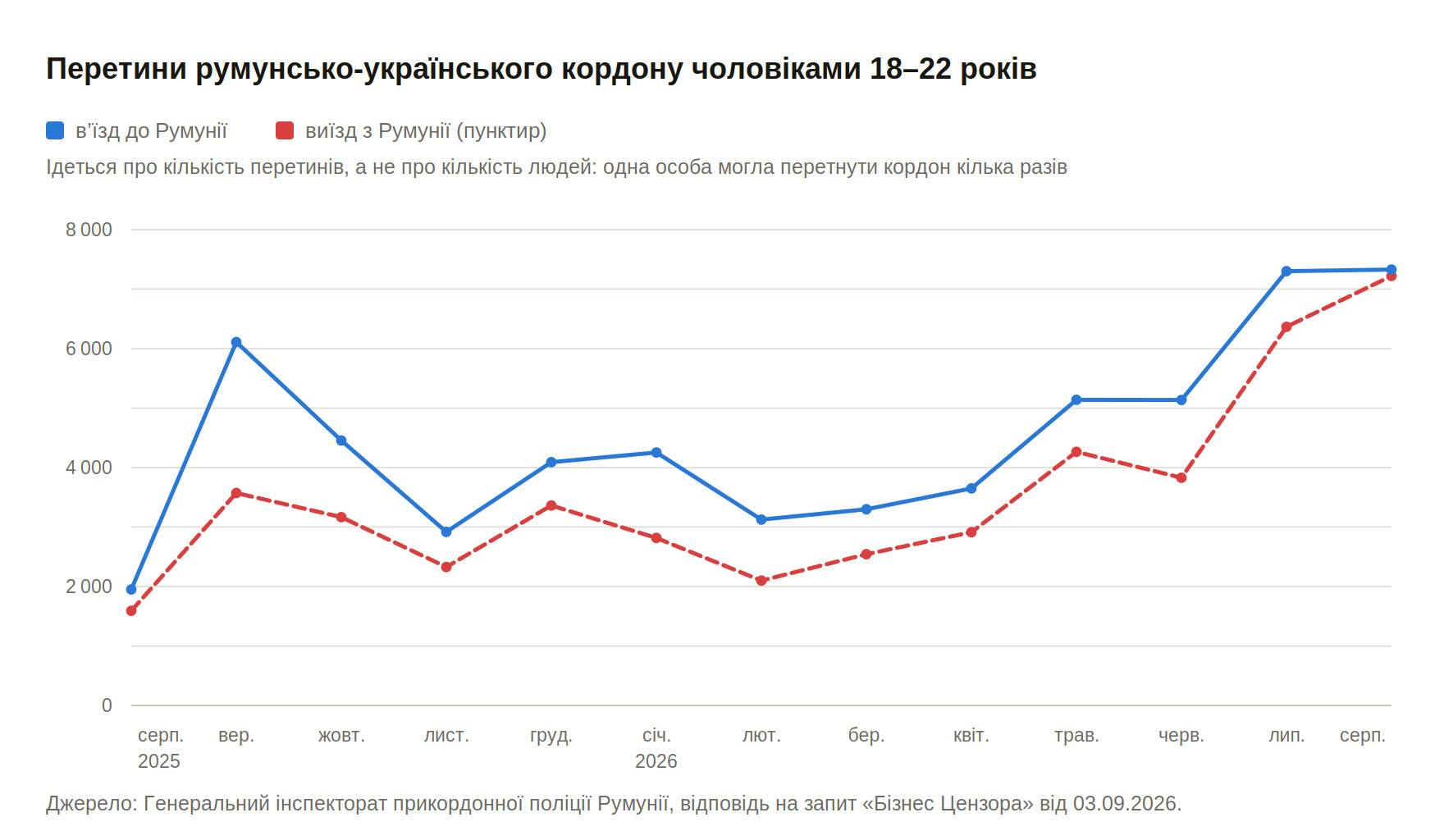
The largest gap between the flows occurred in September 2025 — the first full month the new rules were in effect. At that time, 6,110 young Ukrainians entered Romania compared to 3,572 exits. For comparison, in August 2025, which fell almost entirely under the old departure regime, there were 1,949 entries.
Subsequently, the ratio gradually changed. During the first five months (August – December 2025), exits accounted for 71.8% of entries. Over the last five months (April – August 2026), this figure reached 86.1%. And in August 2026, both flows practically leveled out: 7,331 entries and 7,222 exits, meaning 98.5%.
It is indicative that the number of crossings increases at the end of summer: the peak in 2025 occurred in September, and in the summer of 2026, both flows sharply went up again. This may be linked both to the security situation and to the start of the academic season.
These figures do not equal the number of people and describe only one direction. Romania is not the main departure corridor: Polish border guards reported over 98.5 thousand checks of Ukrainians aged 18–22 in just two months of 2025, while the Romanian direction yielded 58.8 thousand entries over thirteen months. The data concerns only the Romanian-Ukrainian border, so, for example, the route to Romania through Moldova is not included in it.
The labor market lost a third of this group
It is impossible to calculate exactly how many people have left. But the impact of these processes on the economy can be assessed — through those who stopped officially working in Ukraine.
Such attempts have already been made. At the end of August, the job portal Work.ua reported that the number of men aged 18–22 responding to vacancies had dropped by 19% over the year — from 16.7 thousand to 13.5 thousand. In a comment to Ukrainska Pravda, Vasyl Voskoboynyk, head of the All-Ukrainian Association of International Employment Companies, estimated that the majority of men of this age are students, and about 300,000 of them were working, which is approximately 2% of the labor force.
Business Censor requested data directly from the state. The response was provided by the Pension Fund of Ukraine, which maintains the register of insured persons: the number of men aged 18–22 who were assessed the single social contribution as hired employees, as of July 2025 and July 2026, monthly and broken down by regions.
This data captures the disappearance from the official labor market. There can be several reasons: departure abroad, service in the Armed Forces, transitioning to the shadow economy, or enrolling in studies. What is common to all these cases is that the contribution for the person is no longer paid.
Over the year, the number of such taxpayers decreased from 175,130 to 117,462 unique individuals — by 32.9%. This is notably deeper than the drop recorded by Work.ua, which is logical: the latter refers to activity on a job search website, whereas here it is about the fact of the contribution assessment.
At the same time, this data has a significant limitation, emphasizes Iryna Ippolitova, a senior researcher at the Centre for Economic Strategy:
"They do not cover all youth aged 18–22 by any means. Most youth at this time are studying, and they are not included in the statistics."
According to Ippolitova, in 2023, the Institute of Demography forecasted that in 2026 there would be over 700,000 men aged 18–22 in Ukraine. The forecast was made before the decisions on the right of departure for this group, but it gives an idea of the scale: approximately a sixth of them are officially employed.
In other words, the drop by a third recorded by the Pension Fund describes only that part of the age group which had official employment.
"We cannot extrapolate the trends we see among the working individuals to all men of this age," Ippolitova emphasizes.
Where the number of contribution payers fell the most
The variation between regions turned out to be almost fourfold.
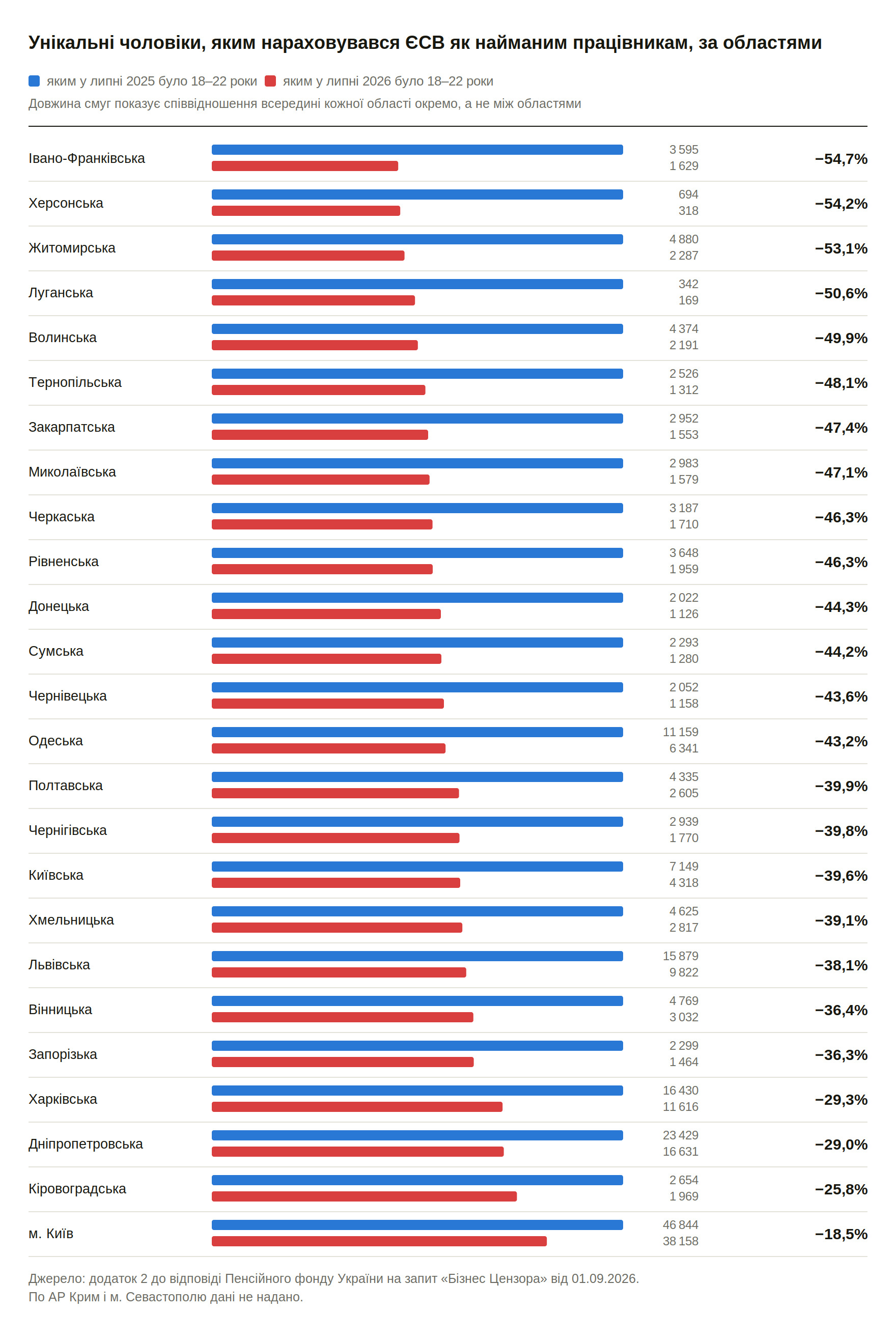
The Pension Fund recorded the largest drop in the Ivano-Frankivsk region: −54.7% (from 3,595 to 1,629 people). It is followed by the Kherson (−54.2%), Zhytomyr (−53.1%), Luhansk (−50.6%), and Volyn (−49.9%) regions.
The smallest drop is in Kyiv: −18.5%, from 46,844 to 38,158 people. This is the only region where the indicator did not even reach a quarter. The next most resilient are the Kirovohrad (−25.8%), Dnipropetrovsk (−29.0%), and Kharkiv (−29.3%) regions.
At the same time, the picture differs in percentages and absolute numbers. Although Kyiv showed the smallest drop in percentage terms, it was here that the most taxpayers disappeared – 8,686 people. This is more than in the Dnipropetrovsk (6,798) or Lviv (6,057) regions.
There is no data for the Autonomous Republic of Crimea and Sevastopol.
When exactly the decline began
The Pension Fund also provided monthly dynamics.
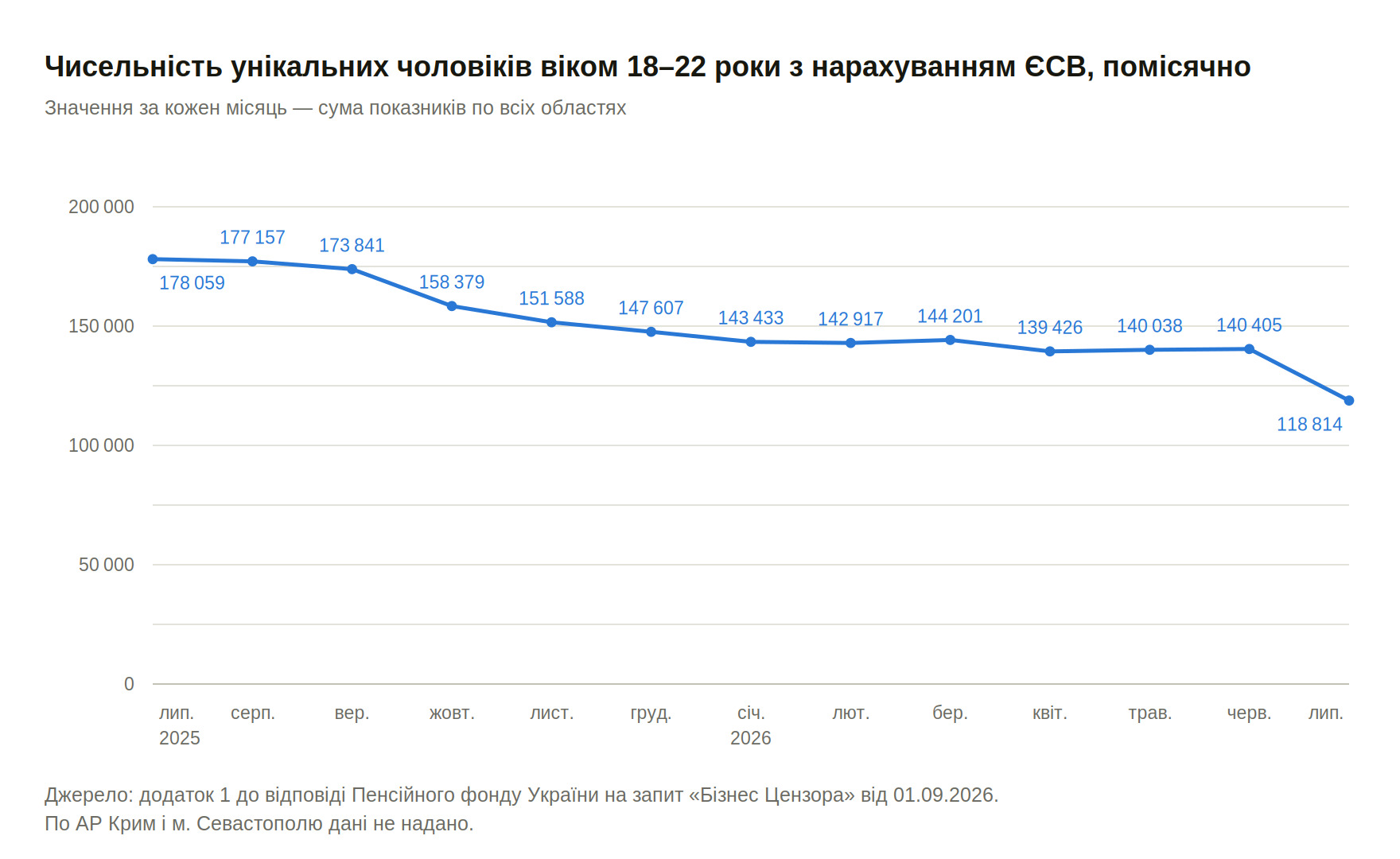
The decline was not uniform. From July to September 2025, the indicator remained almost at the same level, but in October it fell immediately by 8.9% – the sharpest monthly decrease in the first year. Later, the pace slowed down: from January to June 2026, the indicator fluctuated between 139 and 144 thousand.
Iryna Ippolitova draws attention precisely to this shape of the decline.
"It is noteworthy that they confirm the thesis that those who wanted to leave took advantage of the opportunity immediately (the largest drop was in October last year), and then the pace decreased significantly."
July 2026 stands out separately: in one month, the number of taxpayers fell by 15.4%, from 140,405 to 118,814 people. This is the deepest monthly decrease over the entire observation period. Ippolitova explains this as follows:
"The drop in July this year is most likely related to the EU decision regarding restrictions on obtaining temporary protection for Ukrainian men. Although the decision itself was adopted in July, it came into force in August. Thus, for several weeks at the end of July and the beginning of August, this decision was already known, but it was not yet in effect."
As a reminder, on July 15, 2026, EU countries agreed to extend the temporary protection regime for Ukrainians until March 4, 2028, and simultaneously restricted access to it for men of mobilization age who cannot confirm the legality of their departure from Ukraine. The restrictions apply to those arriving in the EU from August 5, 2026.
Thus, as of today, a year after the border was opened for men aged 18–22, the state still does not know how many of them have left. But it knows, down to the exact person, how many of them stopped paying contributions.


