



Ukrainian book publishing is once again being destroyed by Russia. What are ways to save industry?
Throughout the war Russia has been waging against Ukraine, it has been destroying Ukrainian books. In occupied territories, this process was carried out on a massive, centralized scale: Russian books and textbooks were brought in to replace the Ukrainian-language ones that had been burned. In regions free from Russian control, the book infrastructure—printing houses, book warehouses, libraries, and bookstores—constantly suffers damage.
Almost after every heavy shelling, news emerges the following morning that a particular bookshop or publishing house has been hit. Over the last few months, the scale of the losses suffered by Ukrainian publishers has reached catastrophic proportions.
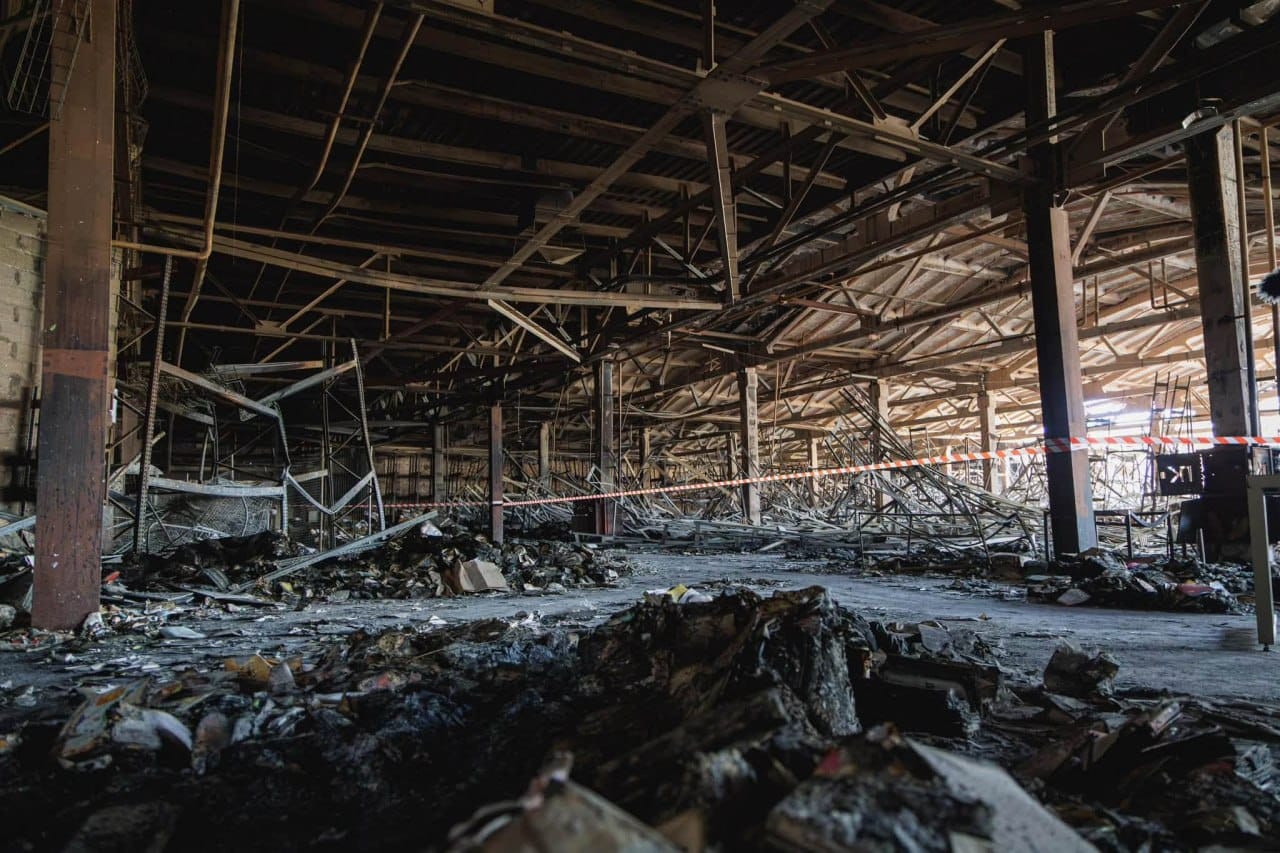
Following the missile attack on Kyiv on 19 July, printing warehouses and the ‘Konvi Plus’ company suffered extensive damage – as a result, schools did not receive hundreds of thousands of textbooks ready for the new academic year. On 1 August, a Russian strike on Kharkiv destroyed the logistics centre and warehouses of the ‘Ranok’ publishing house, where books from many other publishers were also stored. We have lost millions of books, including several print runs of school textbooks.
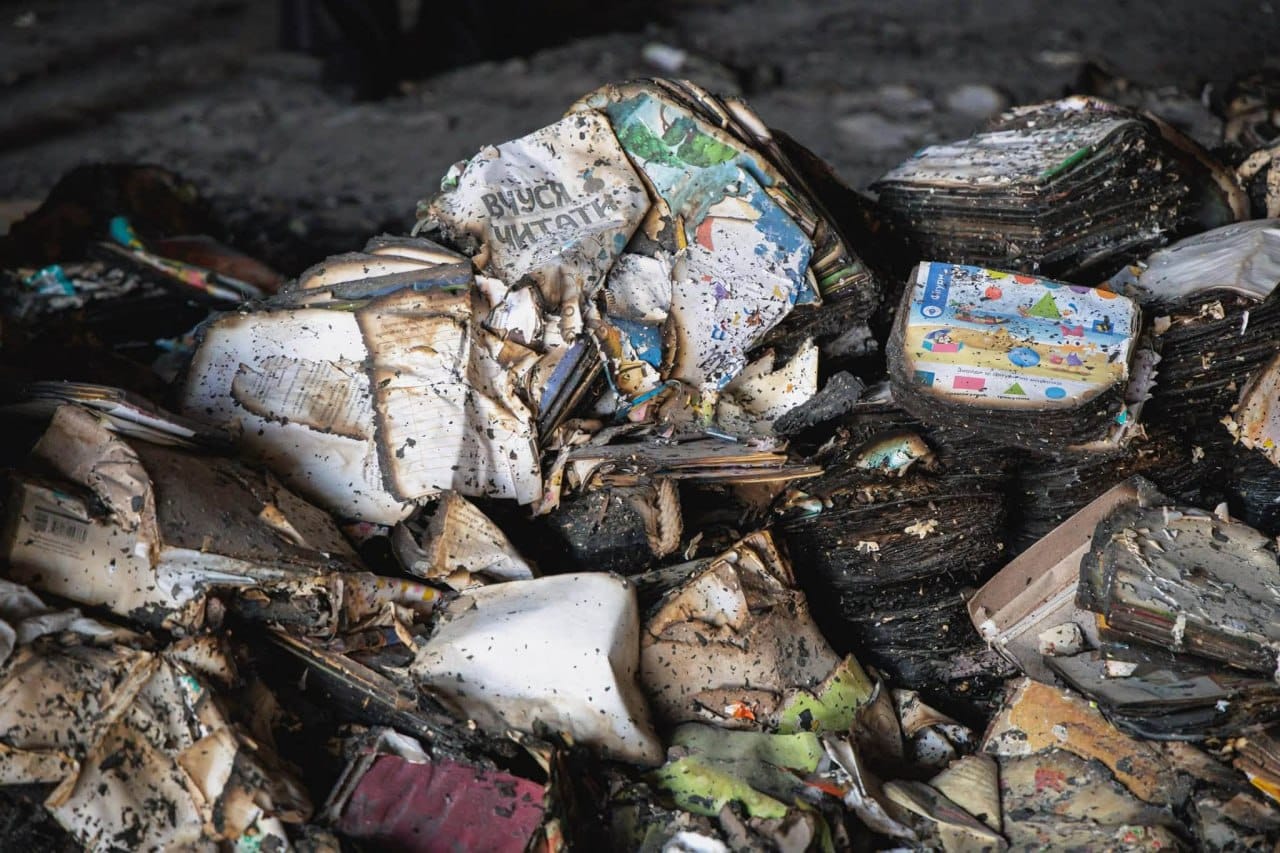
Then, on the night of 28 August, Russia struck the ‘Nova Poshta’ warehouse facilities in Sviatopetrivskyi. Tens or even hundreds of thousands of destroyed books were added to the previous losses. The total losses are still being calculated.
Culture Minister Tetiana Berezhna reported that since the start of the full-scale invasion, at least 21 attacks on book-related facilities have been recorded. Over the summer of 2026, more than 10 million books were destroyed, with direct losses exceeding 1.2 billion hryvnias.
For a publishing house, the loss of a warehouse is not simply the loss of premises. It represents thousands or tens of thousands of books already in print, into which funds have been invested for rights, translation, editing, design, and printing. It is the company’s working capital and the result of the labour of dozens of people, which can be destroyed overnight.
Vivat, "Laboratory", "Nash Format", "Urbino", "Osnovy", #Knyholav, "Vydavnytstvo Staroho Leva", "ArtBooks", "A-BA-BA-GA-LA-MA-GA", "Vikhola", "Stylet i Stylos", "Bukshef", "Ranok", "Georges", "Fabula", "Ridna Mova", "Chytarium", "Tvoia Pidpilna Humanitarka", "Bearded Tamarin", "Vydavnytstvo", "Stretovych", "Nebo", MISON… This is a very incomplete list of publishing houses that have suffered losses as a result of the recent Russian attacks.
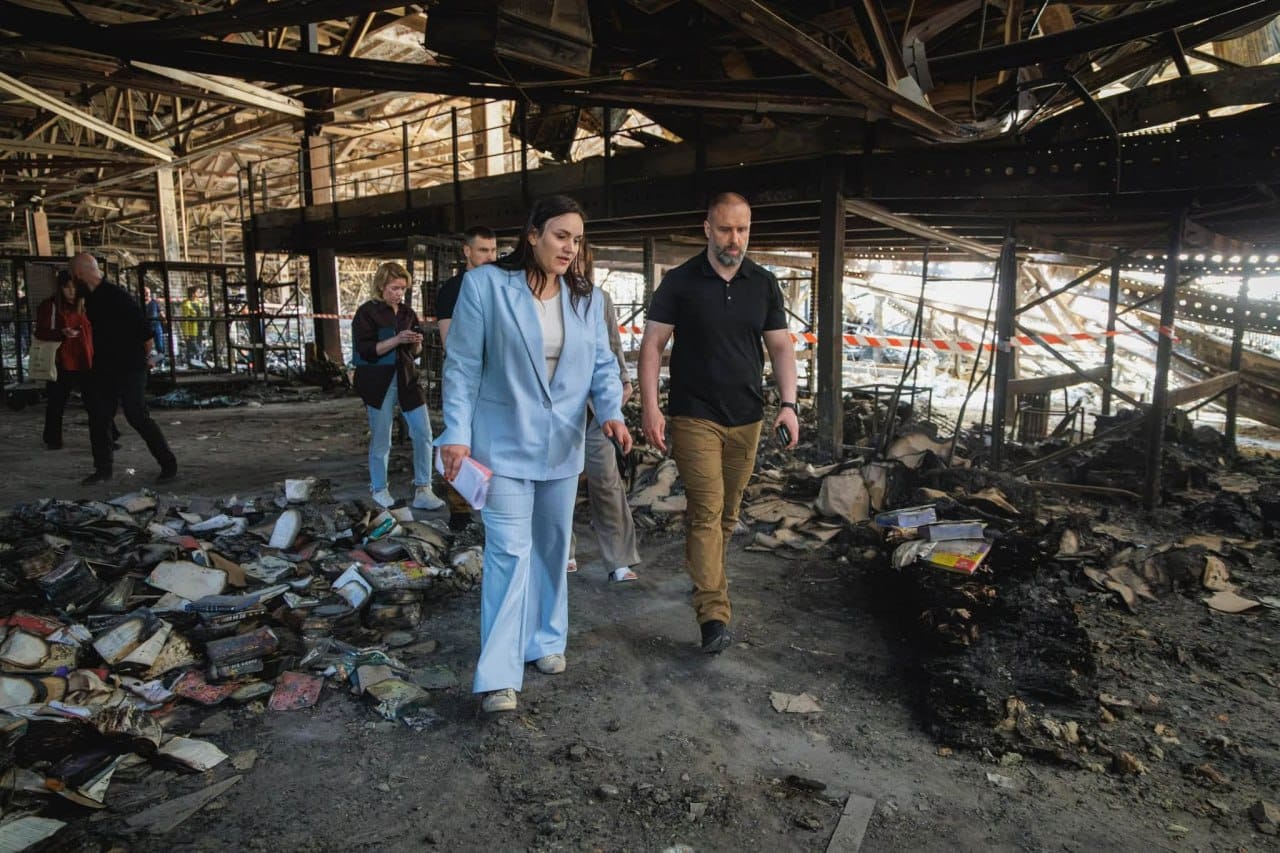
Culture Minister Tetiana Berezhna at the ruins of the "Ranok" publishing house’s warehouse
Both publishing giants and specialist genre publishers have been affected. Both academic publishing houses and projects aimed at popular culture. Both publishers with a glorious history and young publishers who have only just released their first book.
Yevhen Tafiychuk, co-founder of ‘Nova Poshta’, has stated that the company will compensate publishers and bookshops whose books and goods were destroyed as a result of the Russian strike on its fulfilment centre and sorting depot.
That is for the future. At present, we face a shortage of textbooks and thousands of book titles, the loss of raw materials for producing new books, cancelled book launches, the cancellation of the ‘Book Country’ festival, and the introduction of austerity measures, which will ultimately affect readers, as well as the vibrancy and openness of Ukrainian culture.
ON STORAGE: LARGE WAREHOUSES, SCATTERED LOCATIONS OR UNDERGROUND STORAGE FACILITIES?
In the days following the attack on Kharkiv, many publishers found themselves unexpectedly forced to issue public explanations—which at times bordered on excuses—as to why they had stored so many books in one place, especially above ground, and why they continued to operate in cities that are constant targets. These questions would be logical when it comes to works of art or unique museum collections. We explain why this criterion is not correctly applied to an industry characterised by constant turnover, particularly given the growth of online retail.
Viktoria Haidai, director of the ‘Konvi’ printing company, says it is impossible to relocate production capacity from Kyiv: "Over 150 people are working for the holding company. Secondly, relocating a production operation on this scale would take more than a year. The production lines would need to be dismantled and then reassembled. Alternatively, it would require a very large capital investment, which no one is prepared to make."
In the latest attack alone, Vivat lost over 35,500 copies of books. The estimated value of the destroyed stock is over 16.6 million hryvnias. This is not yet the final figure for the losses: Yulia Orlova, CEO and co-founder of the publishing house, notes that there is currently no place in Ukraine that we could consider completely safe:
"We decided at the time that storing all the books in Kharkiv was too risky due to its proximity to the front line, so we moved some of them to Kyiv. Now we see what is happening in Kyiv, and we are moving some of them further, to Lviv. But even in Lviv, the Russians have repeatedly destroyed warehouses in recent years.
The second point is that a book warehouse has quite specific requirements. Paper is hygroscopic; it absorbs moisture very easily, so the right temperature and humidity are needed, and the premises must be heated in winter. We’re talking about tens of thousands of square metres and high-ceilinged rooms, usually 5–7 metres and above, with complex shelving systems and specialised equipment.
Spreading the entire print run across many small warehouses does not simply mean distributing the books across different premises. At Vivat, there are approximately 5,000–7,000 titles in circulation at any one time. Each warehouse requires equipment, trained staff, a warehouse management system, and software capable of tracking the exact location of every item and determining which warehouse to fulfil orders from for online shops, bookshops or large retail chains. It is impossible to predict in advance exactly how many copies of specific books ‘Epicentre’, NOVUS or another partner will order tomorrow, or which warehouse should hold the required number of copies. That is precisely why, both in Ukraine and abroad, businesses predominantly build large, centralised warehouses. This makes sense both economically and logistically."
As for underground warehouses, in her view, this sounds wonderful only in theory. "In practice, I am not aware of any available underground infrastructure in Ukraine covering tens of thousands of square metres that would meet all the requirements for storing books," explains Orlova. "And building it specifically for this purpose is so expensive that, as a result, the books would truly become worth their weight in gold. The publishing industry simply cannot afford such investments."
The writer Andrii Kokotyukha, whose book print runs were also partially destroyed by fire, gives an example of how storing copies in a small underground warehouse would have proved disastrous for a particular publishing house: "It might seem simple – to spread them out across small warehouses, and even simpler to hide them underground. But this is paper; you need to create conditions so that it doesn’t deteriorate, so that a certain temperature is maintained underground.
In June, the ‘Smoloskyp’ publishing house suffered a disaster even without Russian missiles. Thousands of books were destroyed, which happened to be stored in a small underground warehouse – in the cellar. A heating pipe burst, and the books were flooded with boiling water. Due to the negligence of the utility workers, who failed to maintain the pipes, the books were ruined."
PUBLISHERS’ CRISIS MEASURES: FROM STAFF CUTS AND LOGISTICS TO REDUCING BOOK SIZES
The warehouse of the ‘Laboratory’ publishing house was destroyed on the night of 15–16 August; the damage is extensive. A rocket passed through one section of the building, effectively piercing all four floors – nothing remained there that could be restored or salvaged, apart from some charred metal shelving. Anton Martynov, director and founder of ‘Laboratoriya’, notes that there is no one-size-fits-all solution for all publishers, but he also points to an obvious step – decentralising remaining stock:
"Don’t store all your stock in one place; distribute print runs across several locations. We’ve started doing this and will continue. But we must be honest: it’s impossible to predict where the next missile will land.
After an attack, we review the entire logistics model of ‘Laboratory’: we distribute stock across different locations, look for new warehouse capacity, and consider what volume of books it is actually sensible to concentrate in one place. It’s more expensive and operationally more complex, but the war is forcing us to build in redundancies not only in IT or energy, but also in standard warehouse logistics.
At the same time, I would be very cautious about advising other publishers. After yet another strike, it’s easy to say: we should have spread out our warehouses, built up reserves, or moved to another region. It’s much harder to put this into practice when you have to dispatch thousands of books every day, pay salaries, print new runs and keep the business afloat."
Martynov emphasises that the war is forcing a complete rethink of the book market’s logistics: "Virtually anything is possible; it’s a question of resources and economics. Logistics is always built around efficiency: large warehouses and distribution centres exist precisely because they allow us to centralise stock, fulfil orders quickly and reduce the delivery cost of each individual book.
In wartime, this economic efficiency comes into conflict with security. That is why we need more than just the cheapest book delivery system. We need a system that can withstand the loss of a single warehouse or logistics hub and continue to operate the very next day."
The "Factor" group of companies, which includes the Vivat publishing house, began implementing anti-crisis measures following the attack on its printing plant in 2024. Yulia Orlova spoke about this incident, and we quote her words to illustrate the scale of the crisis for an individual publishing house, the industry, and Ukrainian culture as a whole:
"First and foremost, we have separated operational costs from investment projects, and due to the current crisis we have been forced to effectively freeze investment in development. In particular, we do not plan to open any new bookshops by the end of this year. For me, this is a very painful decision, because until recently we were actively expanding our network.
We’re planning the next major pre-order release for 8 September. But the scale of our publishing plan has already changed significantly. Up until July, we were opening pre-orders for around 18–25 books every month. In August, there were only two such titles, and we’re planning nine for September.
We have also reviewed our printing plan. There are critical reprints of books in Category A and, to some extent, Category B, without which we will be unable to meet our sales targets. Then there are books which, under normal circumstances, we would definitely have reprinted, even if they sell more slowly, because they need to be in our publishing portfolio. At present, we simply cannot afford some of these reprints.
We are also reviewing our plan for acquiring copyright. We are not stopping the acquisition of rights to new books, but we are reducing the number of such projects. There are already isolated cases where we have had to decline publishing books whose significant commercial potential we do not currently believe in.
We are working separately with foreign literary agencies, explaining the situation in Ukraine and negotiating deferrals of certain payments and royalties. Not everyone is understanding about this, so it is important for us to constantly explain what is happening in the Ukrainian book industry.
Unfortunately, we’ve had to streamline our team as well. This is probably one of the hardest decisions, because books are created by people. But when the survival of the publishing house is at stake, we have to review our staffing levels.
We didn’t do all this in one go. Step by step, we looked at our income, expenditure and cash flow, and decided what else we could cut back on. As a result, we’ve managed to bring our expenditure more or less into line with our current income."
THE GOVERNMENT AND PUBLISHERS ARE ON THE SAME PAGE. WILL WORDS TURN INTO ACTION?
All publishers are united in the view that the government must play a key role in supporting book publishing, as this is a sector that nurtures the nation’s identity and educational foundation.
Orlova insists that we have reached a point where the problems cannot be solved by publishers’ individual efforts: "We need the government to recognise that preserving Ukrainian book publishing during the war is not a matter of business convenience. It is a matter of preserving Ukrainian culture and identity. We are working with the Ministry of Culture, the Ministry of Economy, the Ministry of Finance and other state bodies. We are trying not just to say that the sector is struggling, but to formulate concrete solutions. The problem is that even when proposals are supported by the Ministry of Culture, they often get lost in the inter-ministerial process.
The sector needs state mechanisms to help publishers replenish their working capital following such losses, in particular affordable insurance against war risks, loans and other support instruments tailored to the specific nature of the publishing business. This will not only compensate for what has already been lost, but also ensure that publishing processes do not grind to a halt and that books continue to be published."
The publishers set out these proposals in an open letter to the President of Ukraine, because "the sector now needs concrete decisions, not just isolated discussions". Orlova lists them as follows:
"Firstly, compensation for losses incurred by publishing houses, printing works and bookshops that have suffered as a result of Russian attacks, and a separate mechanism for replacing destroyed print runs, particularly textbooks.
Secondly, effective insurance against war risks. At present, a publisher’s main asset — the print run of books, that is, goods in circulation — is effectively unprotected. The insurance and compensation mechanism must also extend to finished products.
Thirdly — affordable credit. Once production or business operations have been disrupted, working capital is needed for recovery. Publishers, printing houses and bookshops must have access to government schemes offering preferential credit terms.
Fourthly — the reinstatement of direct state procurement of books for libraries. This simultaneously supports publishers, updates library collections, and makes books more accessible to readers through larger print runs.
Fifth — to finally implement the rent compensation for bookshops provided for by law. This is needed not only in small towns. Bookshops are struggling in Kyiv, Kharkiv, Odesa and other major cities. For example, Vivat is currently forced to close all but one of its two bookshops in Odesa, partly due to excessively high rent."
There is another fundamental issue, she notes: ongoing inter-ministerial cooperation is needed. The book industry does not depend solely on the Ministry of Culture. This involves the Ministry of Economy, the Ministry of Finance, the Ministry of Education and Science, the State Committee for Television and Radio Broadcasting, and the Ukrainian Book Institute. Publishers are therefore proposing the creation of a working group "with a single point of contact and specific deadlines for implementing decisions".
Anton Martynov identifies two of the state’s most important tasks. Firstly, to ensure widespread access to contemporary books through libraries; and secondly, to support effective demand through direct cultural programmes. This would not be aid to individual companies, but to the entire cultural ecosystem – from authors and translators to publishers, bookshops and, ultimately, readers, he believes.
"In many libraries, half the collections still consist of outdated publications, particularly Soviet-era ones. At the same time, books have become significantly more expensive in recent years, and by no means every family can afford to buy new releases regularly," the publisher points out.
"Therefore, updating library collections is not simply a matter of supporting publishers. Above all, it is about giving people access to contemporary Ukrainian and world literature, regardless of their income or where they live. And in the current circumstances, it also offers an opportunity to distribute part of book print runs across the country rather than concentrating them in a few large warehouses. Instead of thousands of copies of new Ukrainian books lying in a few large publishers’ warehouses, some of these books could end up on the shelves of libraries across the country."
As for directly stimulating demand, he cites the 2021 government programme as an example: "A similar mechanism should be launched again – a sort of ‘eSupport’ for culture, where the state does not determine which publisher, bookshop or author should be supported. The reader makes that choice themselves."
Andrii Kokotyukha also believes that the role of the ‘cultural thousand’ remains underestimated. "The state could, firstly, help to promote reading, and reading means buying books. It is impossible not to mention the programme that was heavily criticised before the full-scale invasion. It would be very much needed now. At the end of 2021, that 1,000 hryvnias could have been spent on cultural products: books, films, concerts, theatre performances and travel.
The largest amount was spent on books – over 2 billion hryvnias. This money was held, as it should be, in a treasury account in January; it took time to process it. Then, at the end of February, the full-scale invasion began, and all processes came to a halt.
And when the Russians were driven out of the Kyiv, Kharkiv, Chernihiv and Sumy regions, and people gradually began to catch their breath, it turned out that those 2 billion-odd hryvnias hadn’t gone anywhere and were still sitting in the account. They provided a much-needed boost to the book industry. This money enabled the book industry to start operating actively as early as April–May. It was precisely thanks to this start-up capital from state funds that we have witnessed the publishing boom of the last two years. New series were launched, new festivals emerged, and bookshops and bookshop chains opened, because these books had to be sold somewhere.
So, the hundreds of thousands and millions of books that were destroyed in the fires in the warehouses were there as a result of sound government policy. It was heavily criticised, but I have now shown that it was the right approach. And this is just one example of how the sector can be supported."
Culture Minister Tetiana Berezhna has announced state support for the sector, which is in line with these proposals. In particular, she announced the resumption of the state programme to replenish library collections, the expansion of the e-Book programme, rent compensation for bookshops, and grants for affected businesses. It remains to be seen to what extent these proposals will make their way from the Ministry of Culture to the government and other relevant institutions – let us hope that they will finally be implemented.
PRINTING HOUSES: THE BACKBONE OF THE INDUSTRY
All the measures mentioned for the reprinting of books can only be possible if there is sufficient production space and equipment available – in other words, a sufficient number of printing works. In July, Russian shelling partially destroyed the production facilities of the ‘Konvi’ printing works in Kyiv. Two years ago, the Kharkiv-based full-cycle printing complex ‘Faktor Druk’ (the largest of its kind in Ukraine) suffered severe damage.
By destroying printing works, our enemy is undermining several sectors at once, as this also affects the printing of school textbooks.
"Faktor Druk" resumed full operations over a year ago, thanks in part to donors. The government oversaw this process, and Prime Minister Yulia Svyrydenko reported on the assistance provided to the company.
The "Konvi" printing house is currently assessing its losses and asking itself: "What next?". "Konvi" Commercial Director Viktoria Haidai explains the current situation:
"Regarding grants and charitable programmes: both the state and we are looking into them. So far, neither we nor they have had any results. As for grant funding provided for the purchase of new equipment, we are unable to take advantage of this programme. And this programme entails, in particular, the creation of new jobs. At present, having lost 50 per cent of our capacity, we need to retain the existing, stable workforce. We are not even considering creating new jobs.
The government’s preferential loan (at 0.1 per cent for the first year and 5–7–9 per cent thereafter) for production capacity is also a bit of a complicated matter, because, for example, commissioning a single printing press – if it arrives straight from the factory in Germany – will take between 3 and 8 months. And only then does it start to become operational. In other words, a year won’t be enough for us to meet the criteria for the preferential period and secure this loan for the second year. We simply won’t be able to cope with such interest rates."
DESTROYED TEXTBOOKS: MORE TO BE PRINTED BY NOVEMBER
I would remind you that, in addition to ‘Konvi Plus’, there was also a strike on the logistics warehouse of the ‘Ranok’ publishing house, where a certain number of textbooks had been stockpiled; these were being sorted into small batches and delivered to educational institutions in the eastern region. The Russians chose the summer for their attack – this is the peak period when textbooks are in the final stages of printing and delivery. As a result of these two incidents, one million two hundred thousand textbooks were destroyed.
Yevhen Bazhenkov, Director of the Institute for the Modernisation of Educational Content, says that this primarily concerns textbooks for Years 9 and 4, as well as several titles for Years 6 and 7. The losses are estimated at 150 million hryvnias. Some textbooks were in the printing stage, whilst others were in the delivery stage.
"Certain print runs were lost in their entirety, but this does not mean that children will be left without textbooks for these specific subjects. For example, the biology textbook by Gorobets has been completely destroyed. However, the 100 per cent of textbooks destroyed amounts to 12,000 copies. In addition, three or four alternative publishers also produce biology textbooks by other authors. This means that, as of September, not all educational institutions will be short of textbooks, but only those that, through a competitive selection process, chose a textbook from a publisher whose print run has now been destroyed. This issue is currently being resolved."
Bazhenkov predicts that the missing copies will be reprinted within two months, and efforts are currently underway to find ways to speed up this process:
"Firstly, we are seeking a donor to compensate publishers and businesses for their losses. Secondly, we are currently addressing the issue of extending the deadlines for printing and delivery. This is expected to take place as early as November. Some publishers have found the resources and means to take out a loan and are already reprinting textbooks. Incidentally, the total number of lost copies accounts for approximately 9.5 per cent of the total print run. Much depends on the materials, particularly the paper, as all the paper is produced in the European Union. This means it takes time to procure it and deliver it to Ukraine."
Viktoria Haidai explained how work is progressing on reprinting the school textbooks themselves:
"During the summer textbook printing period, additional production lines are brought into operation, capacity is increased, and staff numbers are expanded. So now, apart from the loss of some equipment, we also need to find ways to ramp up production capacity. How are we currently managing to ensure that children receive their textbooks at school? Our partners – the publishers we work with – are helping us enormously. They have also provided us with financial support. Our suppliers are helping too, particularly our largest supplier, who currently has a full supply of paper and is willing to wait for payment.
Foreign paper manufacturers have also offered small discounts – 10 per cent –, but this also represents a saving for us. In other words, they are not demanding advance payment, as has always been the case in previous years."
Bazhenkov acknowledges that compensation for printing houses is complicated by the fact that they are not the final suppliers of textbooks; therefore, this is handled through the publishing houses.
"Under the contract, textbooks destroyed as a result of martial law do not constitute force majeure. Therefore, the issue of compensation from the state budget is not being considered, as this is legally and legislatively impossible," he explains. "The Ministry of Education and we are looking for a donor; negotiations are currently underway with certain parties.
But the state, for its part, is addressing the issue and providing support so that publishers can, for example, obtain an interest-free loan for a year or two to secure working capital, enabling them to print these textbooks now. All the more so as publishing is a low-profit business: a textbook takes a year to a year and a half to produce, whilst the profit margin is set at 5 per cent."
There are positive aspects to this story which offer guidance on how to minimise potential losses from future disruptions to book production and warehousing. Thanks to the decentralisation of textbook delivery, we managed to avoid the worst-case scenario, in which far more textbook titles would have been destroyed.
"In terms of legislation, the rules were amended a year ago, and we moved away from the centralised delivery of all textbooks at once," says Bazhenkov. "Now, the publisher is responsible for delivering the textbook to the educational institution. However, given that few publishers currently have the logistical capacity, they have voluntarily formed groups of three or four publishers to store and transport the books, thereby ensuring the delivery of textbooks.
In the future, they will try to minimise the accumulation of textbooks in a single location. Secondly, we are currently working on the issue of insurance to cover all stages of risks associated with the war. In other words, to ensure that compensation from insurance companies is possible should such incidents occur."
And one can try as hard as one likes to make sense of the Russians’ inexplicable logic and reassure oneself that Russia is not deliberately targeting the publishing infrastructure. They say books are suffering incidentally, because the enemy is striking general warehouses rather than specifically targeting publishing houses. They say the Russians are so naive that they think drones are being manufactured in printing works. They say that textbooks came under fire by accident… However, the fact remains that the destruction of the Ukrainian book industry by the Russians has become systematic; there are multiple strikes on the very same location, which means that the attack on books is part of cultural genocide. That is why the systematic destruction of the Ukrainian book industry must be brought to the world’s attention.
Olha Skorokhod, Censor.NET
Photo: Tetiana Berezhna’s Facebook page


