



"I reminded world about war in Ukraine and lawlessness in Russia." Czech traveler with nickname JEBAL FCB shouts "Glory to Ukraine" on Red Square in Moscow
The author of the JEBAL FCB blog, Czech traveler David Pichal, published a video: he is standing on Red Square in Moscow and shouting "Glory to Ukraine." He also put up portraits of Putin with the inscription "Murderer." The video went viral while he was still on Russian territory. Why did he take such a risky step? David Pichal himself told us in an interview.
David is 51 years old, lives in the Czech Republic, and owns a business. He says he lives a happy life with his wife, has two already grown-up children, and has been passionate about traveling for the last 10 years.
Where did the name of your blog "JEBAL FCB" ("F#cked the FSB" - Ed.) come from?
Well, at first, it was a very small blog read by a few people, mostly from our town; they followed my hopefully funny adventures during trips. This name was just a joke. Because Jebal comes from my perhaps funny surname Píchal (Píchat is a vulgarism in Czech, meaning the same as "to f#ck" - Ed.). I never planned to be media-famous and still do not strive for it, which is perhaps why I chose my pseudonym in a somewhat vulgar form.
How did you decide to go to Russia?
I first visited Russia in 1989 when I was 15 years old, at a pioneer camp. Then in 2017, I went there on a folding bicycle; in 2018, I traveled through Russia to Kazakhstan and Kyrgyzstan. Last year, I rode across all of Russia to Mongolia, and this year's trip was definitely the last.
What was the main goal?
If you are asking about the destination, initially it was just Moscow and back, a total of 1,800 kilometers to match the visa's validity period. But then I didn't want to return the same way, so I decided to go further — towards Tula, Kursk, and eventually Belgorod. But if you are interested in the reason for this trip, it is unequivocal: riding a "Ukraine" bicycle to Moscow was a planned provocation. There is typical Czech humor in this: arriving at Red Square on a "Ukraine" brand bicycle and shouting "Glory to Ukraine" for its service — it's a beautiful double meaning! Of course, in Russia, you don't need to prove or convince anyone of anything, so I could have ended up in prison anyway. But the main real reason was solidarity.
You also brought special stickers to Russia. Tell us what kind they were and where you put them up.
Before I start talking about this, I want to explain the reasons first. In Russia, there is an opportunity to publicly represent only one opinion; no other is allowed. You are walking and see a person near Red Square: they are waving a flag with Putin's portrait; beneath it is another flag with the inscription "SMO" (Special Military Operation - Ed. note), and the person is also wearing a sign: "There is a war against our Motherland!" The person hands out newspapers containing nothing but lies and propaganda. There are several such people there. And where is the opposing side? Who can say there: "STOP THE WAR!" or "WE DON'T WANT PUTIN!"? Nobody. But I believe there are people in Russia who think this way, and there are many of them. I wanted to show them that some form of protest is possible. So that someone would see it and say to themselves: "Yes, he is a murderer! Finally, it is somewhere!" And maybe one person out of ten will do something similar. There is no point in taking to the streets and letting yourself be arrested. This can happen gradually, perhaps so.
I had 40 small and 10 large stickers of Putin in blood with the inscription KILLER. I filmed most of the moments when I put them up.
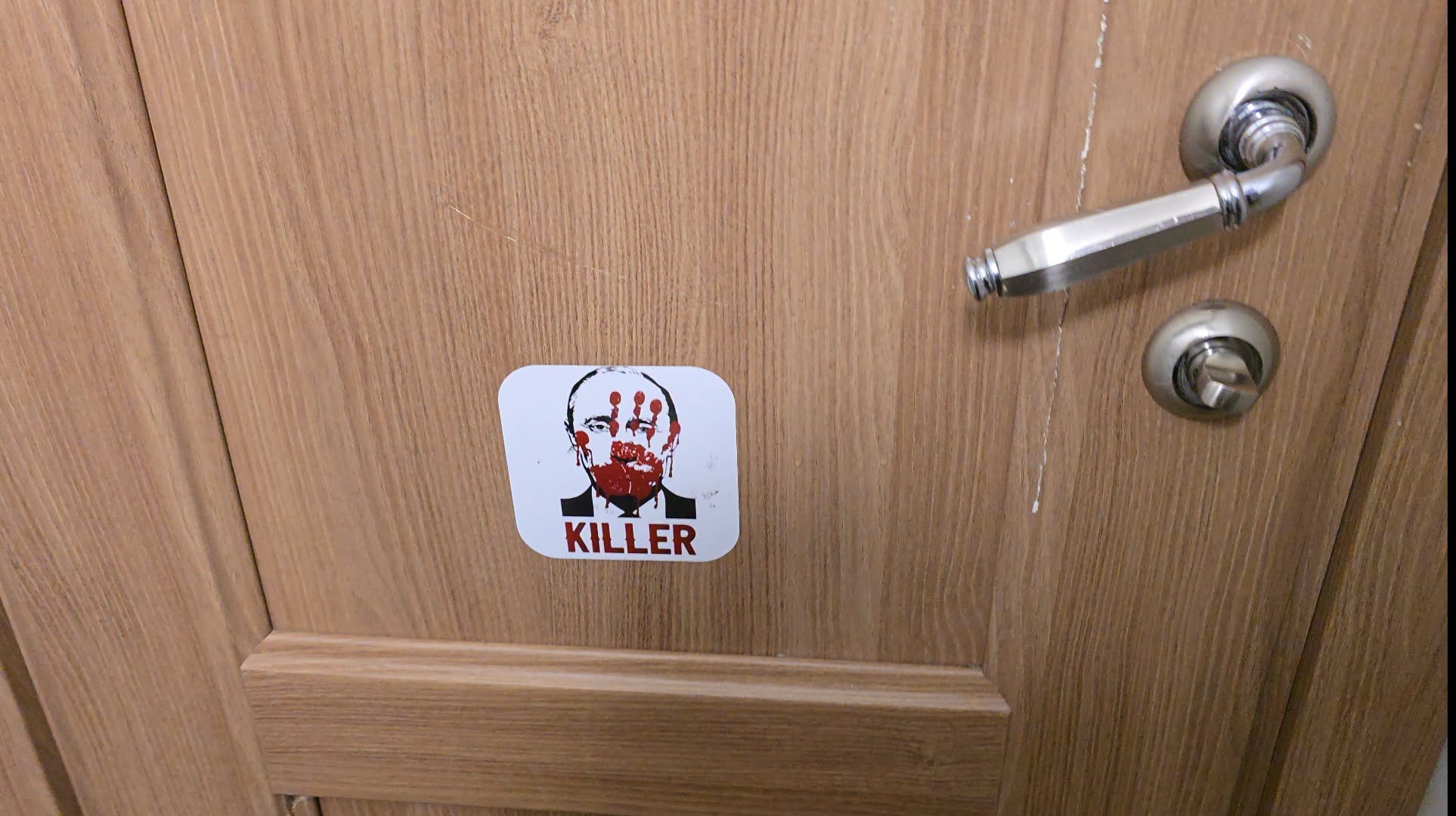
I left most of them in Moscow, where I spent three days. On the first day, I initially inspected all the locations and checked the placement of cameras, and over the next two days, I put them up: in parks, the subway, on Red Square, at bus stops, on shared scooters, in a public toilet opposite the FSB building. There, however, they lasted only one day. Perhaps most of them have already been removed today. I just wanted to use the opportunity, since I was already there, to do as much as possible. In Moscow, I visited the Boris Nemtsov memorial site, the Solovetsky Stone, and other locations.
How did you film the video with the bicycle?
I filmed this video for over an hour near a busy sidewalk leading to the Bolshoy Moskvoretsky Bridge. I said the phrase "Glory to Ukraine" at least ten times because one time the camera fell off the fence, the microphone stopped working, and I misspoke a few times, so I had to re-record. I had no apprehensions or fear. It was joy and euphoria, like when you finish a race. After eight days on the road, I was mentally and physically exhausted. I only kept an eye on the police, who were standing in one place far behind me in the corner the whole time. Only later did I realize that some tourists might have understood me, and one girl was taking pictures of me. That was an unnecessary risk.
Were you afraid to go to Russia at all?
I had apprehensions at the border — primarily because, for example, I might not be allowed in at all. Otherwise, I am used to theoretical danger. I travel everywhere alone and mostly sleep in a tent. I have been to Algeria, Morocco, Tunisia, Iraq, Iceland, Kazakhstan, Kyrgyzstan, last year — to Mongolia and practically all over Russia: from Dagestan, Chechnya, Siberia, Altai, and so on. At the Russian-Mongolian border, I was interrogated for several hours by an FSB officer who found certain things related to Ukraine on my phone and tried to intimidate me. But I won't say what exactly.
This is very dangerous. Did you assess the risks of being imprisoned for a long time?
Yes, I understood this when I went into it. But at the same time, everything was prepared and thought out down to the details. Every morning I checked and prepared my belongings; an ordinary or even a more thorough inspection would have found nothing on me.
You also had a cap with the inscription "Jebu na Putina". Where did you wear it, and how did people react to it?
I wore it only twice and did not notice any reaction. But overall, I assessed this as a very risky act that jeopardized the entire trip.
Returning to the fact that it is very dangerous. What was your motive to do it?
Certainly, to many people, it may seem like a senseless and unjustified risk. On September 8, 1968, in Poland, Ryszard Siwiec immolated himself in protest against the Warsaw Pact invasion of Czechoslovakia. Was his death senseless and unnecessary? Of course, I absolutely do not want to compare myself to this hero. But did my trip spark interest? Did it remind society about the war in Ukraine and the lawlessness in Russia? My answer is YES! Therefore, for me, it makes sense even considering the risk.
One of your stops was Alexei Navalny's grave. What was it like?
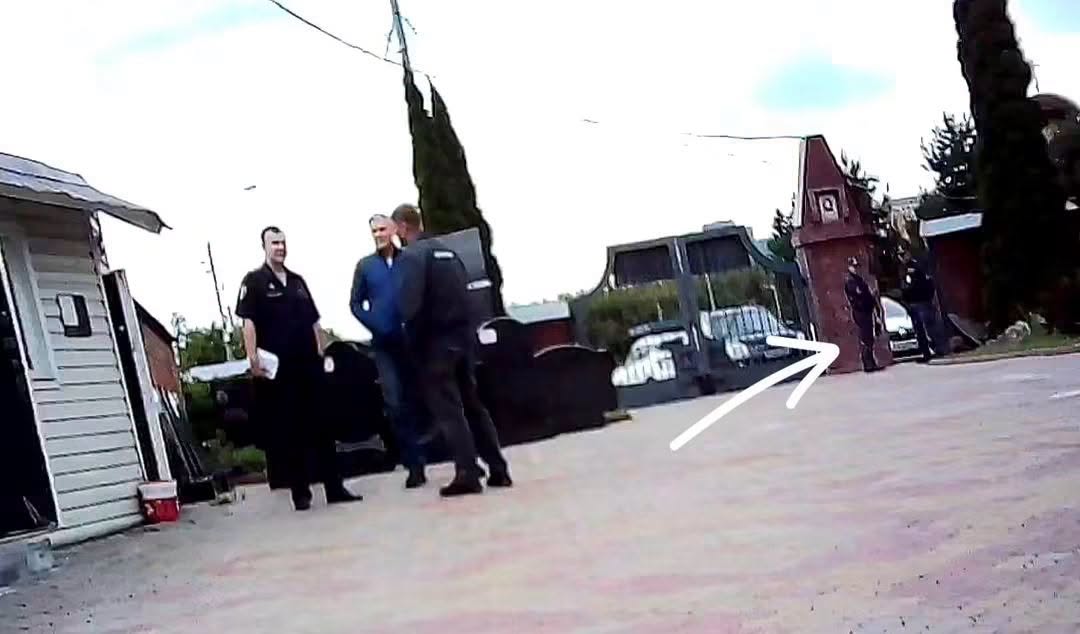
The Borisovskoye Cemetery, where he is buried, is very small. I knew that his grave is located right at the entrance. I did not want to film anything there on my phone, so I mounted a small camera on a head strap and put on a cap. The camera was visible, but not from afar. Directly at the cemetery, there is a police post with several people. One police officer stands right at the entrance with a metal detector, which seemed absurd to me for such a place. Obviously, it was primarily about stopping everyone and conducting a check. I don't know if it was because of my appearance, which is not particularly pleasant, or if he was just surprised, but he let me pass. Perhaps it was because I immediately turned in the opposite direction from what he expected. A man in plainclothes followed me, constantly talking on the phone and staying close the whole time.
It was clear to me that I would not stop at the grave, but rather head for the exit again. I walked around the entire cemetery and saw two police officers already waiting for me at the only exit. They had been watching my movements from afar and were just waiting for the moment I approached them. I decided not to stop at all and, most importantly, to maintain a confident, even determined facial expression. They probably expected me to stop and wait until they gave me more space, but I just kept walking straight at them. I thought they would grab me, but that did not happen. One of them said something like, "What are you doing here?" I replied that I was a tourist and kept walking. He also asked, "Where from?" To this, I apologized and said that I did not understand Russian. That was the end of it. According to my watch, my heart rate was 140.
What is your attitude towards Navalny?
For me, he is a hero because he openly stood against Putin and publicly criticized him. I just do not understand why he returned to Russia. He was very popular among the people, and perhaps he counted on that. Unfortunately, it cost him his life.
Do you know that he said, "Crimea is not a sandwich"? That during the Russian-Georgian war, he called Georgians rodents and wrote that he "really wants to launch a cruise missile at the rodents' general staff"? And that he called for the recognition of the sovereignty of Transnistria, Abkhazia, and South Ossetia?
Certainly, in some ways he was a controversial figure. But who in Russia is not? How can one find an absolutely pure soul there, who from birth and over many generations, has not been influenced by the propaganda that Russians are superhumans? A nation that, in their opinion, saved and liberated the whole world, has the best athletes, conquers space, and so on. They genuinely think all this about themselves.
How did you communicate with the locals in Russia? Do you know Russian?
I was obliged to study Russian under communism in elementary school, and later for another year in high school. A lot has stayed in my head, but I can only communicate on topics related to travel, various needs, and so on. My knowledge is not enough for any grand philosophical discussions. In any case, I understand more than I speak — meaning I mostly understand who is saying what to me.
How did the locals react to you, a Czech? Because the Czech Republic is recognized by the Kremlin as an unfriendly state.
I think better than if I had named another nationality — for example, said that I was a German, American, or Englishman. Ordinary people remember us as part of their world — as Czechoslovakia, which belonged to the Eastern Bloc, so they always reacted with relief. Especially older people. I did not feel that they perceived us Czechs as enemies.
Based on your observations, what percentage of Russians are genuinely against killing or "liberating" Ukrainians?
I was told that eight out of ten people love Putin. But this was told to me by a fanatical taxi driver who, according to him, would immediately give his life for Putin. He was from Azerbaijan, and his brutal views included, among other things, the idea of destroying Armenia and things like that. I talked to him for over two hours and, among other things, learned that all of us in the West are "brainwashed."
In reality, I think that half of the population might be against the war in Ukraine. But this does not mean they want to change the regime. In my opinion, Putin would win elections even if they were controlled by the West. People are under the strong influence of propaganda, which convinces them that the world wants to destroy Russia, that the CIA is to blame for the collapse of the USSR and installed its own Yeltsin, and that only their current president can save them.
You published the video when you had already left the borders of Russia. But. Aren't you afraid that the Russians might find you in the Czech Republic too? Russian intelligence services operate in Europe.
I published the video on Monday evening, meaning three days before my planned departure, and it was a big mistake. I had no idea how much publicity all this would get, and for the last 40 hours, I had no internet access at all. My wife tried to warn me that the video had gone viral, but these messages did not reach me. As late as Wednesday afternoon, I was debating whether to stay overnight until the next morning or head to the border immediately. I decided to leave Russia that day. Had I decided to stay overnight and I still had money for a hotel, I would absolutely not have been able to cross the border. At that point, the video already had over 100,000 views and had been shared 500 times. Moreover, as early as Wednesday morning, while I was still in Russia, the Russian outlet Izvestia wrote to me asking if I could give them an interview. Meaning they already knew what was happening. However, no problems arose at the border at that time.
Would you go to Russia or Belarus again, for example?
If my video hadn't gained so many views and this whole story hadn't gotten so much publicity, I would have tried something similar again next year with the same intent. Now I know that I will never do it again.
The Czech Republic has sheltered a great many Ukrainian refugees. But now, over time, the attitude towards them is getting worse. Why do you think that is?
This is caused by the pressure of Russian propaganda. Some weaker people let it influence them. The Czech population is aging; few children are being born. When the extremely numerous generations born between 1968 and 1978 retire, the whole system will collapse. Our economy needs every decent foreigner who decides to live here, work, and support our economy. Ideally, we need hundreds of thousands more people. And where to get them? I am definitely in favor of a Slavic people close to us — Ukrainians. I know that after the war they will want to return, and their state will also need them. But personally, I have only positive experiences with Ukrainians in the Czech Republic and would say that even now we are not able to replace them on our own.
Iryna Romaliiska, Censor.NET


