



Why have vape shops taken over Ukrainian cities when 93% of e-cigarette market operates in shadows?
A bookshop, a café, a store, a pharmacy, a vape shop… Find the odd one out in this sequence. Here’s a little hint.
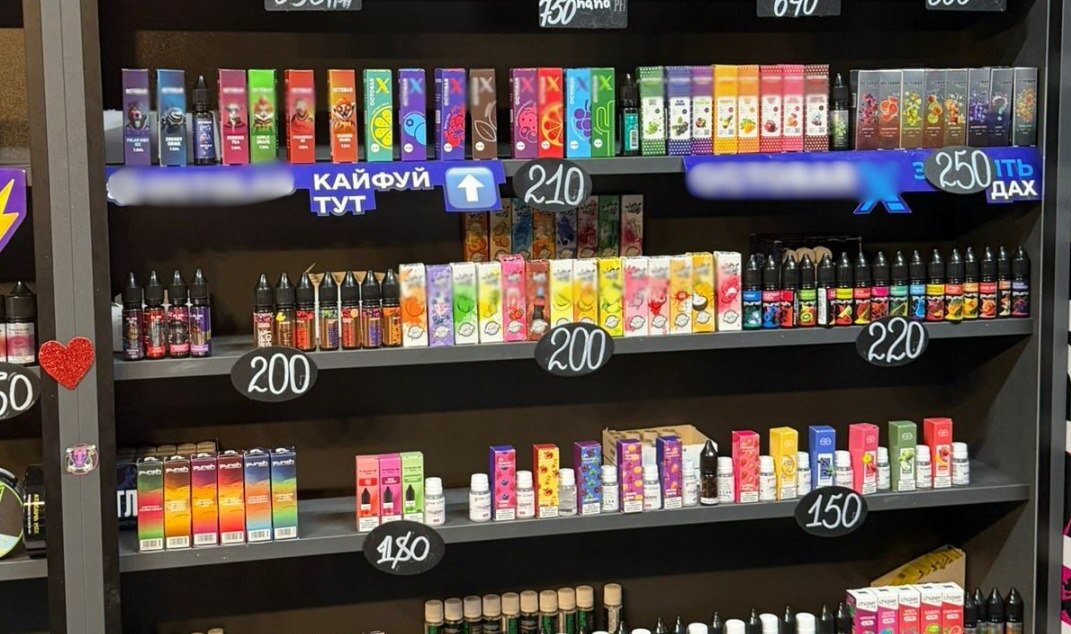
According to a Kantar study, 93.3% of products on Ukraine’s e-cigarette market do not comply with legal requirements. Only 4% can be classified as compliant.
Estimates by the Growford Institute also indicate that the illicit share of the vape liquid market rose to 95.8% in 2026. This means that around 95% of vapers use illicit liquids on which no excise tax has been paid to the state budget.
Given these figures, a reasonable question arises: how have vape shops appeared on virtually every corner? They squeeze in between cafés and currency exchange offices at public transport stops, have their own retail spaces in shopping malls, and operate comfortably in upscale residential neighbourhoods.
Moreover, vape shops have signs, advertising, websites and social media pages. E-cigarette liquids and so-called "disposables", which Kantar says are almost entirely illicit, are sold in supermarkets.
This creates a paradox. A market in which illicit products account for more than 90% has been operating openly for years. Why is the state unable to bring it under control?
Business Censor sought the answer to this question together with experts and law enforcement officials.
The budget loses more than UAH 18 billion
E-cigarette use is becoming more widespread in Ukraine. According to surveys by the Kyiv International Institute of Sociology, 4.3% of adults used e-cigarettes in October 2024, rising to 5.2% in February–March 2025 and 6.6% in November–December 2025. Meanwhile, 22.9% of adult Ukrainians smoked conventional cigarettes at the end of 2025.
These trends have emerged despite Ukraine’s ban on the production and import of e-cigarette liquids with flavours other than tobacco, in force since 11 July 2023, and a complete ban on their sale since 11 July 2024, intended to remove flavoured products from the market.
"However, contrary to the expectations of those who initiated the bans, their actual consequences have been a large-scale shift of the e-cigarette liquid market into the shadow economy, with growing losses in budget revenue and a lack of state oversight of compliance with quality standards for these products," Tetiana Koshchuk, a taxation expert at the Growford Institute, told BusinessCensor.
In 2025, the state budget received UAH 122.5 billion in excise tax revenue from tobacco products and e-cigarette liquids. Vape liquids accounted for less than UAH 0.5 billion, or less than 1% of the total. This contrasts sharply with the prevalence of e-cigarette use.
According to estimates by the Growford Institute, in 2026, losses in excise duty, VAT and retail excise duty due to the illegal market for e-cigarette liquids will amount to at least 18.7 billion UAH (12.6 billion UAH in excise duty alone). This is almost twice as much as the expected revenue from taxing international parcels.
The ban on vape liquids with flavours other than tobacco spurred the emergence of DIY e-liquid mixing kits. Users select ingredients to prepare a mixture to their taste.
Available components include a nicotine-containing base (a nicotine booster, which accounts for around 10% of the finished liquid’s volume and is the only component that may carry an excise tax stamp, although it is often sold without one); a wide range of flavours (flavourings); glycerine; mixing containers; and other items.
"At best, manufacturers of DIY e-liquid mixing kits pay around 10% of the excise tax required under the Tax Code. They exploit a legislative loophole, arguing that, technically, the ban applies to the flavoured liquid that consumers mix themselves, rather than to its individual components," says Tetiana Koshchuk.
A simple example illustrates this. The sale of 30 ml of e-cigarette liquid should generate around UAH 450 in excise tax for the state, at a rate of EUR 300 per litre. But if a DIY e-liquid mixing kit is sold instead, the budget receives, at best, only the excise tax on the nicotine booster (3 ml, or 10% of the total liquid volume), amounting to UAH 45. Moreover, according to the Growford Institute’s taxation expert, excise tax frequently goes unpaid altogether.
"Selling vape liquid components separately allows the average price of a 30 ml DIY e-liquid mixing kit to remain at UAH 350, giving these products an unjustified competitive advantage and making them more affordable. By comparison, using 30 ml of vape liquid is equivalent to consuming 15 packs of conventional cigarettes (20 cigarettes per pack), which would cost a smoker an average of UAH 2,200," Tetiana Koshchuk says.
Many EU countries have already gained experience in tackling the issue of DIY e-liquid mixing kits. In Poland, for example, regulations clearly stipulate that components intended for use in e-cigarettes must be subject to excise tax, regardless of where they are sold.
Indicators of such intended use include the placement of ingredients in specialist tobacco and nicotine product outlets, in sections selling these products in supermarkets, at petrol stations and elsewhere, as well as statements on the packaging indicating this intended use.
What law enforcement is doing
There have, however, been some successes in tackling the illicit e-cigarette market. The Economic Security Bureau of Ukraine (ESBU), together with the National Police, has exposed a number of vape shop chains and illegal manufacturers. Pre-trial investigations arising from these operations concern not only the sale of e-cigarette liquid components, but also the deliberate fragmentation of businesses into networks of sole proprietors and limited liability companies to achieve tax "savings".
The Economic Security Bureau acknowledges that Ukraine’s illicit e-cigarette market remains substantial. According to the ESBU’s analysis, more than 90% of the products examined from the main players in this market segment show signs of illicit trade.
"However, this figure does not mean that 90% of Ukraine’s entire e-cigarette market is illicit. It refers specifically to the findings of the analysis of the business entities and products covered by the ESBU’s study," the Bureau explained in response to an inquiry from BusinessCensor.
According to the ESBU, several main mechanisms underpin the illicit segment of the market. These include the illegal production of liquids and other e-cigarette products, the illegal import of finished products, their storage and subsequent sale without the proper payment of taxes, and distribution through an extensive network of physical retail outlets and online channels.
A separate problem is the sale of products that may resemble legal goods but fail to meet statutory requirements concerning composition, labelling, volume, nicotine content or taxation.
"Specifically, between January and July 2026, the ESBU’s Main Detective Unit entered 35 criminal proceedings concerning e-cigarette liquids into the Unified Register of Pre-Trial Investigations. Notices of suspicion were served on 35 individuals linked to the illicit trade in these liquids. Twenty-five criminal cases concerning liquids used in e-cigarettes were referred to court," the ESBU said in response to an inquiry from BusinessCensor.
During searches conducted between January and July 2026, law enforcement officers seized 29,725 e-cigarettes, 1,160,310 units of e-cigarette refill liquids and 1,045 litres of bulk components for manufacturing liquids from illicit circulation.
The seized materials constitute physical evidence, and their subsequent handling is strictly governed by Ukraine’s Criminal Procedure Code. Some are sent for forensic examination, while the remainder are kept in designated storage rooms. The fate of the entire seized batch is determined exclusively by a court judgment or order following the completion of the investigation or court proceedings. There are three possible outcomes:
- Disposal, carried out by specialist companies holding the appropriate licence;
- Return to the owner, if the trial or investigation establishes that the products are legal, that the search or seizure was unjustified, or other grounds for their return;
- Forfeiture to the state, if the goods are legal and have commercial value.
In 2026, the Economic Security Bureau carried out a series of large-scale operations and more than 180 searches to tackle the illicit market in e-cigarettes and vape liquids. More than 100 of these searches took place simultaneously: in May 2026, ESBU detectives and the National Police conducted a major crackdown across 12 regions of Ukraine.
However, no custodial sentences have been handed down in these cases so far, and no further details are available. The National Police reminded BusinessCensor that, under Article 222 of the Criminal Procedure Code, information from a pre-trial investigation may be disclosed only with the written permission of the investigator or prosecutor and to the extent they deem permissible.
Can the vape market be legalised?
The Economic Security Bureau also points out that the existence of a retail outlet openly selling illegal products does not, in itself, mean that the activities of those involved constitute "an isolated instance of illegal trade".
"In many cases, a retail outlet is merely the final link in a more complex chain. Behind it may be manufacturers or suppliers, warehouses, transport infrastructure, other sales outlets, and business entities used to conduct financial transactions. This is why shutting down an individual shop or seizing a batch of products does not always mean that the entire scheme has been dismantled," the ESBU explained to BusinessCensor.
Overall, law enforcement officials say that identifying everyone involved and establishing the circumstances of the illegal activity requires a range of investigative and procedural measures to document the products’ origins, supply and distribution channels, the scale of the illegal activity, and the movement of funds. The growth of online sales presents a separate challenge.
"Once a physical retail outlet has been shut down, sales may move to other retail premises or online, including social media and messaging apps," the Economic Security Bureau says.
The ESBU therefore focuses on dismantling illicit networks in their entirety by identifying their organisers, supply and distribution channels, production and storage sites, and financial flows. In other words, rather than pursuing individual shops that spring up like mushrooms after rain, it seeks to identify and eliminate the source.
"This approach allows us to tackle not only individual instances of illegal trade, but also organised schemes for the illicit trade in excise goods," the ESBU said in response to an inquiry from BusinessCensor.
According to Tetiana Koshchuk, a taxation expert at the Growford Institute, even lifting the ban on sales of e-cigarette liquids with flavours other than tobacco would not automatically bring the market out of the shadow economy.
According to the Growford Institute’s estimates, the illicit share of the vape liquid market had already reached 76% in the first half of 2023, before the ban came into force.
"Without stronger action by regulatory and law enforcement bodies to combat the illicit trade in e-cigarette liquids, bringing a substantial share of this market into the legal economy is simply impossible," Koshchuk says.
Meanwhile, a proposal has been put forward in Ukraine to introduce a separate excise tax on nicotine boosters, but at the same rate as for finished e-cigarette liquids. In effect, this would merely formalise the current situation, in which excise tax is paid, at best, on 10% of the total liquid volume.
"Can this be called bringing the market out of the shadows? No," Tetiana Koshchuk insists.
Moreover, if EU countries are tackling the sale of e-cigarette liquid components separately to prevent tax revenue losses, why should Ukraine act differently? In 2026 alone, Ukraine will lose at least UAH 18.7 billion in tax revenue to the illicit vape market.
"And the more vapes replace conventional cigarettes, the more our state budget will be depleted. Ukraine has no alternative but to step up its efforts to combat the illicit e-cigarette liquid market," the expert concluded.


