


Undisclosed criterion and shelter costing 9 million: why government’s requirement for businesses has stalled
On 29 October, Prime Minister Serhii Koretskyi announced that the government was giving businesses more time to equip shelters so they could operate during yellow-level air raid alerts. The transition period was due to end on 4 December, but the government decided to extend it until 4 March. The prime minister explained the delay by saying that "a significant proportion of businesses have not even begun to meet the basic requirements for keeping people safe."
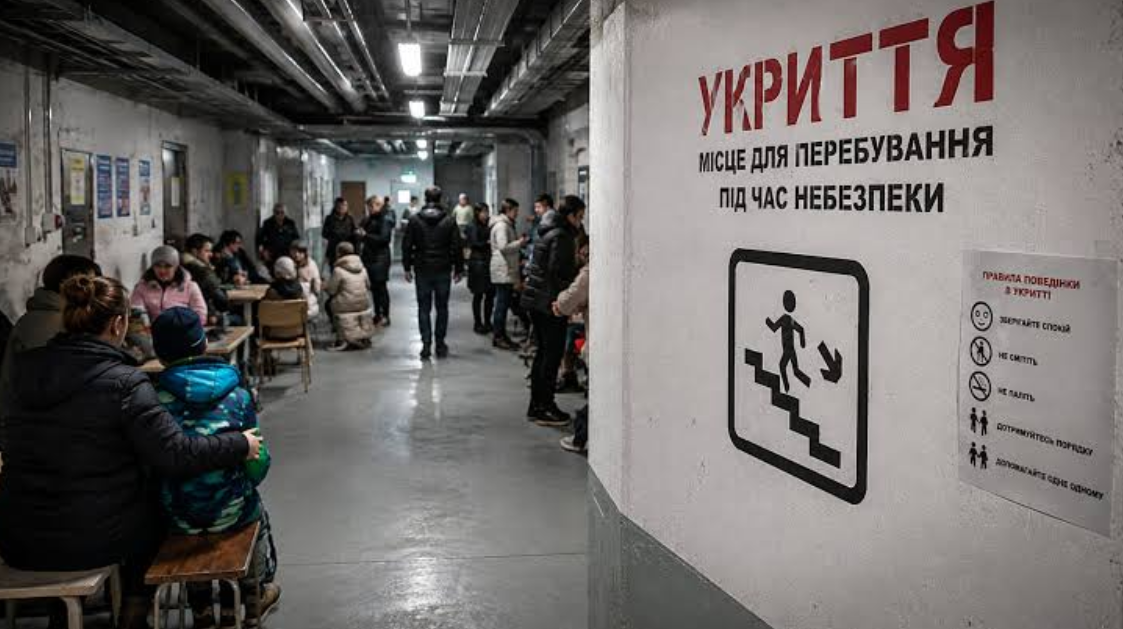
Business Censor examined why the main requirement for a safe space is not being made public, how much a shelter costs, who has managed to prepare, and who will be held responsible if people are harmed during an air raid alert.
What the government has required of businesses since September
Since September, Ukraine has had two levels of air raid alerts. During a red alert, businesses must suspend operations. A yellow alert is issued over a drone threat, and businesses may continue operating, but only if they have a protective structure, a dual-purpose structure, or an equipped safe space. These rules were introduced by Cabinet of Ministers Resolution No. 1092 of 4 September, subsequently supplemented by Resolution No. 1128 of 15 September.
Businesses are responsible for equipping their own safe spaces. Their protective properties must be substantiated by calculations, and an information sign measuring 100 by 60 cm must be displayed at the entrance, informing visitors whether there is a shelter on the premises.
The stakes are high for retailers: according to data from the Ukrainian Council of Shopping Centers (UCSC), air raid alerts accounted for 30.8% of shopping centres’ operating hours in September.
The Ministry of Internal Affairs, whose remit includes the State Emergency Service (SES), used Ministry of Defence methodologies to draw up proposed shelter criteria. These state, among other things, that "at a distance of 5 metres from an explosion, only monolithic reinforced concrete provides protection, while even brick walls 510 mm thick and aerated concrete are destroyed." A safe space must therefore be in an interior room, behind at least two substantial walls without windows.
Businesses without shelters were initially given a transition period until 4 December: until then, they could operate during yellow alerts with the consent of their workforce. On 29 October, the government extended this period: military administrations must collect data on compliance with the requirements by 4 March 2027.
The key parameter is not being made public
To equip a safe space, a business owner needs to know how much blast pressure the walls must withstand. This parameter, measured in kilopascals, was set by the Ministry of Defence and the General Staff. Business Censor asked the Ministry of Defence what it was. The value, however, was not disclosed to us.
A response prepared at the ministry’s request by the Central Research Institute of Armaments and Military Equipment of the Armed Forces of Ukraine explained that this was information for official use only. According to the response, "access restrictions are established by the requirements of the order of the Ministry of Defence of Ukraine dated 17 October 2023."

According to the Ministry of Defence, the parameter was shared with the Ministry of Internal Affairs, the Ministry for Restoration, and the SES, which are responsible for communicating it to businesses.
This means businesses must obtain the parameter through intermediaries: the local military administration, the local SES office, or a contracted design or expert assessment organisation.
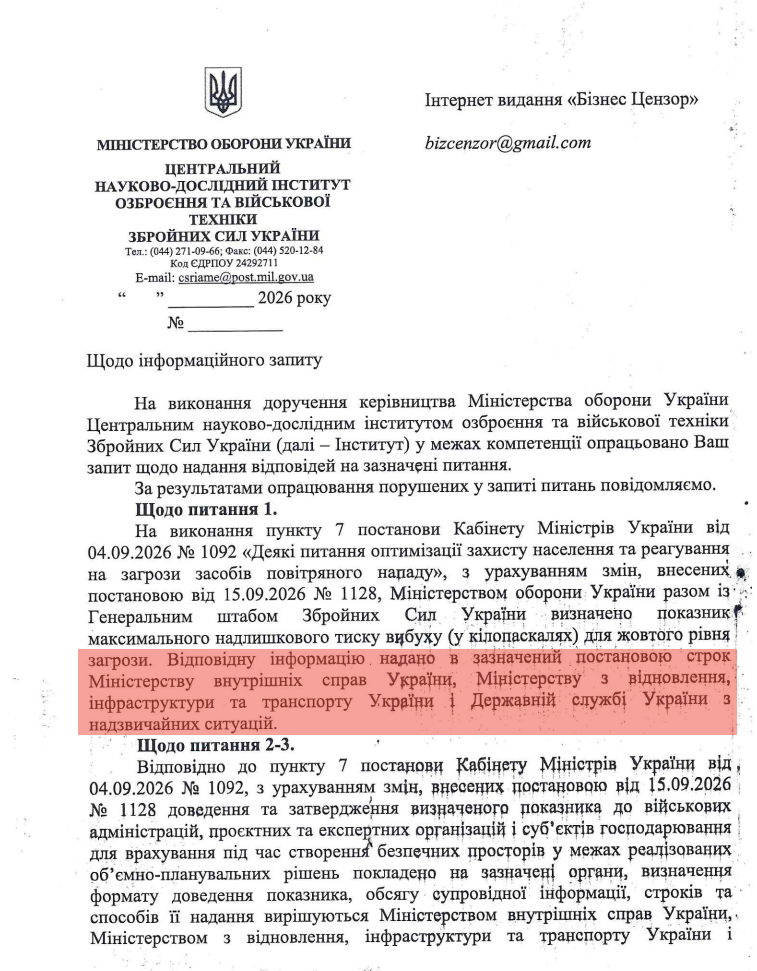
Some businesses approached the Ministry of Defence directly to obtain the parameter. According to the response, between 15 September and 26 October, the institute responded to 15 requests from businesses and associations in the same way. The institute said those responses were similar.
Speaking to Business Censor, Nina Yuzhanina, an MP and member of the Verkhovna Rada Committee on Finance, Taxation and Customs Policy, highlighted an imbalance in the resolutions themselves: they specify the dimensions of the sign at the entrance but do not explain what businesses should do next.
"They specified the dimensions of the sign in the resolution, what it should look like so people can see it. But they said nothing about the rest. They did not explain how to submit requests or documents," the MP says.
Under the logic of the resolution, every entrepreneur wishing to operate during yellow alerts would have to approach the authorities for calculations and parameters, Yuzhanina explains. In her view, the number of retail outlets in the regions gives an indication of how many such requests there could be.
"How many premises would need to be assessed? First of all, what exactly are they supposed to ask about? Whether their premises meet the requirements? No, they almost certainly do not. And they have no other premises. So how are they supposed to provide a shelter or this safe space?" she asks.
Businesses are also raising unresolved issues. In an appeal to the Ministry of Economy on 28 October, the Union of Ukrainian Entrepreneurs called for clear technical criteria for equipping safe spaces and for inconsistencies in regulatory requirements to be eliminated.
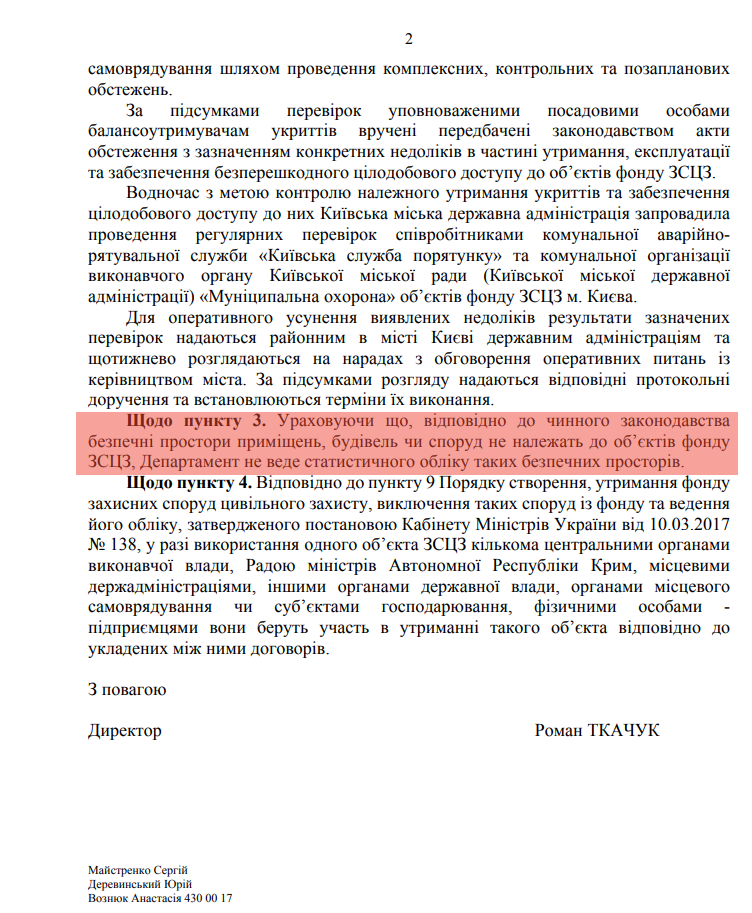
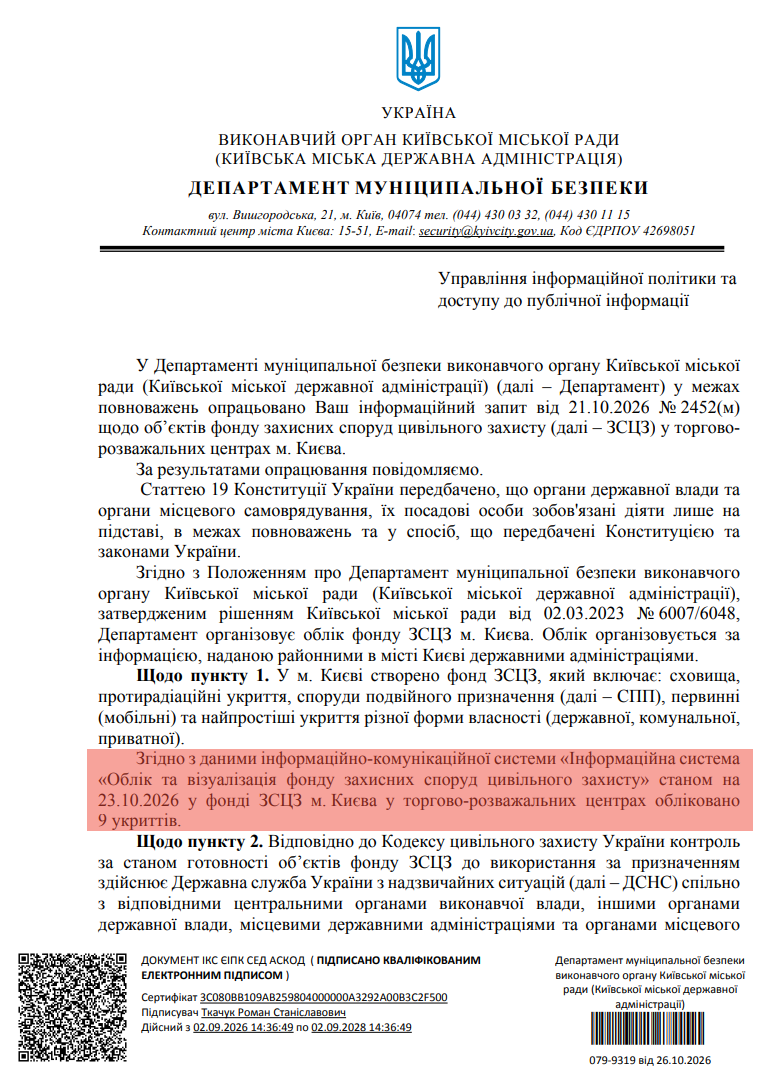
There are no data to verify the prime minister’s claim that large numbers of businesses have not begun to comply: even in Kyiv, the authorities do not know how many businesses have already equipped a safe space. In particular, the Kyiv City State Administration’s Department of Municipal Security, which maintains the city’s shelter records, told the newsroom that safe spaces are not included in the stock of protective structures, so no statistics on them are available.
Cinemas are preparing, but half of cafés could close
Major chains operating in shopping centres are preparing to meet the requirement. Multiplex told Business Censor that 12 of its cinemas already have shelters or safe spaces, while the rest are making preparations. Where the requirements cannot be met, there will be no screenings during yellow alerts. Shopping centre owners are funding the work, while the chain contributes indirectly through rent and service charges.
There are few fully equipped shelters within shopping centres themselves. As of 23 October, Kyiv’s stock of protective structures included nine shelters in shopping and entertainment centres.
The outlook for the restaurant sector is worse. According to Olha Nasonova, a restaurant consultant, director of the Restaurants of Ukraine analytical centre and co-founder of the National Restaurant Association, at least half of Ukraine’s restaurants and cafés risk being unable to operate because of the new requirements. She gave this assessment to Business Censor before the prime minister announced the extension of the shelter deadline.
Around 15% of establishments operate in basements, Nasonova says, and will be able to remain open during yellow alerts. Most, however, occupy ground-floor premises with panoramic windows. Whether they can comply with the resolution depends on whether there is an official shelter nearby, such as a metro station or basement. Even in central Kyiv, for example at the beginning of Andriivskyi Descent, there is no such shelter to be found. Roadside cafés and cafés at petrol stations have no shelters and must close during yellow alerts across the country.
A small room inside an establishment can accommodate staff, but not 50 or 100 customers, the expert explains. Some restaurants are already deciding to close or put their projects on hold until spring.
"A transition period? This feels rather like mockery of businesses. What is an establishment supposed to do in those three months? It cannot dig a shelter," Nasonova stresses.
Large businesses have more options, Yuzhanina notes: a shopping centre can install several shelters in its own car park or equip an underground car park. Small businesses, she says, cannot afford shelters: they are too expensive.
There is another issue, however: where should they go? Many businesses, including shops and cafés, occupy the ground floors of residential buildings. Who will decide where mobile shelters can be installed, and how? What paperwork is required for such construction? Unfortunately, there are no answers yet.
It is also unclear what difference having a shelter makes; in other words, what procedure should be followed during a yellow alert. Must employees and customers take shelter? If so, the business will still be idle, defeating the purpose of a yellow alert. And what about activities with more serious implications than retail, such as dentistry or medicine in general? A patient has just had a tooth drilled when an alert is issued; what should the dentist and patient do? What about more extensive operations when a patient is under general anaesthesia?
Access to these shelters also remains unexplained. Are owners obliged to admit anyone seeking shelter, or are they exclusively for staff and customers during opening hours? What should those who cannot fit inside do? And who will be held responsible if tragedy strikes?
People’s safety must unquestionably come first. But simply telling businesses to equip shelters without clear, understandable instructions is not enough. After all, a shelter should serve a purpose beyond ticking a box.
From 2.7 to 9 million: how much a mobile shelter costs
If there is no shelter nearby and the premises are unsuitable for a safe space, the remaining option is a mobile shelter next to the building. In his statement on 29 October, Koretskyi said: "There are ample opportunities to purchase mobile structures." Business Censor asked mobile shelter manufacturers how much their products cost, how quickly they can be supplied, and who is buying them.
The Kovalska Industrial and Construction Group told Business Censor that shelters for 20 and 50 people are ordered most frequently. They cost between UAH 2.7 million and UAH 4.7 million, excluding delivery and installation, while a shelter for 100 people costs UAH 9 million. Manufacturing takes an average of five days, and installation takes three to five days.
BUNKEROK, which also manufactures mobile shelters, said its production backlog stands at two to three months, counted from the date of advance payment. Before the prime minister’s announcement, the company told the newsroom:
"Frankly, no — a business that only starts addressing this now will not be ready by 4 December. Production lines are overloaded."
Both manufacturers describe a similar core customer base. At Kovalska, around 70% of orders come from manufacturing businesses, while the remaining 30% come mainly from logistics companies.
BUNKEROK has seen an increase in enquiries from petrol stations, state-owned enterprises and manufacturing businesses since 4 September.
Neither manufacturer mentioned shops or food service establishments among its customers.
Small businesses operate at their own risk
In a small neighbourhood convenience store in Kyiv’s Teremky area, the owner cheerfully rings up purchases, ignoring the loud siren sounding outside. Asked about operating after 4 December, he shrugs: "We’ll manage somehow." A shop assistant in the neighbouring store gives a similar answer.
Small shops survived and kept operating through much tougher challenges in 2022. "Our walls are strong," the shopkeeper says reassuringly. "Don’t worry, I’m not afraid." We exchange jokes, and I realise there is no point in asking any more questions. The conversation will only upset him, because he clearly does not know what will actually happen. Providing a separate shelter for the little shop is not feasible, so all he can do is hope to avoid fines.
According to Yuzhanina, the strongest reaction so far has come from Lviv, where small businesses outnumber large and medium-sized ones. Fellow MPs from Lviv told her about panic among entrepreneurs who had read the resolutions and brought her data on the frequency of yellow alerts. If these establishments close for every alert, retail and tourist services will grind to a halt, municipal budget revenues will fall, and people will lose income and wages, the MP explains.
"We should value those who are working and give them the opportunity to work in Ukraine. But having read these resolutions, I do not see the authorities acting with the care and precision needed to achieve that goal," she explains.
Yuzhanina sees a solution in pooling the resources of local communities and businesses. Cities could assess shelter needs on streets with many small shops and cafés, install shared shelters for several establishments and contribute an even larger share of the cost than the entrepreneurs themselves. In her view, local councils could initiate such measures by appealing to the government. Protecting people’s lives, the MP stresses, must be a prerequisite.
"Instead, they have taken this approach: we have told you what to do; if you do not do it, we will shut you down, and then we will think about what comes next," the MP says.
There is another complication: the government has deferred all capital expenditure because of a shortage of funds. This means that even if cities decided to equip shelters, the corresponding payments could simply remain pending at the Treasury "until better times".
Increasing responsibility or shifting it?
Ihor Chudovskyi, a lawyer and partner at the Globa & Globa law firm, considers the requirement to protect employees and visitors justified.
"A yellow alert is not a green traffic light. A drone does not become any safer because the colour in an app changes," he explains.
The question, he says, is how the state organises compliance with this requirement. The resolutions do not establish a separate fine for operating without a shelter, Chudovskyi explains. An inspector must identify a specific article of the law and establish the elements of an offence. Possible measures include compliance orders, liability under Article 188-16 of the Code of Ukraine on Administrative Offences for failing to comply with lawful demands by civil protection officials and, where lives are at risk, a court-ordered suspension of operations at the premises.
"Once the transition period ends, the minutes of a workforce meeting alone will not be enough to continue operating without the protection required by the resolution. Employees’ signatures are no substitute for a concrete slab," Chudovskyi says.
If people are harmed, he says, claims for compensation and criminal liability may follow, including for breaches of occupational safety legislation. This would require proof of a specific duty owed by the responsible person, a breach of that duty and a causal link to the consequences.
"It feels as though the government is trying to shift responsibility and shed its duties as the state," Yuzhanina says. She explains the logic as follows: once businesses were allowed to operate during yellow alerts, the question arose of who was responsible for people’s lives.
"Either we do not operate at all, prioritising people’s safety, or we operate and now shift responsibility onto the owners of establishments," she said, explaining the government’s logic.
Oversight should help prevent such consequences: under the Civil Protection Code, the SES is responsible for inspecting shelters, while the police merely assist it. The National Police confirmed this in response to the newsroom’s enquiry.
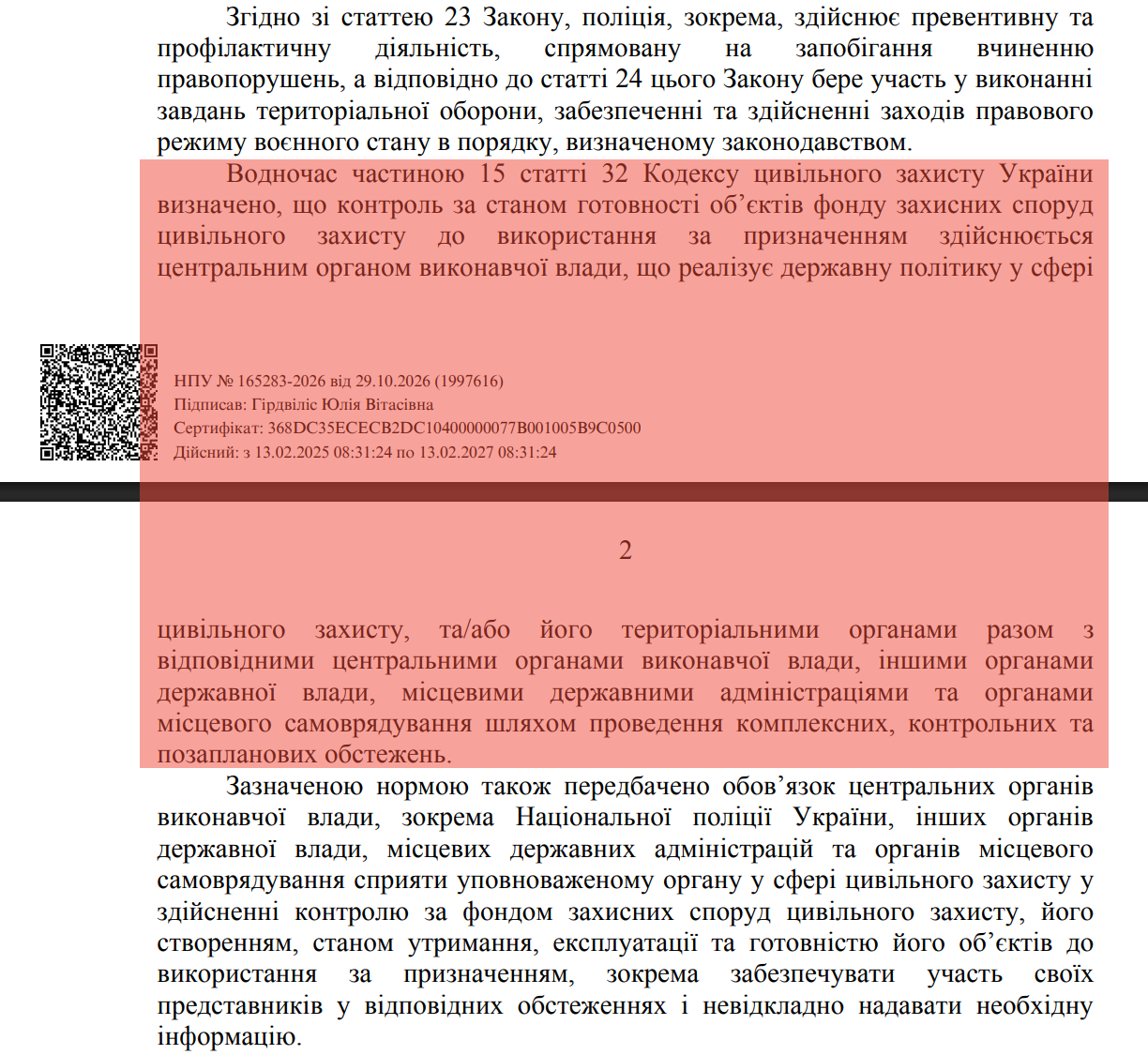
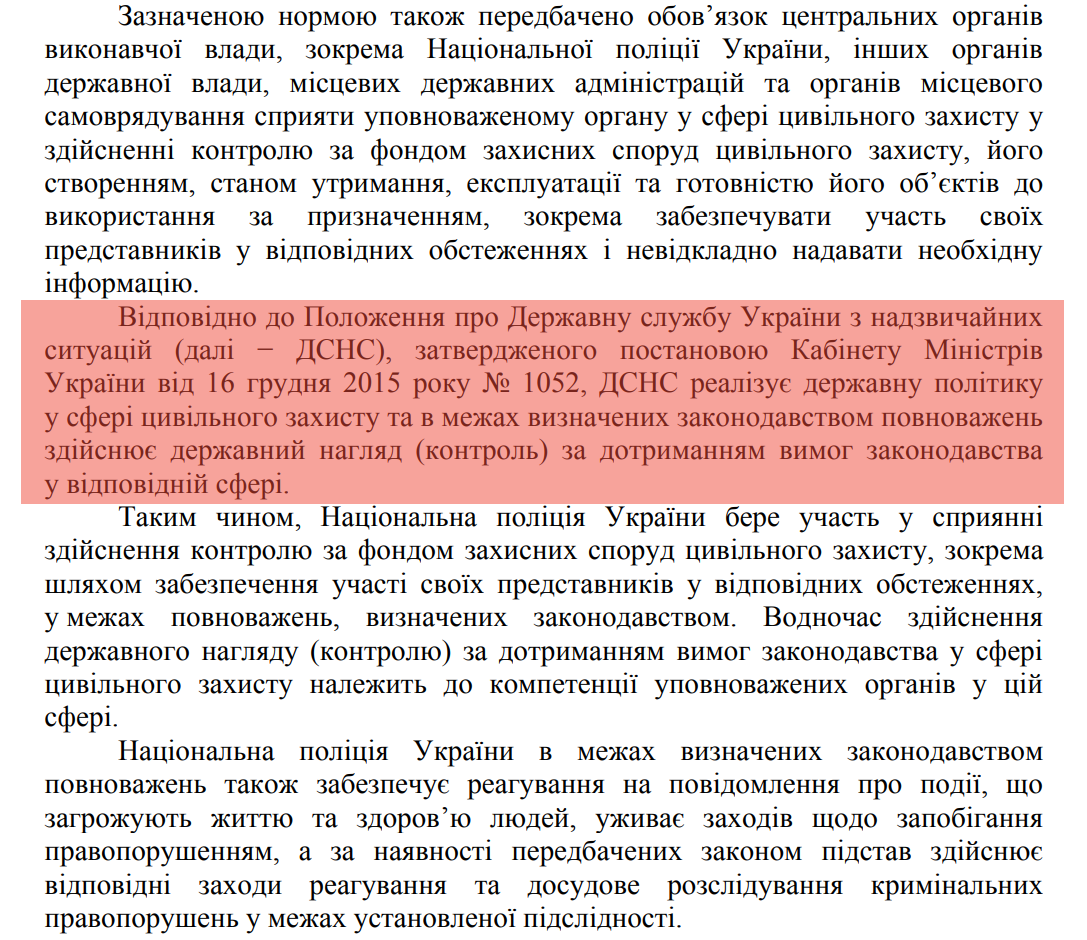
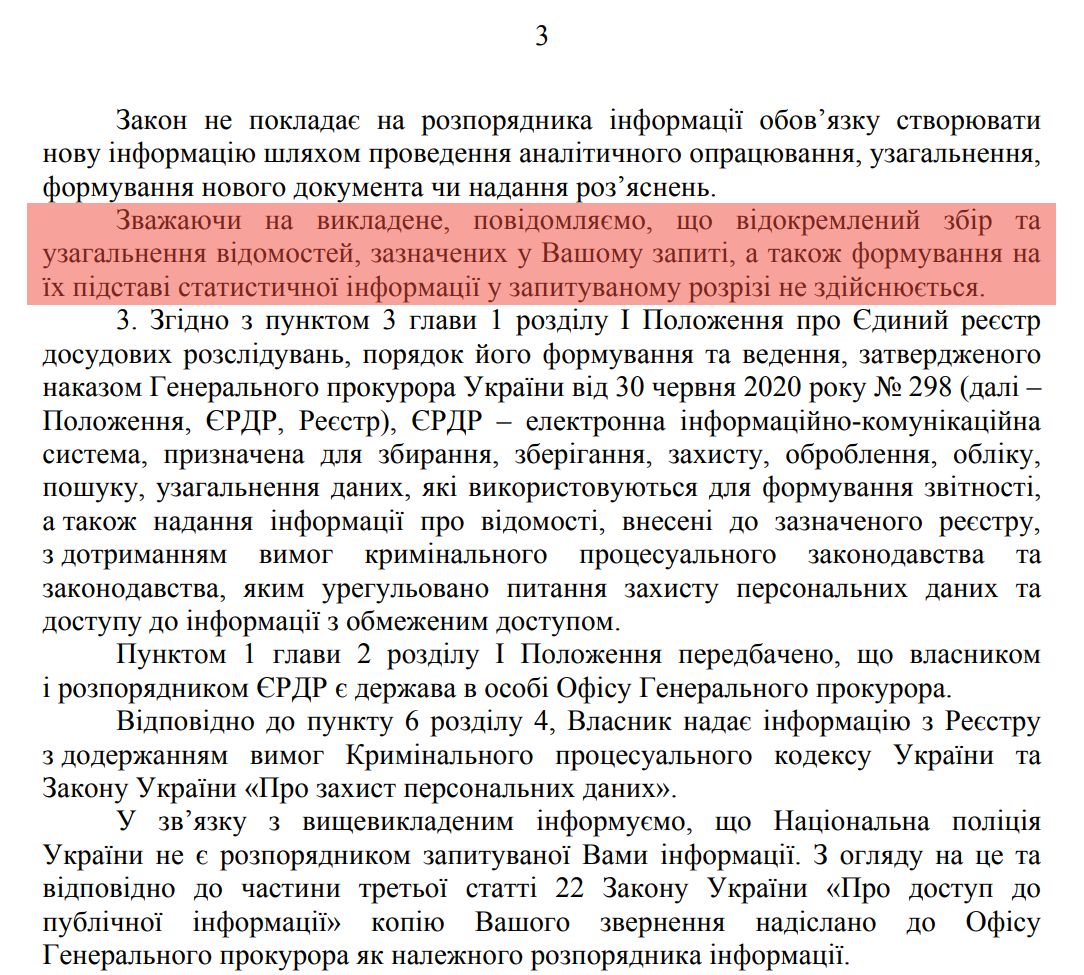
Meanwhile, liability provisions that predate the new rules are already being applied: police investigate such cases under general provisions of the Criminal Code, the Business Censor has found.
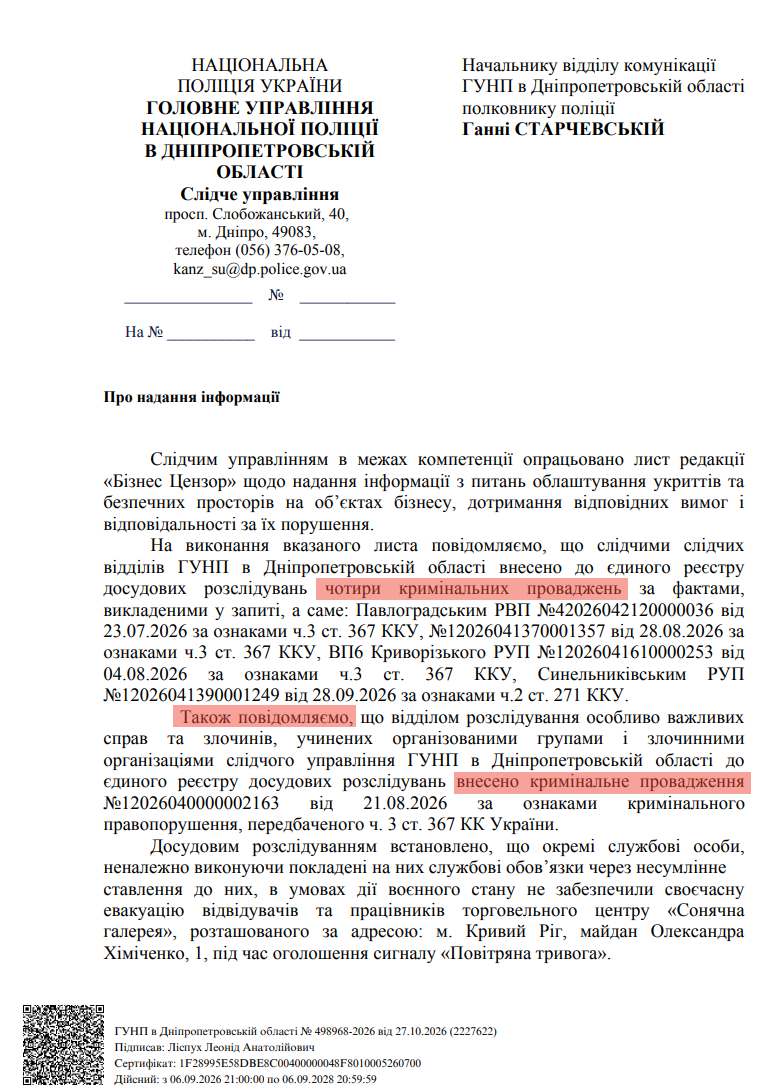
- 23 July — Pavlohrad area, Part 3 of Article 367 of the Criminal Code of Ukraine (official negligence);
- 4 August — Kryvyi Rih area, Part 3 of Article 367 of the Criminal Code of Ukraine;
- 21 August — Kryvyi Rih, Soniachna Halereia shopping centre, Part 3 of Article 367 of the Criminal Code of Ukraine;
- 28 August — Part 3 of Article 367 of the Criminal Code of Ukraine; the location was not specified in the response;
- 28 September — Synelnykove area, Part 2 of Article 271 of the Criminal Code of Ukraine (violation of occupational safety legislation).
Police said these proceedings were opened "in connection with the facts set out in the enquiry", meaning shelters and people’s safety on business premises, but did not specify which premises were involved. Four of the five proceedings were opened before Resolution No. 1092 was adopted. These investigations are therefore not being conducted under the new rules: the provisions on official negligence and occupational safety violations were already in force.
Following the strike on Soniachna Halereia, media outlets reported that the director of one of the supermarkets operating during the alert had been served with a notice of suspicion. Responding to the newsroom’s enquiry, police confirmed that one person had been served with a notice of suspicion in the case, without identifying them.

The investigation established that "…certain officials, improperly performing their assigned official duties through a negligent attitude towards them, failed, under martial law, to ensure the timely evacuation of visitors and employees of the shopping centre…"
Thus, while the SES remains the responsible regulatory authority, businesses in practice face liability in the same way as before the new rules, through criminal proceedings following attacks.
What will change for businesses by 4 March
The government is only now planning to check whether a significant proportion of businesses have indeed "not even begun" to comply with the requirements. In his statement on 29 October, Koretskyi did not specify an exact new deadline: military administrations will "collect data on compliance with the requirements" by 4 March 2027, after which the government will decide on further steps.
According to the prime minister, the minimum requirement is a basic safe space, a mobile shelter or information on the location of, and access to, the nearest underground shelter. Requirements will depend on the number of people on the premises, with the Ministry of Economy and the Ministry of Internal Affairs promising further details. A nearby shelter may also be used, provided it has sufficient capacity.
"The postponement does not mean the requirements are being scrapped. People’s safety must be a priority," Koretskyi stressed.
Businesses were already allowed to use a shelter belonging to someone else under a contractual arrangement, pursuant to Cabinet of Ministers Resolution No. 138 of 2017, the Kyiv City State Administration pointed out.

This provision will not help establishments along highways or in areas of detached housing where there is no official shelter nearby. The state itself has also failed to build enough shelters over the years of war.
"Almost five years of war, and nowhere have enough shelters been built," Nasonova points out in her conversation with Business Censor.
Chudovskyi believes that setting a deadline in a resolution will not, by itself, solve the problem:
"Setting a deadline in a resolution is easier than providing protection in rented premises. What is needed is affordable technical solutions, advice, co-funding and cooperation with building owners. Otherwise, the state risks doing a better job of organising sign inspections than protecting people," he says.
Both sides have obligations, he says:
"Businesses are responsible for fulfilling their obligations. The authorities are responsible for clear rules and an effective civil protection system. Shifting all responsibility onto a café owner does not in itself mean that safety has been organised," the lawyer points out.
Five questions for the government
Until 4 March, the Ministry of Economy will collect proposals from companies and business associations to prepare amendments to Resolution No. 1092. The ministry acknowledges that micro and small businesses "generally lack the financial, technical or organisational capacity to equip their own shelters". Both businesses and the public clearly expect this work to answer a number of questions that currently seem largely rhetorical. We have raised some of them above; here, we will try to organise them more systematically.
-
Where should shelters be installed? The land around a building generally does not belong to the owner of a shop, café, beauty salon or any other business. According to the Union of Ukrainian Entrepreneurs, for example, obtaining approval from landowners and local authorities is complicated, and the union is calling for the process to be simplified. The government allows businesses to use a nearby shelter, but how, and with whose consent, can an entrepreneur install a mobile shelter where none exists? Could this create corruption risks involving the authorities responsible for issuing such permits?
-
How will business shutdowns affect urban economies and people’s lives? Businesses without shelters will have to suspend operations during every alert, regardless of its colour, while alerts in Kyiv accounted for 30.8% of working hours in September. Business associations warn of the risk of small shops, pharmacies, food service establishments and petrol stations suspending operations, with resulting losses of jobs and tax revenue. Koretskyi himself acknowledged: "We cannot allow the economy and the functioning of the country to grind to a halt." But has the government assessed the potential losses to municipal budgets and employment? Will people be able to buy food and medicine and access urgent services during prolonged air raid alerts?
-
How can businesses verify that a shelter meets the requirements? The Ministry of Defence considers the pressure parameter used to design a safe space to be information for official use only. Business associations are also calling for clear technical criteria for safe spaces. What should an entrepreneur do if they buy a shelter for several million hryvnias and later discover that it does not meet the required parameter?
-
Who exactly must a shelter accommodate? The government promises to link the requirements to the number of employees and visitors. But if a small room can accommodate only staff (as Nasonova told the newsroom) what should happen to visitors? Should they be asked to go outside, where debris could fall?
-
Who is responsible for ensuring that people reach the shelter? The Soniachna Halereia case highlights an important issue: why officials failed to ensure the timely evacuation of visitors and employees. If a shelter is shared or located nearby, who leads people there, who is responsible for access, and what should be done if visitors refuse to go?
This list is not exhaustive. Answers must be sought now, before the new requirements take effect. Businesses need clear, understandable and predictable rules, without gaps that leave room for conflicting interpretations.


