


"Bastrykin has issued secret order not to release Ukrainians." Why Ukrainians remain in Russian captivity after 11 years in prison
Valentyn Vyhivskyi, 43, is one of the Kremlin’s first Ukrainian political prisoners. The FSB detained him in Crimea in the spring of 2014. The Russians accused him of espionage and sentenced him to 11 years in prison. Valentyn served his entire sentence in a high-security penal colony, spending most of it in solitary confinement in appalling conditions. But even after that, Russia refuses to release him — he has been forcibly held in a deportation centre for more than a year.
DEPORTATION CENTRE
Kyiv resident Valentyn Vyhivskyi has spent 11 of his 43 years in a high-security penal colony in Kirovo-Chepetsk, in Russia’s Kirov region. His sentence ended on 17 September 2025.
"We had arranged for a lawyer to meet Valentyn outside the prison," Valentyn’s father, Petro Vyhivskyi, tells Censor.NET. "But he never even made it through the prison gates. A prisoner transport van drove in, picked him up directly from the colony grounds and took him to court in Kirov." In the courthouse corridor, the lawyer managed to photograph Valentyn after he had served 11 years in a Russian prison. Just hours before he would find himself in a centre that he, too, calls a prison.
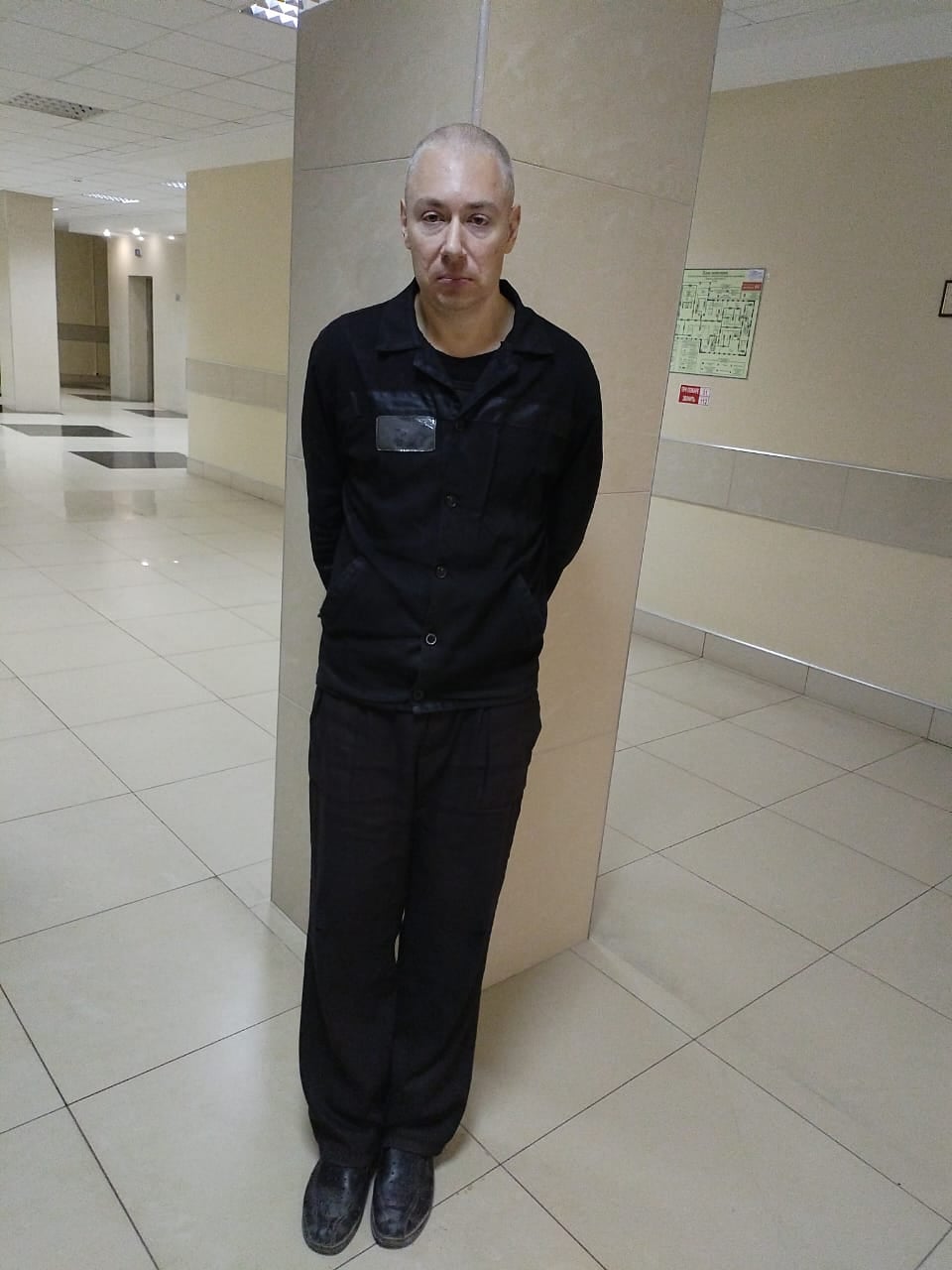
The Kirov court ruled that Valentyn must be deported to Ukraine immediately. Because he poses a threat to Russians. "The presence of Vyhivskyi V. P. in the territory of the Russian Federation poses a real threat to public order and to the rights and legitimate interests of citizens of the Russian Federation," the decision ordering Valentyn’s deportation states.
What is more, Valentyn was banned from entering Russia for 10 years. Yet he is not allowed to leave Russia. Under a ruling by the same court, the Ukrainian is being held at the Temporary Detention Centre for Foreign Nationals run by the Russian Interior Ministry’s Directorate for the City of Kirov. He was initially ordered to spend 120 days at the centre, but his detention has since been repeatedly extended. Valentyn Vyhivskyi has now been held there for more than a year.
- It is just another prison, Petro Vyhivskyi says of the conditions in which his son is held, but the conditions are a little better than in the high-security penal colony. He is still locked up, with bars on the windows and a hatch in the door through which food is passed. He is taken to court in handcuffs. There is a television. We managed to get a phone to him, and we even managed to send him money in various ways. He can afford to buy some extra food. They are allowed out once a day - in a cage.
- Does the phone have internet access? Can he use it?
- Yes, they give him the phone during the day and take it away in the evening. My son is now getting to know the world again, because it has changed enormously in the eleven years he spent in a Russian prison.
- Is there a set routine in the cell?
- Sleeping during the day is not forbidden. They are free to set their own routine inside the cell, but only inside the cell. They are not allowed out of their cells. Except when they are taken to court. At least that gives him a chance to see something of the city.
- Tell us about his health.
- Compared with when he was in a punishment cell, his health is good now. But he needs medical treatment, of course. A whole host of ailments, a whole host of problems. Eleven years in prison take their toll. He does not tell us anything at all, but you can see that he has health problems.
- And how is he coping emotionally?
- It varies. Right now, he is in a fairly combative mood because he is caught up in a legal battle with the Russian authorities. He appealed against the latest rulings, but the court rejected his appeal. He is now filing a cassation appeal. But overall, he is not doing very well, because he cannot see any prospect of being released.
The court rulings Petro refers to are decisions extending Valentyn’s detention at the deportation centre. The court’s official position is that there is no safe section of the border between Russia and Ukraine, making deportation impossible. The judges also refuse to allow Valentyn to leave Russia on grounds that include concern for his own welfare. The court rulings state: "At present, there are no functioning Ukrainian diplomatic missions or consular offices, there are no channels of communication between the states, and it is impossible to notify Ukraine of the decision ordering deportation. With the special military operation under way, it is currently impossible to carry out the deportation procedure for security reasons, including the personal safety of foreign nationals."
"So there is a court ruling ordering his deportation because he supposedly poses some terrible, mortal threat to Russian society. But then there is another ruling keeping him in Russia, in this deportation centre. It is absurd," says Petro Vyhivskyi.
He has been fighting for his son for many years, speaking to journalists and addressing various international forums. He says Valentyn has offered the judges several options: he is willing to leave Russia at his own expense via third countries. Instead, the judges extend his detention every time.
Petro Vyhivskyi is convinced that his son is actually being held under a secret order issued by Alexander Bastrykin, head of Russia’s Investigative Committee. "There is a secret directive from Bastrykin requiring all Ukrainian men of conscription age to be held in these centres in Russia for at least 2 years so that they do not go off to fight," Petro says. "The judges are shown this decision in court, it is discussed, but it appears nowhere in the case documents."
According to Petro, he even offered to pay for fuel for the deportation centre’s prisoner transport van so that they could take his son to any border. "The administration even seemed willing to do it. But they are waiting for instructions from above, from Moscow. So far, no such instructions have come," says the elder Vyhivskyi.
CONVICTION
Valentyn Vyhivskyi was born in Prypiat. After the Chornobyl nuclear power plant disaster in 1986, his family moved to Kyiv. He was 3 years old. He finished school in the capital, later graduated from Kyiv Polytechnic Institute, and ran a small business of his own. He was passionate about aviation and was in contact with many people in the field in various countries, including Russia.
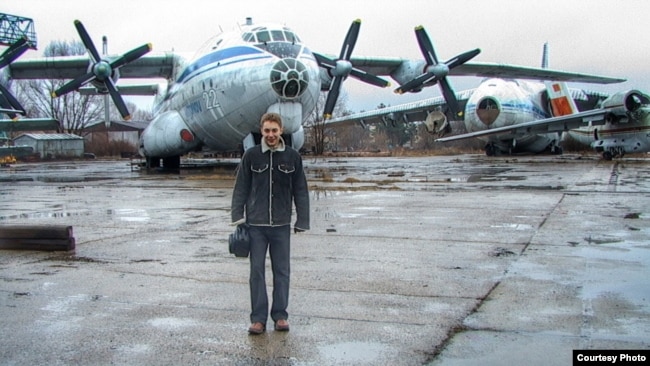
Two months after Crimea was occupied, on 17 September 2014, Valentyn travelled to the peninsula. His father says he went there "on volunteer business". He was detained immediately. "The war had begun, and here was some Ukrainian talking to aviation engineers from Russia — that was probably what drew the Russian security services’ attention to Valentyn," Petro Vyhivskyi said in an interview with LVIV MEDIA 3 years ago.
For an entire month, his family did not know what had happened to Valentyn. He had simply disappeared and never returned from Crimea. A month later, they discovered that he had been arrested. They eventually located him in Lefortovo Prison — a historic prison in Moscow that remains in use and is known as the Russian security services’ main detention facility. Valentyn was charged with espionage under Article 276 of the Russian Criminal Code. He was convicted in a closed trial, with the Moscow Regional Court sentencing him to 11 years in a high-security penal colony. The unclassified portion of the verdict states that Valentyn Vyhivskyi was accused of "collecting and storing, with the intention of transferring to a representative of China’s military attaché’s office in Belgium in exchange for payment, information constituting a state secret — design and other technical documentation for a combat aircraft engine". During the investigation, Valentyn signed a confession. In court, however, he said he had falsely incriminated himself under torture. Later, in an interview with Radio Liberty given while in prison, Valentyn described it as follows:
"They beat me for several days at the Lubyanka (the FSB headquarters building stands on Lubyanka Square in Moscow; the name is also used figuratively to refer to Russia’s entire FSB system — ed.), and then something utterly unimaginable began. They took me into a forest, forced me to my knees, put a sack over my head, and started shooting, staging a mock execution."
During the so-called investigation, Valentyn was held in Lefortovo Prison. "My son wrote that Lefortovo had a magnificent library. I later read that, in terms of the size and variety of its collection, it is one of the best libraries in Russia," says Petro Vyhivskyi. "It has books you can no longer find in Russian libraries. After all, the people held in Lefortovo are no ordinary prisoners. My son wrote at the time that he had read more than 200 long, serious books." In the penal colony, however, Petro says his son no longer had the luxury of good books. "The most intellectually substantial book he found there was How the Steel Was Tempered."
PRISON
Following his conviction, Valentyn Vyhivskyi served his sentence at Penal Colony No. 11 in the Kirovo-Chepetsk area of Russia’s Kirov region. He spent most of his sentence in solitary confinement, in a so-called PKT — a "cell-type confinement unit". This is how he described his conditions in an interview with Radio Liberty in 2021:
"I have been held in a concrete basement for almost five years now! A prisoner is usually held in a PKT for no more than six months, but I have been here for five years! Every time, they extend my punishment for all sorts of imaginary violations. For example, after exercise, they offer me a broom and a shovel to ‘clean up’. And when I refuse, because I have sworn that I will not lift a finger in this country, they write me up for another violation! And I am back in this stone box! I am not even allowed to speak on the phone. I cannot hear my loved ones’ voices!"
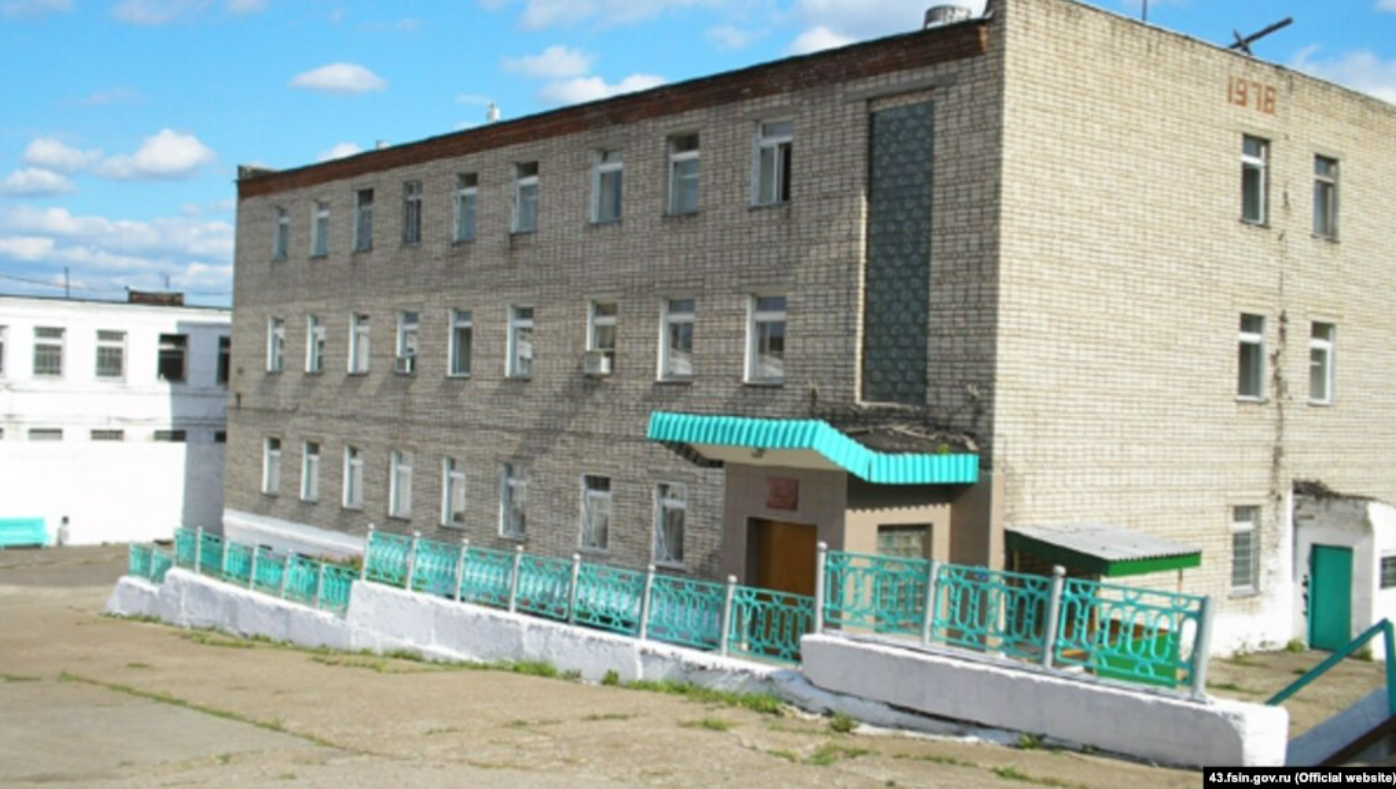
In an interview with Censor.NET, his father says Valentyn refused to work in the penal colony, arguing that any work in the aggressor state meant strengthening its military capabilities.
Valentyn described a typical day in his solitary cell: "Well, you get up, take your mattress out, then sit on a bench all day. The cell is usually cold. In winter, your fingers freeze when you write a letter. I mostly read. Books, magazines, newspapers, letters from my family. What else? Exercise. I go out with the other prisoners, but I am forbidden to speak to them, unless I do it secretly so the guards do not notice. The rest of the time, I can only talk to the concrete wall. Even the radio in my cell does not work — or rather, it is barely audible."
Valentyn was also repeatedly placed in a ShIZO — a "punishment isolation unit". "Because he was always vocal about his pro-Ukrainian stance," his father says. He was also frequently banned from corresponding with others. On one occasion, his letters were blocked for four months because prison censors discovered that Valentyn was writing the word "russia" with a lowercase letter in his letters to his parents. Once he promised to use a capital letter, his mail was allowed through again.
Iryna Herashchenko, a Ukrainian MP from European Solidarity, worked on bringing Ukrainian political prisoners home during Petro Poroshenko’s presidency. Speaking to Censor.NET, Herashchenko says Vyhivskyi was always on Ukraine’s exchange lists.
- We fought hard for his release all those years, says Iryna Herashchenko. Just as we did for the release of all our political prisoners. There were about fifteen high-profile names. We managed to bring almost all of them home. Unfortunately, we could not get Valentyn out. Russia would not hand him over. Although we managed to bring many others home — Nadiia Savchenko, Hennadii Afanasiev, Yurii Soloshenko…
- Why, specifically, did Russia refuse to hand over Vyhivskyi?
- Russia constantly uses our captives to blackmail Ukraine. Back then, for example, they said they were prepared to hand over those held in Russian prisons, but demanded that we hand over Tsemakh (Volodymyr Tsemakh, a figure in the case concerning the downing of flight MH17 and a former militant of the so-called "DPR" — ed.) and the Berkut officers. But our position was that Tsemakh and the Berkut officers first had to face court verdicts, and only then could they be handed over to Russia. Later, Zelenskyy handed them all over without trial. Why Russia did not hand over Vyhivskyi even then, I do not know.
"A FAMILY TRADITION"
"I am the father of a spy, the son of an enemy of the people, and the grandson of an enemy of the people," Petro Vyhivskyi often says of himself.
His maternal grandfather, Frants Kashperovych Harbovskyi, and his brother were arrested by NKVD officers in 1937. For many years, the family knew nothing of their fate. Petro Vyhivskyi thought his grandfather had died somewhere in the Soviet camps. But they recently discovered that he had been executed by shooting in Zhytomyr as an "enemy of the people".
Petro Vyhivskyi’s father, Stepan Vyhivskyi, was a partisan in 1943, aged 17. He later served in the 582nd Separate Engineer Battalion of the 260th Rifle Division and reached Berlin. Six months after his demobilisation, in 1951, Stepan Vyhivskyi was convicted as an "enemy of the people" for allegedly collaborating with the Germans. Stepan was imprisoned in Russia’s Kirov region, the same place where his grandson, Valentyn Vyhivskyi, is now being held. "Imprisonment in Russia’s Kirov region is our family tradition," Petro jokes sadly.
THE SCALE OF THE PROBLEM
Petro Vyhivskyi says Russia is holding more than just his son in these deportation centres. Valentyn alone, for example, has crossed paths with a dozen Ukrainians. And that is just in Kirov. How many there are across Russia is unknown.
Mykola Polozov, a Russian lawyer and human rights defender who has handled the cases of many of the Kremlin’s Ukrainian political prisoners, says Russia is preventing more than just political prisoners from returning to Ukraine. This applies to any men who have served their sentences in Russia. Polozov gives another example: "When the Russians retreated from Kherson, they took prisoners from penal colonies and pre-trial detention centres with them. These people served the remainder of their sentences in Russia. They were supposedly released, but were also sent to these centres. They are still being held there."
Although some do manage to get out, these are largely isolated cases. Petro Vyhivskyi says: "I know of a case in which two men were released, but only after they had gone on hunger strike and slashed their wrists."
Censor.NET contacted the Secretariat of Ukrainian Parliamentary Commissioner for Human Rights Dmytro Lubinets. It said it was aware of cases in which Ukrainians were being held in Russian deportation centres after completing their prison sentences, including Valentyn Vyhivskyi’s case. However, the Ombudsman’s Office has no exact figures on how many people are in this situation.
A SOLUTION
Petro Vyhivskyi has appealed to various Ukrainian authorities for help getting his son out of Russia: the Office of the President, the Ombudsman, and the Coordination Headquarters for the Treatment of Prisoners of War. The Coordination Headquarters was established in March 2022 to locate, secure the release of, and bring home Ukrainian military personnel and civilians held captive by Russia. "In practice, two bodies deal with this — the Coordination Headquarters and Lubinets’s Office. I constantly send them all the information about Valentyn, every court ruling, every document. They say they use all of it in their contacts with the Russians," Petro says. He adds: "An official once asked me how I would assess the Ukrainian authorities’ efforts to secure my son’s release. Before I could even open my mouth, the official said: ‘Well, if your son were home, the assessment would be positive.’ But my son has now been held there for a year and a month."
"There is currently no effective solution," says Mykola Polozov. "With the start of the full-scale invasion, the Russian authorities stopped releasing Ukrainians from these centres. At first, they allowed them to leave via Georgia, but later discontinued that practice. There are isolated cases, but overall, the Russian authorities do not let them out."
The Ombudsman’s Office told Censor.NET that Dmytro Lubinets had established contact with Russia’s Commissioner for Human Rights, Yana Lantratova. He has been asking her to help secure the release of people such as Valentyn Vyhivskyi. But this has not helped.
The Office also said that the Ombudsman and Ukraine’s Foreign Ministry had explored alternative routes for getting these people out of Russia — via Estonia and Lithuania. "The use of such routes is complicated by obstacles imposed by the Russian side, including requirements to depart exclusively by air, to hold a valid passport, and to obtain confirmation from the receiving state," the Ombudsman’s Secretariat said in its response.
Censor.NET also contacted the Coordination Headquarters for the Treatment of Prisoners of War, asking what measures were being taken to bring these Ukrainians home. Its response consisted of a single sentence: "In coordination with other authorities, we are doing everything possible and developing various strategies to secure their release."
Censor.NET has managed to record an interview with Valentyn Vyhivskyi, who remains imprisoned in Russia. We will publish it very soon.
Iryna Romaliiska, Censor.NET


