



Amid intensified Russian strikes, Ukraine is drowning in corruption and political chaos – The Economist
The release on 19 August of another batch of wiretap recordings by anti-corruption agencies featuring conversations between senior Presidential Office officials was shocking not because of the schemes themselves, but because of how routinely the figures in the "Forrest Gump" case discussed them.
The Economist reports this, according to Censor.NET.
What was heard on the recordings
On the recordings, the voice of Iryna Mudra, former deputy head of President Volodymyr Zelenskyy’s Office, can be heard relaying someone’s view that corruption should not be eradicated but "systematised and controlled." According to the publication’s journalists, the recordings describe corruption schemes not as exceptional violations but as part of routine business: bankers who were initially unwilling to break the law suddenly became compliant after conversations with senior officials.
The materials emerged at an exceptionally bad time for the authorities—amid Russia’s intense aerial campaign and the greatest challenge to Zelenskyy’s presidency during his entire tenure, mounted by a man from his own former team, the publication emphasizes.
Challenge from Fedorov
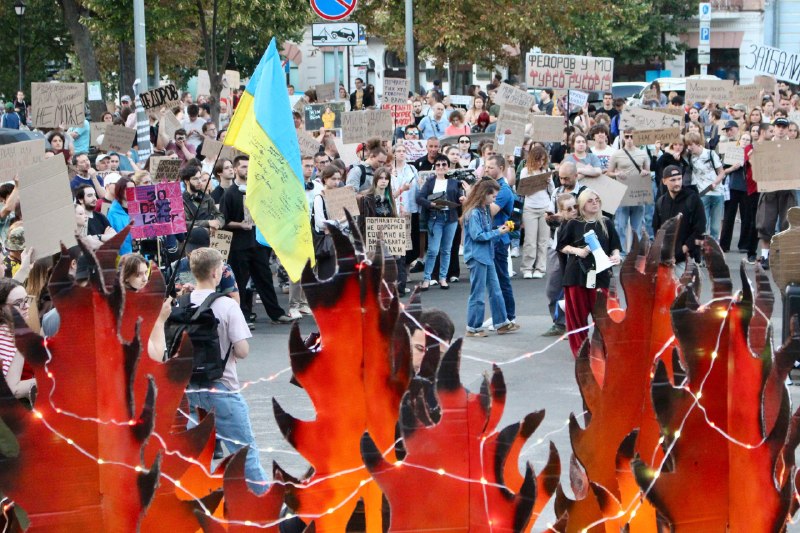
Former Defence Minister Mykhailo Fedorov, who was dismissed in July after a conflict with the military command, released a video address on the eve of the recordings’ publication calling on Zelenskyy to hold elections. In the publication’s assessment, this was unlikely to be a coincidence: both events occurred ahead of a parliamentary vote on the appointment of Fedorov’s successor, Yevhen Khmara.
Fedorov criticised the country’s leadership for incompetence and corruption, calling for elections as a way to "reset" the system. So far, according to the publication, the idea has not resonated with Ukrainians, most of whom share Zelenskyy’s position that holding elections during the war would be a "tsunami" for the country. Nevertheless, Fedorov has broken an unspoken taboo, and a sense that a "reckoning" is approaching is growing among some government officials.
Essence of the corruption scheme
The investigations centre on two related operations—"Forrest Gump" and "Themis." According to investigators, Presidential Office employees organised a money-laundering scheme to raise UAH 150 million in bail for former Justice Minister Herman Halushchenko, who had previously been charged in another anti-corruption case. Officials hacked a state registry to seize several companies and then used them to raise the money, according to the publication. Senior managers at Sense Bank—a former Russian institution nationalised in 2023—disabled its anti-money laundering system so that the transactions could proceed without obstruction, sources at the National Bank told the publication.
Pressure on anti-corruption bodies
- The article states that Ukraine’s anti-corruption trio—NABU, SAPO and the High Anti-Corruption Court—has developed into an influential independent force in recent years. In July 2025, it withstood an attempt by the president to subordinate these bodies to more controllable institutions, just as they were investigating cases involving Zelenskyy’s closest associates; protests forced the president to abandon the move.
However, according to the publication, the pressure has continued, particularly against SAPO head Oleksandr Klymenko. The journalists say the recordings reveal particular fear of Klymenko: Mudra allegedly expressed concern about his possible reappointment for another term.
Differing assessments of anti-corruption bodies’ role
Supporters believe that the anti-corruption bodies have become a counterweight to centralised presidential power amid a weak parliament, government and opposition. Critics, however, fear that these institutions are becoming an independent force that decides for itself when and how to destabilise the government.
One senior official described them as "effectively a parallel government." Even people close to NABU acknowledge the Bureau’s growing politicisation: in particular, there is no procedural explanation for why the recordings were released on the very day of the vote on Fedorov’s successor. A former detective noted that the law had given these bodies access to the most intimate moments of politics and people’s private lives, creating a risk that this instrument could be turned into a political weapon.
Harshest winter and Zelenskyy’s response
In the publication’s assessment, the political confrontation is likely to intensify in the coming weeks. A senior official interviewed by the journalists said that, with October approaching, the situation would deteriorate simultaneously on several fronts and that the president, while remaining outwardly confident, had begun to recognise the growing problems.
Ukraine is entering its fifth wartime winter considerably more vulnerable than in previous years, with a shortage of air defence missiles amid a severe Russian escalation against infrastructure and civilian businesses.
Recent Russian strikes on civilian vessels have closed Ukraine’s deep-water ports just when the country needs to export its harvest. If diplomatic efforts fail to restore shipping, economic losses could reach $10–12 billion, or about 5% of GDP. At a press conference on 22 August, Zelenskyy revealed a $27 billion defence budget shortfall caused by unplanned expenditure. In the publication’s assessment, this news was unlikely to have surprised the president himself, and he may have disclosed the figure to discredit Fedorov’s record as defence minister.
Ratings and political prospects
Until his dismissal, Fedorov remained a loyal presidential ally. His video address made it clear that he is now a rival, and the Presidential Office is taking this seriously.
An unpublished poll seen by the publication, conducted shortly before the recordings were released and Fedorov issued his address, placed the 35-year-old politician third in a hypothetical presidential race with 16%. Zelenskyy led with 21% of the vote, former Commander-in-Chief Valerii Zaluzhnyi had 18%, while Budanov ranked fourth with 8%.
The publication emphasizes that these figures remain purely hypothetical: elections are illegal under martial law, and Ukrainians themselves do not want them. However, the situation could change if the political chaos continues.


