



Deep strike in August: 12 oil refineries and 2 defence industry enterprises in Russian Federation were hit, - Ministry of Defence. PHOTOS
In August, the Ukrainian deep-strike campaign against Russia reached depths of over 1,500 km from the state border, targeting critical nodes of the enemy’s military machine. The defence forces struck 12 major oil refineries, facilities in the gas and petrochemical sectors, and enterprises within the enemy’s military-industrial complex.
This was reported by the Ukrainian Ministry of Defence, according to Censor.NET.
As noted, deep strikes against the Russian Federation are particularly important for inflicting damage on the enemy’s economy, reducing its defence-industrial capabilities and creating a cognitive effect. All of this is necessary to make the cost of waging war unacceptable to the enemy.
The Ministry of Defence emphasises that Ukraine is systematically striking not only direct military targets, but the entire supply chain supporting the aggression. Targets range from facilities involved in the production of fuel and raw materials to those involved in the manufacture, storage, protection and delivery of weapons.
What was affected
For example, in August, the following were affected:
- 12 large oil refineries;
- 2 gas processing and petrochemical plants;
- 3 large fuel terminals and oil depots;
- 2 key defence industry enterprises (including the destruction and damage of 6 workshops).
A number of Russian military airfields and other logistics facilities were also targeted by long-range strikes.
Details
The Ministry of Defence has outlined the most significant long-range strikes of the past month, which have raised the cost of the war for Russia.
Attacks on the Russian Federation’s oil and fuel infrastructure
In August, at least 12 major Russian oil refineries, with a combined design capacity of around 100 million tonnes of petroleum products per year, were hit.
Key targets of the attacks included:
- "Lukoil-Nizhegorodnefteorgsintez", approximately 800 km from the national border;
- Syzran Oil Refinery, ~800 km;
- Kirish Oil Refinery, ~450 km;
- "TANECO", ~ 1,200 km;
- "Slavneft-YANOS", ~ 700 km;
- "Lukoil-Permnefteorgsintez" ~1,500 km;
- Novokuybyshevsk Oil Refinery, ~ 1,000 km;
- Saratov Oil Refinery, ~700 km;
- "Bashneft-Noyl", ~ 1,400 km;
- Ilsk Oil Refinery, ~400 km;
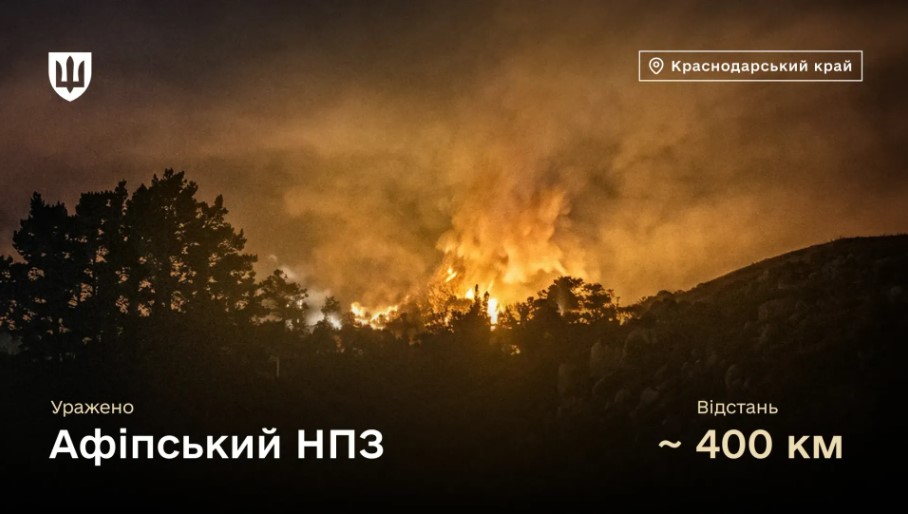
- Afipsk Oil Refinery, ~400 km;
- "Orsknefteorgsintez", ~ 1,500 km.
The attacks targeted the most vulnerable parts of the production process: primary refining, secondary distillation, hydrocracking and catalytic reforming units.
Attacks on the Russian gas and petrochemical industries
Damage to the raw materials infrastructure leads to a shortage of specific components, which directly affects arms production.
The following were affected:
- "Tobolskneftekhim" (a central gas fractionation plant with a capacity of 6.6 million tonnes of feedstock per year), ~ 1,900 km;
- Astrakhan Gas Processing Plant (two U-272 gas separation units), ~ 1,200 km.
Their products are essential for the manufacture of rocket and aviation fuel, explosives, composite materials and components for drones.
The destruction of the Russian Federation’s fuel logistics
Attacks on ‘Tamanneftegaz’ (up to 19.9 million tonnes of petroleum products and liquefied gas per year, ~500 km), the Yeisk oil loading complex (over 1 million tonnes for maritime transport, ~500 km) and the Lyudinovskaya oil depot (~500 km) affect not only individual enterprises but also Russia’s overall capacity to store and transport the fuel required to wage war.
Attacks on the Russian military-industrial complex
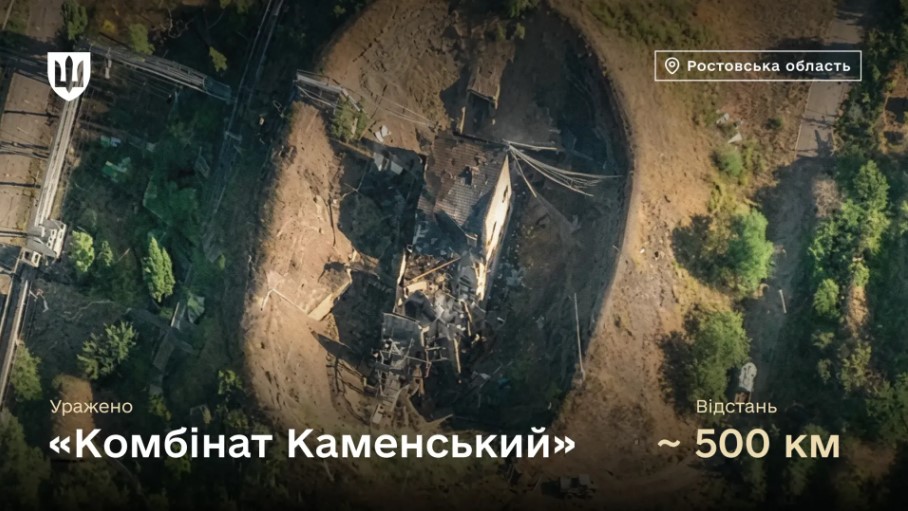
At the "Kamensk Plant" (~500 km), which produces solid rocket fuel for the "Uragan", "Smerch" and "Tornado-S" multiple launch rocket systems and for airborne weapons, two workshops were completely destroyed and a further four were significantly damaged.
The ‘Progress’ Rocket and Space Centre in Samara (~ 1,000 km), which supports a constellation of military satellites, has also been hit, which is having a direct impact on the enemy’s reconnaissance capabilities.
"The deep strikes against Russia in August represent another step towards raising the cost of waging war. The aggressor is paying, and will continue to pay, dearly for its actions," the Ministry of Defence emphasised.


