



Jet-powered Shahed is not just weapon of destruction, but also tool to bring city to standstill — analytics

Russia has changed its tactics for attacks on Kyiv, increasingly using "Shahed" drones, which reach the capital faster and can pose a threat throughout the day. Due to repeated attacks and prolonged air raid alerts, the enemy is effectively using drones not only to strike targets but also to paralyze the city.
This is discussed in an article on Texty.org, according to Censor.NET.
Details
At first, the Russians used jet-powered drones individually or in small groups.
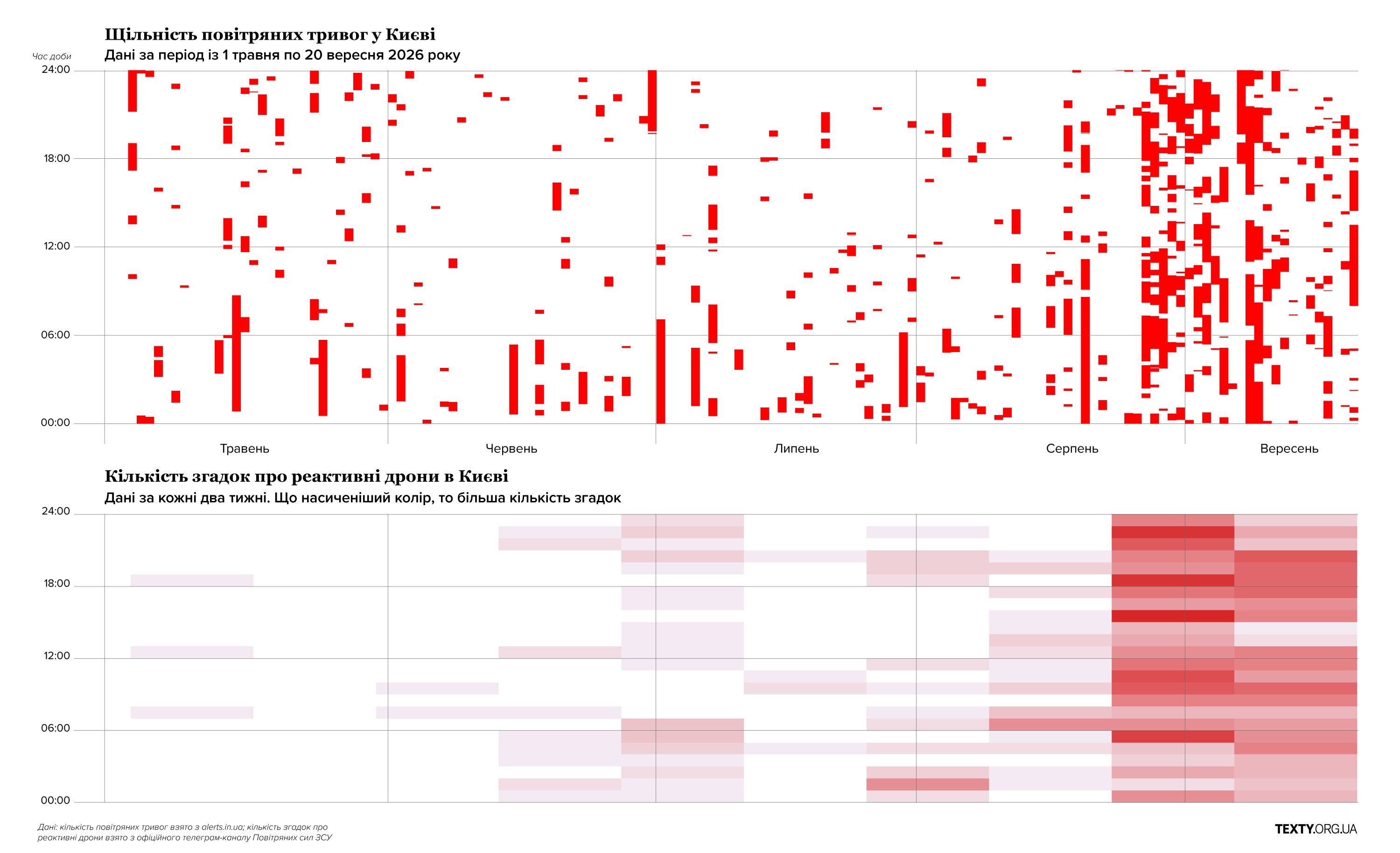
"Isolated mentions of them appear much earlier, but during May through July, this is not yet accompanied by a fundamental change in the pattern of alerts. The real turning point comes in August, when reports of jet-powered UAVs become regular."
It is precisely from mid-August that the picture changes dramatically. The red segments on the graph become denser and appear with increasing frequency throughout the day—at night, in the morning, during the day, and in the evening. Instead of isolated red spikes, long vertical lines form, covering almost the entire 24-hour period. "The city may emerge from one state of alert, only to face the next one shortly thereafter," the authors noted.
Ідея про "перекриття" робочого дня повітряними тривогами не нова.
"Ukraine had already endured endless 'training' runs by 'Kinzhal' carriers, with one alert following another. The Russians tried to achieve a similar effect using conventional 'Shaheds,' but their mass raids were largely confined to nighttime. Jet-powered drones made it possible to extend the threat far beyond nighttime hours," the article states.
The Emergence of the First Jet-Powered Shaheeds
The first jet drones flew into Ukraine as early as the winter of 2024.
One of the first clear mentions in the news dates back to January 8, 2024.
"The first jet-powered Shahed-238 was shot down over Ukrainian territory. The engine is Chinese. It flew as far as the center of the country. It was traveling at a speed of over 500 km/h. I didn't think they would show up here so quickly. Iran recently unveiled it for the first time at an exhibition," Serhiy Flash wrote on social media.
Over the next year, the Russians continued to refine them. The new engines made it possible to change direction more quickly and adjust the course during the final leg of the flight.
As early as July 2025, the first relatively large-scale use of jet-powered drones in Kyiv was recorded. According to official reports, up to 8 jet-powered UAVs were deployed over the capital at that time.
A tool for alarms
The difference between the speed of a conventional "Shahed"—250 kilometers per hour—and that of a jet—600 kilometers per hour—becomes a problem.
"The latter leaves mobile machine-gun teams with no chance. There aren't enough anti-aircraft missiles to cover everything, and some systems are ineffective at low altitudes. That leaves MANPADS and aircraft," the authors write.
Business Losses
The enemy is causing economic damage through prolonged air raid alerts.
"Even a single hour of threat disrupts the operations of businesses, commerce, transportation, and government agencies. It is important to remember that Kyiv is one of the regions with the highest gross regional product.
"Based on the results for 2021, its value was estimated at nearly 1.3 trillion hryvnias. Therefore, for a city like this, constant attacks mean hundreds of millions of hryvnias in losses per day. Of course, the enemy prefers to take full advantage of such an opportunity," the article states.
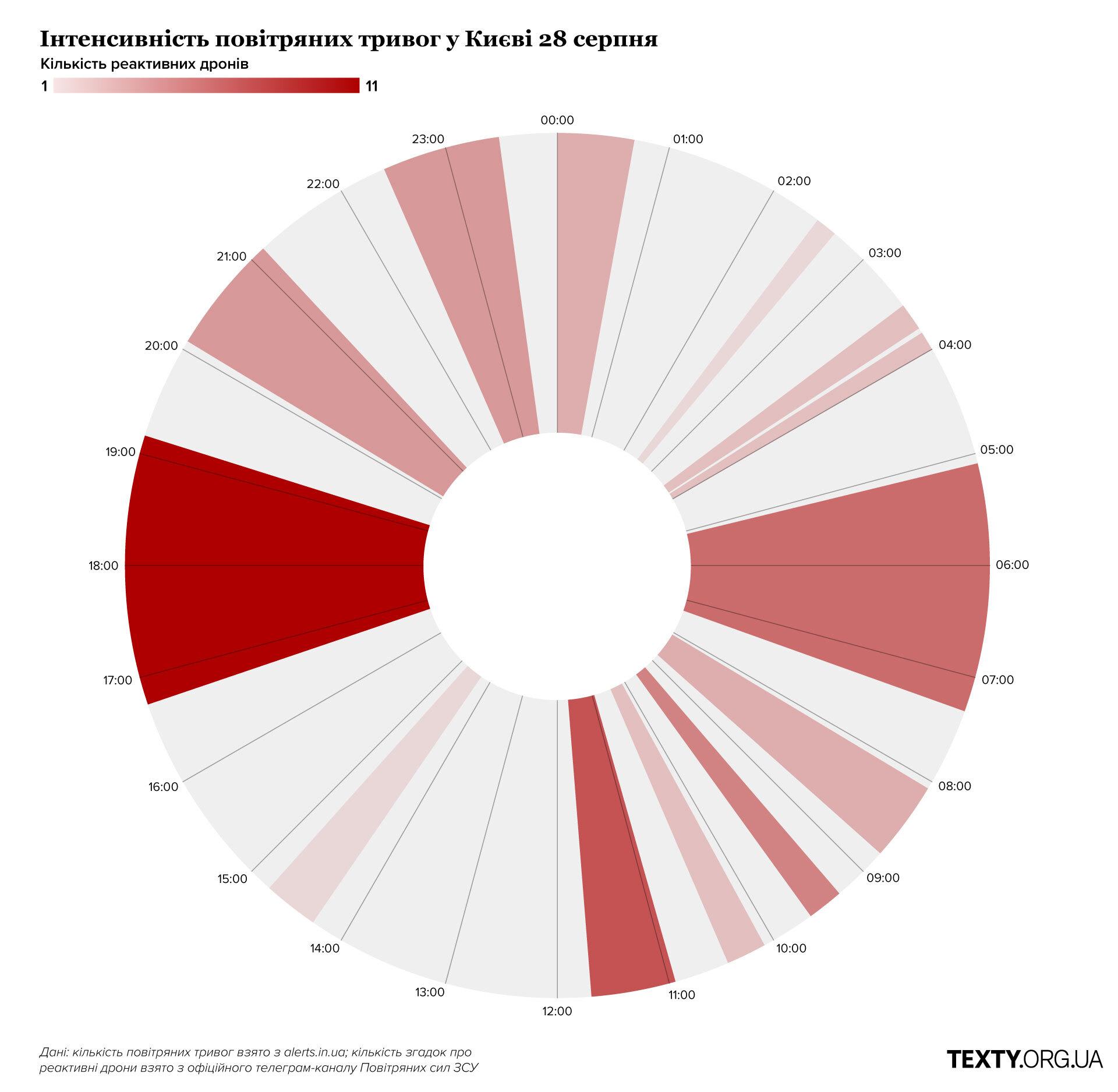
There is always a delay between the all-clear and a full resumption of operations. People need to return from their shelters, and businesses need to restart their equipment and work processes. If a new alert is issued shortly thereafter, an organization or manufacturing facility may simply not have enough time to return to normal operations.
Therefore, the white gaps on the graph do not necessarily indicate full operation. The city spends part of this time simply getting back up and running after a previous outage. The next alert may begin before this recovery is complete.
Overall, as a result of this approach, all key parts of the day are affected: sleep, the morning commute, daytime work hours, the evening rush hour, and late evening.
Drone attacks are also disrupting logistics in Kyiv. Getting from one side of the city to the other is becoming a challenge.
The flight paths of conventional "suicide drones" and jet-powered ones differ.
Typical flight paths consist mostly of long, straight segments and only a few course changes. The flight paths of jet drones are much more winding—they approach Kyiv from different directions, change course several times, and form a dense cluster over the southwestern part of the city.
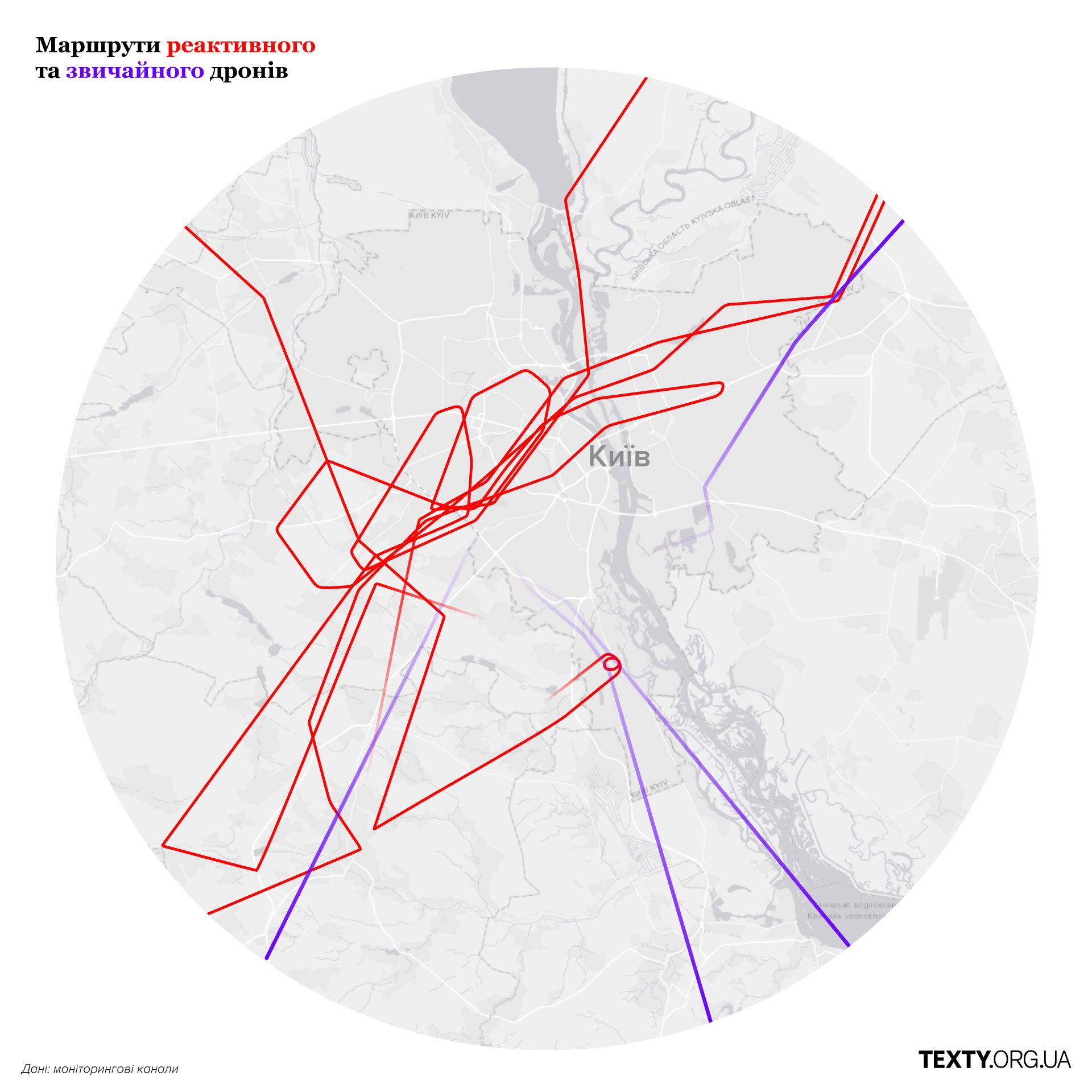
The loops and repeated turns themselves can directly affect the duration of the alarm. Even a fast drone that doesn’t fly over the city in a straight line but makes an extra loop covers a greater distance and remains in the potential threat zone for longer.
If a drone flies away from the city and then returns, this may extend the current alert or trigger a new one.
The authors noted that such a low-cost weapon for striking targets in the Ukrainian rear serves not only as a delivery vehicle for warheads but also as a means of paralyzing a city.
"The city finds itself caught between two bad options. If operations are halted every time there is a drone threat, Kyiv could come to a standstill for most of the day. If operations continue, people remain under real threat—often without the ability to quickly reach a safe place," they concluded.


