


Russia will increase its military spending to record high in 2027 at expense of social spending and taxes, - DIU
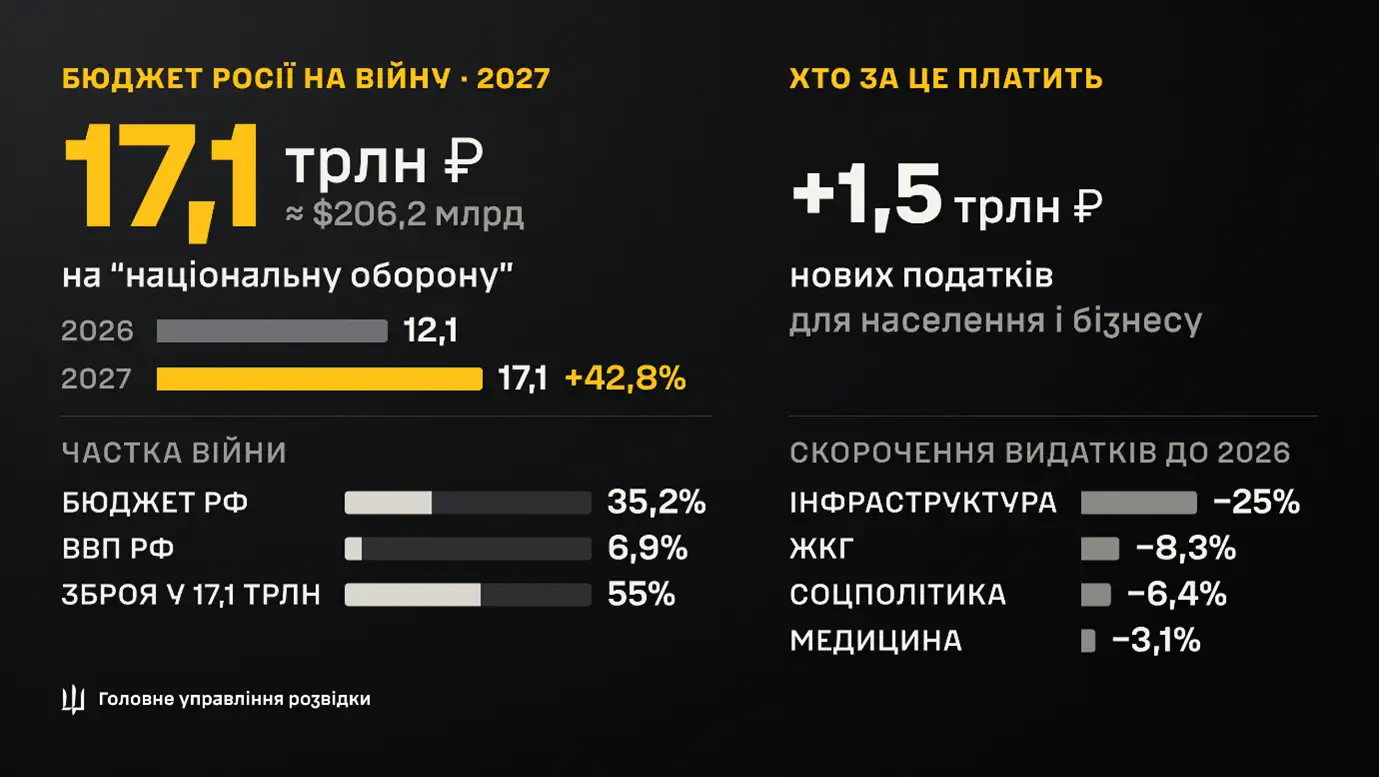
In 2027, Moscow plans to allocate around $206.2 billion to so-called ‘national defence’. This is 42.8 per cent more than the Kremlin had earmarked for waging war in 2026 – a figure, it should be noted, of $144.4 billion.
Consequently, Russia’s military expenditure will amount to 6.9 per cent of GDP or 35.2 per cent of total federal budget expenditure, reports Censor.NET, citing the Defence Intelligence of the Ukrainian Ministry of Defence.
Details
The Kremlin plans to allocate $146.3 billion towards the procurement of weapons and military equipment for the occupying forces, which accounts for 55 per cent of Russia’s projected expenditure on the war in 2027.
In order to fund its criminal war against Ukraine, Moscow plans to increase the tax burden on the population and businesses within Russia next year. According to the Kremlin’s estimates, this will generate additional revenue of around $18.1 billion for the budget.
In addition, Russia plans to cut expenditure on the maintenance of road and municipal infrastructure by 25 per cent, as well as to reduce funding for social and other civil needs in the regions. Specifically, expenditure under the ‘Social Policy’ heading is set to be cut by 6.4 per cent, ‘Housing and Communal Services’ by 8.3 per cent, and ‘National Economy’ and ‘Healthcare’ by 3.1 per cent, respectively.
In 2027, the Russian Federation intends to reduce the costs of maintaining the temporarily occupied territories in the Donetsk, Luhansk, Kherson and Zaporizhzhia regions.
The Russian Federation’s officially projected budget deficit is set at 2.2 per cent of GDP. However, there is a high probability that the actual deficit in the Russian treasury could almost double – to nearly 4 per cent of GDP.
Domestic borrowing is set to be the main source of funding to cover the deficit. In 2027, the volume of such borrowing is planned to increase to $74.1 billion.
At the same time, there are grounds for expecting that the level of borrowing in Russia in 2027 will be significantly higher.


