


Maidan cases refute Russian Federation’s myth of US-organised "coup d’état" in Ukraine, - Office of Prosecutor General
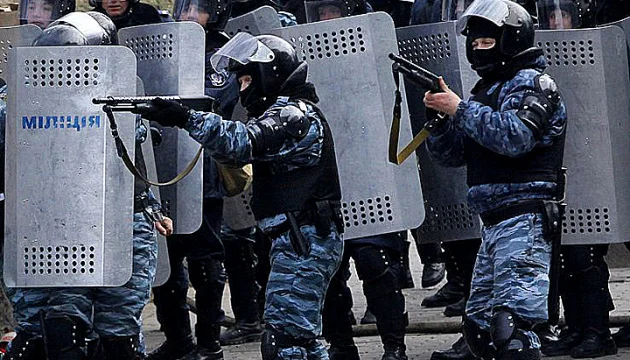
The investigation files and court rulings in the Maidan cases completely debunk Russian propaganda alleging a US-orchestrated ‘coup d’état’ in Ukraine in 2014. Investigators have proven that the Revolution of Dignity was preceded by hybrid aggression by the Russian Federation, with the involvement of the Ukrainian leadership and security forces at the time. However, not all the murders of protesters have been solved, and due to delays in the courts, the cases may be closed due to the expiry of the statute of limitations.
This was stated by Oleksiy Donskyi, head of the Maidan Affairs Department at the Office of the Prosecutor General, according to Censor.NET, citingzmina.info.
Debunking a Russian myth
He emphasised that the Russian myth claiming that in 2014 the US allegedly organised a "coup d’état" to remove Viktor Yanukovych from power was created to justify the aggression against Ukraine, and therefore debunking it is one of the main tasks.
The investigation, according to Donskyi, has established the opposite: Russian hybrid aggression came first, and Ukrainian law enforcement agencies became its tools. The Russian leadership and Russian security service officers, he said, directly coordinated the actions of Ukrainian security forces.
"Everything happened exactly the opposite way: first came the Russian hybrid aggression; unfortunately, Ukrainian law enforcement officers and the Ukrainian authorities became the instruments of this aggression. The Revolution of Dignity was civil society’s resistance in response to the aggression perpetrated by the Russians through the Ukrainian authorities and Ukrainian law enforcement officers," the expert notes.
Russia had two objectives: to push the then government to a point where it would be impossible to waver between choosing the European Union or Russia, and to suppress the protests according to Russian scripts. Russian officials travelled to Kyiv, issued instructions, held joint events, took to the Maidan and later provided organisational support.
The overthrow of the Yanukovych regime
Speaking of the "overthrow of the regime" of former President Yanukovych, Donsky emphasised that it was the Russian authorities who had transported the president – who had not yet been removed from office at that time – to the Russian Federation. He recalled the verdict of the Podilskyi District Court of Kyiv dated April 2025. The court sentenced Yanukovych in absentia to 15 years’ imprisonment, and Konstantin Kobzar, the former deputy head of the State Security Service, to 10 years for incitement to desertion and organising illegal crossings of the state border.
Court rulings in the Maidan cases
At the same time, according to Donskyi, there have been a catastrophically small number of court verdicts in the Maidan cases. The courts have convicted 101 individuals, whilst a further 129 have been exempted from criminal liability on non-rehabilitative grounds (primarily due to the expiry of the limitation period), where the cases did not reach a final decision. However, for almost every category of offences, there is at least one verdict that has come into force. References to these rulings can be found in the report by the ZMINA Human Rights Centre, the prosecutor notes.
Unsolved cases
As Donskyy acknowledged, the murders of 22 January 2014 – those of Serhiy Nigoyan, Mykhailo Zhiznevskyi and Roman Senyk – remain unsolved. Some of the murders that took place on 18 February have also not been solved. In total, there are over five thousand crimes against participants in the Revolution of Dignity, and many of them have yet to be investigated.
"The main factor is, first and foremost, the mass scale of these crimes – that is, the tens of thousands of law enforcement officers who took part in them, who took steps to prevent the identification of the attackers and the subsequent destruction of documents," explains Donsky, outlining the reason for the difficulty in solving these crimes.
The prosecutor cites the inability to carry out operational work as another key factor that has hindered the identification of those responsible. He notes that on 18 February it was impossible to gather evidence and report the matter to the law enforcement authorities, as the government had not yet changed at that time. However, Donskyy does not cite the war as one of the main reasons for the delay in the court proceedings, as the full-scale invasion began eight years after the investigations started.
Donsky sees the main problem in the judicial system as the lack of strict rules on time limits and the procedure for hearing cases. According to him, the concept of ‘reasonable time limits’ is abstract, and therefore allows proceedings to be dragged out and rights to be abused. Preliminary proceedings, during which questions of guilt are not resolved, can last up to five years.
"We have repeatedly raised the issue of amendments to the Code of Criminal Procedure that would oblige courts to hear these cases within a reasonable timeframe. We have been actively supported in this by the victims, their representatives and a group of lawyers. At present, the concept of ‘reasonable time limits’ is abstract, and therefore allows for the abuse of both procedural rights and the trial process itself, " said Donskyi.
He proposed amending the Code of Criminal Procedure to oblige the court, if there are several years remaining before the statute of limitations expires, to hear the case at least three times a week for five to six hours and to prioritise it.


