


Final battle for Toretsk: media reported on assault from which around hundred female defenders did not return. VIDEO
The assault on Toretsk in May 2025, which involved over a hundred Ukrainian soldiers and armoured vehicles, failed to secure a foothold in the town. The families of nearly a hundred soldiers who took part in that assault are still waiting for news of those missing in action.
This is reported in an article by hromadske, as reported by Censor.NET.
The operation
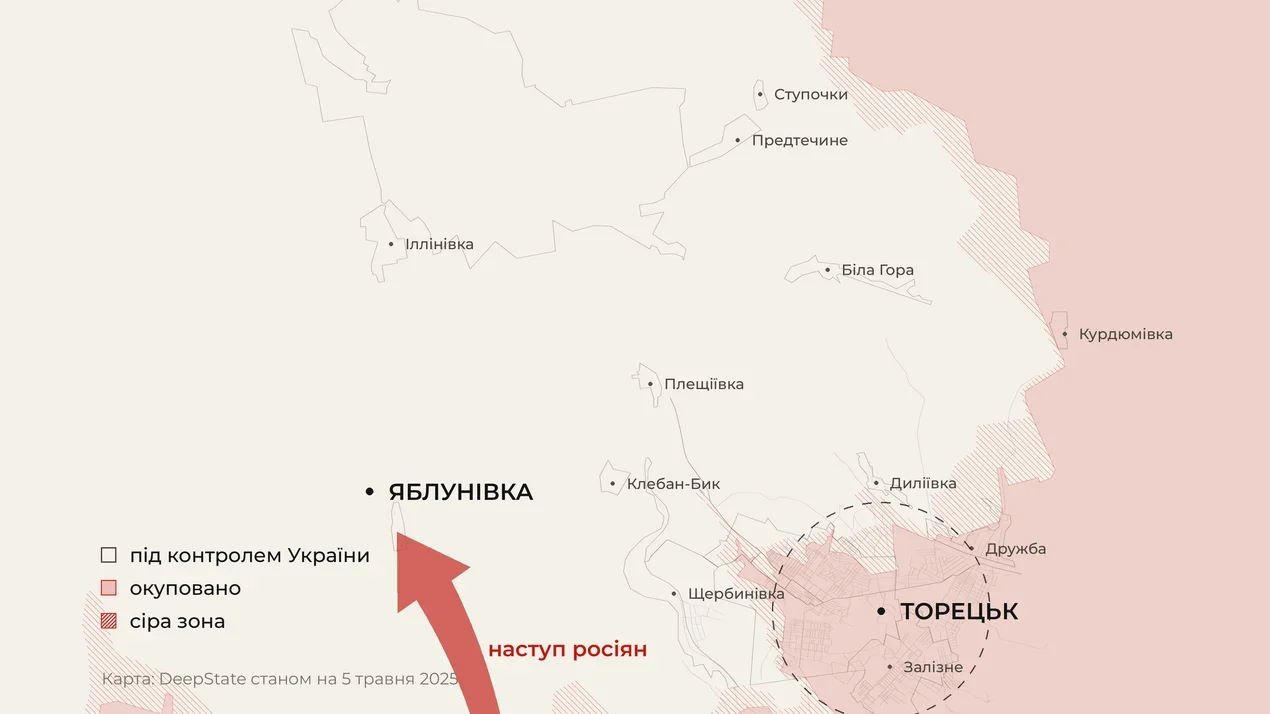
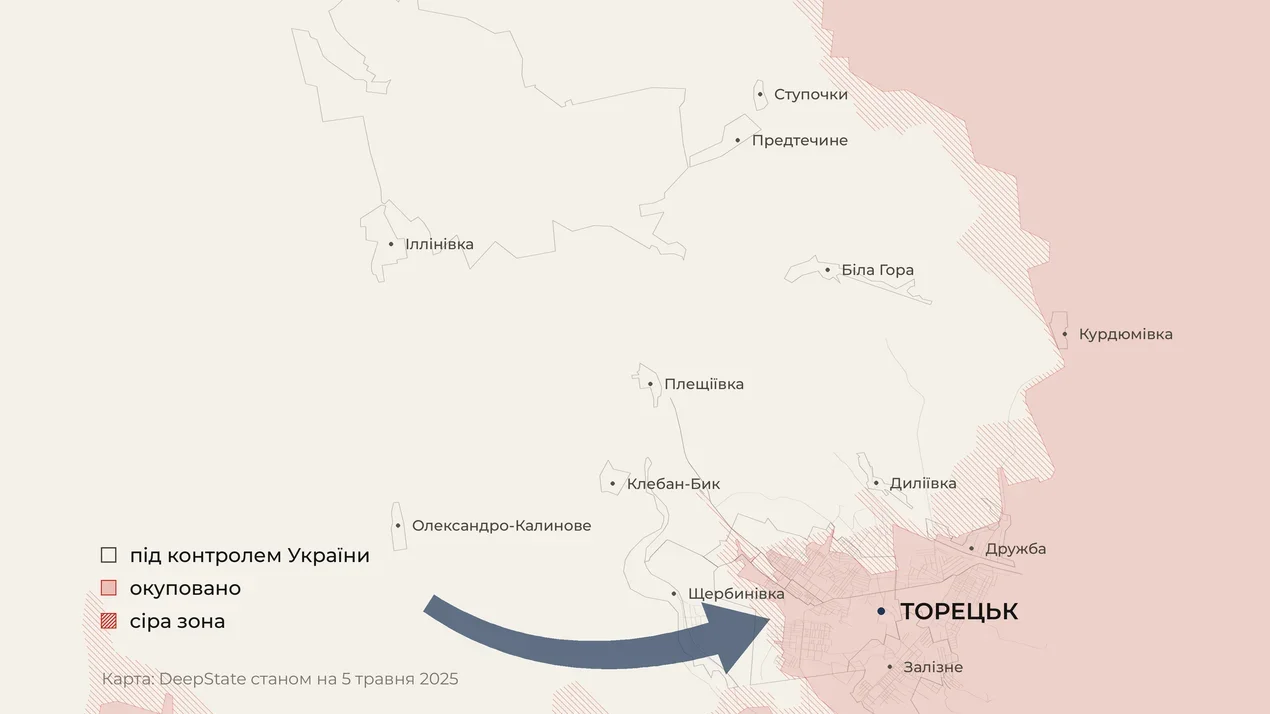
As of early May 2025, the Ukrainian Defence Forces had almost no control over Toretsk. Most of the town was occupied, with the remainder a grey zone. From there, the Russians had a clear route to Kostiantynivka – 10 km away.
Soldiers of the 100th Separate Mechanised Brigade were tasked with holding back these advances. By the time the operation began, the 100th SMB had been holding Toretsk for nine months.
The brigade’s commander at the time, Ruslan Tkachuk, explains that the operation was intended to draw enemy forces away from the right flank, where a Russian breakthrough towards Yablunivka threatened to encircle the Ukrainian units in Toretsk.
"I didn’t want that task, but someone had to do it, and the command based its decision on who was capable of carrying it out. Of course, there was no alternative. You can’t redeploy a brigade – let alone two – very quickly. And when the enemy had advanced 11 km in two weeks, believe me, we simply couldn’t keep up," he said.
The plan was to use an assault to draw units of the Russian Federation’s 150th Division away from the flank towards the town. To achieve this, armoured vehicles were to break through to the centre, where infantry would then clear the buildings.
Battalion commander Roman Ostapchuk explains that they prepared thoroughly for the assault: they trained at firing ranges, recreated a model of the town centre complete with every building, and co-ordinated the actions of the fighters and armoured vehicle drivers in detail.
"In my opinion, the assault was well thought out. Overall, the start went well, but then we were hit by very large forces from all sides. In assaults like this, some loss of equipment is to be expected. Its task was to reach the city and transport the infantry. It succeeded in doing so. No one would have reached the outskirts of the city on foot, let alone its centre," says Ostapchuk.
Other commanders disagree
An officer from the brigade headquarters, which was stationed alongside the 100th Mechanised Brigade, says they lost a great deal of equipment and personnel there.
"It was reckless to drive in with vehicles back then — the concentration of FPVs was insane. We had our own ways of getting into the high-rises to retrieve our own men, but all around us the ‘FPVs’ were exploding like popcorn. It was simply a nightmare."
In his view, the operation made no sense at that point: Ukrainian fighters had withdrawn from the north of the city to the outskirts in April, and it was no longer possible to stabilise the line of defence.
The commander of another battalion, speaking on condition of anonymity, stated:
The commander was supposed to lead the assault with his deputies, rather than sending people on a daft mission. All the brigade commanders laughed at that. We’d moved away from large-scale assaults as far back as 2023. We should have forgotten about such assaults: too many casualties and absolutely no point
On 6 May, he watched live coverage of a large convoy of military vehicles heading towards the centre of Toretsk. His battalion had not been informed of the operation.
The first wave of the operation
On the morning of 6 May, a fog hung over Toretsk as 21 armoured vehicles entered the town. They had deliberately waited for this weather to conceal the convoy’s movements. Smoke was also being released above the armoured vehicles.
Tkachuk, then brigade commander of the 100th Mechanised Brigade, explained that the roads had been cleared of mines prior to the assault, and the convoy was led by a tank equipped with mine-clearing ploughs. It did not return due to a damaged track and was later destroyed by drones, though the crew survived.
Ostapchuk added that over 100 fighters took part in the first wave, and 14 armoured vehicles returned.
"We drove in perfectly; it was absolutely brilliant. On the way back, a few vehicles were hit, but otherwise we managed to get out of there completely unscathed. And the enemy began firing ‘Grad’ and ‘Uragan’ rockets at our positions," added Tkachuk.
Infantryman Stepan (name changed), whose group continued to hold the police station, describes the recapture of the police station as one of the most successful episodes of the operation.
They held the building for three days. The shelling became increasingly frequent. Stepan asked his commander for permission for the group to move to a neighbouring building and set up defences there.
‘Two more strikes and we’re done for here.’
"No, you’re not allowed to," replied the commander.
The fighters had expected a brief assault, so they hadn’t taken any food or water with them. The promised drone resupply was initially limited to ammunition, and the following day they received only a few bottles of water and some food. A five-litre bottle of water, left behind by the Russians and found inside the building, saved them from dehydration.

On the third day, during the shelling, a brick struck Stepan, whilst a concrete slab fell on another soldier, killing him. The group decided to leave the building.
Due to a shoulder injury, he carried his body armour in his hands as he made his way back to his comrades, taking cover from drones. Eventually, he met a fellow soldier in a copse and, together with him, reached a position from where he was evacuated.
The second wave
Two days later, another convoy set off for Toretsk.
On 8 May, says the wife of one of the soldiers, her husband already knew what tragedy had unfolded two days earlier. He sent her a video of Toretsk, in which she could make out three bodies.
"Unfortunately, their families will be told that they are missing in action. We were ordered not to retrieve the dead or the wounded," he wrote.
At 4 am, just before the operation, he reported that the second group was to transport the infantry to Toretsk and evacuate the wounded, and promised to be back by 8 am. However, he did not get in touch again. A few days later, Iryna received notification that he was missing in action. He was last seen at that very police station.
On 8 May, "fewer than 50 fighters" set off for Toretsk in eight armoured vehicles. Due to the fog, one vehicle got lost; seven reached the centre. Two "Bradleys" were destroyed; the rest returned. Twelve people were evacuated from the town, and a few more made their way out on foot, says battalion commander Ostapchuk.
Using publicly available data, hromadske journalists have managed to identify 86 servicemen from the 100th Mechanised Brigade who went missing or were killed in Toretsk between 6 and 10 May 2025. These figures are not definitive, as commanders of the 100th Mechanised Brigade confirm that troops involved in the operation continued to fight for the town for up to three months. In other words, some of the fighters went missing or were killed during the assault, whilst others were lost later.
"One of hromadske’s sources recalls that at the headquarters of the ‘Luhansk’ operational-tactical group, which was responsible for the defence of Toretsk, there was daily talk of new casualties: sometimes 15, sometimes 20 people," the article states.
"An entire battalion of motivated men, who were preparing for some great undertaking, were ultimately just wasted. What’s the point of going there when 99 per cent of Toretsk has already been lost? To hold positions that in a week’s time there’ll be nothing to supply them with – and, more importantly, no one to man them? And in the end, it achieved nothing. The enemy wiped out our best men and destroyed our equipment. It had absolutely no impact on the enemy’s subsequent advance," says one of the officers.
According to the source, the battalion might have been needed to defend another sector, specifically Kramatorsk, following a possible occupation of Toretsk.
The command of the 100th Mechanised Brigade attributes the failure of the assault not to a lack of training or equipment among the fighters, but to a shortage of forces and resources for follow-up operations after the infantry had been landed. At the same time, Ruslan Tkachuk believes that the operation achieved its main objective – it forced the Russians to redeploy forces from the Toretsk breakthrough sector.
One of the officers from the operational-tactical group, who takes a critical view of the operation, agrees with this assessment: a single battalion could not have carried out such a task – an entire brigade should have been deployed, as the attacking force must outnumber the defending units by at least three to one. But he adds: in that case, he does not understand why the assault was authorised in the first place, and describes it as a "complete failure".
Who is responsible?
Two sources interviewed by hromadske, who were serving in the Operational-Tactical Group (OTG) at the time of the assault, claim that the decision to hold Toretsk came from the president:
The (President’s) Office was pressing us to hold Toretsk for as long as possible, because there was a threat to Kostiantynivka, so the battalion that was in reserve was sent there, when we should simply have refused. I think there was an unspoken directive from the Office – of course, not an official order – and the generals weren’t averse to taking a risk, to relive the past glory of their previous successes
"The President has repeatedly behaved in this way. Recently, he refused to accept that both the corps and the commander-in-chief had reported in their briefings that we had lost Rodynske. The President said: ‘No, go on, recapture it’," notes another source familiar with the military and political situation.
The media sent an enquiry to the President’s Office, but no response had been received by the time this article was published.
Meanwhile, the then Commander-in-Chief of the Armed Forces of Ukraine, Oleksandr Syrskyi, denies that Zelenskyy was involved in planning the assault, emphasising that it was a tactical-level operation.
According to him, the President did not issue any orders regarding its preparation or execution.
"Accordingly, the combat operations in the Toretsk area on 5–8 May 2025, in terms of their scale and the level of forces involved, constituted combat operations directly commanded by the brigade commander.
The General Staff was, of course, informed about the planning of these operations. On the basis of a request from the corps commander (at that time still the Operational-Tactical Unit – ed.), the Commander-in-Chief allocated the necessary forces and resources.
At the same time, the General Staff did not exercise direct command over these combat operations, as their scale meant they did not fall within its level of command and responsibility," he noted.
Serhiy Sirchenko, commander of the "Luhansk" Operational-Tactical Group, and Serhiy Sobko, the then chief of staff, declined to comment on the operation. However, according to the testimony of two military personnel, Sobko was unaware of the assault until the convoy appeared on the headquarters’ screen.
At that time, the "Luhansk" Operational-Tactical Group was subordinate to the "Khortytsia" Joint Forces Operation, headed by Mykhailo Drapatiy.
"If we consider the level of the ‘Khortytsia’ commander, then all this was done with his consent – either explicit or tacit," noted one of the officers.
The General Staff declined to comment on Drapatiy’s involvement when asked, citing the current commander-in-chief’s busy schedule.
The battle for Toretsk became one of the longest during the full-scale invasion. Ruslan Tkachuk, former brigade commander of the 100th Mechanised Brigade, says that during the fighting in the city, Ukrainian forces eliminated nearly 20,000 Russian soldiers. At the same time, Toretsk came at a considerable cost to the Defence Forces.
"I lost a great many there, believe me. We fought for half of Toretsk for 15 months. No other town held out for so long in street fighting. The fighting in Toretsk was extremely fierce. It is a place drenched in blood," he says.
The families of nearly a hundred soldiers who took part in that assault are still waiting for news of those missing in action.
"Most of the commanders responsible for planning and executing the assault have since been promoted. Sirchenko became deputy commander of Operational Command ‘North’, Tkachuk became deputy commander of the 19th Army Corps, and Ostapchuk became commander of the 100th Mechanised Brigade," the article concludes.


