



Bill on sanctions against Russia: Senator Graham promises, Trump is in no hurry
Yesterday’s tweet by prominent Republican Senator Lindsey Graham that President Donald Trump had given the green light to pass the sanctions bill against Russia that Graham is promoting caused a moderate wave of excitement in Ukraine and among its supporters abroad.
The words of the 70-year-old senator from South Carolina were quoted by most of the leading Ukrainian media outlets and commented on by experts and bloggers. The reason for this is clear in light of Donald Trump's recent arbitrary actions in Venezuela and the world at large. Many people in Ukraine, and elsewhere, perceived the US government's abduction of President Maduro, along with the arrest of two sanctioned tankers, as a long-awaited example of tough action from the world's chief policeman. In other words, Donald Trump has finally abandoned his isolationist election roadmap and moved on to a foreign policy programme based on force. Perhaps Trump is ready for more decisive action in the Russian-Ukrainian war?
"Censor.NET" looked into what is currently happening around the "Graham-Blumenthal bill" and whether we should really expect it to be passed next week.
"...WILL ALLOW PRESIDENT TRUMP TO PUNISH THOSE COUNTRIES WHO BUY CHEAP RUSSIAN OIL"
So, what did Lindsey Graham write in his tweet?
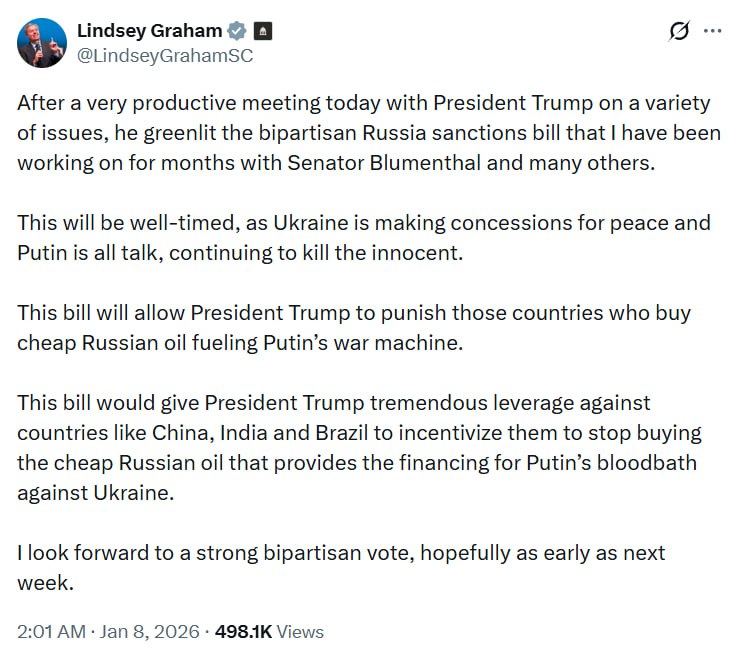
"After a very productive meeting today with President Trump on a variety of issues, he greenlit the bipartisan Russia sanctions bill that I have been working on for months with Senator Blumenthal and many others," Graham said.
"This will be well-timed, as Ukraine is making concessions for peace and Putin is all talk, continuing to kill the innocent, he added. "This bill will allow President Trump to punish those countries who buy cheap Russian oil fueling Putin’s war machine,"
The senator goes on to specify: "This bill would give President Trump tremendous leverage against countries like China, India and Brazil to incentivize them to stop buying the cheap Russian oil that provides the financing for Putin’s bloodbath against Ukraine."
At the end of his post, Graham effectively makes an announcement: "I look forward to a strong bipartisan vote, hopefully as early as next week."
Readers who are fluent in English can read the full text of this document. We would like to remind you that the bill, drafted by Senator Republican Lindsey Graham and Democrat Richard Blumenthal, gives the US President the authority to impose secondary tariffs of at least 500% on imported goods from countries such as China, Brazil and India that continue to trade with Putin's regime.
From the outset, the idea of the bill's authors was to put pressure on Putin; that is, these measures should be taken if the Kremlin disrupts peace talks to resolve the Russian-Ukrainian war or violates the peace in the future. (Or, we might add a third option, prolongs the war while feigning readiness to negotiate).
PUTIN DRAGS OUT NEGOTIATIONS, TRUMP - SANCTIONS BILL
The question arises: if this bill is so effective that it easily garners bipartisan support, why don't we have the Graham-Blumenthal bill yet?
There have been several peaks in this story, but there is still no conclusion. The first peak was in July last year, when, in the midst of preparations for the vote, it became clear that Trump had decided to act independently — he threatened to impose "secondary tariffs" of up to 100 per cent on countries that still trade with Russia. We remember what happened next — the Graham-Blumenthal bill was postponed until better times, especially since lawmakers went on holiday.
The second peak of excitement around the Sanctioning Russia Act occurred in November 2025. Always on the lookout for new carrots and sticks for his next deals, Donald Trump told reporters that the Graham-Blumenthal bill could apply not only to Russia but also to Iran. He added that the sanctions outlined in the bill were, of course, his idea.
It is important to note here that Trump, first, emphasised that the bill is being promoted by Republicans (no points for the enemy Democrats!), and secondly, the tone of his comments ("OK with me") indicated that although he supports Graham's bill (and is the author of the idea itself!), he is not directly demanding its adoption.
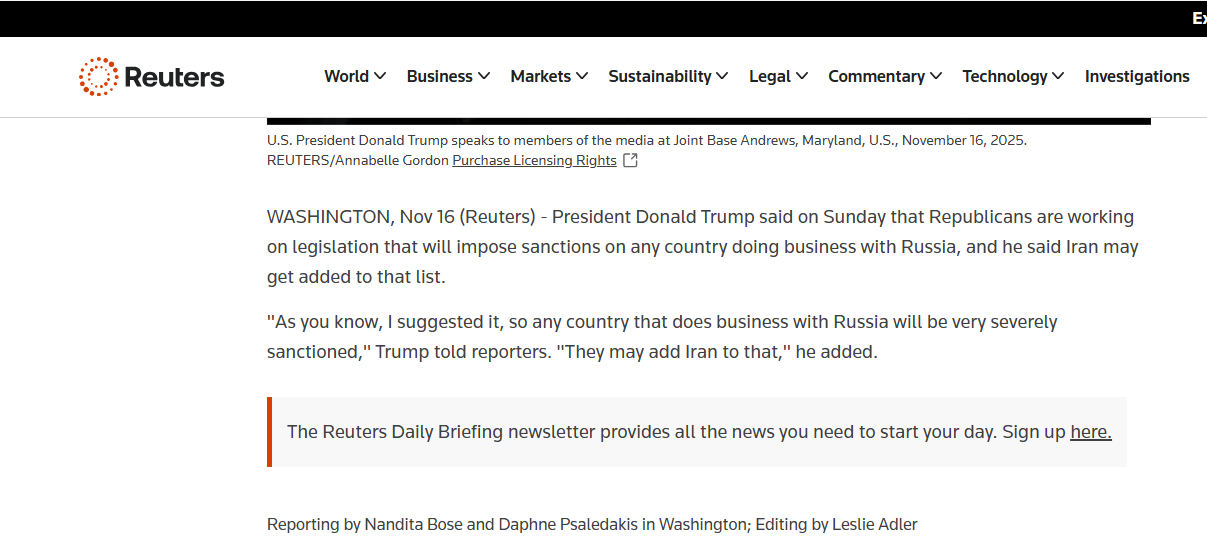
All this, however, did not prevent the authoritative publication Bloomberg from concluding that his statement was the strongest evidence of his support for the bill on sanctions against Russia.
We note that at that point in time, Trump was mentally somewhere between his meeting with Putin in Anchorage and his current belligerent imperialist phase. The bill remained just a bill at that time.
A HELPFUL TOOL AGAINST THE RUSSIAN FEDERATION, BUT NOT A WEAPON OF MASS DESTRUCTION — UNTIL TRUMP GAVE THE GO-AHEAD
As mentioned above, the current stage of festive reports in this long-running story was provoked not only by Lindsey Graham's tweet, but also by the energetic actions of Trump and his team at the beginning of the new year. Many of those involved felt that what had not been achieved in six months could now be achieved in a moment.
"Thank you, Senator @LindseyGrahamSC, to you personally and to Senator @SenBlumenthal, as well as to everyone else who contributed to this bill. I appreciate our interparliamentary cooperation," wrote Ruslan Stefanchuk, Chairman of the Verkhovna Rada, on X social media. He added that he hopes the bill will soon become law.
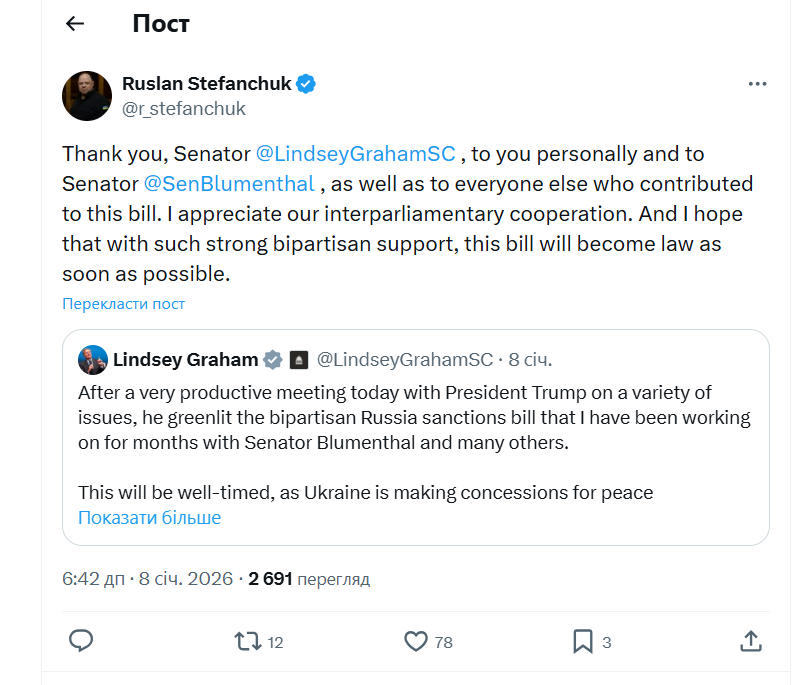
Of course, in this situation, the speaker of the Ukrainian parliament must show optimism and (entirely justified) gratitude to his American colleagues.
On the other hand, the Graham-Blumenthal bill has not yet been passed, and given its long history, who knows if it ever will be. Moreover, there are several circumstances that make this document, to put it mildly, inferior to the Jackson-Vanik amendment of 50 years ago.
Roman Shrike best articulated these circumstances on his Telegram channel. We have already touched on some of his points, but not all of them.

One more argument can be added to Shrike's list — about the Trump-Graham tandem. More precisely, about the fact that in this tandem, the needs and demands of the former determine the position and actions of the latter. And perhaps the most striking demonstration of this was directly related to Ukraine. This is the case when Lindsey Graham, within a few days, first praised Volodymyr Zelenskyy wildly, and then, after the legendary quarrel in the Oval Office in February, cursed him just as wildly and even refused to have anything to do with the Ukrainian president.
In his biography on Mr. Graham's official website, he is recommended to visitors as a "conservative problem-solver." What he has in common with Donald Trump is a remarkable flexibility in negotiating, changing tactics, and a combination of the ability to find his opponent's weak spots and a penchant for frontal trolling.
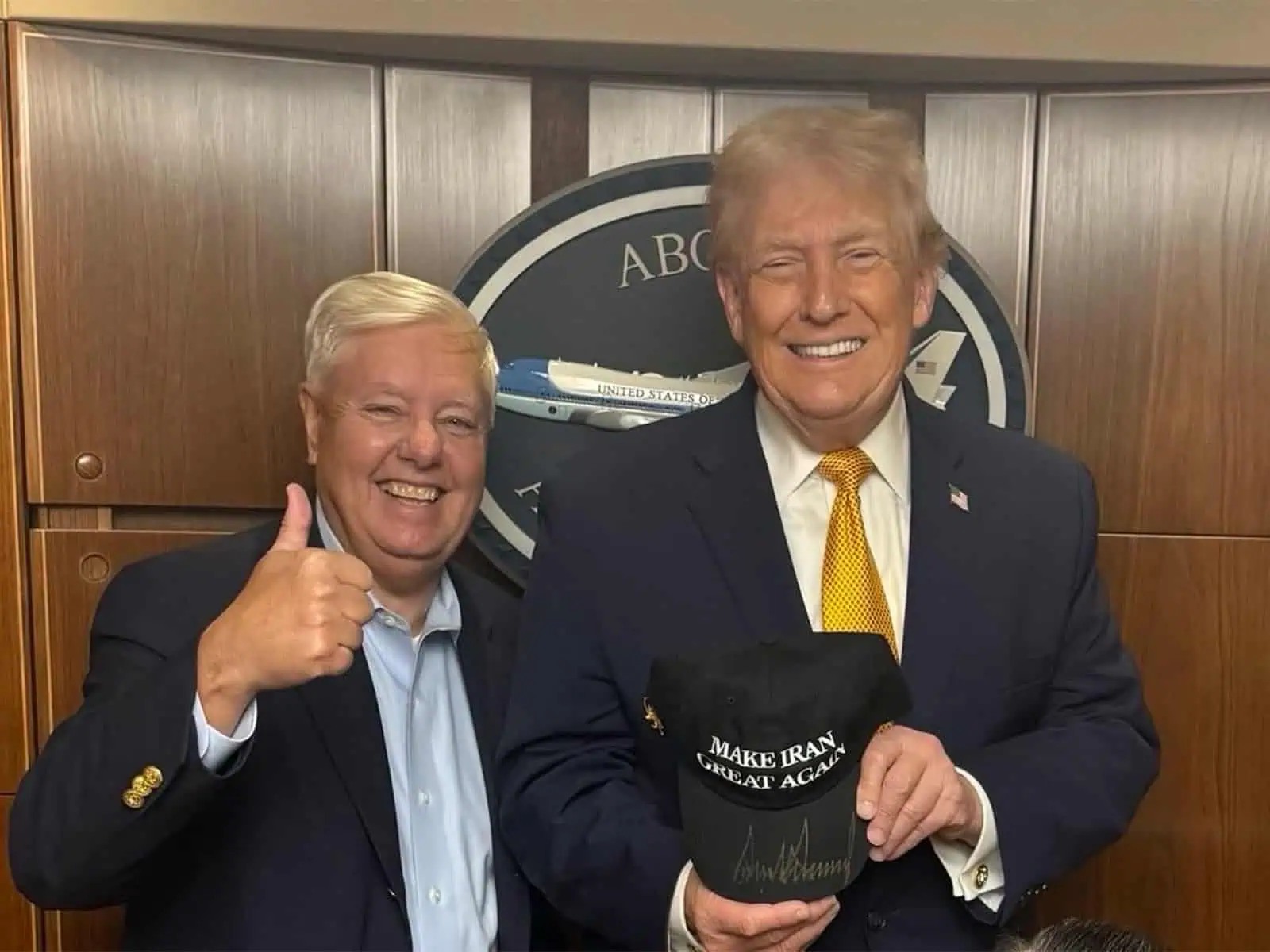
Simply put, if Trump needs it, Graham will first promote his bill again, and in five minutes he will say that with such a wonderful, very wonderful president, America does not need Congress, he will do everything himself!
MP YEHOR CHERNIEV: "WHEN WILL THE BILL BE PASSED? WE ARE DEFINITELY CLOSER TO THIS EVENT, BUT WHETHER WILL IT HAPPEN NEXT WEEK — WE'LL SEE."
Nevertheless, are we being too critical of the Graham-Blumenthal bill? We should not forget that several hundred experienced and influential people, primarily from the US Congress, have been involved in promoting and editing it over the past few months. And its presence on the US President's radar speaks volumes.
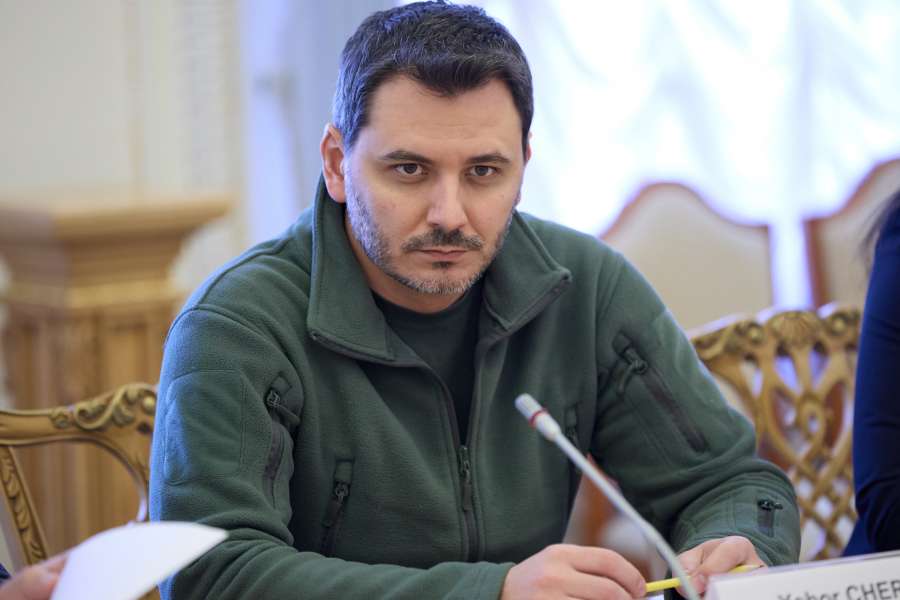
We discussed the situation surrounding the anti-Russian sanctions bill with Yehor Cherniev, a member of parliament ("Servant of the People" faction) and head of Ukraine's permanent delegation to the NATO Parliamentary Assembly.
Throughout 2025, Cherniev actively met with his American colleagues, integrating Ukrainian interests into the text of the Graham-Blumenthal bill. Therefore, he has a deep and systematic understanding of this story.
- Yehor, when you read Lindsey Graham's latest announcement that the S.1241 bill — the Sanctioning Russia Act of 2025 — had received Donald Trump's blessing, and that Congress might pass it as early as next week, did you think to yourself, yawning, "God, how many times has this happened before, and here we go again"?
It is important to understand that, unfortunately, Congress today is not a subject entity. (We in Ukraine love to talk about the Verkhovna Rada in this way, but in reality, our Verkhovna Rada is sometimes more of a subject entity than the current Congress). And the procedure for putting bills to a vote in Congress depends on the speaker. It does not matter in what order the bill passes through both chambers. As far as I understand, there are no conciliation committees or other procedures that can collectively push for a decision on the agenda of their meetings. No, all this is decided solely by the Speaker. And, in fact, it is up to him whether a bill will be put to a vote.
As for this bill, so far we see that he does not have such a will. And the reason is that everything is happening with an eye on the Trump administration.
I am reading your post from 12 December last year, where you write from Washington: "One of the stumbling blocks is the introduction of new sanctions against russia, including Graham's bill. Speaker of the House of Representatives Johnson, who is completely following Trump's lead, is currently blocking its submission to parliament for consideration. That is why Congressmen have begun the process of bypassing Johnson's decision, which requires 218 signatures."
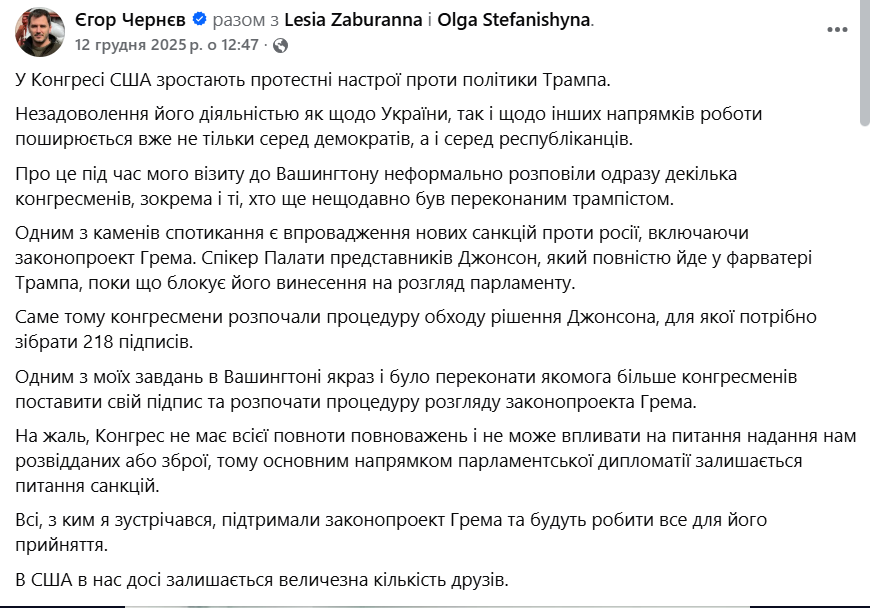
Comparing the situation a month ago with the beginning of this year, we see that the bypass procedure has not been successful. In fact, the situation has hardly changed. But we have an extremely energetic, forceful start to 2026 from the Trump administration. The capture of Maduro and the reformatting of power in Venezuela, the arrest of two tankers with Russian "protection"; renewed pressure on Greenland. This raises the question: are the current geopolitical circumstances such that they will facilitate the passage of the law this time?
In fact, today, as yesterday and the day before, the decision depends on Trump personally. And with all due respect to Lindsey Graham, I am confident that although he, like the vast majority in both houses, will vote for this bill, for the vote itself to take place, it must first be brought up for consideration. And for that to happen, Trump needs to give the appropriate instruction to Speaker Johnson.
As for the geopolitical situation, it seems to me to be more positive for us than it was a month ago. The scales have tipped in our favour. The starting point for this was the fake attack on Putin's residence — which Trump refuted. This was followed by a series of events, some of which concern us and some of which do not. This series of events strengthened the position of both Trump and the United States in the eyes of the international community. I think we can expect more decisive steps from President Trump going forward.
- Lindsey Graham said that the bill will be passed next week. What do you think about this timeline?
- Well, unfortunately, we have heard several times that it is about to happen — in the middle of summer, at the end of summer, before the holidays... On the other hand, the geopolitical situation has changed. The context has changed. We are definitely closer to this event, but whether it will happen next week — we will see.
- You and many of your fellow politicians attach great importance to the adoption of this bill. But it does not impose sanctions on Russia, it only explains what these sanctions should be. Is Trump not already aware of this? And in any case, isn't it Trump who decides when the time is right for this law? So why all the effort on our part and on the part of its bipartisan initiators in the United States?
The thing is, there are several versions of this bill. When it was first introduced, the Democrats tried to amend it, then the Republicans. The bill was vague, which also drew criticism from some members of Congress. Now, within the framework of a discharged petition — that is, in the procedure of bringing it outside the Speaker's decision — there are also two versions of the document. One from the Democrats and one from the Republicans. And now one of these versions (I don't remember which one) has already gathered 214 signatures out of the 218 needed. And this version of the document is more specific.
But at the same time, yes, Trump definitely has the authority to impose sanctions on his own. And these efforts by Congressmen were an attempt to help us, since Trump was not inclined to take serious steps.
- It is also known that the largest buyers of Russian energy resources are China, India, Turkey, Hungary, and Slovakia. Do you believe that the United States will impose draconian sanctions on these countries?
- I think the sanctions will be implemented either gradually or on a country-by-country basis. We saw this with India. This selective approach will inevitably influence the behaviour of other countries. Again, we see the position of the United States: they are gradually increasing the pressure. And Venezuela will also play its role on this global chessboard — by adjusting world oil prices. This will give the United States more global influence in this area.
- Given the above-mentioned questionable points, why do our side and American authors attach such importance to this bill?
- Because this is something we can influence, having an absolute majority in Congress among both Republicans and Democrats. I am referring to sanctions policy. Figuratively speaking, if we cannot achieve this through the White House, we advocate and try to resolve this issue through our friends in Congress.
- Overall, does this turbulent post-New Year foreign policy phase from Donald Trump give you at least some cause for optimism - at least on our issue? Or does anxiety prevail, because this elephant seems to want to crush what little normality remains in this china shop?
- I would say that I see more positives in this. Because in this case, the United States' show of force is a signal to Russia that while they are still negotiating with them (as they did with Maduro for some time), they can act decisively.
...AND INSTEAD OF AN EPILOGUE
This material was being prepared for publication when Donald Trump's interview with the New York Times became known.
When asked about his attitude towards the bill on sanctions against Russia, Trump replied:
"I think there are 84 or 85 senators who want it... So I support it, but only if it's subject to me. And you know, I support it," Trump replied.
The White House chief later added that he hoped the bill would not have to be implemented. "We already have serious sanctions against Russia," he said, stressing that Russia's economy is currently in very poor shape. At the same time, he noted that Russia is a larger and more powerful country in this regard compared to Ukraine...
Yevhen Kuzmenko, "Censor.NET"


