



Daria Kaleniuk: "Yermak should face criminal liability"
Ukrainians in rear-area cities, especially Kyiv residents, are now struggling to get by in extreme conditions: power outages, disruptions to water supply, and biting cold in their apartments. All of this is the result of Russia’s systematic strikes on the country’s critical infrastructure. At the same time, these hardships are bringing long-standing problems inside the state to the surface: pervasive corruption, weak governance, and a lack of planning and transparency.
Thanks to the work of the National Anti-Corruption Bureau of Ukraine (NABU) and the Specialized Anti-Corruption Prosecutor’s Office (SAPO), individual cases of abuse are becoming the subject of investigations and public scrutiny. Their "Midas" operation has already gone down in history as one of the most high-profile corruption scandals of recent years. This was exactly where we began our conversation with Daria Kaleniuk, Executive Director of the Anti-Corruption Action Center.

- Doesn’t it seem to you that ‘Mindichgate,’ which started quite loudly, has died down a bit lately?
- It’s true, we’re not seeing any new recordings right now, so you could say it has died down somewhat. At the same time, NABU’s top-tier investigations, though less loudly, keep coming out. At the end of December, suspicion notices were issued to five lawmakers from Servant of the People over "envelopes." A few days ago, Yuliia Tymoshenko was also served with a suspicion notice. Also over ‘envelopes,’ but not for receiving them, for handing them out. The question remains: who was handing them out to Servant of the People? If you’ve said ‘A,’ there has to be a ‘B’ as well. By the way, I think there were more than five people taking them. But who was giving them out, and where did that money come from? Those are the questions we should be getting answers to. I hope NABU will investigate and examine this, and we’ll see everything in the ‘next seasons.’
Also, today (we are recording this interview on January 21, – O.M.), Rostyslav Shurma was served with a suspicion notice over ‘green energy.’ Journalists have been investigating this for a long time. It’s a pity Shurma is not in Ukraine. But he now has an official suspicion notice. The question is: where are the suspicion notices for Halushchenko and the ‘girl he brought in’? (former head of the Ministry of Energy, Svitlana Hrynchuk. – O.M.).
- She gave an interview just a few days ago, saying she sees no grounds for being served with a suspicion notice. In other words, she claims she did nothing illegal.
- Certainly! The question is: how did she end up in that position? The NABU tapes that were made public left a certain "aftertaste" of how personnel matters were handled. Mindich told the president, "Talk to Hera." The president called Halushchenko, who was moved from the Ministry of Energy to the Ministry of Justice, while his protégé remained at the Ministry of Energy — the "girl he brought in." An interesting situation.
One more thing: where is Yermak’s suspicion notice? This is a very important question for NABU. It should be issued. Searches were conducted, and then what? I understand he announced that he had joined the military. But recently, in response to MPs’ request, the Ministry of Defense said Yermak had not voluntarily mobilized. I do not know which front he went to, but the question remains: where is the suspicion notice?
- They say Zelenskyy and Yermak have not lost contact.
- I also hear different rumors. On the one hand, Zelenskyy is in constant contact with Yermak, consults with him, and Yermak proposes certain personnel decisions. On the other hand, there are claims that Zelenskyy, on the contrary, has somewhat distanced himself from Yermak, and that these latest personnel reshuffles are his own initiative. We do not know for sure where the truth lies.
- What do you think?
- Yermak has lost most of his influence, which rested on direct, constant physical access to Zelenskyy, he was always by his side, 24/7. At any time of day, in the Office, on trips, at meetings, and at press conferences, Yermak’s shadow was always there. When he was physically present, he controlled what information reached Zelenskyy. He gained legitimacy and, accordingly, could resolve a host of issues on the president’s behalf, handling personnel appointments, assigning tasks to the security services and government officials, and acting as Ukraine’s top diplomat. He was responsible for energy and for defense, for everything, without any real official accountability. That is no longer the case. Even if Yermak calls someone on Zelenskyy’s behalf and tries to gather some officials somewhere, in some basement or back office of his, they will not go there and are unlikely to follow his instructions. So, in reality, he has lost his main leverage. Have Yermak’s people remained in the system? I think so. And that is where the question of personnel changes comes up.
- For example, SBU First Deputy Head Poklad and HUR chief Ivashchenko are described as Yermak’s people.
- Why would Yermak’s people need to remain such if they can represent themselves?! Poklad can be Poklad’s own person. Why would he still need to be Yermak’s person?! That’s the question here.
Overall, however, I am glad that Operation "Midas" took place, and that it led to certain changes in the structure of state governance. Although, of course, not to the full extent society had hoped for.
Let’s look at positions. Budanov is the head of the Office of the President. But does he influence justice, or the reform of law enforcement bodies and the judicial system?
It is unclear. Because there is Tatarov — the unchanged Deputy Head of the Office of the President responsible for justice. In early January, the president said that some institutions had been performing unsatisfactorily, so the problems needed fixing, and that his personnel decisions were linked to this. And he dismissed Maliuk. So why does Tatarov remain? And what about Prosecutor General Kravchenko, and State Bureau of Investigation (SBI) head Sukhachov? Why?! If Maliuk had been dismissed over the attack on NABU, that would have been a logical reason. Because there was, indeed, fabrication: the SBU helped the Prosecutor General’s Office fabricate these criminal cases about "Russian influence" and an imaginary seed trade with Afghanistan or Uzbekistan. Then Zelenskyy should have dismissed both Kravchenko and Sukhachov as well. But there is no mention of these figures at all. There was only information that the Office of the President would develop a bill on the SBI by the end of January. And when we try to understand who is actually preparing it, we realize it is Tatarov — the person who wrecked the SBI reform by installing Sukhachov as its head through a fake competition, a friend with whom they co-authored books. What kind of a cleanup is that?! So I conclude that Zelenskyy dismissed Maliuk because he was not attacking NABU enough.
- Another version was that Maliuk was dismissed, allegedly because he failed to protect Yermak during "Mindichgate"...
- This is a continuation of the same story. Because he did not attack NABU and SAPO enough, allowed Operation "Midas" to go ahead, and allowed searches to be conducted at Yermak’s and as a result, Zelenskyy took a hit. This conclusion becomes logical if you look at who is now in charge at the Security Service of Ukraine (SBU). The First Deputy is Oleksandr Poklad, whom Zelenskyy promoted. He is a well-known overseer of the service’s political and economic portfolio. He served as a deputy head and followed Yermak’s instructions to neutralize NABU and SAPO all the way to the end, even when Maliuk had already "edged away" somewhat and tried to distance himself from it. Poklad, meanwhile, demonstrated to Zelenskyy that he serves reliably, carries out illegal instructions to the end, and shields the president from problems with NABU and SAPO and he was rewarded with a promotion, becoming First Deputy. And Yevhen Khmara, a combat officer who was supposedly to replace Maliuk, is merely a smokescreen, because simply appointing Poklad as the head of the SBU would have looked highly suspicious.
- It is also possible that parliament would not have voted to approve his appointment.
- Yes. But parliament has not voted on the head of the SBU even now, because the issue was not brought to the chamber floor. That is why Khmara, who has very strong reviews from combat units and fellow soldiers, may appear to be in the position of SBU head, but he is only the acting head. His deputies are appointed and dismissed by the president. So what can Yevhen Khmara actually do about the service’s political and economic portfolio? The answer is obvious.
- So he was probably put there to focus specifically on special operations?
- And to cover for Poklad. There has to be a nice picture for PR. As if Maliuk, a war hero whom the military "stood up for", was replaced with an even younger and better combat officer. But first, he has not actually been replaced, because Khmara has not been officially appointed and remains in limbo. Second, they assigned Poklad as his overseer, who would handle all political matters. That is why the changes that could have indicated Zelenskyy had learned from his mistakes, that he is truly trying to strengthen the state from within and wants to act within a framework of restoring justice, have not happened. He has not abandoned attempts to use law enforcement agencies for political purposes or persecution. He has no desire to genuinely reform these bodies. He is satisfied with Kravchenko, who has said he is in his place and will come after anyone who demands his resignation. I am still waiting for him to come after me.
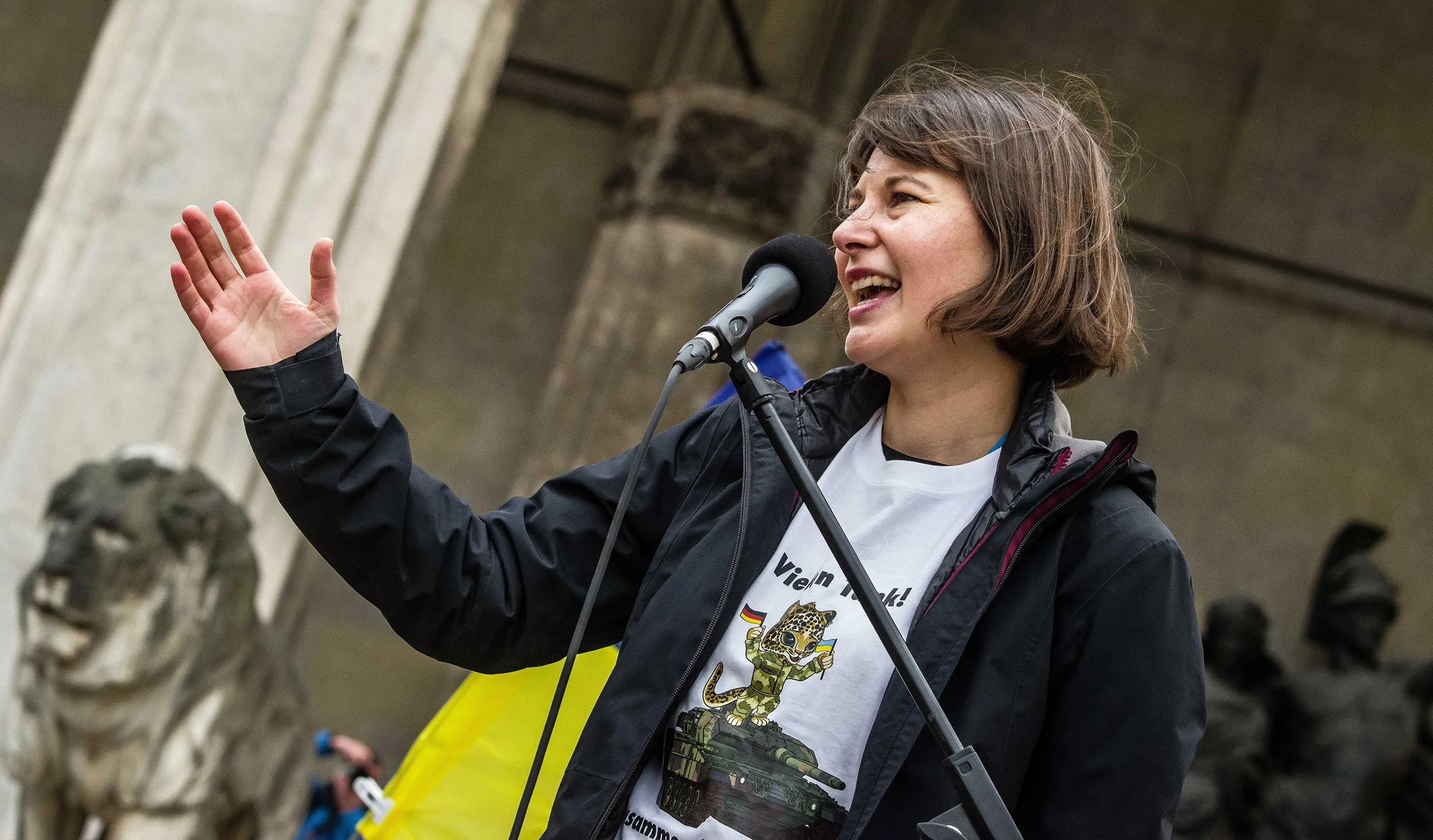
- And the already-mentioned Sukhachov, who, by the way, is also on the NABU recordings.
- You know, after our article was published on Ukrainska Pravda about why Kravchenko and Sukhachov should resign against the backdrop of these Zelenskyy reshuffles, I received a letter from the SBI. It says it is "super secret" and must not be disclosed because it is a secrecy-of-the-investigation matter. But we will publish it. In the letter, they asked a series of questions: whether I am really the author of that article; why I believe the SBI and its director, Sukhachov in particular, had a personal interest in the attacks on NABU and SAPO; and why I think there was unlawful influence by figures in Operation "Midas" on the SBI. Simply breathtaking questions!
- Was it an email?
- Yes, it was an email sent to the Anti-Corruption Action Center’s inbox.
- What an interesting way to communicate. It could have easily gotten lost.
- Good thing it did not get lost. A fine letter! But if you are conducting an investigation, summon me as a witness. Serve me with a summons. There is a procedure. Instead, they sent a letter. I have just recorded a video answering their questions, and we will publish it.
In general, there are signs of a conflict of interest on Sukhachov’s part in this case. His wife, Iryna Sukhachova, worked in Energoatom’s structures when Halushchenko oversaw the company’s operations. Kudrytskyi has publicly said that Sukhachov and Halushchenko are compadres. So they are friends and close. Recall that on July 21, the SBI served suspicion notices in a traffic accident case on three "NABU people." Suddenly, it happened on the very day the SBU "took down" Ruslan Mahamedrasulov and carried out a slew of searches of NABU detectives on suspicion of some imaginary Russian influence. That is, Sukhachov had an interest in NABU not carrying out Operation "Midas," in the Mindich recordings not surfacing, and in there being no investigation into the embezzlement of at least $100 million at Energoatom.
In addition, from the Mindich recordings and from court hearings where SAPO prosecutors laid out the evidence in more detail, we can see that Basov, a former Energoatom employee, was boasting that he had influence over the State Bureau of Investigation (SBI), and that he visited the agency under the codename "railway station." The name "Losha" is also mentioned several times in the recordings. This whole epic story once again confirms that the SBI, apparently, will not cleanse itself, and that Tatarov will not carry out any reforms there. Yet the bureau’s relaunch should follow a systemic approach, analogous to the Bureau of Economic Security: a separate law, a genuine competition with a selection commission in which the decisive influence would be held by representatives nominated by international partners. It was the commission’s international members who pulled the competition through at the Bureau of Economic Security. All serving SBI staff should also undergo re-attestation, as was done at the Bureau of Economic Security. Tatarov is clearly not interested in such a course of events. But there is an EU requirement to reform the SBI, and I think we have a good chance of pushing this through parliament. Meanwhile, Sukhachov expects to head the agency through the end of the year. But that does not work for us.
- Let me return to "Midas." NABU promised us that "more would follow," but instead they showed up at Tymoshenko’s late at night. I will not quote Kolomoisky, but many people noted that the amount involved is small, by Yuliia Volodymyrivna’s standards. Why did it happen this way?
- Al Capone was put away for tax evasion, even though he was a notorious gangster whom they had been trying to catch for decades. Yuliia Volodymyrivna has been in Ukrainian politics for many years and is associated with various offshore schemes, major kickbacks, and bribes. But it is good that she was caught in a very basic scheme. Offering a bribe is a simple case. "Midas," by contrast, is a complex case: money laundering, legalization of proceeds, and the embezzlement of hundreds of millions. It has to be investigated for a long time, even at the pre-trial investigation stage. Once such cases reach court, they take a long time to hear. Here, everything is straightforward: the transfer of a bribe and simply documenting that fact. Yes, only $40,000. But criminal law provides for a severe punishment for this — imprisonment. After this, it will be very difficult for Yuliia Volodymyrivna to survive in the political environment. I think this is the end of her political career and, at the same time, the beginning of another one — as an incarcerated person who will face criminal liability. From here on, she will focus on her defense.
Look, Tymoshenko is now talking about political persecution, Zelenskyy, and so on. But back in the summer, she was saying that NABU and SAPO are "America’s agents." So does that mean it is America’s agents who are now holding her to account, not Zelenskyy?! Then let her say so! What does he have to do with it?!
You asked why NABU and SAPO have taken up this case now. It seems to me it did not involve only four MPs who were receiving envelopes. I think there were more. Also, this case likely stopped the payments overall and it is no secret that the mono-majority was held together by them. When that "addictive needle" of envelopes for Servant of the People stops, others appear who want to buy them off and "hook" them on it again, and for bigger money, so they vote the way they are needed to. That is where Tymoshenko came in, as a seasoned political shark. And not only her, there could also have been other political forces as well.
- Which ones exactly?
- Those who consistently vote with the mono-majority: the remnants of the Opposition Platform – For Life, For the Future, and Trust.
- The Tymoshenko recordings also mention that she wants to destroy the mono-majority. After they were made public, a version emerged that she had been negotiating this with Yermak, who, as is known, has strained relations with Arakhamiia. So is influence by the former head of the Office of the President possible here?
- Anything is possible. But let’s look at the motive. Yuliia Volodymyrivna built her career on mediating the supply of Russian gas to Ukraine: in the late 1990s and early 2000s, she ran a monopoly that handled its import. She had very good relations with Putin and signed gas contracts. Even in recent years, her narratives have closely echoed the Kremlin’s messages, about "external governance" and similar themes. So it is entirely possible that Yuliia Volodymyrivna wanted to bring down the mono-majority. Perhaps not in her own interests, but in the interests of those with whom she has good relations. What role did Yermak play here? I don’t know. And more broadly, what his role was, and why he systematically sabotaged Ukraine’s preparations for winter, is also a question. Embezzlement in the energy sector was taking place while he held the position. Why did he "lull" all of us, Zelenskyy included, into thinking everything would be fine once Trump came to power? Where was the preparation for the worst-case scenario? There was not even any thought of it!
I will voice a somewhat conspiratorial version that needs to be confirmed, but if Yermak really cooperated with Yuliia Tymoshenko to split the mono-majority, it cannot be ruled out that it may have served the enemy’s interests.
- Yermak’s alleged ties to Russia have been discussed for a long time…
- Of course. We have been looking at this since the moment he was appointed. Yermak’s father worked at Russia’s embassy in Afghanistan when there was a war there. We understand that ordinary people would be unlikely to end up there in such circumstances at such a time. He clearly had experience working in security services tied to the Soviet system. On top of that, Yermak himself was a business partner of a Russian businessman. So the question is: whose interests was he serving when he was weakening our defense capability and sabotaging preparations for an energy crisis? I believe this should be handled by counterintelligence — the Security Service of Ukraine. And how is Poklad supposed to deal with it if he is Yermak’s "loyal dog"?! By the way, some people described him to me as a "patriotic devil." I do not know him personally. But why be someone’s enforcer, someone’s "dog," if you can, as we discussed, work in your own interests?!
- Will Yermak ever be held accountable?
- I very much hope so. He must face criminal liability. After those searches, NABU must "say B" — issue a suspicion notice — and through court proceedings we must find out what was happening there. Because without Yermak’s knowledge, no one would have been dealing with the matters outlined in "Midas."
- Two figures in "Midas", Mindich and Tsukerman, are now in Israel. As we saw from Tkach’s investigation, they "care deeply" about Ukraine’s fate, from a seaside resort…
- With security guards who beat journalists.
- And cynically claiming it wasn’t them. Now, the presidential decree on sanctions says Mindich and Tsukerman have Israeli passports. Israel does not extradite its citizens. Is this a dead end when it comes to bringing them back and taking further procedural steps? Or can we return them?
- But Khrystenko was somehow brought back from the United Arab Emirates. True, in a very strange way.
Not voluntarily, and not within the framework of international legal cooperation.
- Voluntarily — under pressure.
- Yes. The only question is whether there is the will and it is not there. Israel may not extradite its citizens, but it has strong security services that cooperate closely with the Americans. If I were in their place, I would hand Mindich over to the United States as an asset that can be used to pressure Zelenskyy. He is an insider who knows all the weak points of Zelenskyy and the state’s governance. That is why I believe Mindich being in Israel is a danger for Ukraine. It would be better for the country if he were here, held accountable, and under the watch of the security services. Instead, as I understand it, they helped him leave.
- As we saw, he left without any obstacles. While he was still here, there were no searches at his place, unlike with Tymoshenko. They were carried out after he had already left. What is your view on searches conducted under exigent circumstances?
- Criminal procedure law provides for cases in which a search conducted under exigent circumstances is permissible. For example, when there is a risk of evidence being lost. As I understand it, NABU used certain special surveillance measures in relation to Tymoshenko. The audio recordings confirm that her conversation with an MP was recorded. Circumstances likely forced NABU to carry out a search under exigent circumstances. It was later legalized by the High Anti-Corruption Court, which upheld the suspicion notice, meaning the search was deemed lawful. At the same time, I want to say that some law enforcement agencies abuse this mechanism. In particular, the SBI did so when it carried out a search under exigent circumstances at Vitalii Shabunin’s home, where his wife and children were present, as well as at the Kharkiv apartment of Jus’s mother. It was unclear why this search was deemed "urgent." Where was the risk of evidence being lost? What exactly was that risk? Vitalii was with his military unit. At any point, after investigating the case for two years, they could have obtained a court warrant, but instead they chose this route. This is how unreformed institutions used for political repression, the SBI, the Prosecutor General’s Office, and the SBU — abuse this practice. Judges then legitimize these searches under exigent circumstances, as happened in Shabunin’s case at the Pecherskyi Court. And then you can do whatever you want, trying to prove there was no threat of evidence being destroyed, the judges do not care, because the SBI itself keeps them "on the hook."
- Do you think we have been shown everything in the Tymoshenko case?
- No. I believe NABU has other evidence in addition to the recordings that were made public. Usually, several types of evidence are used to confirm the same fact or events so that a court can deliver a conviction without any doubt. Because even a doubt is interpreted in the defendant’s favor. So I am more than sure it is not only the tapes.
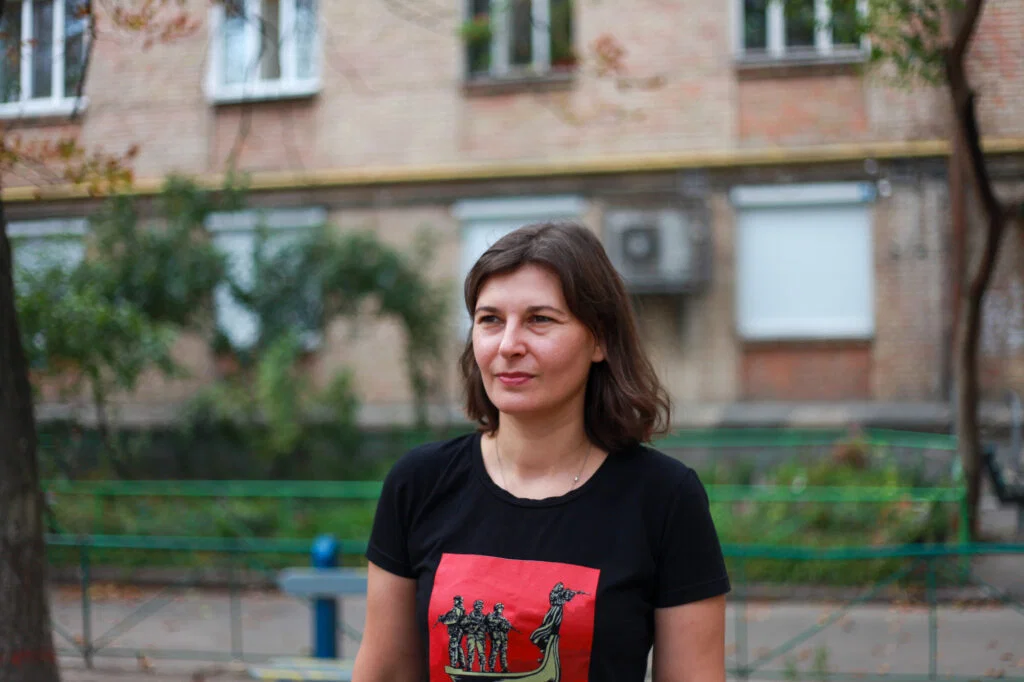
- So is it "all lost"?
- It is. But we still need to keep watching to make sure there are no attempts to finish off NABU and SAPO with new legislation or to dismantle the High Anti-Corruption Court. Under such circumstances, the case may not even make it to a verdict. There is a court of first instance and an appeal ahead. In any case, this means years and political retirement for Tymoshenko.
- Bribes in parliament are a fairly entrenched practice. I remember that more than ten years ago, so-called "turncoats" were being paid millions of dollars, whereas now we are talking only about thousands. It seems MPs have grown smaller-scale, yet they still take money for votes. Why is this problem impossible to eradicate?
- This problem dates back to the 1990s. But little by little, it is being curbed. MPs have shrunk in part because of anti-corruption legislation. Before 2014, asset declarations were filled out by hand, stored somewhere as PDFs, and there was no liability for lying. Everyone wrote whatever they wanted. There was no requirement to declare beneficial ownership of companies or expensive jewelry. Now all of this has to be included in declarations, and there is liability for false information. This process is closely scrutinized not only by the public and journalists, but also by NABU and SAPO. In fact, asset declarations are one of the core tools for examining and investigating top officials and MPs. Tymoshenko says that the money seized by NABU was declared. I think they may have found a bit more. In addition, the phone that was seized may serve as additional evidence regarding other assets. So this may not be only about offering bribes to MPs, but also about illicit enrichment.
But I have digressed. The point is that today it is harder for MPs to steal money by the sackful. It is easier, unless you are a friend of the president. Moreover, the overall quality of MPs is not very high. Even under Yanukovych, MPs were businesspeople who never left their businesses, serious players. They understood what they were selling themselves for and how to play the political game, low on integrity, but smart. The parliament of this convocation is largely a collection of random individuals who, over these six years, have still not understood what it means to be an MP. There are exceptions. But most are people who never wanted to be public servants and still do not grasp what that entails. They simply gained access to easy money: show up, press buttons, and get five thousand dollars a month. That’s it!
- So are we capable of fully breaking this "corrupt backbone," at least in parliament?
- We can make offering bribes to MPs and receiving bribes as risky as possible. These NABU cases will serve as a serious warning for many, not to take bribes and not to hand them out. But completely eradicating corruption also depends on how people turn out for elections and how they vote.
- Judging by previous elections, quite immaturely.
- But perhaps the war has already taught us that we cannot vote like that, that elections are not a joke, because MPs determine the laws we live under, what kind of government and prosecutor general we have, and whether we will buy Russian nuclear reactors from Bulgaria, which are useless and so on.
In addition, we need to understand that people who go to parliament not to steal really have to work very hard. In fact, it is not an easy job. Decent people, for example, representatives of honest business or journalism who are ready to put their lives on hold and go to parliament, should be paid a decent salary. Yes, it has been raised, but that has not changed the quality of MPs.
I work a lot with MPs from European Union countries, so I can see the difference in quality. There, they have resources for professional aides who help draft bills properly, do analysis, handle communications, and so on. But again, quality depends on whom we vote for: whether we believe in "golden mountains," in hypothetical "shashliks," or whether we treat our choice like adults and understand that someone may tell an unpleasant truth while also offering the right solution.
Of course, we still have to live to see the elections. But sooner or later, they will take place. So for voters, some reassurance lies in the fact that Ukraine is moving toward the European Union. This is supported by a majority of Ukrainians, around 85 percent. We genuinely need to anchor ourselves as closely as possible to the EU and break away from Russia. To do that, we have to pass a large number of laws required by the EU. In other words, European integration becomes a kind of marker: if an MP does not vote for such laws, they are either a traitor to the state or a top-level corrupt official. This should be the benchmark Ukrainians use when assessing MPs, both current and future ones. If they do not vote for laws tied to EU assistance, that means they are against Ukrainians receiving salaries, against children being able to attend schools (which are funded from the budget), against pensions, and so on. That means they are acting against the people of Ukraine. We understand that most of our budget expenditures, aside from defense spending, are financed by our partners. And this is no longer primarily the United States, but the European Union, with some support from the World Bank and the IMF. So in this respect, voters have a somewhat simplified way of monitoring MPs and assessing how effectively they are doing their jobs.
- But you still have to keep track of who votes how, what they support. When you can, as before, vote "for fun".
- I hope that both this war and the current situation in the energy sector, particularly in Kyiv, have shown that your survival directly depends on your choices.
- By the way, if not for "Mindichgate," we would have more electricity today, right?
- Of course! It is obvious that Russia bears primary responsibility for the lack of electricity and heating. However, if there had been no looting in the energy sector, and if we had a competent energy minister with a clear mandate from the prime minister and the president, to prepare for the worst-case scenario, when Russia, in subzero temperatures, would try to knock out all our energy infrastructure and "kholodomor" (a ‘cold’ riff on ‘Holodomor’ — starving people with cold instead of hunger - ed.note) people in the freeze, then the necessary measures would have started last year. Back in autumn 2024, Yura Nikolov, Viktoriia Voitsitska, and I discussed the need to preserve basic functionality, ensuring that, in the event of power outages, high-capacity generators would keep sewage systems running and water available. We warned that the winter of 2024–2025 could be catastrophic and that Kyiv could be frozen. We were lucky then because the weather was mild, which bought us time. But instead of preparing for the worst-case scenario, building protection and bringing in generators, they were stealing. In other words, they had no Plan B for protecting people!
- It seems to me they do not have a Plan B, not only on this issue, but overall.
- They do not think about the worst-case scenario at all! In late 2024, I had occasional communication with them. They were not prepared! Their planning horizon was at most a month ahead. And that is frightening. I do not understand how this is possible! Zelenskyy must draw conclusions. Because this year may be his last chance to cement his name in history not as the person who allowed Ukraine to fail, but as the one who saved it.
For that, he has to change himself and change the model of governing the state: delegate authority to competent people — not based on loyalty, but on their capacity to deliver results.
- But is he even capable of that? We can see from the latest appointments how he wants to keep everything under his personal control. He even chose the energy minister, even though it is not within his remit.
- Yes, it cannot continue the way it did before. There have already been many "red flags" that showed him that and sent the signal. Right now, we are living through one of them: half of Kyiv is without heating. The "Mindiches" are carving up the energy sector, there was no energy minister for half a year, and nothing was prepared to protect against attacks. This is the fault of both the president and the mayor. You are both to blame. And you will not be able to toss the blame back and forth like a "hot potato," because, electorally, it is now very convenient to pin it on someone. Klytschko, whose city has the biggest budget, should have stocked up on generators instead of repairing roads and landscaping parks. What do I need a landscaped park for right now?! I walk along Zvirynetska Street and see, it has been made beautiful. But what good is that to me if I have no heating and no electricity at home? We have to assess reality and the conditions we live in in a sensible way. The risk of this situation was known a year and a half ago. The question for Zelenskyy and Klytschko is: what did you do? People should be asking it. Voters usually have short memories. But this question needs to be kept in mind. Of course, first and foremost, the Russians are to blame, the enemy wants to freeze us. But the fifth year of the full-scale invasion is coming soon. The threat was known. And it is not only about air defense — about Patriot missiles that had to be obtained and are problematic because we depend on international partners. There should have been a comprehensive set of solutions: how to prevent these attacks, how to reduce their impact on critical infrastructure, and a Plan B, Plan C, Plan D — what to do if it happens.
- Klytschko told the people of Kyiv: "Leave."
- One blogger responded to this on Instagram: "Klytschko said to leave, so we're waiting for a message from Booking about which warm houses we can go to. We'll get in the car and go right away." Of course, it makes sense to leave if you have the opportunity. But objectively, not everyone can do that.
- You say we should have been strengthening air defenses. This brings to mind Hrynchuk again, she also said that while she was running the ministry, the authorities were "doing everything to the maximum" to prepare for such a possible scenario, but that physical protection cannot work at 100% without effective air defense. What do you make of that statement?
- Of course, physical protection cannot work at 100%. But it can work at 80–90%, or at least 50%. Yes, it will not save you from a ballistic missile. But if one lands nearby and does not hit, for example, a thermal power plant, fragments can destroy it or significantly damage it and that is exactly what physical protection can shield against. It is the same with Shahed drones.
That is why all these statements are deeply cynical. I am waiting for suspicion notices to be issued for both Hrynchuk and Halushchenko.
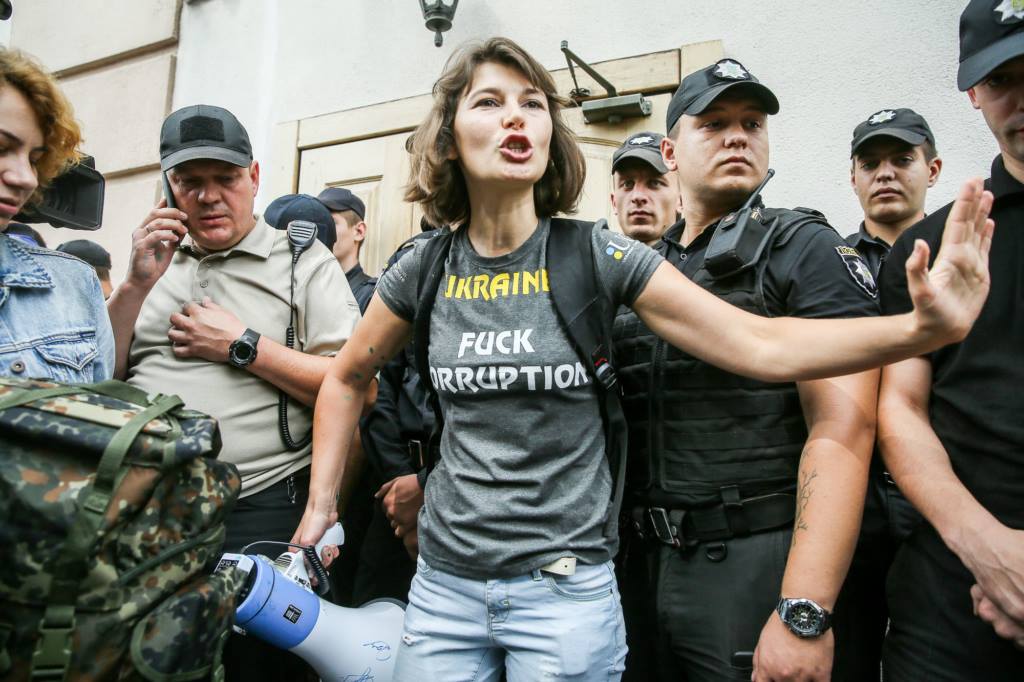
- Are we, as a people, capable of learning the lesson we have received?
- You know, I ask myself: why were we given such trials? But in any case, this war is felt most acutely by our soldiers on the line of contact, and by their families and loved ones. They understand the price for sure. For most people, however, it is probably harder to grasp the cost of irresponsible governance. When you are at home and there is no electricity at minus 20, you do not know what to do. You probably remember that, in fact, this is the responsibility of the president, the prime minister, and the mayor. And who are these people? Who put them in these positions? The answer is obvious. And to prevent this from happening again, so that the next generations do not have to live through such hardcore firsthand, but learn from our mistakes, we have to make conscious choices and become more mature and responsible. Because governing a state is a complex task. It is not a joke.
Olha Moskaliuk, Censor.NET
Photos provided by Daria Kaleniuk


