



"Nothing was prepared anywhere. We started digging, taking up defensive positions. There were no weapons, except for few assault rifles," - Roman Kovalenko (Revizor) on first days of battle for Kyiv
On March 7, 2022, approximately one battalion of enemy manpower and equipment entered Moshchun. However, the Russians did not recover a single vehicle; all of them were either burned or disabled, as was the majority of their personnel.
In March 2022, the 5th Company, commanded by Roman Kovalenko, call sign "Revizor", found itself in Moshchun near Kyiv. Roman spoke, perhaps for the first time, about the battles in this dacha settlement, the Russian assaults and their attempts to advance toward Kyiv, and the dead and wounded here. Few know that two mortar operators from the 2nd Mechanized Battalion of the 72nd Brigade remain in captivity to this day, since March 11, 2022, four years already!
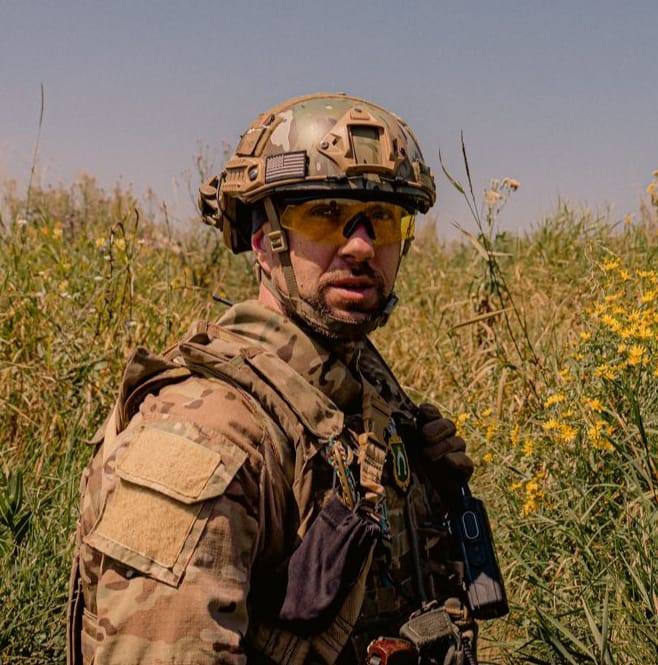
Moshchun proved to be the outpost of Kyiv. Had the Russians managed to break through the defense here, they would have easily reached the capital, which they so desperately sought. However, despite their superiority in manpower, equipment, and weaponry, they failed. They ran up against the 5th Company of the 2nd Mechanized Battalion of the 72nd Brigade. They were unable to overcome it, even though they forced our soldiers to retreat. To retreat and mount a powerful counter-resistance.
In fact, we met with the commander of that company, who no longer serves in the army due to his health condition, right in Moshchun. We walked the streets where the battles took place, inspected the house that served as his command post, and walked to the forest where the infantrymen had retreated. I looked at the road, an ordinary two-lane village road, and my skin crawled at my interlocutor's words that it was impossible to cross due to the density of the fire. There was the garage containing the soldiers' much-needed equipment just twenty paces away, yet they could not reach it for ten days.
Every year during these days, Moshchun is mentioned in accounts of the defense of Kyiv, but the chronological details of what happened here and how are being told, perhaps for the first time, by a person who found himself in this hell on the very first day of the full-scale invasion.
For reference, I will add that before 2022, few Ukrainians knew of the settlement of Moshchun, although, incidentally, the TV series "Svaty" was filmed here... A small village where, due to its proximity to the capital, houses had begun to be rebuilt into estates. However, according to statistics, out of nearly three thousand houses located here, two thousand were destroyed during March 2022... Destroyed—meaning completely. To this day, the majority have not been restored.
One more thing. For the defense of Moshchun, none of its defenders received the title of Hero of Ukraine... Although, had it not been for the soldiers of the 5th Company and the commander of the 2nd Mechanized Battalion of the 72nd Brigade, who literally stood their ground to the death, the Russians would have succeeded in entering the capital. It was precisely the people I spoke with about the events of those days who prevented this from happening.
ON FEBRUARY 25, WHEN RUSSIAN PARATROOPERS ATTEMPTED TO BREAK THROUGH INTO HORENKA, ANTI-TANK GUNNERS OF THE 72ND BRIGADE TOOK TWO VEHICLES OUT OF ACTION ON THE BRIDGE WITH A SINGLE MISSILE
The 72nd Brigade arrived here on February 24, though the commander of the 2nd Mechanized Battalion and his subordinates had visited these areas for reconnaissance two weeks before the start of the full-scale offensive.
- "I left for Kyiv on February 24 at around two in the morning, says Roman Kovalenko, who served as the commander of the 5th Company of the 2nd Mechanized Battalion of the 72nd Brigade at the beginning of the full-scale offensive. On the 23rd, we drove the equipment for loading; it was supposed to be in Kyiv by six in the morning. The battalion commander said then: "Those who are local, get home quickly. There will be no briefings. Get some rest, because tomorrow will be a very difficult day." I took a minibus home. I took off my jacket, washed my hands, and sat down to eat. My mother had served some soup, and I had just taken the first spoonful when my phone chimed, a message arrived in our battalion group. I thought I should read it immediately, not put it off. I read: "Urgent, load for departure by 12:00." I called a taxi and went to the railhead. We loaded the equipment onto the train, put the personnel on trucks, and around two in the morning, we left Bila Tserkva, some in "tablets" (UAZ-452 - ed.), others in "Urals." Some of the people had already been moved, a battalion command and observation post (COP) was deployed in the woods near Stoianka, and communication was being established. We encountered the war and the missiles on the road here, in the Boiarka area. That’s where we saw the first explosions."
We got onto the Zhytomyr highway, and things were chaotic there! Some were moving from Kyiv toward Zhytomyr, others toward Kyiv. We arrived at our designated point and were unloading equipment while enemy planes were already flying in the sky, and everything was exploding and burning...
Prior to that, it had been determined who would occupy which lines. My company was supposed to take positions from Moshchun to the village of Chervone. In that village, there is a well, a spring, right up to that point. Later, I was given a different sector, the very bottom of Chervone, and ordered to stretch my forces to the right and left. I objected: "Wait, I conducted reconnaissance for two days, I explained who should stand where, I had everything written down." I had pre-planned where each platoon should be located and who would be in charge. But they told me: "No, you need to take positions in Moshchun itself." I double-checked with Kalyna, the deputy battalion commander. He confirmed my initial plan. About 20 men on a ZIL truck, with a few more soldiers and me in a "tablet", went out first. We arrived in Chervone, Kalyna called: "Roma, where are the drivers?" - "I took them with me." - "Send them back to the railhead immediately!" Our IFVs (infantry fighting vehicles - ed.) had arrived from Bila Tserkva. So we started digging, because nothing had been prepared anywhere. We didn't even have any actual weapons with us at the time. And that was when my soldiers, having reached the outermost street, saw a katsap IFV for the first time, they took a shot and knocked it out.
We began taking up defensive positions. But there were no weapons, only a few assault rifles. The weapons were in a vehicle that had broken down on the road. Well, as usual...
- Where did it break down?
- Somewhere on the Zhytomyr road.
- What kind of weapons were there?
- Crew-served weapons, and also the assault rifles of some soldiers who hadn’t taken them along.
- What do you mean by "crew-served"?
- RPGs, DShKs (heavy machine gun -ed.), SPGs. Everything was brought to us that night. But what was frustrating: on the day we took positions in Moshchun, the Russian airborne landing in Hostomel had already taken place. They were flying over us! We saw them! But we had nothing to shoot back with. If only we had RPGs... I don't know... I felt so much regret then that there were no RPGs, I would have taken a shot.
- Did you shoot with assault rifles?
- From an assault rifle... What’s the use of an assault rifle when there are ten choppers...
- Right over our heads?
- They were flying so brazenly! Later, on another day, the guys were already firing machine guns at them, but what did that fire matter, they turned around and struck with free-flight aircraft rockets (FFARs). That was when Anhelina, our combat medic, was killed. That was on the 28th. I wasn't here then; I arrived toward evening...
The deputy commander for logistics saw how it happened. He had brought necessary supplies, and they were being unloaded just as the aircraft attacked. The Ural driver was wounded. Anhelina was providing him with medical aid when the next Russian aircraft launched FFARs... One hit the girl directly...

The red arrow on the map shows the Russians’ route
On the morning of February 25, Russian paratroopers attempted to break into Kyiv in the Horenka area. There were no tanks in that column, but soldiers of the 72nd Brigade from an observation post saw BMDs and "Tigers"; the Russians had chosen fast-moving vehicles. However, the column was stopped at the bridge. In the area of the current "Fora" supermarket, a tank of the 72nd Brigade was stationed, with anti-tank gunners positioned nearby. They were the first to engage, using a "Korsar" (anti-tank guided missile - ed). The soldiers recall that a truck was also traveling in that column. The anti-tank gunners of the 2nd Mechanized Battalion of the 72nd Brigade took two vehicles out of action with a single missile. Our BMP-1s were already in Horenka as well. They pounded the enemy, who, after the column was destroyed, tried to find cover in the reeds on the riverbank. But high-explosive fragmentation grenades found them. All of this stopped the Russians. They rolled back to Hostomel, to the first houses. Following this, the soldiers of the 72nd Brigade blew up one part of the bridge. They didn't have time for the other...
They couldn't manage everything because there were not enough people. The 2nd Mechanized Battalion of the 72nd Brigade had to cover 34 kilometers of the front: from the Kyiv Sea to Horenka. Later, they were "given" an additional sector up to the Romanivskyi Bridge, meaning up to Irpin.
Soldiers of the 2nd Mechanized Battalion of the 72nd Brigade also blew up the bridge in Dymer. They had laid explosives in advance and were waiting for the command. At that moment, a company-tactical group of the 80th Airborne Brigade was returning from near Chornobyl. It entered Lyutizh and stayed there for several hours when the order came to return through the battle formations of the 72nd and move toward Hostomel. This group was traveling through Dymer. At the same time, the 95th Brigade was also entering Hostomel from the direction of Bucha. The plan was as follows: to surround the airport, where the Russians had already landed, from two sides. When the 80th made contact, they were told: "We will blow up the bridge behind you. You won't be able to come back if something happens, because another massive enemy column is approaching." It was coming from the direction of Chornobyl. Along the way, it split into several branches: some went straight to Dymer, others stopped in the Kozarovychi area, dispersing near the cemetery... Part of the column went toward Hostomel. The paratroopers crossed the bridge, and behind their last vehicle, the bridge exploded and collapsed... A paratrooper who was in that very last vehicle described this, like scenes from a movie, in an interview with Censor.NET.
- The bridge in Dymer was blown up by Maks Shvets, a young lieutenant; unfortunately, he was killed later, recalls Mykhailo Dzeryn, who in 2022 served as the commander of the 2nd Mechanized Battalion of the 72nd Brigade. That was his first combat task. He joined us in the summer of 2021, and his first rotation was in Avdiivka. But there wasn't much work for him then; in those parts, everything had already been mined before him. Data on mined areas were handed over via reports and paperwork. He had no practical experience. And here, his first mission, and it’s a bridge right away. The responsibility was immense: enemy columns were marching on Kyiv! The soldiers of the engineering and sapper platoon, including Maks and Serioha Kutsyi, who was killed in 2023 in the Vuhledar direction, along with two other guys, laid the charge. But they used a bit more fuse than necessary. Consequently, it burned for a long time. Well, how long. Relatively long. Up to a minute. But how do we always want it? You pull the trigger, and there’s a shot. You light the fuse, and you want an immediate explosion. While that fuse was burning, the platoon commander's heart nearly stopped. He thought they’d have to go back there, that they’d done something wrong. While he was overthinking it, the fuse burned down, and it went bang. The bridge collapsed. Passage became impossible. Maks's heart was racing then, but he and his subordinates did their job perfectly.
- When and where was this young lieutenant killed?
- In Bakhmut, on the highway leading to the city from Horlivka. He was traveling with the deputy commander for moral and psychological support (MPS) when a 152mm shell hit the vehicle directly. Maks was killed instantly. The deputy for MPS was severely wounded but survived.
"ONE COMPANY COVERED 10 KILOMETERS OF THE FRONT. THIS IS WRONG. BUT AT THAT TIME WE WERE IN SUCH CONDITIONS, THERE WAS NO TIME TO ANALYZE WHAT WAS RIGHT OR WRONG. THE MAIN THING IS THAT THE COMPANY DID NOT LET THE OCCUPIERS INTO THE CAPITAL"
- On the 27th, at around 11:00 a.m., the battalion commander called: "Go to Moshchun. Take an IFV and go," continues Roman Kovalenko. "The enemy has entered!" In Moshchun, there is a small bridge over the Irpin River. It had not been blown up. A small number, about 14 vehicles, advanced across it toward Moshchun. Our armored group, consisting of three IFVs, moved out and engaged the enemy. Several enemy vehicles fired in our direction. But the Muscovites didn't particularly want to engage in a fight. Apparently, they didn't expect to encounter resistance here.

The very bridge in Moshchun
Having crossed the bridge, the Russians took the road to the right. At that time, our three BMPs were traveling from Chervone. Anton Antoniuk and Serioha Okhrimenko (Serioha was killed near Bakhmut in 2022) were unfamiliar with the terrain. Before setting out, I told them to head to the edge of the dachas near the forest, and then begin pushing out the Russians from there. They went first. Looking at their tracks, I saw they had raced along the frontline instead of staying under the cover of the forest! I thought: what to do, we are moving along the frontline. Chaos ensued; no one understood which vehicle belonged to whom. We lost people then... Anton among them.
When I arrived in Moshchun itself, I saw equipment but did not open fire immediately. I let one, then a second vehicle pass, and only then did I realize these were not our vehicles. I told the gunner: "Open fire!" A soldier named Kim and I jumped off the vehicle because an aircraft was approaching...
- That day, you drove the Russians back. You took one vehicle out of action, but two slipped into Moshchun...
- Those two that slipped through had been under fire. But only later did we realize they were our IFVs, one of them was Anton’s. The enemy had all returned across the river; the Muscovites withdrew. Kim and I reached a farm where they raised quail. We sat there and had a smoke. I radioed the battalion commander: "I’ll try to start and recover the disabled Muscovite IFV." But as soon as we moved toward it, three more Russian vehicles came from behind the bridge. They were already supported by artillery. I told Kim: "Let’s blast them!" We had picked up an NLAW while walking to the farm. Kim let one vehicle pass, then another. I suggested: "Kim, get on one knee and open fire with the NLAW as soon as I open the gate." He took a shot but missed, unfortunately. Later, he reproached himself for a long time, thinking he had made a mistake.
Our armored group engaged one of the enemy vehicles and scored a direct hit, knocking out an air defense command vehicle. The column turned around, abandoned the disabled vehicle, and left. Inside the abandoned vehicle, we saw three computers, these were workstations. We also found a pile of brand-new telnyashkas (telnyashka is a type of undershirt worn with military uniforms of the Russian Armed Forces - ed.)....
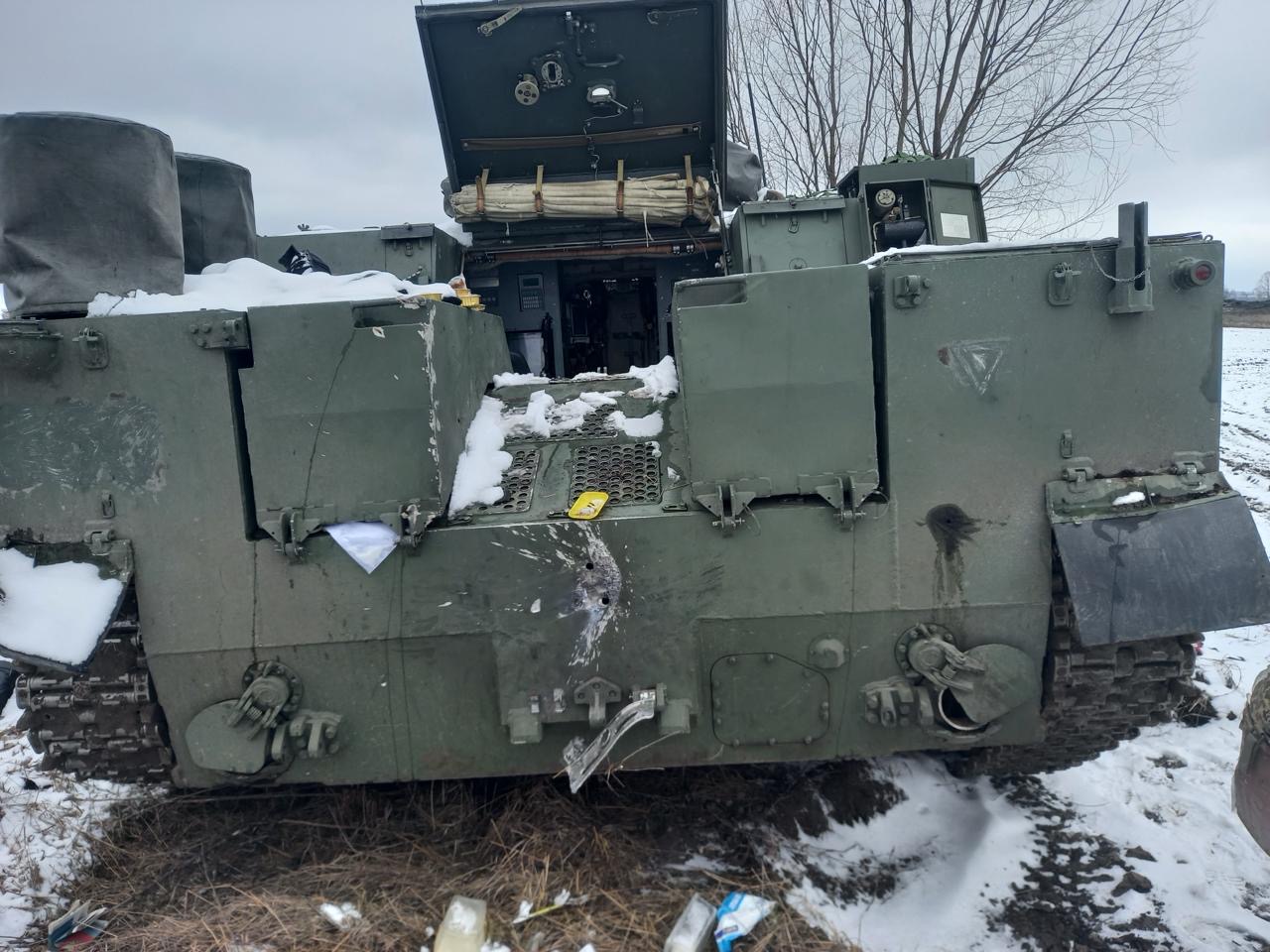
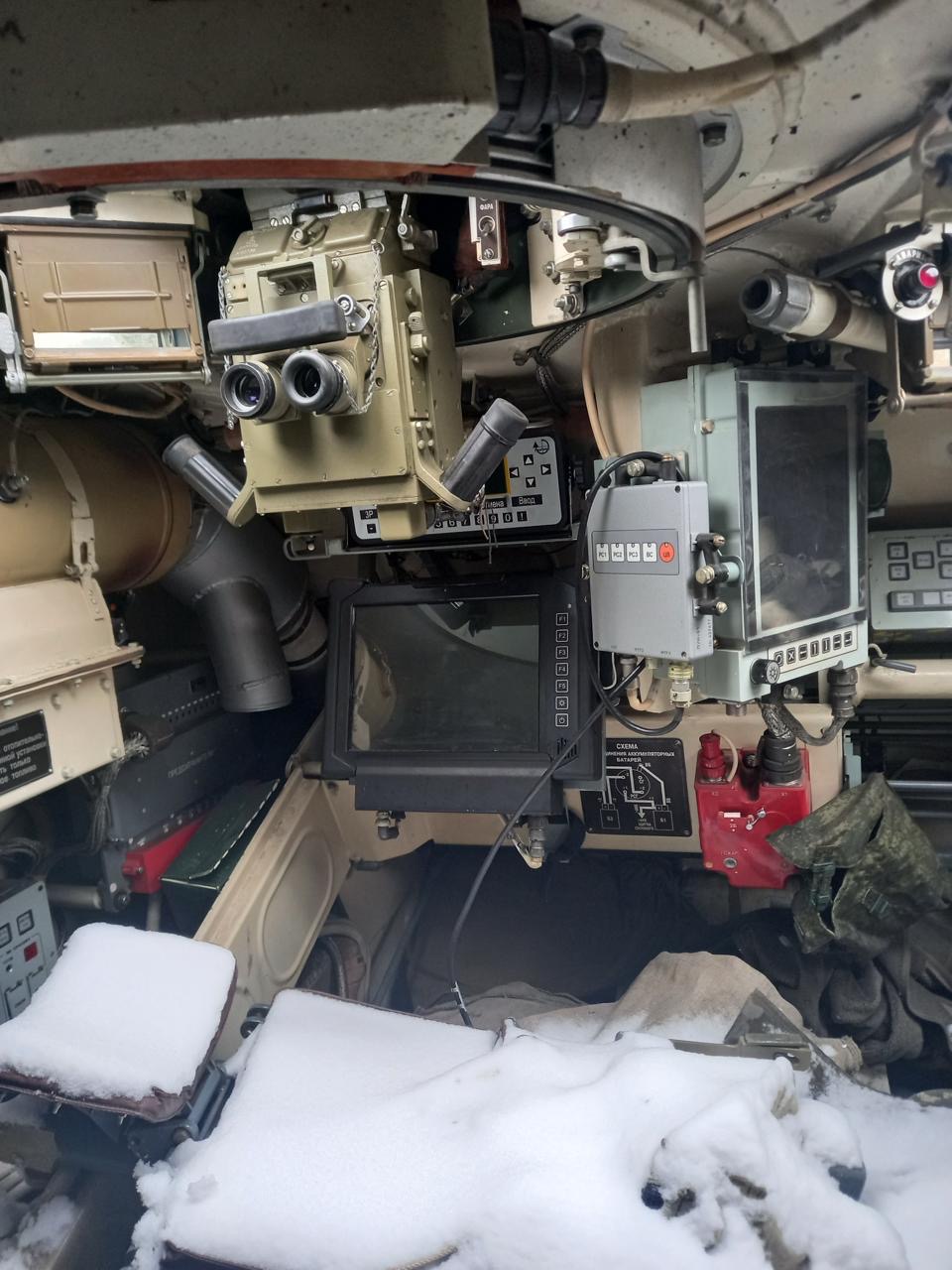


Not far from us, as we learned later, soldiers from a reconnaissance platoon were in a trench. They were also striking enemy armor. Initially, that platoon had been attached to me in Chervone. The battalion commander had moved them to Moshchun earlier to take up defensive positions and establish coordination, as I was told the National Guard was supposed to be stationed here.
We returned to the main trench; Kalyna, the deputy battalion commander, arrived, and tanks came to push out the katsaps. I said: "There’s probably no one left here by now." We realized they had returned across the small bridge. And the battalion commander told me: "Petrovych, leave someone in charge in Chervone, and here, organize the defense and choose a COP for yourself. You're here tomorrow." I left and collected my things. I took ten men with me from Chervone and left platoon commander Andrii Zynoviev in charge. I told the company's first sergeant: "Help him out, and I will be visiting you." So, by the time I arrived in Moshchun, the reconnaissance platoon and the mobilized personnel who were sent to both the scouts and me were already here. As a result, everyone thought that everyone in Moshchun belonged to the 5th Company.
On the same day, the small bridge through which the enemy vehicles had slipped was blown up. They could no longer pass through there.
- On the 28th, I chose a house for the command post, finding a sturdy building – a three-storey building with a semi-basement, - continues Roman. "It wasn't exactly a cellar, but a plinth level, with windows above the ground. This house was located near the spot where the enemy had attempted to break through. It was convenient for commanding the company, being close to the frontline.

This is how the house where the soldiers of the 5th Company were briefly based looked in the spring of 2024
There were no people in that house. We carefully opened the door. The next day, the owner arrived and began to protest. I said to him: "Listen, I did everything carefully, I didn't break anything. You see what's happening. Tomorrow, the house might not even be here anymore." Well, he fumed for a bit and then calmed down.
On that same day or the next, "Javelins" were brought to us. The enemy did not attempt to enter, but we were heavily shelled by artillery. One of the shells struck a house near the one we had occupied. Kim provided medical aid there...
Censor.NET published a detailed account of this back in March 2022. At that time, we did not name the participants of the events. Now we can state that Roman, whom we quoted then, is the commander of the 5th Company, Roman Kovalenko, and Yurii is Kim, whom we repeatedly mention in this article. That account complements this story, adding important pieces to the larger picture.
"We started digging trenches in front of the river," continues Roman Kovalenko. "Beyond that is a field through which everything is clearly visible. People would go out to the trenches for duty shifts, leaving their belongings in the houses further back. That’s how we began creating a defensive line. What did we dig with? Shovels."
- Did you also dig near the forest, creating a second line?
- San Sanych Marchenko once served with us. He was mobilized to our unit in the very first days of the full-scale invasion.

Roman Kovalenko with Oleksandr Marchenko in Moshchun, March 2022
He found a tractor somewhere, and in the early days, he dug all the trenches where he was directed: both closer to the river and in the forest behind the road, where the memorial stands now. But the trenches and dugouts there have been somewhat remodeled. In March 2022, they were positioned slightly differently...
This is how I had planned it: I had positions along the houses toward the river. At the far-left position was a soldier with the call sign "Rzhavyi" (Rusty - ed.) with a DShK. He had an excellent field of vision. I managed to deploy the men I was given up to the forest edge toward Chervone. I desperately wanted to close that gap, but I didn't have enough personnel. Even when people did arrive, there were no weapons, nothing to arm them with; only a few had assault rifles. I managed to place those who arrived near the dachas, but as for the area where they eventually broke through... I had planned to set up a position there. I had walked through it, scouted everything, and thought out exactly where to place people so there would be visual contact between positions, and everything would be covered. But we didn't have enough time. It was from that forest edge that the katsaps advanced. Further along was the "Mars" position, a priest who treated alcoholism and drug addiction lived there. I stationed 20 men there because the river approached that spot, and they could have broken through, they tried, but we held the line. My guys took out of action a significant amount of equipment there as well. But closer to Moshchun from that "Mars" position, the Russians managed to lay down pontoons.
- "What can one say when a company is covering 10 kilometers of the front?", remarks one of the brigade's officers. "How is a company commander supposed to stretch himself to control everything? Where do you find the people for such a distance? It is not right to do it this way. But we were in those conditions. There was no time to figure out what was right or wrong. The task had to be carried out to prevent the occupiers from entering the capital. The company succeeded in that."
"ON THE FOREST EDGE, MY MEN KNOCKED OUT THREE ENEMY AIRBORNE ASSAULT VEHICLES AND A TANK"
- What was happening leading up to March 6th? — I ask Roman Kovalenko.
- Oh! There was such shelling! They were shelling Chervone with artillery. Our HUR (Defense Intelligence) operators would go out across the small bridge, heading into those forests toward the glass factory on the other side, conducting diversions and blowing things up. They would leave at night and return by morning. Perhaps some katsaps sabotage groups were scouting roads they could use to enter, flying drones, observing, and reconnoitering. Perhaps these groups were quietly entering, looking for gaps at the seams where they could pass through. On the night of March 5th, they finally entered. I had an IFV and six men positioned under the forest at the end of the dachas in that spot. Alim was the gunner, and Denchyk (he was killed near Vuhledar) was the rifleman. They had a point they would drive out to in order to engage the enemy. That enemy group entered from the direction of the forest, through a small street. On foot. They eventually felt out an open sector where no one was stationed, and there was no movement. There was a gap of about two to two and a half kilometers with no one to hold it.
And at night, the battle began; airborne assault vehicles (AAVs) rolled out and started blasting us. We knocked out a BMD with a Javelin then. On the 5th, they demolished my COP with artillery; only the semi-basement and a bit of the second floor remained. By that day, there were already small arms battles within Moshchun. We realized the katsaps were here, on the right flank. My mechanics were still sitting there, firing back. On the night of the 5th, the platoon commander reported to me that the enemy was throwing a pontoon crossing across the river.

Footage of the pontoon crossing, which allowed the Russians to enter Moshchun
On the 6th, they began storming us from the outermost street.
- And when did the enemy equipment enter?
- Most likely on March 7. I called for reinforcements: "Give us ammo, we are running out of ammunition." But the guys wouldn't bring anything; they refused: "I won't make it through, everything is under fire." I called for a IFV and said: "Get over here." He came to us. He parked the IFV almost right at the COP, ran in: "Commander, we're here." I said: "Are you kidding? Get back out of here! Don't stand here." They were driving out, firing back, because they already saw the katsaps in the streets. But one of them hit the vehicle with a "Mukha" (RPG-18 -ed.)... Sashko, the driver, was wounded in the leg then; the shaped-charge jet burned through. Now everything is fine, he can walk, he survived. But he was severely concussed. After that hit, the IFV stopped right by the garage where our equipment was stored. It survived. It was repaired later and sent to the 8th Company.
As later analyzed by the brigade command, up to a battalion of personnel and equipment entered Moshchun. The enemy failed to recover a single vehicle when they fled, every one of them was knocked out or destroyed; it all remained in Moshchun.
"I clearly remember that three AAVs and a tank were destroyed at the edge of the forest," adds Roman Kovalenko.
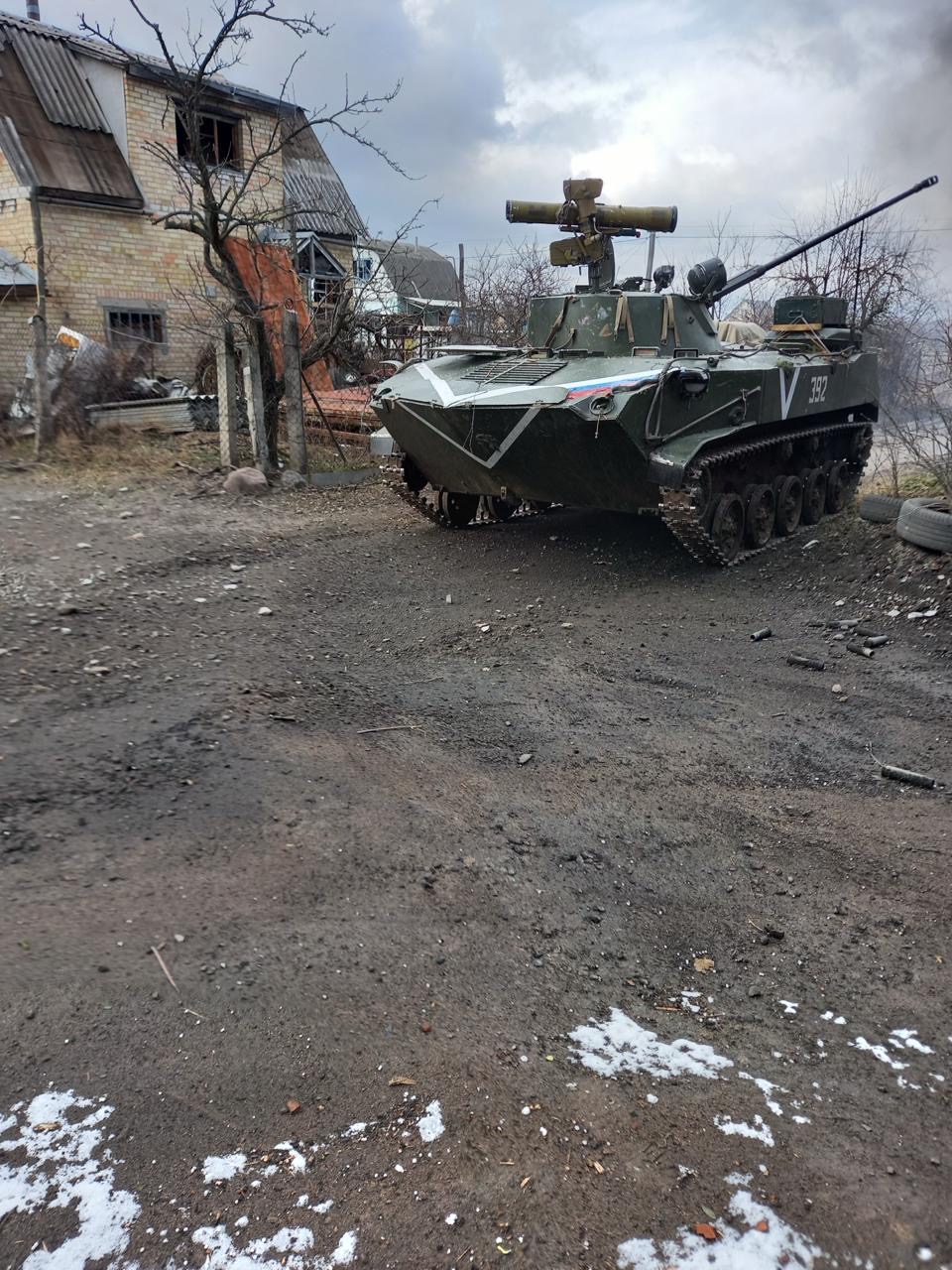
One of the enemy vehicles captured by the soldiers of the 72nd Brigade
- When did you relocate from the COP?
- We relocated on the 6th. I destroyed the radio set, as that was the priority. Drone chargers and some weapons were left behind. All my personal belongings stayed there, including a book I had brought with me. When my things were being gathered, the book fell out. When I returned here in late March, I found my toiletry bag that had been left in the bathroom and picked up the book. When we were retreating, we couldn't take everything. We took only what was of primary importance. We headed along the same small street through which the Russians had broken through, toward the spot where the battalion commander was later wounded, to an unfinished house near the forest edge.
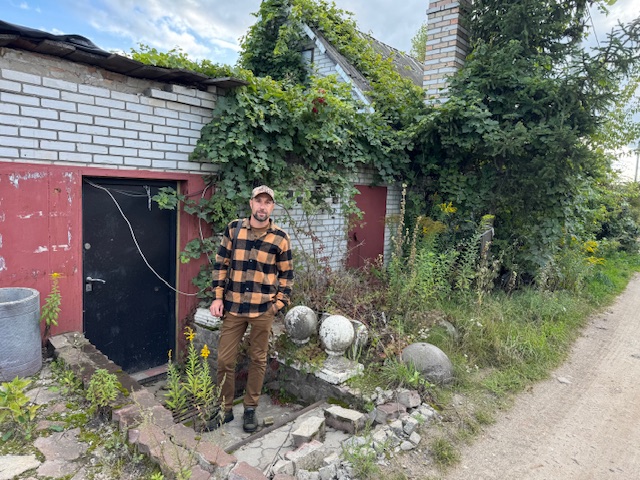
Roman Kovalenko near the house where his COP was located, during the recording of the interview in the summer of 2025
We withdrew, and our infantry began to panic: "We won't hold out!" I'll be honest, I was panicking too, because the men were running. We had to hold the defense, but they climbed out of the trenches and left. The reconnaissance platoon commander and I looked at each other, and he said: "Roma, let's set up a defense; we have to try to hold the men." We didn't stop until we reached the village club. The OUN members arrived, along with the International Battalion and the Georgians, and together we moved in a skirmish line to occupy the trenches along the forest, near the road to the corner of the dachas, where the minibus turns around now. I was deploying the men. It was pure chaos!.. There was no communication, and radio sets were scarce. And they just started pounding us there day after day! Everything was being thrown at us.
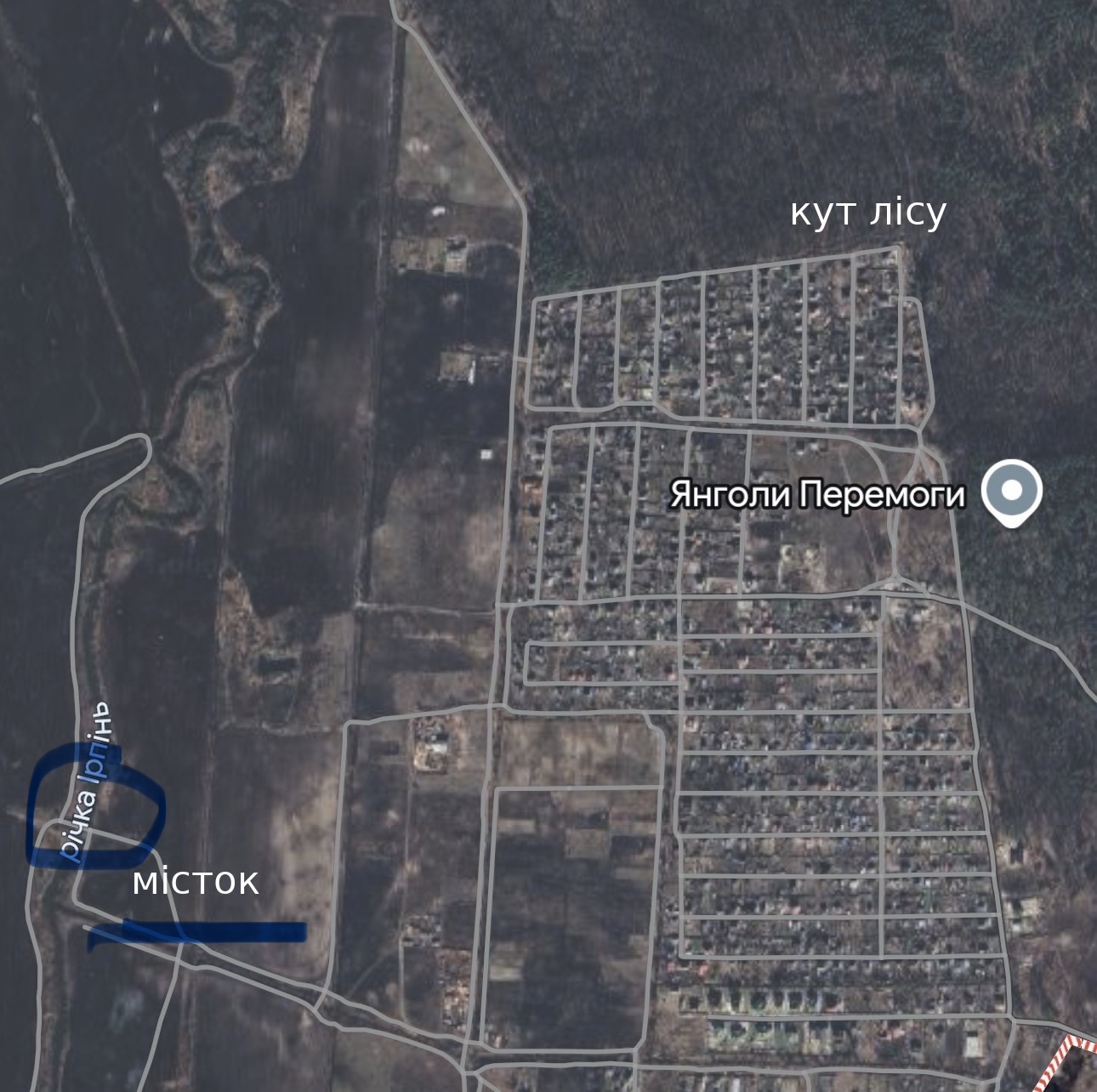
The map marks the blown-up bridge and the forest corner, also known as the "corner of the dachas", where the enemy managed to enter. "Angels of Victory" is the name of the memorial dedicated to the soldiers killed in 2022. It was there that the trenches holding our troops were located.
Meanwhile, the enemy had taken the summer cottage area. The HUR troops went out every night, killed them, and returned. We already wanted to storm the area and clear it then.
On the 8th, the battalion commander visited me. I was to show him where Rzhavyi had stood, the positions, and how the men were deployed. As we were heading there, we stumbled upon the katsaps. I raised my hand to show my yellow armband, I didn't understand who was in front of me: our guys or not? One raised his hand back, but another opened fire, there seemed to be four of them. The distance between us was about two hundred meters. There were two or three other men with us, though I don't recall exactly who.
- Did you see white armbands on them?
- It was hard to see. We had to move uphill, and they were at the top. I saw someone crossing the road. Ours or not?.. When I raised my hand, they opened fire on us. We retreated immediately. The battalion commander then raced off to drive them out. Their equipment was knocked out then. The next day, March 9, the battalion commander was wounded. We were on our way to coordinate a clearing operation with "Aidar" when we came under fire. The commander sustained a shrapnel wound. His driver, Sania Yemets, was killed... He was a former soldier of ours who had mobilized in the first days of the full-scale invasion.
The emotional state of the men was grim. About 20 or 30 men had arrived with the battalion commander as reinforcements. After the commander was wounded, his deputy, Kalyna, came to us to help hold the defense.
"THE MEMORIES ARE SUCH THAT IT IS HARD TO STAND ON THIS GROUND"
We walked through Moshchun several times with the participants of those events; they recounted what happened and how during those March days. All the events unfolded literally on four of the village's streets. But the density of fire here was such that, as my interlocutors recall, you couldn't even lift your head in the trenches in the forest behind the road, where the memorial has now been established. They approached the company's soldiers not via the road through Moshchun, but through the forest. One of the battalion's officers recalls finding terrified soldiers in a trench. They complained they hadn't had anything to eat or drink for two days. "And five meters away from them, in the adjacent trench, there was plenty of food. I told them that, but they were afraid even to poke their heads out of the ground," the officer recalls. "So I went myself and brought back, I remember, a bucket of varenyky; volunteers were already delivering things like that. I took a pack of water and brought it to the guys. I even ate one varenyk with them. It was delicious. With potatoes..."
"What can I say," adds Roman Kovalenko. - Our equipment was in a garage, it's the one closest to the street, clearly visible from the forest and the trenches we moved through. Behind the garage was a two-story building where my guys from the 5th Company and American snipers stayed for a long time. Probably until about March 11, when it became impossible to remain there; my guys were still running back and forth. Pasha Ropalo, carrying a machine gun, was running from that garage and the fire all around was already so intense! - he crossed the road and dove straight into our trench, jumping right on top of me.

Behind Roman Kovalenko is that very garage which they could not reach for several days. A disabled IFV belonging to the 5th Company remained on the road near the garage. The officer himself is standing on the road beyond which the Russians were already positioned. In March 2022, it was impossible to cross.
- Did you take your belongings?
- What property are you talking about?! Both generators and sleeping bags were in that garage. Initially, the first sergeant was stationed there when it could be considered the rear. The forward positions were closer to the river. But then the garage ended up in the grey zone, which was impossible to reach. And on the 11th, I was severely concussed.
- How did that happen?
- That day, the katsaps started storming our positions in the woods. Two IFVs were driving down one street, and two more along a parallel one. Our guys knocked one out with an RPG. But a group of katsaps bypassed us along the forest edge and essentially entered our rear. Vania Soroka spotted them first and warned the others, saving us from being surrounded. He threw a grenade himself and killed the captain, the group leader. He wasn't finished off; he died on his own. We had fatalities then. It was also then that a mortar crew from the 2nd Mechanized Battalion was captured. They were at a position in the forest. One of the mortar operators returned in an exchange nearly a year ago. The other two are still in captivity. Vania Soroka later sustained a severe wound near Bakhmut and lost his sight. In my opinion, this is a man who already deserves the title of Hero of Ukraine for his actions in Moshchun.
We had a lot of shell-shocked men back then. "Grads," aviation, and helicopters were flying at us, and tube artillery was pounding us. They hit us harder than in previous days. Our tank moved out for direct fire, it drove down the street. It spotted an AAV, knocked out one, then a second. Then the tank's loading mechanism jammed, something broke and that tank was withdrawn.
Being shell-shocked, I was evacuated to a hospital in Kyiv. Many of us were evacuated then. I received treatment for seven days and then returned.

This photograph was taken by the author of the article on March 13, 2022, in a Kyiv hospital while visiting Roman Kovalenko.
- Who remained in command of the company?
- The following day, the deputy brigade commander, Vladyslav Naliazhnyi, brought in a company from a motorized infantry battalion as reinforcements.
- Did they remain at your positions in the forest, in those trenches?
- Yes. Later, on the 13th or 14th, they were driven out by "Uragan" and "Smerch" fire and retreated even further. The Muscovites even entered those trenches behind the road. And they continued to advance. That was when "Kosmos," the deputy commander of the motorized infantry battalion, was killed. It was difficult, but the Muscovites were unable to advance beyond that forest.

…Thanks to the fact that the dam upstream near Dymer was blown up, the Irpin River flooded significantly, preventing the enemy from bringing new units into the battle. They could not transfer as many forces from Hostomel as they had intended. They were no longer able to transport equipment because the pontoons had been swept away. Consequently, our soldiers began to drive them out. When it became clear that they could not hold their ground, they left behind small observation posts. However, the bulk of the personnel disguised themselves in civilian clothes found in the houses and tried to swim across the water to escape.
- I returned here on the 20th or 21st of March, - continues Roman. "Some of my men were still here. I gathered up to a hundred people. We took up positions at the forest corner. The enemy was gone; they had been driven out of Moshchun by that point. But the katsap artillery was still pounding the area, striking us with phosphorus munitions."
This is how the guys fought in the forest in Moshchun. One moment was filmed from two different angles.
It was clear from the news that the katsaps had been driven out of Bucha. Wounded and various stragglers remained around, as we found buried corpses, and there was a stench. After all this, people were afraid to go beyond the forest because the enemy had left many tripwires behind. So, Mykhailych and I walked slowly, gradually reaching "Mars." We moved very carefully, searching for tripwires. We made sure no one was there... But they were gone only from our side. They were still on the other bank of the river. There was still movement and gunfire there.
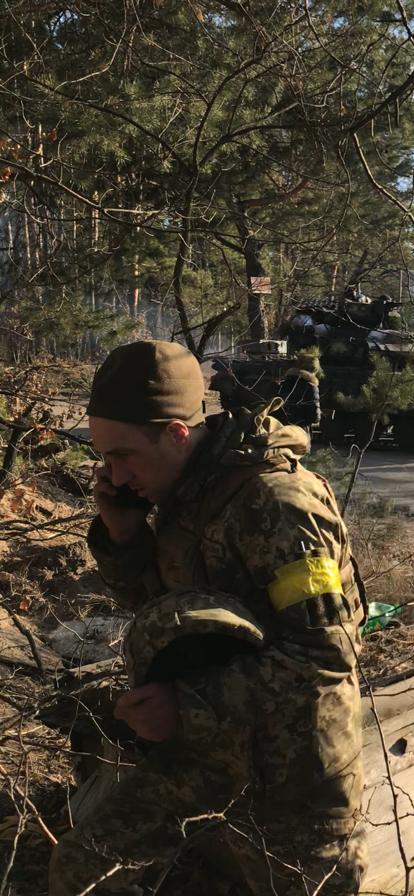
- So, when you returned, there were no combat operations here anymore?
- Only artillery strikes and aviation attacks, they were targeting Moshchun specifically. They also hit the forest. But there were no more assaults, breakthroughs, or battles. We went all the way to the river to retrieve the dead, pulling our guys out of the trenches while artillery fired at us.
This video was filmed by Roman Kovalenko on March 22, 2022, as they were retrieving the body of one of their comrades.
- Did you retrieve all the fallen? Are there any still missing?
- We found all those missing. I think it took a long time to identify Vasia. First, we retrieved the dead from the forest. We hadn't walked the streets of Moshchun itself yet. Later, I did go, looking around. Katsaps were lying around, but I didn't see any of ours. On the outermost street, there were many katsaps lying. There, I saw a katsap with a sailor's cap; a telnyashka had fallen out of his backpack... It was then that I found my book near the COP, the one that fell out when we were retreating on March 6. I took it.
Roman looks in all directions. He looks at the houses, fences, and trees, which have grown significantly during this time and changed the landscape.
- So many people died here! I nearly lost my own life here. The memories are such that it is hard to stand on this ground. How this entire defense held, how much the guys endured...
Somewhere here is a small house where katsaps were sitting in the windows, and we just couldn't hit them with an SPG. It simply wouldn't work. We hauled it from place to place, set it up. But it didn't work. Then we brought an AGS. I fired from it; everything was exploding in front of me because everything was flying at us too. And at that time, we didn't care that bullets and shrapnel were flying around. We ran back and forth. We were trying to do something.
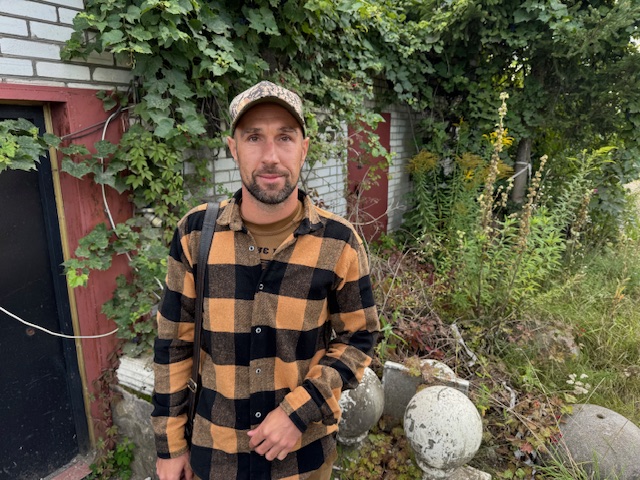
- Did you understand that Moshchun could essentially have become the gateway to Kyiv for the enemy? That is why the Russians were so desperate to break through here...
- Well, yes. Nearby is Pushcha-Vodytsia; from here to Kyiv, it’s just a stone’s throw away... Everyone understood that. I thought they would press against Horenka, trying to enter there. But they were crushed on the first day, so they decided to come here. They managed to break through here. But not for long. We still managed to drive them out, to stop them. And that is the main thing.
We are already preparing to leave Moshchun, walking along the streets from the company’s former COP toward the road, toward the forest where Roman’s soldiers had their positions. Near the garage they couldn’t reach for so long, the man suddenly begins to laugh, pointing at some goats roaming around like the absolute masters of the village.
- And the goats are grazing just as they were! They were wandering here even then, which amazed us tremendously. There are, after all, eternal values in this world.
Violetta Kirtoka, Censor.NET


