



How veteran Vladyslav Sambur is fighting to recover UAH 4 million paid during his captivity to his mother, who had been stripped of parental rights
"A mother stripped of parental rights squandered her son’s UAH 4 million while he was in captivity" — headlines like this swept through the media last year. This is the story of Vladyslav Sambur, a serviceman with the 501st Separate Marine Battalion. After almost three years in captivity, a shock awaited him back home: his military unit had been paying his entire salary and additional remuneration to someone who, legally, had no ties to him.
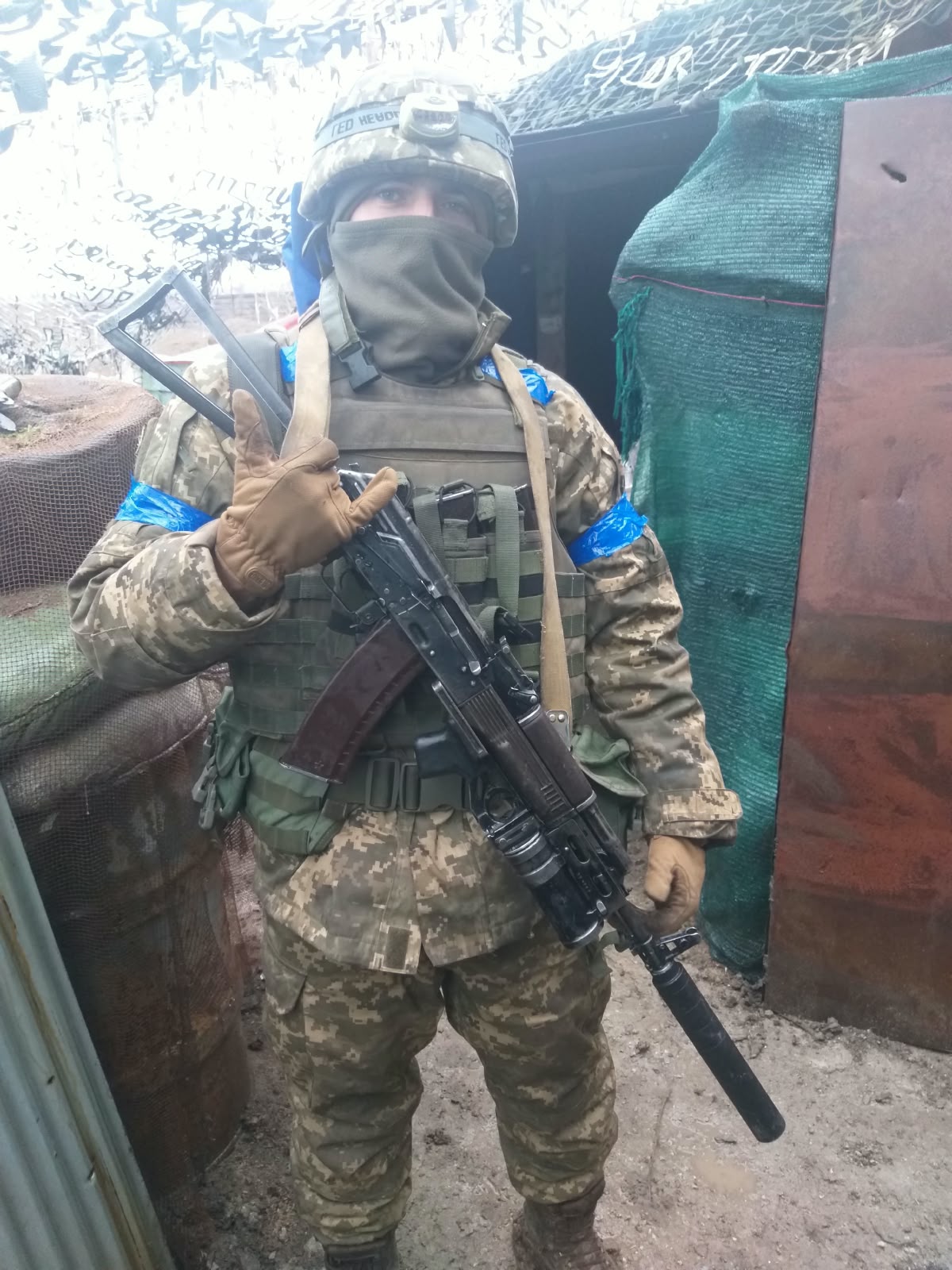
What happened after the public outcry remains out of the spotlight. One would expect the state to provide a soldier who survived all the horrors of Russian imprisonment and captivity with legal and social support and comprehensive assistance. Instead, today, a year and a half after his release from captivity, Vladyslav Sambur is forced to seek justice in court. He has not received a single kopeck of his money, his disability benefits have still not been credited, and no criminal proceedings have been registered over possible fraud involving the payments.
Censor.NET is following the situation and asking: why, a year and a half after his release from Russian captivity, is the veteran seeking justice in court on his own? Given that Sambur’s case is not an isolated one, it is worth examining how to unravel this tangle of legal oversight and indifference.
THE STORY: "SHE JUST SQUANDERED MY MONEY"
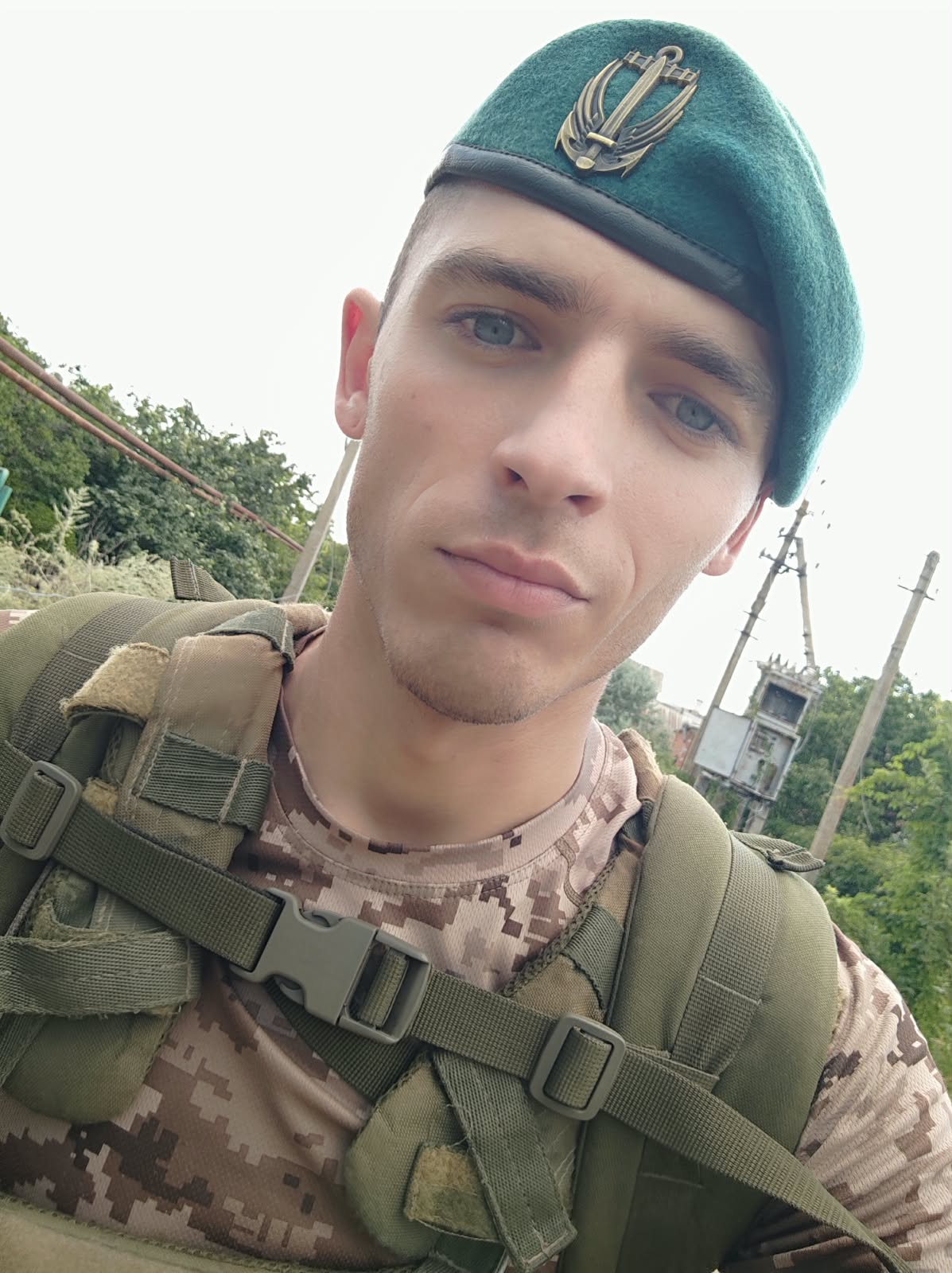
Vladyslav Sambur, from Berdiansk, had dreamed of becoming a paratrooper since childhood. He signed a military service contract in July 2018 and was serving with the 501st Separate Marine Battalion when Russia launched its full-scale invasion. After receiving orders to redeploy to Mariupol, he spent the first weeks of the full-scale war there with his fellow servicemen. Like all the other soldiers in the battalion, he was taken prisoner on April 4, 2022.
For almost three years, Sambur was transferred between various Russian penal colonies and pretrial detention centres. Among the places he endured were the notorious Olenivka and the hell of Taganrog. Daily beatings, hunger, psychological abuse… Vladyslav spent most of his captivity in Penal Colony No. 4 in Alekseyevka, Belgorod region.
He has spoken in several interviews about what he endured at the hands of his Russian torturers. I will quote one passage:
"Have you ever seen people whose bodies were blue after beatings? We were covered in blue bruises. From the top of our backs almost down to our heels. Some had concussions. Those who could move on their own carried the others because the beatings were so severe."
Because of the appalling living conditions, Vladyslav developed an infectious form of tuberculosis, which Russian doctors diagnosed as cancer. He also developed polyneuropathy in captivity. Along with the two blast injuries Vladyslav had sustained before being taken prisoner, these conditions severely damaged his health.
Sambur was finally freed from captivity in January 2025. After his return and initial treatment, a shocking surprise awaited the serviceman: the payments he was entitled to had been paid to his biological mother, who had been stripped of parental rights back in 2005. He therefore had to put on hold the dreams that had helped him endure Russian abuse.
Sambur maintains that his personnel file, in which he had provided information about his mother, disappeared from the military unit. As a result, Vladyslav had to spend six months after his release from captivity restoring his combatant status:
"I had to call the Ministry of Defence and the Marine Corps Command to restore my combatant status. And when I was discharged on May 22, 2025, they did not give me my pay certificate. The territorial recruitment centre submitted a request for a replacement certificate to establish that I was not receiving any payments from the unit."
Sambur believes that he lost his money through the military unit’s fault, so he went to court to demand that it help recover the lost sum. There is now a court ruling requiring military unit 1965 to accept Sambur’s application for the return of the funds.
"They can simply give me back my money. Who they paid it to is their problem. Legally, my mother has had no ties to me since 2005. When I signed the contract, I stated that I was deprived of parental care. I also listed the educational institutions I had attended (a boarding school).
"Of course, they would not have transferred money to her on their own initiative. As I was later told, my mother came in with my birth certificate. But this did not happen just once. She came in every year, submitted applications, and received UAH 100,000 for each year I spent in captivity, plus my health improvement allowance.
"The only letter she sent me in captivity was written before she received the first payment. That first payment was almost UAH 2 million, and after that she disappeared.
"In my lawsuit, I demanded that the military unit examine the situation and take certain steps to pay me the money. We have been in litigation with them for almost a year now. My lawyers have submitted multiple formal requests to them. Even the enforcement service has sent them letters."
He said that his mother, Svitlana Sambur, had been stripped of parental rights because, with five children at the time, she could not provide them with proper care and education. As the eldest, Vladyslav looked after the younger children and therefore did not attend school.
"If she had at least bought apartments with that money, so there was some property, that would have been something. But she essentially bought nothing and just squandered it. She is still paying off an old house in a godforsaken village," he adds.
Vladyslav had maintained some contact with his biological mother, so she knew he had been taken prisoner. Based on the information he has, Vladyslav believes his siblings also took part in squandering his money, but he cannot prove it.
Vladyslav, now 33, lives in Cherkasy. He has enrolled in a university programme in psychology and dreams of working for a veterans’ organisation. He is supported by his cousin, who also survived Russian captivity.
Another difficulty for Vladyslav has been the protracted process of arranging his disability payments. The relevant department at the local territorial recruitment centre has still not accepted his application documents:
"The head of the department initially gave me August 28 as the date to bring in my documents. I came on the 28th, a Friday, and she said: ‘I’m not seeing applicants today.’ Then she went on leave from Monday. She won’t be able to see me until November 10. I called the Defence Ministry’s hotline and lodged a complaint."
Vladyslav was assigned Group III disability status (subject to reassessment), but his condition is currently deteriorating. This year, he has already undergone one course of treatment at a state hospital and plans to undergo three more.
MILITARY UNIT: PAYMENTS TO THE MOTHER WERE MADE IN ACCORDANCE WITH THE LAW
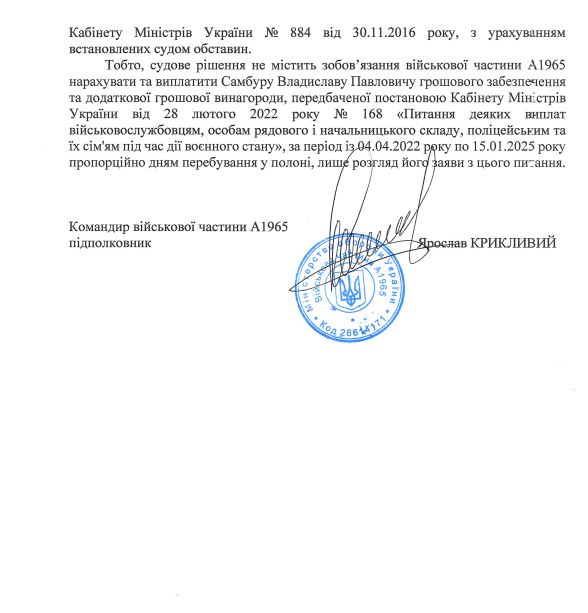
In a brief comment, the coordinator for prisoner-of-war matters at the 501st Battalion said that Vladyslav Sambur’s case was being handled. In its detailed response, the military unit’s command states that the payments to Svitlana Sambur were lawful and that Vladyslav’s lawyer had been informed of this.
The military unit will appeal the court’s ruling and maintains that it acted lawfully because, unlike under the current procedure, military units in 2022–2023 had no access to state registers and were not required to verify the information.
Furthermore, in a conversation with Censor.NET, a representative of the military unit stated that he had Vladyslav Sambur’s service record and autobiography at hand, neither of which mentioned that his mother had been stripped of parental rights.
Judging by the response, the military unit did not report the possible fraud, so no criminal proceedings have been registered. Why it took our inquiry to draw attention to this remains an open question. Perhaps the State Bureau of Investigation or the Military Law Enforcement Service should ask it.
We reproduce the military unit’s response in full:
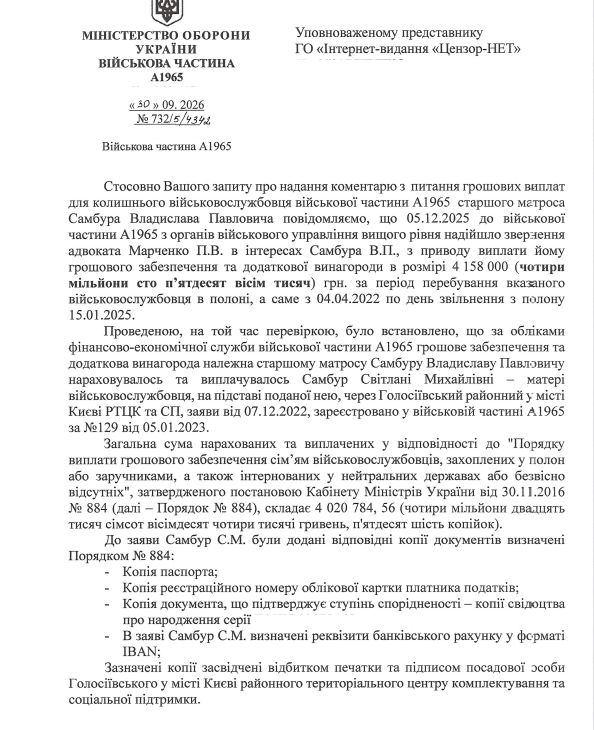
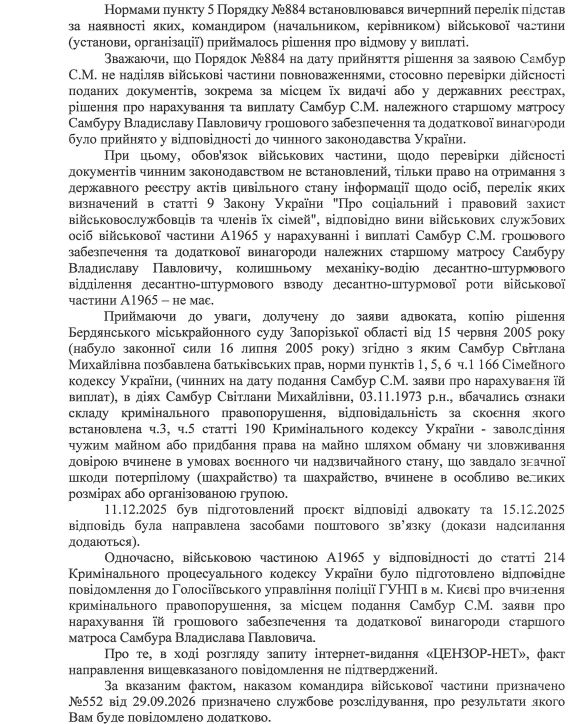
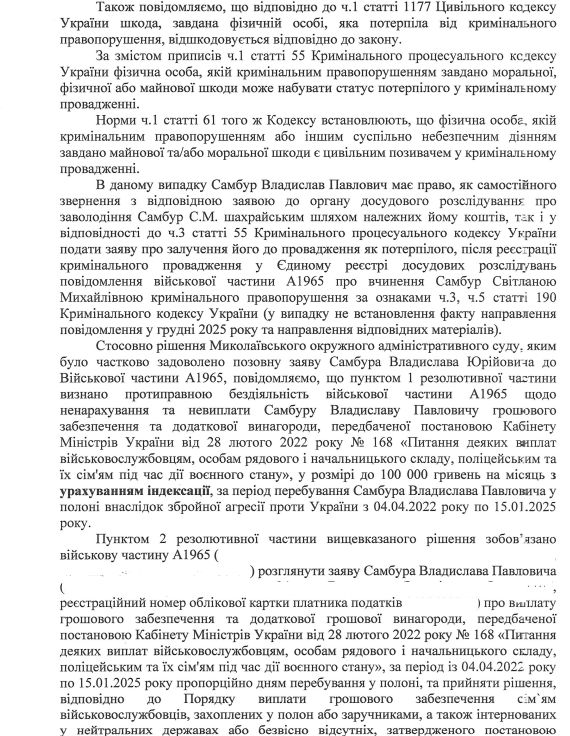
Sambur’s case is not the only one of its kind, even within the 501st Battalion. The state has made some administrative improvements. Since 2024, military units have been authorised to request extracts from the civil status register and verify whether family ties remain legally valid. In February 2025, amendments to Ukraine’s Law "On the Social and Legal Protection of Military Personnel and Members of Their Families" came into force, under which the family members of a serviceman or servicewoman held captive receive only 50% of their military pay. The remaining 50% is transferred to the service member’s deposit account.
LAWYER’S COMMENT: THE MONEY BELONGS TO THE SERVICE MEMBER
Lawyer Roman Lykhachov, who specialises in cases involving military personnel, also notes that Vladyslav Sambur’s case is not isolated and is complex.
"The courts now take the position that funds paid to relatives still belong to the service member," he says. "Interestingly, both the Cabinet of Ministers resolution and Article 16 of the law stipulated that relatives could receive the funds, but neither clearly specified how those funds could be managed or spent. There have therefore already been several favourable court rulings requiring those who received service members’ money while they were in captivity to return it.
"So the first issue is civil liability: this money must be returned."
In Vladyslav Sambur’s case, his mother spent the money while owning virtually no property.
"We need to establish what she spent it on. Simply saying, ‘I just spent several million,’ is not good enough. This really is a matter for the police, because fraud may have been involved.
"A lawsuit needs to be filed against the mother, but there are also questions concerning the military unit. First, it is worth establishing whether the unit followed all the procedures correctly and whether it violated the rules in force at the time. Again, did the service member’s personnel file state that his mother had been stripped of parental rights? That could have called her eligibility to receive the funds into question.
"The military unit’s position here is telling, as is the possibility that it did not report the matter to the police. After all, we are talking about UAH 4 million that never reached the service member. The military unit relies on Cabinet of Ministers Resolution No. 884, which clearly specifies the documents required to receive the payments. At the time, there was indeed no provision requiring it to verify the certificate or obtain an extract from the civil registry.
"It is also possible that the court ruling stripping the mother of parental rights was not entered into the civil registry database. In that case, the state failed to establish an effective mechanism for ascertaining the circumstances and ensuring that the funds were allocated fairly.
"Such cases do occur. We have a case where a couple was divorced by a court. The court ruling dates back to 2011, yet the former wife receives the service member’s money because no one submitted the ruling to the civil registry office. There is also a fairly similar case in which payments were made to a serviceman’s mother even though he had a wife and child."
At present, it appears that the litigation will continue and Vladyslav will face a long struggle to recover his money. From any perspective, in Sambur’s case, the state failed to provide a transparent procedure for safeguarding his rights and verifying all the circumstances surrounding his family ties. We remember that in 2022, the state itself was fighting for its survival and was only beginning to improve the mechanisms for protecting military personnel. Yet a soldier who devoted his endurance and sacrificed his health to defend it deserves better treatment.
You can support Vladyslav Sambur financially by transferring funds to his card:
4441 1177 0190 1713
Olha Skorokhod, Censor.NET


