


How and why Koretskyi government left local communities without money
For a month now, the State Treasury Service has not been processing payments from local budgets. Local communities have money in their accounts but cannot access it. Even loan funds received from the EBRD are being blocked. These payments are essential, among other things, to the operation of municipal utilities and preparations for the heating season.

"To ensure people do not go unpaid, municipal utilities are being forced to take out loans," says Lviv Mayor Andrii Sadovyi.
However, the Association of Ukrainian Cities told BusinessCensor that municipal utilities have already accumulated wage arrears, exposing their managers to potential criminal liability. This is despite wage payments being classified as protected expenditure that must be given priority.
Overall, the situation is critical across Ukraine. Local communities are reporting blocked payments to contractors providing transport, building maintenance, healthcare, social and educational services, clearing and rebuilding structures destroyed by shelling, preparing for the heating season, and more. The situation is deteriorating daily. Until now, communities had some reserves to fall back on: they arranged for essential services to be provided against earlier advance payments or on credit. But that cushion is now running out, as no company will keep working on credit. Moreover, it is unclear how these debts can be repaid, even if the Treasury unblocks all local budget payments today.
Until now, local authorities have had some leeway – they have arranged for essential services through advance payments or on credit. But this is now running out, as no company will work on credit. Moreover, it is unclear how these debts will be repaid, even if the Treasury were to unblock all payments from local budgets today.
In practice, this means transport services grinding to a halt because cities simply cannot buy fuel, rubbish piling up in the streets because it cannot be collected and street cleaners cannot work, problems at hospitals, and no heating in homes. People simply have not yet felt the full extent of the problem.
Animals appear likely to be the first to feel the consequences firsthand: Odesa Zoo has already warned that Treasury payment delays could leave its animals without food.
BusinessCensor began looking into this story. It turned out to resemble the rabbit hole in "Alice in Wonderland": we kept falling deeper, with no bottom in sight.
Why local communities’ payments were halted
The main reason is a budget deficit caused by declining state budget revenues and a failure to fulfil commitments to secure international financial assistance. On September 18, the Finance Ministry abruptly halted funding for capital expenditure nationwide, without warning or discussion. Local budgets came under pressure at around the same time.
Speaking at a meeting of the Congress of Local and Regional Authorities under the President of Ukraine on October 6, Prime Minister Serhii Koretskyi explained that deferring non-priority expenditure was a necessary step to meet defence needs and pay salaries and pensions.
Dmytro Bilotserkivets, a Kyiv City Council member who serves on its Standing Commission on Budget and Socioeconomic Development, told BusinessCensor that problems with the state budget had prompted the government to impose strict spending cuts while allowing certain categories of expenditure to be funded.
In other words, he said, communities can spend their money, but within limits. For example, they can provide subventions to the military. The restrictions essentially cover expenditure on capital construction and repairs, the proverbial "relaying of paving stones". But they supposedly do not apply to energy resilience.
"In recent years, subventions to the Armed Forces of Ukraine were the priority for the city budget. This year, unfortunately, the priority shifted to capital construction. While around UAH 10 billion was allocated to capital construction in 2025, the figure for 2026 is almost UAH 20 billion," Bilotserkivets said.
According to Nila Ostrovska, head of the Krasyliv amalgamated territorial community, the state is now using communities’ money to meet its most critical needs — defence and social services.
"These are major items of state expenditure. Unfortunately, communities’ money is going towards these areas, while we have been left with the problems," she told regional television channel TV7+.
Communities, then, do not object to funding the military, but they also need to keep their towns and villages functioning every day. An ambulance that cannot reach a call because it has no fuel, or rubbish left uncollected, are problems that need to be addressed here and now.
The phantom Cabinet resolution
Questions also arise regarding the legal grounds for blocking, or rather ‘postponing’, payments.
On 28 September, the Cabinet of Ministers adopted a decision on prioritising budget expenditure in the context of limited financial resources, as reported on the Government portal. Business Censor attempted to locate the relevant resolution, but neither the text of the document nor even its reference number is publicly available.
The editorial team has obtained a draft resolution entitled ‘Certain issues regarding ensuring the balanced implementation of the state and local budgets in 2026 under martial law’. It appears that the State Treasury Service of Ukraine is acting on the basis of this document when suspending payments from local budgets. However, the catch is that it was supposed to come into force upon publication. As it stands, it has no legal force.
Business Censor submitted a request to the State Treasury asking it to clarify, in particular, on what grounds payments from local authorities are being blocked. However, at the time of publication, we had not received a response. It is therefore difficult to understand the logic behind the officials’ actions.
"The prime minister explicitly said there would be manual control — and unfortunately, that is exactly what we have," Oksana Prodan, an adviser to the chair of the Association of Ukrainian Cities, told BusinessCensor.
Former Ukrainian Deputy Prime Minister Hennadii Zubko had previously warned about the risks of manual control.
"Who receives funding and for which expenditure will depend on an individual Treasury official — a direct path to corruption," he stressed.
Prodan highlighted another telling detail. Communities are trying to negotiate arrangements over outstanding debts with contractors, suppliers and banks, but penalties and interest are already accruing.
"To avoid penalties, they need the government decision on which the blocking is based. The decision whose substance was posted on the Finance Ministry’s official website, but which does not exist — it has not been published, and without a number, which it does not have, there is no decision," she explained to BusinessCensor.
According to Oksana Prodan, unless the government urgently unblocks vital payments, people will be left without essential services. And unless the government adopts a decision providing legal grounds for communities’ failure to make payments for services, goods, loans and so on, communities will face penalties for failing to meet their obligations while also giving testimony in criminal proceedings over violations of budget legislation.
Payment priorities amid limited financial resources
Assuming that the State Treasury Service is currently following the resolution "Certain Issues Concerning Balanced Execution of the State and Local Budgets in 2026 under Martial Law", the document requires the agency to prepare a daily cash flow forecast for its accounts each month.
This forecast serves as the basis for a "forecast of available financial resources for each ten-day period, incorporating the actual opening cash balance for that period, projected domestic borrowing and revenues of the state and local budgets, the unified contribution for compulsory state social insurance, and other receipts expected during the relevant ten-day period".
If this forecast shows that the cash balance, together with expected receipts into the general and special funds of the state and local budgets, is insufficient to cover expected expenditure for the planned month, the State Treasury Service must process payments subject to special arrangements.

The overall logic is that when funds in the single treasury account are insufficient, the Treasury processes payments in order of priority: security and defence, state debt servicing, pensions, salaries and social benefits come first. In other words, the most critical expenditure.
In Oksana Prodan’s view, blocking local budget payments amounts to authoritarianism and a rollback of decentralisation and democracy, neither of which has anything to do with martial law.
"From my personal conversations with international partners, they are shocked. The Association of Ukrainian Cities has not yet formally approached them," Prodan says.
Speaking from the rostrum of the Verkhovna Rada on October 14, Kyiv Mayor Vitalii Klychko said there were attempts to destroy local self-government in Ukraine and not just in the capital.
"By removing community heads on spurious grounds. By bringing absurd accusations and intimidating the heads of small communities with criminal cases <...> All cities are dealing with the problems the government created by freezing payments," he said.
When will local communities’ payments resume?
Speaking in the Verkhovna Rada on October 16, Serhii Koretskyi said that the Cabinet of Ministers of Ukraine had begun gradually restoring funding for temporarily suspended state budget expenditure, including for regional needs.
He attributed this to lawmakers passing bills on which the receipt of international assistance was conditional. According to the prime minister, the relevant documents can now be submitted to the European Commission to secure some of the funds urgently needed to cover the financing gap before the end of the year.
"We are gradually beginning to release funds that were temporarily frozen, in the hope and expectation that some money will come in as a result of the laws passed, and in the hope that the coming parliamentary sitting weeks will be equally constructive, productive and effective," Koretskyi said.
However, the key point in his remarks is that Ukraine will receive only some of the promised funds. This will therefore not resolve the broader budget problem. An immediate improvement in the processing of communities’ payments should not be expected at this stage.
Information from the Association of Ukrainian Cities confirms this. According to Oksana Prodan, some payment orders submitted by local authorities before September 14, 2026, have now been partially paid in certain regions.
"Those submitted after September 14 have not yet been processed in any region. Payments have not been unblocked," she told BusinessCensor.
Incidentally, the resolution "Certain Issues Concerning Balanced Execution of the State and Local Budgets in 2026 under Martial Law" (although we can only assume that it has any bearing on the situation) states that it will remain in effect until December 31, 2026.
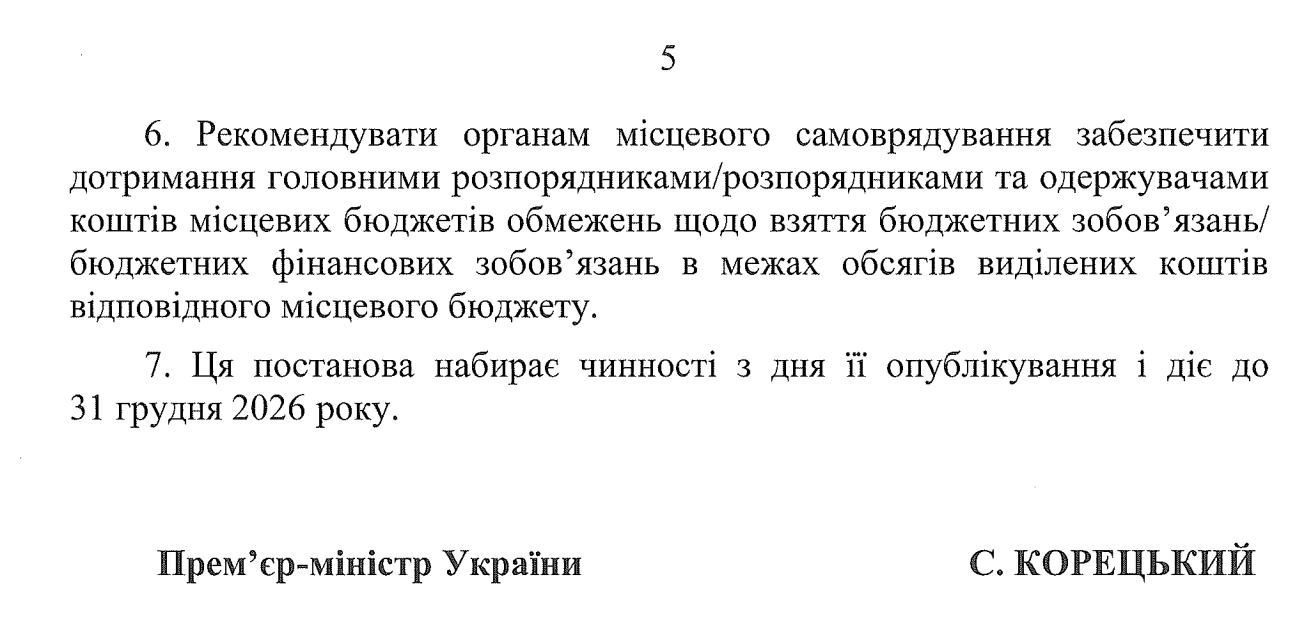
There is therefore no guarantee that communities’ payments will not be blocked again before the end of the year. After all, the money the budget needs will not appear out of thin air. And this is happening on the eve of a winter that even officials describe as "the most difficult in history".
Meanwhile, the state places responsibility for preparations for the cold weather squarely on local authorities. In late August, the National Security and Defence Council adopted a decision holding military administration officials, mayors and enterprise managers personally responsible for failing to implement approved resilience plans.


