



"Soldiers have right to choose their unit rather than submit to government’s ’perverse bureaucratic logic,’" - Palamar, deputy commander of "Azov" Battalion, regarding his return from AWOL
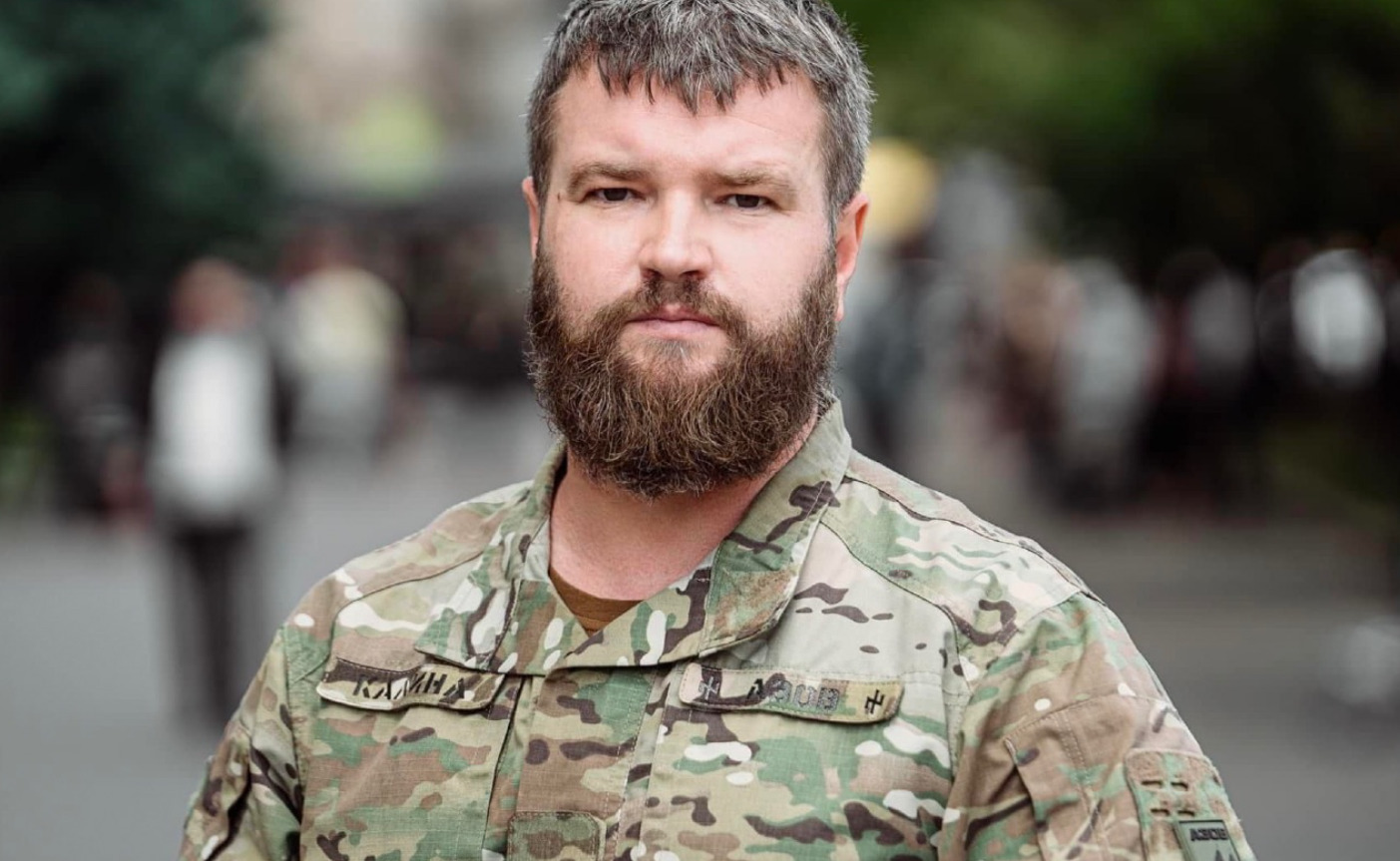
Sviatoslav (Kalyna) Palamar, deputy commander of the 1st Corps of the Ukrainian National Guard "Azov," called on the Cabinet of Ministers and the Ministry of Defense to radically change the bureaucratic rules regarding the return of military personnel from the AWOL. He is demanding that soldiers with actual combat experience be granted the fair right to independently choose the unit and branch of the Armed Forces (Armed Forces of Ukraine, National Guard of Ukraine, or State Border Guard Service) in which to continue their service.
He wrote about this on Facebook, according to Censor.NET.
Reasons for the AWOL
Palamar emphasized that civilian officials in ministerial offices have absolutely no understanding of the psychology of soldiers who have spent years teetering between life and death. The assumption that the threat of criminal punishment will force people to return to places where their rights were violated is a profound mistake.
"Soldiers who are currently on the AWOL for various reasons have been through war, witnessed death, and carried out combat missions for years. They certainly aren’t afraid of criminal proceedings, trials, or virtual imprisonment. You can even go off to fight from there, because there aren’t enough cells for everyone right now. Many soldiers chose the AWOL not because of the war. They left due to specific problems in their units, because of their commanders, and because of a loss of faith in a system that has often been unable—and unwilling—to acknowledge its own mistakes," Kalyna stated.
The paradox of the system: recruiting people off the streets while ignoring ready-to-serve soldiers
Palamar identified departmental ties as the main flaw in the current government resolution. If a soldier leaves the ranks of the Armed Forces of Ukraine (AFU), the system leaves him no choice but to return to the AFU, prohibiting a transfer to the National Guard or the State Border Guard Service, where conditions or leadership might be more professional.
Palamar called this situation outright absurd given the severe personnel shortage on the front lines:
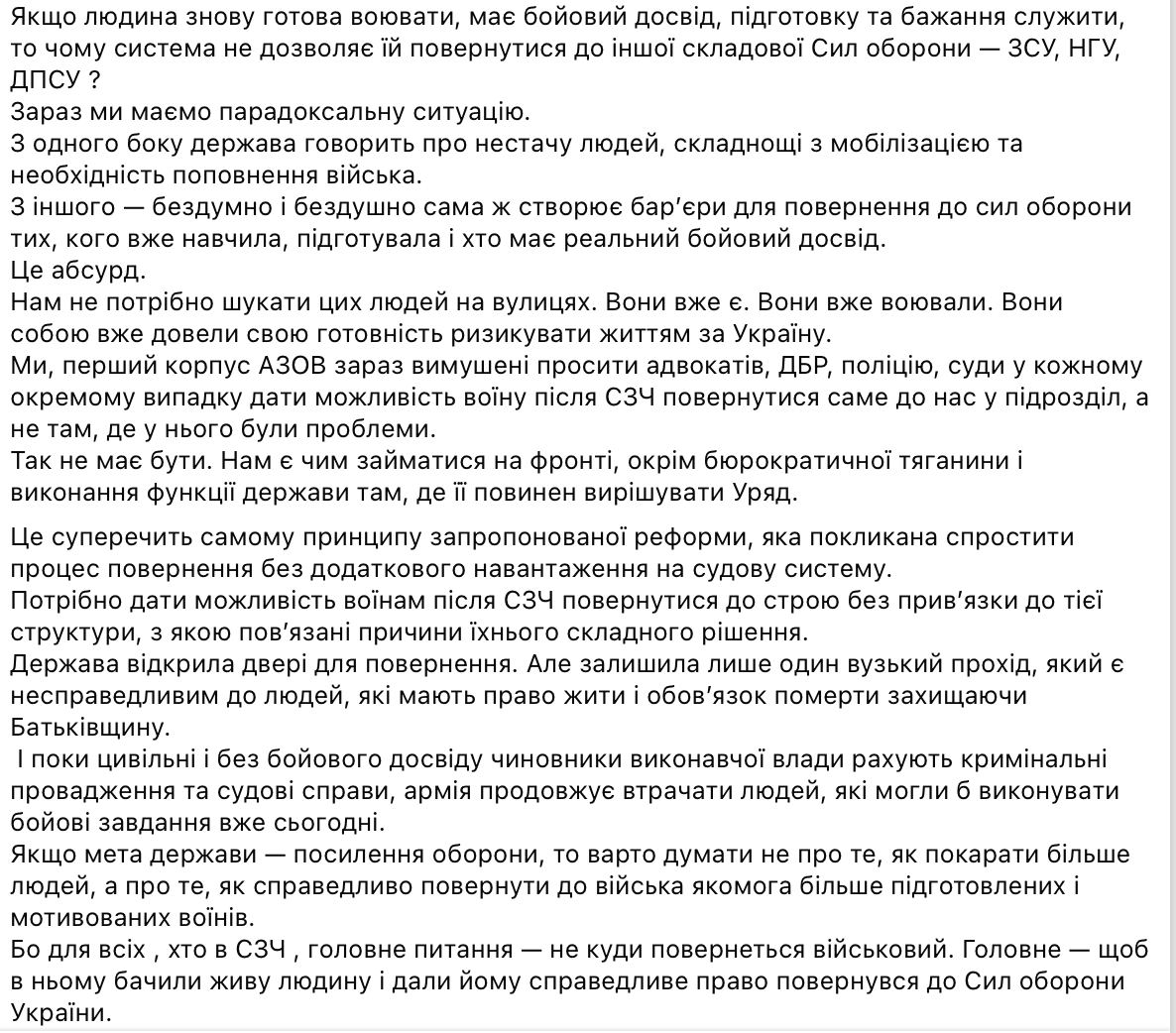
"On the one hand, the government talks about a shortage of personnel, difficulties with mobilization, and the need to replenish the troops. On the other hand, it thoughtlessly and callously creates barriers to the return to the defense forces of those it has already trained, prepared, and who have real combat experience. This is absurd. We don’t need to look for these people on the streets. They’re already here. But today, we—the 1st AZOV Corps—are forced to ask lawyers, the State Bureau of Investigation, the police, and the courts, in each individual case, to allow a soldier to return specifically to our unit. We have enough to do on the front lines without having to deal with bureaucratic red tape and performing the state’s functions in areas where the government should be handling them."
A call to the government: address the causes, not the consequences
A representative of the "Azov" Command has appealed to the Cabinet of Ministers and the Ministry of Defense, demanding an end to "civil-political pretense" and calling for the military to be granted fair and broad opportunities to transfer between different components of the Defense Forces.
According to Palamar, as soon as the state allows veterans to return to places where they are seen as living people—and not merely as "staff numbers for reports"—the army will instantly receive a massive influx of trained fighters capable of carrying out combat missions today.


What preceded it?
- As a reminder, on June 12, the Ministry of Defense launched a new program: for 100 days—from June 12 through September 20—service members who left the military without authorization can voluntarily return to a unit of their choice and have their pay reinstated.
- On June 15, Deputy Minister of Defense Mstyslav Banik reported that 80 applications had been submitted during this period, 22 of which had been approved.
- As of June 16, it was reported that in just a few days, nearly 200 service members had submitted applications via the "Army+" app, and 51 of them had been approved.


