



PACE proposes that Russian Federation’s frozen assets be used to compensate Ukraine
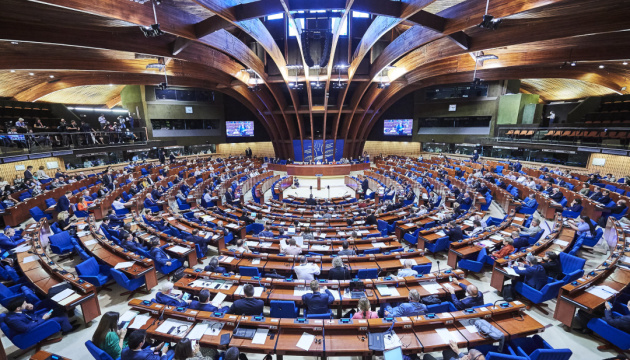
The PACE Committee on Legal Affairs and Human Rights has called for the establishment of a mechanism to use Russia’s frozen state assets to pay compensation to Ukraine in accordance with the rulings of the European Court of Human Rights.
According to Censor.NET, this is stated on the website of the Parliamentary Assembly of the Council of Europe.
The committee approved the relevant draft resolutions and recommendations on the basis of a report by the British MP Tony Vaughan.
Russian assets may be used to provide compensation to Ukraine
In two inter-state cases brought by Ukraine, the European Court of Human Rights has already found Russia responsible for serious human rights violations linked to its war of aggression.
At the same time, the amount of compensation that Russia is to pay to Ukraine has not yet been determined.
The committee noted that, given the scale of the damage inflicted on Ukraine, the sums involved could be very substantial.
"The amounts awarded could potentially run into billions, tens of billions or hundreds of billions of euros," the statement said.
Members of parliament concluded that the use of Russian state assets to pay compensation to Ukraine in cases relating to the war would be in accordance with international law.
Following the start of Russia’s full-scale invasion, around 260 billion euros’ worth of assets held by the Central Bank of the Russian Federation were frozen. Approximately 210 billion euros of these are held in the European Union.
The committee proposed setting up a special financial mechanism under the auspices of the Council of Europe. It is to receive Russian assets and channel the funds to Ukraine.
PACE wants to strengthen the enforcement of ECHR rulings
PACE noted that Russia was suspended from the Council of Europe on 16 March 2022. Six months later, it ceased to be a party to the European Convention on Human Rights.
At the same time, Russia remains obliged to comply with the ECtHR’s judgments concerning violations committed prior to the suspension of the Convention’s application to the Russian Federation.
"This obligation under international law does not diminish over time and cannot be repealed by Russian domestic legislation."
The Committee also called on states to ensure that the European Court of Human Rights’ judgments against Russia can be enforced at national level.
In particular, the legislation of these countries must allow claimants to seek enforcement of the compensation awarded as long as the Russian Federation refuses to pay it voluntarily.
Furthermore, PACE proposes the creation of a public list of individuals implicated in large-scale human rights violations established by rulings of the European Court of Human Rights, but who have not yet been held to account.
It is proposed that the following be included in the list:
- persons implicated in large-scale human rights violations;
- people who have not yet been brought to justice;
- information that needs to be updated regularly.
The list is to be forwarded to the member states of the Council of Europe, the European Union and the International Criminal Court with a view to imposing targeted sanctions or bringing criminal proceedings.
The draft resolutions and recommendations approved by the committee are due to be tabled for consideration at the PACE plenary session on 30 September.


