



Viktor Pavlov: "UGV is expensive hardware, but compared to human life, it costs pennies"
Drone Industry
This is not just an interview, but a full-fledged tour of the UGV school based at the Third Assault Brigade, which Viktor Pavlov and his comrades have been developing since January 2025. Demand for training among service members is so high that the waiting list is booked eight months ahead. Unmanned ground vehicles are becoming increasingly widespread at the front, but there are not enough people who can train qualified operators. The state welcomes the initiative but does not yet fund it, so the team has to look for resources for their activities on their own.
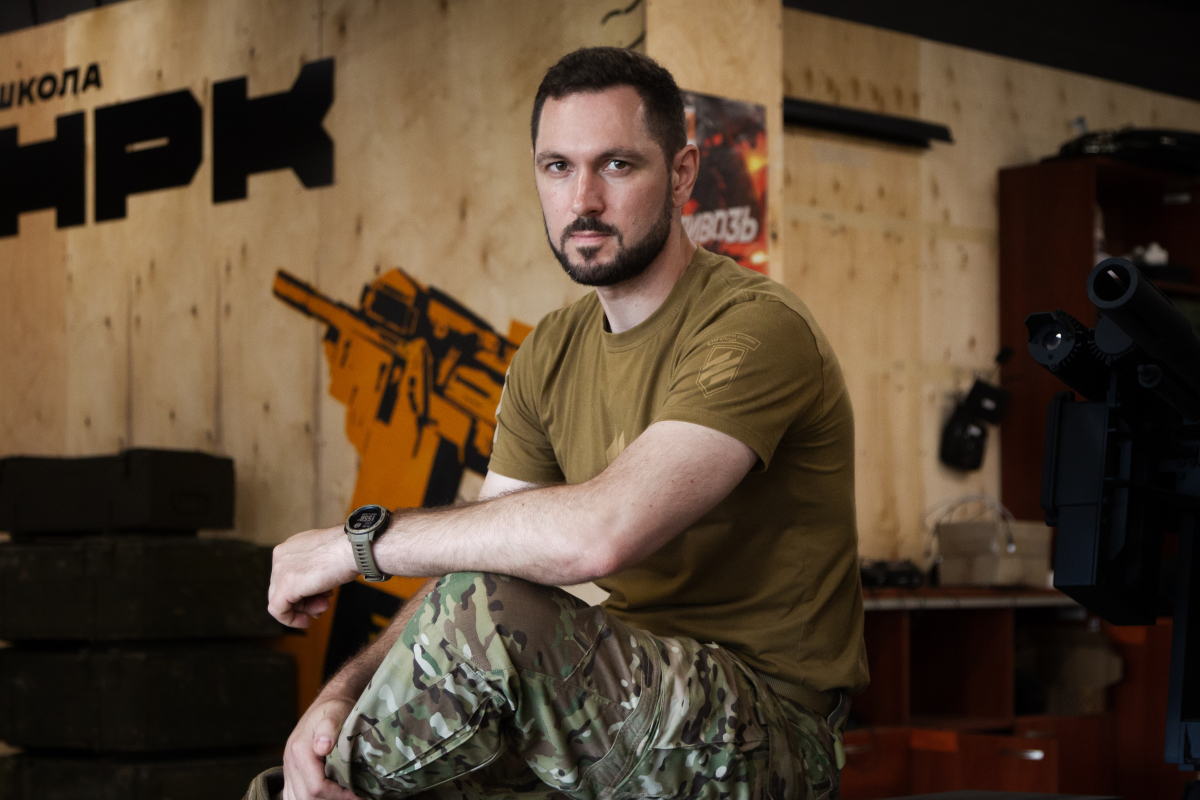
"First, I’ll show you our UAV pilot school, and then we’ll get to the UGVs," says Viktor Pavlov as he steps out of the car.
Before the war, Viktor was an entrepreneur; among other things, he founded the UAmade retail chain. In March 2022, he handed over the management of his business and volunteered for the front.
He joined the SOF unit "Azov-Kyiv". Later, the unit became the Third Assault Brigade. At the front, he initiated the creation of the first aerial reconnaissance platoon (Zaporizhzhia direction), took part in the battles near Bakhmut, and together with his comrades built a system of unmanned units within the brigade.
In September 2023, he initiated the creation of the NOVA Technology Center, whose mission was to research new solutions, test them in combat conditions, and integrate them into the brigade’s operations. As part of this work, Viktor became interested in unmanned ground vehicles – UGVs. Together with his comrades, he began exploring this field, and later, they started testing ground drones in combat.
This line of work developed within the brigade. In 2024, it was the "Third" that created the first official UGV unit structure. In parallel, Viktor came up with the idea of opening a UGV school. The idea was supported, and since January 2025, he has been building it up.
– "Quite nice Quidditch arena you’ve got here," I say as I walk into the huge hangar where UAV pilots are training.
Tyres hang from the ceiling at different heights, pipes are set up on the ground at all sorts of levels and seemingly impossible angles. Piles of broken bricks either imitate breastwork or they simply haven’t been cleared away after construction. Somewhere in the middle of all this chaos, FPV drones buzz hysterically – the guys are practicing maneuvers.
– "We have two courses for pilots," Viktor explains. "Basic and advanced. The basic course covers the fundamentals of control. The advanced one involves payloads and training that is close to real combat conditions."
We move on – the area is huge. At some point, I realise an FPV is flying straight at me. Literally.
– "Is this how you always greet your guests?" I ask, stepping out of the drone’s flight path.
The drone hovered next to us for a few seconds and then slowly drifted away, as if it were patrolling or looking for another target.
– "Depends on who the guests are. It might be carrying a warhead," Viktor jokes.
At least I hope he’s joking.
We walk up to a multi-storey building where the UGV school is located. "Killhouse Academy" reads the sign above the entrance. The doors themselves are painted in the Third Assault Brigade’s signature orange.

– "There was nothing here before," Pavlov says. "Just abandoned grounds. We turned it into a school."
– How did the idea of creating a UGV school come about in the first place?
– We started working with unmanned ground vehicles quite a while ago. Back in 2022, after foot operations, it was clear that UGVs could handle a lot of tasks – reconnaissance, ambushes, demolitions, evacuation. In January 2023, I built a small 12-kilogram tracked drone that we tested. By the end of the year, we had set up a unit, the NOVA Technology Center, and began exploring what we hadn’t had time for before. When you’re fighting, you don’t have time to study and improve new systems.
From time to time, Viktor pauses to greet his comrades. They greet each other the old-school way, gripping each other’s forearms rather than palms, like Roman legionaries. This "vein-to-vein" handshake became established in the Ukrainian nationalist movement in 2014, although it had been used in right-wing subcultures, especially among football ultras, since the early 2000s.
– We set up workshops for repairing Mavics, for munitions, for UGVs, and started studying ground drones," Pavlov continues. "We travelled around Ukraine for this. In 2024, we started using them in combat in the Avdiivka sector. Then we requested an official structure, and the Third Assault Brigade got the first formal UGV unit. And people need to be trained, scaled up, recruited. That’s how the idea of a UGV school came about. That was in 2024. We started looking for funding and began building it in January this year.
As Viktor explains, the creation of the UGV school pursued two goals. The first was recruitment, finding people who would later join the Third Army Corps. The second was to help train not only their own troops, but also soldiers from other units.
– Right now, on behalf of the Corps, we train all of Ukraine’s Defence Forces here at this school. We have a huge queue – eight months ahead. The demand is high, and there aren’t enough instructors. We’re currently training instructors to speed up the process and increase, so to speak, our throughput.
– Does the state help in any way?
– "It supports us," Viktor smiles. "They say: ‘Good job.’ But there’s no financial assistance yet, because our structure hasn’t been formally approved. We want to set up a training centre within the Corps, but it’s still waiting for sign-off. Once it’s approved, we’ll be able to do everything officially – train people, assign VOS codes (VOS – military occupational specialties, ed.), and receive state funding and proper material support. For now, it’s just an informal initiative outside the official structure."
– So, if I understand correctly, the problem is army bureaucracy?
– To some extent. The logic is that corps formations should fight and training centres should train. But in our view, a corps with real hands-on experience knows better what and how to teach. With that level of expertise, it would be logical to create a training centre inside the Corps, then the classes would be far more useful, in-depth and constantly updated.
We walk inside. The spacious lobby is not without a certain cosiness, even though it is modestly furnished in a very military way: a couch, trophies from competitions, a coffee machine, posters on the walls. People move back and forth between multiple doors and staircases, each busy with their own tasks. And although it feels a bit chaotic, everything in fact runs like clockwork.
– You said you travelled around Ukraine when you were setting up the school. How popular are UGVs in the world? Is this purely our know-how
– UGVs existed before the full-scale invasion. Take, for example, the Estonian manufacturer behind the THeMIS drone, which specialises in them. But there were no conflicts like this one. On top of that, the battlefield has been transformed by unmanned systems. So we need smaller platforms that are harder to detect and cheaper, because they’re expendable. That’s how manufacturers started producing them – and we began deploying UGVs. Today, we Ukrainians have unquestionable leadership in terms of the number of manufacturers and combat experience. That’s a fact.
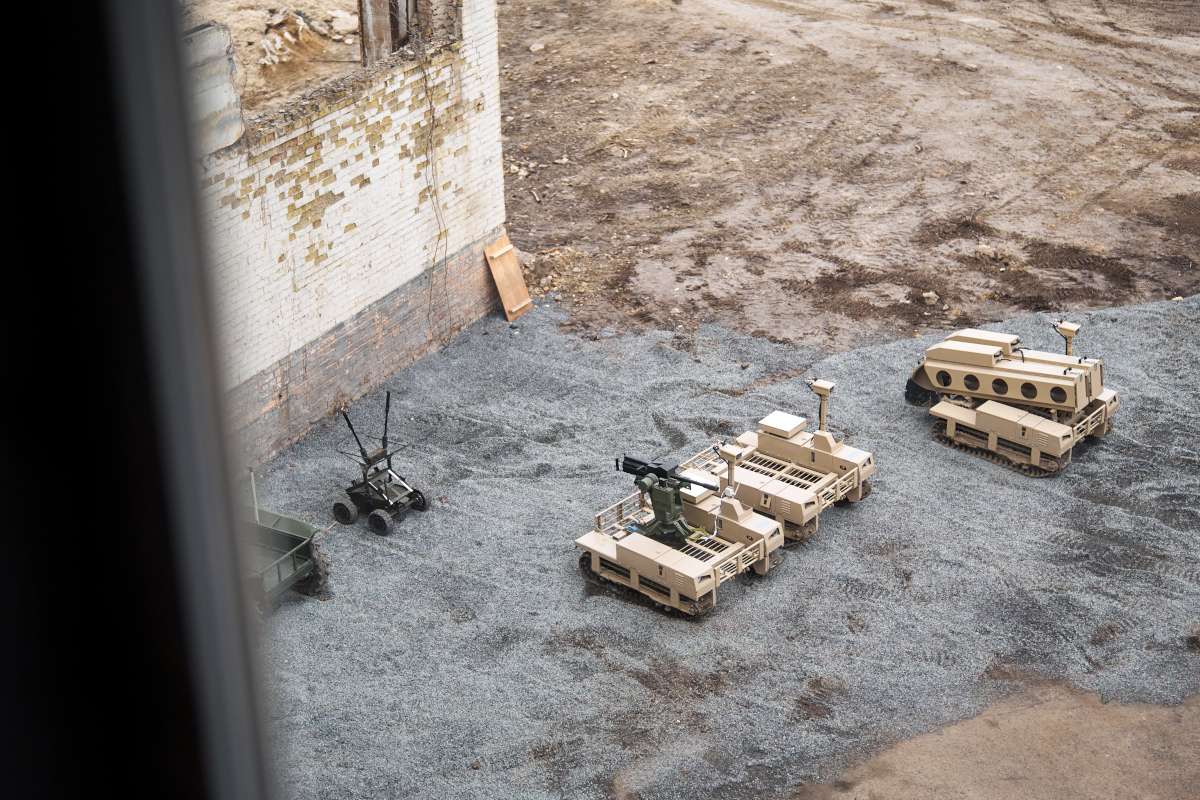
– How important are UGVs at the front today, and what tasks do they perform?
– "They’re extremely important," Viktor replies instantly. "First of all, they’re needed for casualty evacuation and logistics. Logistics means everything an infantryman has to carry on his back or haul in a pickup. So they save lives, because people don’t have to move across the battlefield. Evacuation teams face less risk. Sometimes there’s no way at all to evacuate the wounded in the ‘standard’ way, so to speak. There have already been many cases where UGVs saved people in such situations."
According to him, the issue now is scaling. New units are being created, but not everyone knows how to operate unmanned ground vehicles.
"Our task is to pass on this knowledge. We’re strong and powerful when we’re all in it together – and when we know how to fight using every available tool," Viktor Pavlov stresses.
Overall, unmanned ground vehicles are currently classified by function as follows: logistics, evacuation, engineer support and fire support. Engineer support covers mine-laying and demining, obstacle emplacement, smoke screening, and other tasks. Fire support covers kamikaze ground drones (yes, we already have those), machine guns, grenade launchers and so forth.
– When people hear ‘drones’, they immediately think of flying platforms, and UGVs are often overlooked. Why such injustice?
– "That’s life," Viktor smiles philosophically. "It just so happened that UAVs started being used earlier. There were no UGVs at the front back then. They only really appeared last year. Systemically, the first dedicated unit within the Third Assault Brigade emerged in May–June 2024. That’s where it all started. After that, it’s about media coverage, popularising what UGVs do and the benefits they bring. The more they’re used, the more units employ UGVs, the more video footage appears – and the more society understands what these machines actually do."
We move into a dugout – a fully-fledged control point for ground drones that can drive around the surrounding area. Operators steer the vehicles as they carry out various tasks. They are accompanied by Mavics. This place brings you a little closer to combat conditions – not in simulation, but in real life.

– Is the Mavic the operator’s eyes?
– "No, we have digital communication and a forward-facing camera," Viktor explains. "The Mavic gives more of an overhead view so you understand where to move. Or it’s launched as a relay to provide a backup communications channel."
– So the combination of aerial and ground drones is still necessary?
Read more: What is drone synergy and how does it affect warfare?
– It is, but if you have stable digital communication, you can rely entirely on the forward-facing cameras. You conduct reconnaissance, plan the route – and then you just drive, seeing everything in front of you."
Viktor leads us to the garage. There, a group of guys are busy turning UGVs inside out. Tools are scattered around them – hammers, screwdrivers, drills, spanners and other kit.
– "These are all cadets who are learning not only how to operate the drone, but also how to maintain and repair it," Viktor explains. "UGVs have to be serviced before and after every run. If something breaks, they need to know how to fix it. This is one of the components of the training."
– "It's like driving school," I suggest as an analogy.
– I wouldn’t say driving school really teaches you how to swap out road wheels, tension tracks or change a tyre. They give you the theory, but you need practice. That’s why the guys do everything with their hands – they strip things down, straighten them out and bolt them back on.
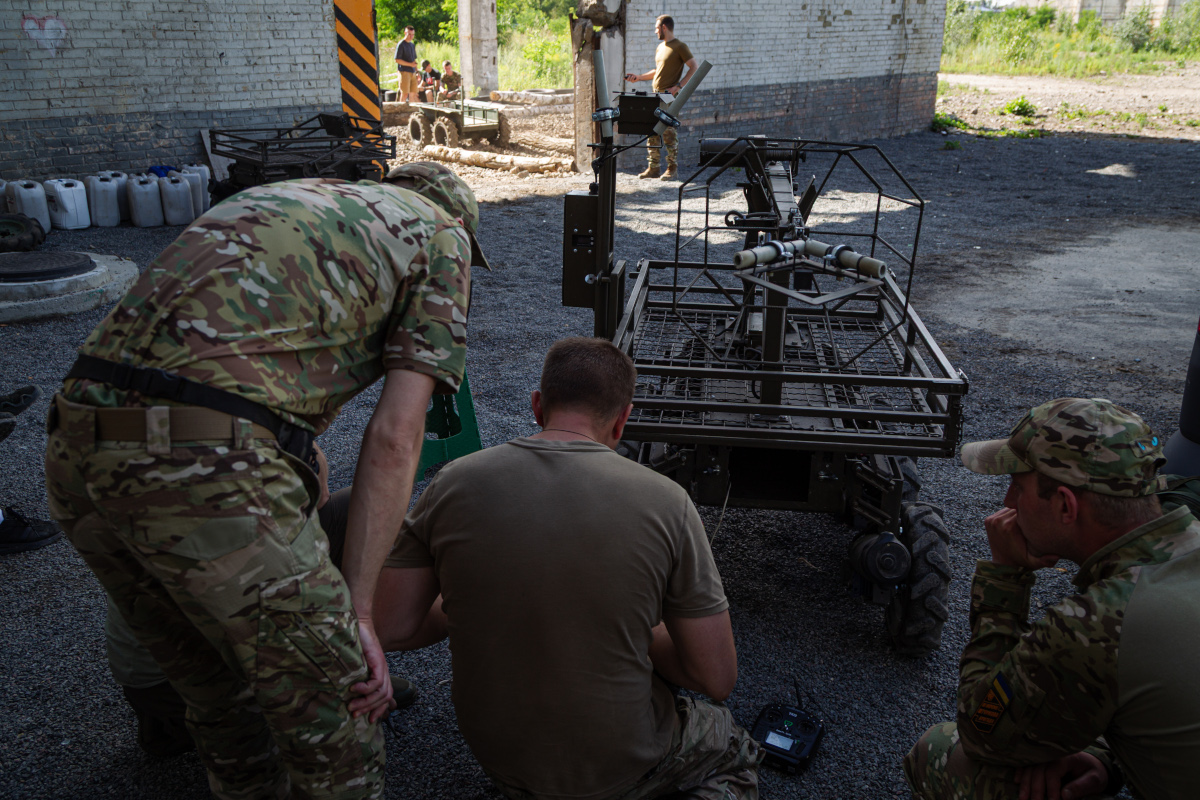
Viktor starts walking past the UGVs parked in the garage, pointing at each and giving a brief description:
– "Tracked Termit, wheeled Tahran – that’s the medium class. They fit into a pickup, which makes it convenient to bring them to the mission area. Here’s Vepryk, the Ratel S – it’s used as a kamikaze or for laying mines: you can mount two anti-tank mines on top and it drops them. This is the Shablya remote weapon station with a Browning. Another Tahran here, just a smaller one – there are three types in total. And this is Liut, a ground drone integrated with a 7.62-mm turret. These are mine-laying systems mounted on the Termit. You can load ten anti-tank mines into one system, two systems per vehicle – so you can carry twenty mines at once and lay them remotely in segments."
All this time we’re moving, getting closer to the training range where UGV operators practice.
– The six-wheeled Teslia. It has an automatic telescopic mast with antennas to increase coverage when we use a mechanical system. Zmiiy is a heavy drone that weighs over 700 kg and can carry half a tonne. Manufacturers keep coming here to test their systems and run trials to improve their platforms. And this," Viktor points to a pile of charred metal, "is drones brought back from the battlefield – or rather, what’s left of them.
– Why collect them?
– To show what’s left of these drones, to show that they’re expendable and that we need a lot of them – and that it’s far better for them to be destroyed than for a person to die. People need to understand that this is just metal. Yes, it’s not cheap, on average about $10,000. But compared to human life, that’s pennies.
We finally reach the training range. Here, the trainees break into groups and, together with instructors, practice basic elements: driving in, turning, parking – simple drills, Viktor says.
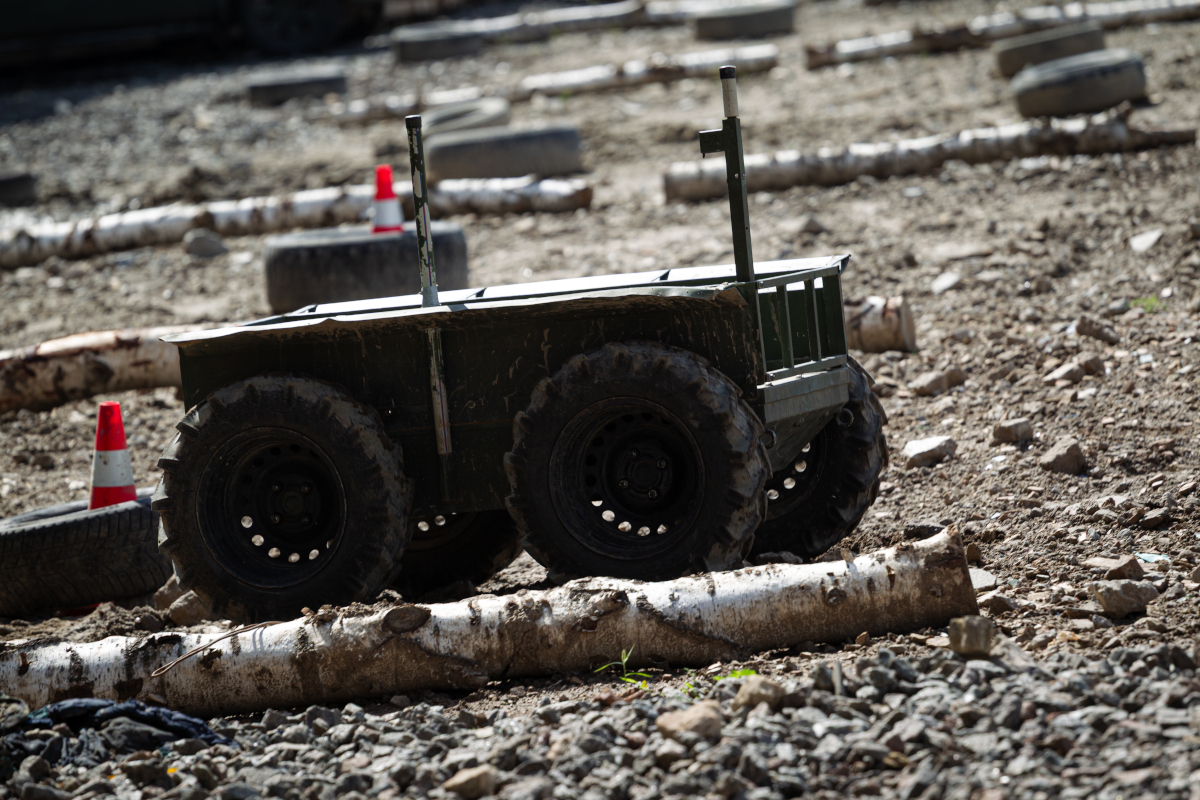
– How much does training on the range help on the battlefield? It’s calm here, almost greenhouse conditions, so to speak. At the front it’s completely different.
– "It’s obviously different," Viktor agrees. "We try to provide the basics. For example, the checklist for setting up a control point doesn’t change. But there will be far more stress, terrain factors, gradients and threats. Still, the controls are the same, the drone is roughly the same. Besides, every month we have a review week: we analyse, we learn, we visit combat units, gain new experience and feed it back into the training programme. Sometimes manufacturers come to us and teach new things about their platforms."
– Do you get foreign visitors?
– Yes, all the time. Various delegations, ambassadors from different countries. They’re interested because this is something new.
– It’s also a useful experience for civilian operations. For example, in areas affected by natural disasters or major accidents. UGVs are not limited to purely military use.
– Yes, we’ve discussed this, including with Ukrzaliznytsia. For instance, instead of sending a whole train with tools when they repair the tracks, a drone can do the job. It’s cheaper. The same goes for rescue services. In short, UGVs are useful anywhere there is a risk to people.
When asked whether working with drones feels like dealing with some kind of space-age technology, Viktor says there is nothing cosmic about it. But he is convinced that everything will keep improving: software will be adapted, artificial intelligence will be used. According to Viktor Pavlov, this will be a kind of evolution – a completely natural process.
– Right now, every action makes us look for a counter-action. Unmanned systems appeared – movement across the battlefield became harder. You need something else to move with, hence drones on the ground. UGVs appeared – UAVs started taking them out. So we need counter-systems that will destroy these aerial targets: self-guided turrets, EW systems and other capabilities. People refine platforms and tactics. So sooner or later, however futuristic it may sound, we’ll get to a point where robots do the fighting.
– Many experts I’ve spoken to say robots will never replace humans entirely, and people will still be needed on the battlefield.
– Of course, people will still be needed but they’ll be sitting in cover, at a distance, rather than physically on the battlefield if you can send in a robot or a drone instead. Even now, humans are less involved. Reconnaissance used to be mostly on foot; today it’s mostly done with drones. Another vivid example is artillery adjustment, that’s also done under drones. Yes, people will be needed because someone has to make decisions, prepare the platforms, maintain them, although even that is already being automated. The only question is when.
– "Hard to argue with that," I say. "Especially given that factories already use robots that perform many functions, replacing human labour. Robots building robots, in a way."
– "Or repairing them," Viktor adds. "All of this will happen in stages. And it’s hard to say anything like, ‘That’s it, from now on only robots fight.’ It doesn’t work that way. It’s an organic process."
Viktor leads us upstairs to show us the rest. The UGV school he runs is not just a range and a garage. It has lecture rooms, simulator rooms, command posts and other facilities, everything needed to prepare unmanned ground vehicle operators as thoroughly as possible.
– What problems do you most often encounter in your work?
– Speaking about UGVs in general, the main issues are aerial threats – FPVs, dropped munitions, minefields. The systems are not perfect yet; they need to be improved for field use. When it comes to the school, the biggest pain point is funding to keep everything running. We’ve created conditions that make it comfortable to study here. The Defence Forces of Ukraine train here, and we teach service members free of charge. Some of our instructors are wounded veterans now in civilian status, whom we pay salaries. So funding is crucial.
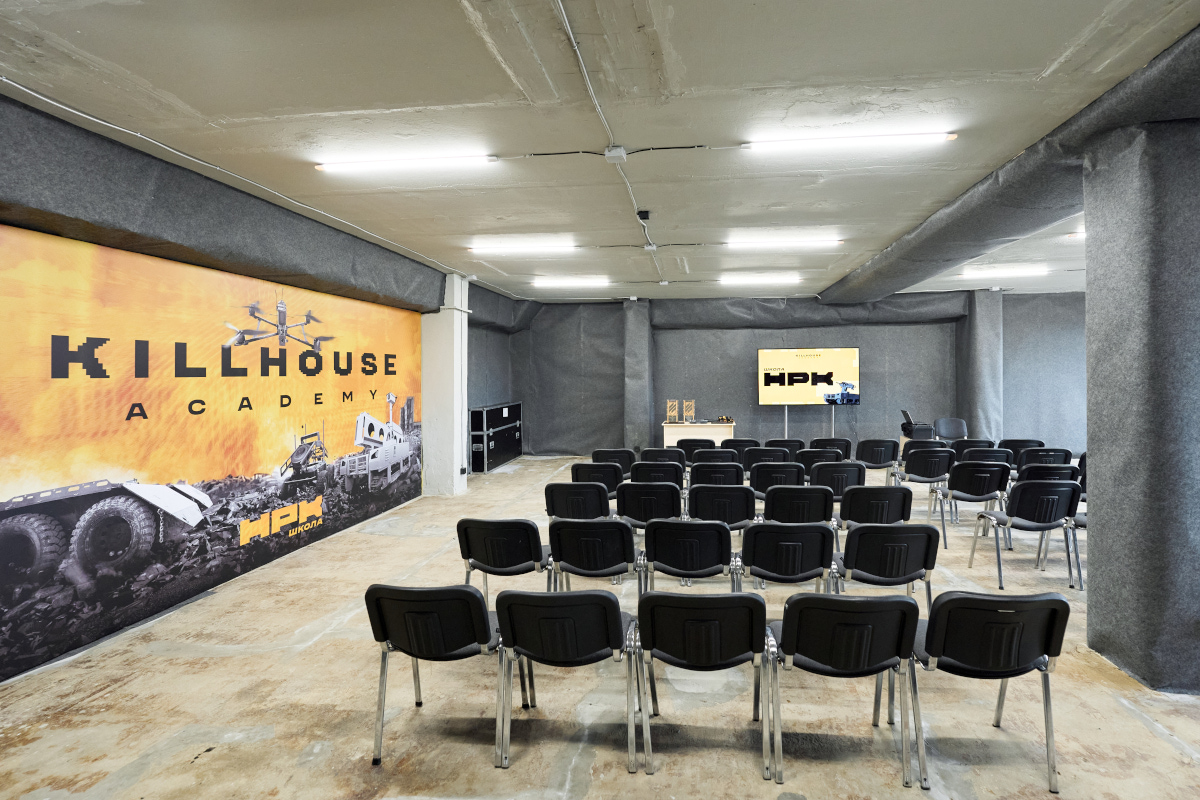
We enter a lecture room. A class is in progress.
– We can fit up to 100 people in here. Sometimes we run large training events. For instance, we recently trained two officer groups of 90 people each. We have several lecture halls, so multiple groups can study in parallel.
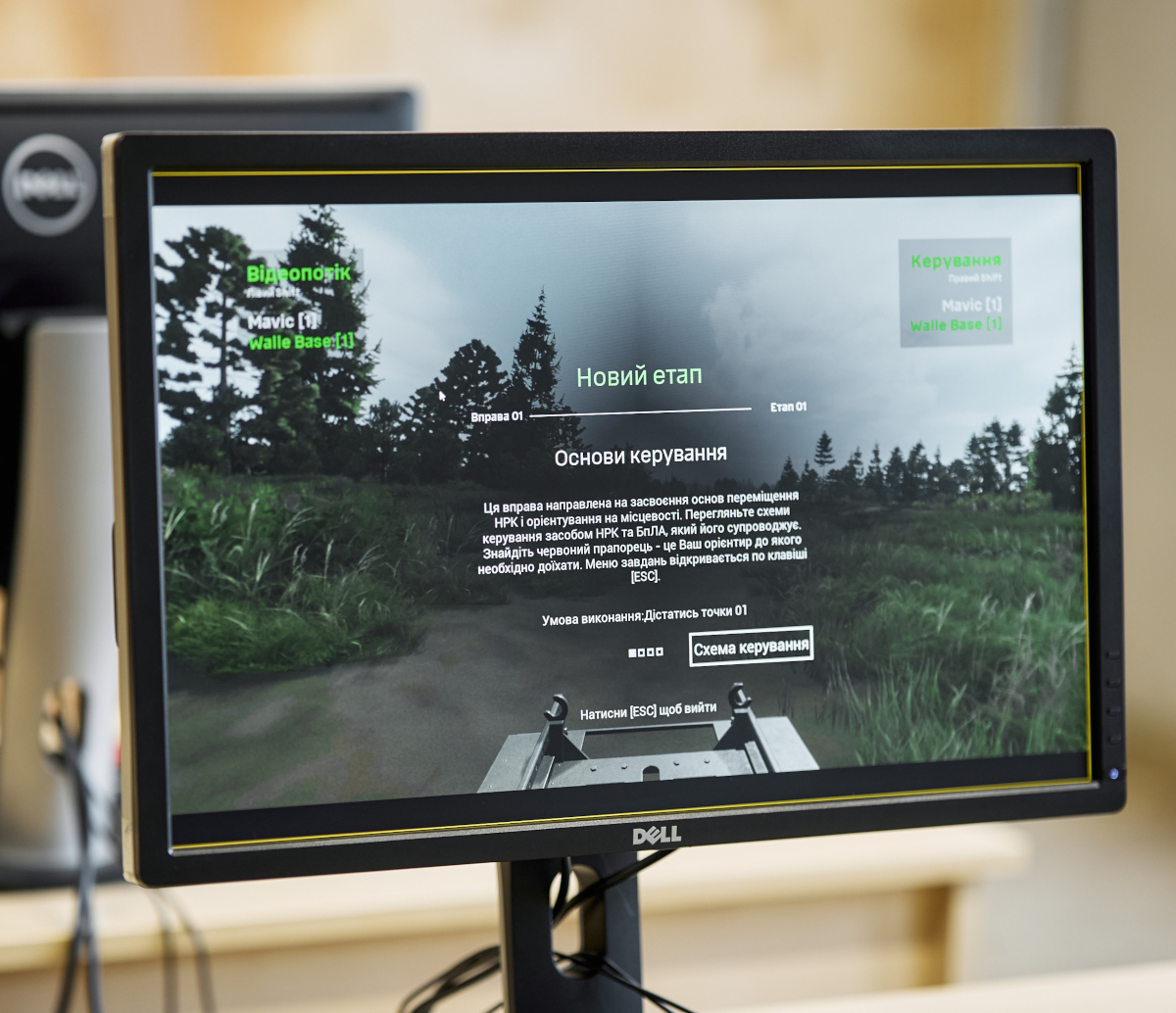
Next, we move to the simulator room. Several dozen computers are lined up in the middle of a large room. It’s reminiscent of the computer clubs that were popular at the turn of the millennium. Only here, instead of Counter-Strike, they fight using serious training software. Viktor boots up one of the computers to show how it works.
"This simulator was developed specifically for unmanned ground vehicles. Right now, it’s the only UGV-dedicated simulator of its kind in the world. It was built by the Center for Scaling Technological Solutions. They keep upgrading it, adapting it to real combat conditions, and it’s getting better all the time. You can choose different missions here – ‘Firing’, ‘Evacuation’, ‘Basic driving’ – and different drones. You’re not just driving around an empty field, because there are threats like FPVs, and your vehicle can be destroyed if you fail to hide it.
– Was the simulator created especially for you?
– Not exactly. We provided our input and advice, and our vision was taken into account during development. One of the features is that you can work in multiplayer mode, people split into teams and operate together. One, for instance, is the ground-drone operator, and another flies the Mavic.
–How long does the training course for a UGV operator take in general?
– We have two courses: basic and advanced. The basic course lasts five days, the advanced one two weeks. The basic course is aimed more at civilians. It doesn’t cover, for example, tactics of employment. It’s mostly theory plus hands-on driving and basic handling. The advanced course includes UGV maintenance, preparation and mission execution. In two weeks, a person gets a set of skills that allows them to go to a military training centre and pass the exam to obtain a military occupational specialty.
– All right, but why do civilians need this? To broaden their horizons, or is it more of an attraction?
– They’re interested. Some are preparing for mobilisation so that when it happens, they already have some skills. We run an introductory day course on Saturdays. After that, people decide whether they want to continue. Essentially, it’s the start of the basic course
– How much does it cost?
– The basic course costs 8,000 hryvnias; there are concessions. We train service members free of charge, which is why there’s a waiting list eight months long. But there’s no queue for the basic course. Groups are still small
– Do women join the course?
– Of course, far fewer than men but they do come. They’re interested, and some are very battle-hardened women who do a lot of useful work. Some volunteers want to understand UGVs better so they know how they can help. Manufacturers also send their employees so they can get to know UGVs, because people who go to work for them don’t always understand how these systems are used. And the more they understand the benefits and how the military employ them, the better the platforms will be adapted to soldiers’ needs. So in addition to training, we constantly provide consultations for manufacturers
The tour is coming to an end. To conclude, Viktor Pavlov shares his plans:
– We want to expand and set up a UGV engineering school, because we need to train technicians. In addition to operators, a unit needs specialists in different trades: fitters, welders, mechanics, electricians, software engineers who can configure drivers and software, and communications specialists who understand signals and can tune antennas. Units need people like that, so creating an engineering school is our next challenge.


