



We’ve learned to watch. But we still haven’t learned to act
When I had just signed a contract with the Armed Forces of Ukraine after serving in a volunteer battalion, it was a cool, rainy autumn in 2015, we came to Pokrovsk to pick up our army payroll cards at PrivatBank. To a city that was still called Krasnoarmiisk back then, Krasik. To a city that has now, for all practical purposes, been wiped off the face of the earth.
There were seven of us. We rushed in for an hour; chunks of mud brought in from the Butivka mine were falling off our combat boots. A cleaner barked at us right away — for the now-dirty floor, for the noise, for the crowd, for our very existence in that space. I laughed. But my friend Maksyk blushed and made it worse; he started shyly sweeping those chunks of mud under a cabinet. Maks is already dead.
But back then, we were all still alive, still instinctively trying hard to be "normal," to be convenient. We didn’t yet know words like "reintegration" or "veterans policy." But we could already feel it in our bodies: the civilian world wanted us to simply fit into it. Not get in the way. Do not break the rhythm. Do not force it to change the rules or perform miracles of understanding and empathy.
Around the same time, my comrade-in-arms Kashel, also now killed, took out a bank loan to buy a laptop for the position. The form required a workplace and a supervisor’s phone number. He put down my number, the number of his immediate commander. When they called and asked whether I was a director, I felt a deep sense of responsibility: the bank might, after all, refuse us the loan. I spent a long time explaining the war, how the Armed Forces are structured, brigades, battalions, batteries. I explained, "I’m a crew commander," but they didn’t understand and didn’t want to: "So are you a director or not?!" In the end, I said, "Yes. I’m a director. Director of the Armed Forces of Ukraine." They approved the loan.
The system has always been crooked, absurd, humiliating, and non-inclusive. In it, you could only mimic, agree that you were a director. Sweep the mud under the cabinet. Back then, it wasn’t ready for us.
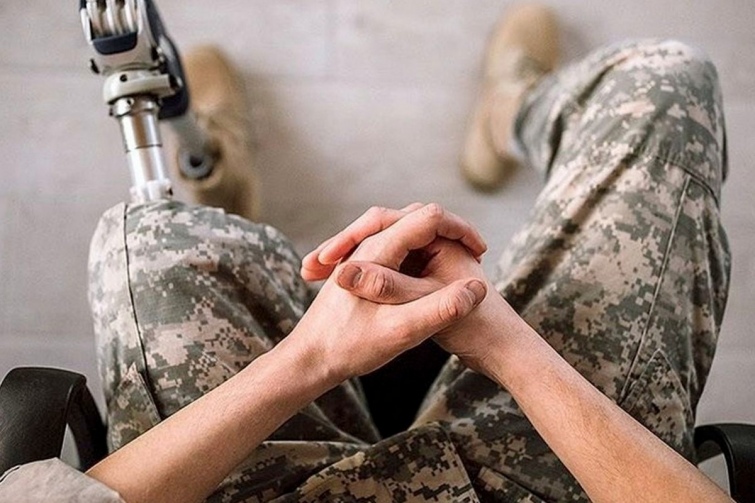
Eleven years of war have passed. Now, an amputee veteran cannot get a bank card because he cannot hold it in his hands for the photo that is supposed to confirm the card belongs to him. He is offered a power of attorney. Formally, as a "solution"; in practice, as a denial of autonomy. The system no longer yells, shames, or insults. It is polite, courteous and… utterly helpless. Over these eleven years, the system has not become more cruel. It has become more prepared. But not for people — for reporting.
Yes, over this time we have learned many right things: to look for a long time, attentively, without turning away. We have learned to express sympathy in the "right" language, vetted by hundreds of respected "experts" in communicating with veterans without extra words or careless gestures. We have learned to speak poetically about trauma. Not to ask about it, or to ask about it "properly." To shame one another for asking and for what we did not ask.
We have learned to tell stories. To make documentaries. To write texts after which you want to fall silent. But we keep coming back to unswept floors and soulless, reinforced-concrete instructions.
I remember one documentary shot with substantial state funding. It features a woman veteran with the call sign Liutyk. Without legs, she crawls up the stairs, slowly dragging her wheelchair behind her. The lighting is set just right. The viewer feels compassion. But the stairs remain. No one comes back to that building to change the ramp angle. No one asks why a person without legs ended up facing those stairs at all, what kind of building it is, or whether she will be crawling up the same stairs again tomorrow, this time without a camera crew.
Everyone accepts reality as it is — bleak: "Oh, we would have helped! We would have carried her in. We now know how to offer help the right way! We can even ceremonially deliver a bank card to a veteran once all of Facebook has written about him."
But procedure is never neutral. It is always designed for a particular body: one that can stand, hold, sign, wait, look into a camera. When a person cannot follow the procedure, the system does not see its own limitations in that. It sees an "exception," a "difficult case," a "problem." And instead of changing the rule, making it inclusive, it offers workarounds: a power of attorney, a guardian, an intermediary, a ceremonial in-person handover of the card, the dismissal of an employee. In effect, it asks the person to give up a part of themselves so the system can remain unchanged, pristine, and convenient for reporting.
Perhaps it’s time we finally understand this: inclusion is not an intention, and not a tone of voice. It is a set of very specific decisions. It is an answer to the question "how, exactly." How exactly does a wheelchair-using veteran get into our water park that offers discounts for war veterans? Which entrance? Who meets him? Who is responsible for the ramp that exists only on paper? Who exactly are we inviting to a Father’s Day contest at school, and what do we do with a child whose father was killed in the war? Who is supposed to factor that in and communicate it to the teacher, the principal, the methodologist? How do we word a questionnaire that includes a "children" field if someone may come to us whose child was killed by Russian shelling?
Every step in every activity has to be designed not for the "average person," but for all of us. Without hands. Without legs. Without sight. Without a home. Already without children. Already without a dad. Without the familiar way of being in this world. How do we speak to them not in theory and job descriptions, but in a real hallway, at a service window, in a queue? How do we carry out "standard procedures" that have long since stopped being standard? And in that moment, who is the one that finally has to change, the person, or the rule?
Perhaps this matters more than hundreds of discounts, retreats, "recovery" programs, and sanatorium treatments that most veterans have never actually used. Perhaps what matters more is not how beautifully we talk about trauma, but how we act in the moment when a traumatized person is standing in front of us. Or sitting. Or crawling toward us.
The war is not "somewhere out there." It never was "somewhere out there." It has been here for eleven years. And the people it has changed are here, too. The only question is whether we are finally ready to accept them in our reality — not only in words, from TV and smartphone screens, but in rules, spaces, and everyday actions.
Valeriia Burlakova, veteran, media and campaigns coordinator at Amnesty International Ukraine


