



"It would take $300-400M to jam all drones in skies over Kyiv with EW," – Contra Drone co-founder Tymofii Yurkov
Drone Industry
Before the start of the full-scale war, Tymofii Yurkov was an entrepreneur in the aerial imaging sector. After Russia’s invasion, he became involved in UAV technologies for defense needs.
In 2023, Yurkov’s team received a request from a military unit that had been purchasing UAVs from them. The soldiers reported problems with electronic warfare (EW) systems supplied by another company, which had proved largely ineffective in combat conditions. In response, Tymofii and his partners developed and manufactured antennas for those systems at their own expense and sent them to the front. After the new antennas were installed, the effectiveness of the EW systems roughly doubled.

This experience became the impetus for developing the company’s own electronic warfare solutions. The team began designing Ukrainian-made EW systems tailored to the real needs of units on the front line.
Today, Contra Drone develops comprehensive, modular, and functional counter-drone systems that undergo extensive testing and are continuously refined based on feedback from the military. The company’s focus is on creating effective technologies that help units counter enemy drones and save soldiers’ lives.
As part of the ‘Drone Industry’ project, Censor.NET spoke with Tymofii Yurkov about how electronic warfare works, how much money would be needed to fully close the sky at least over Kyiv, why Ukrainians keep being geolocated to Peru, how EW affects human health, and the challenges manufacturers are facing today.
– The abbreviation EW has entered the everyday vocabulary of Ukrainians. Still, not everyone fully understands what it is and how it works. Please explain.
– An electronic warfare system is a comprehensive solution that, in our case, helps prevent FPV strikes. More broadly, EW can be used against virtually anything: for counterterrorism purposes, to jam navigation and communications, whether Wi-Fi, radio stations, handheld radios, or other types of communication. There can also be systems that jam large UAVs, suppress GNSS navigation (Global Navigation Satellite System – ed.), mesh networks, as in the case of Shaheds, video signals, and so on.
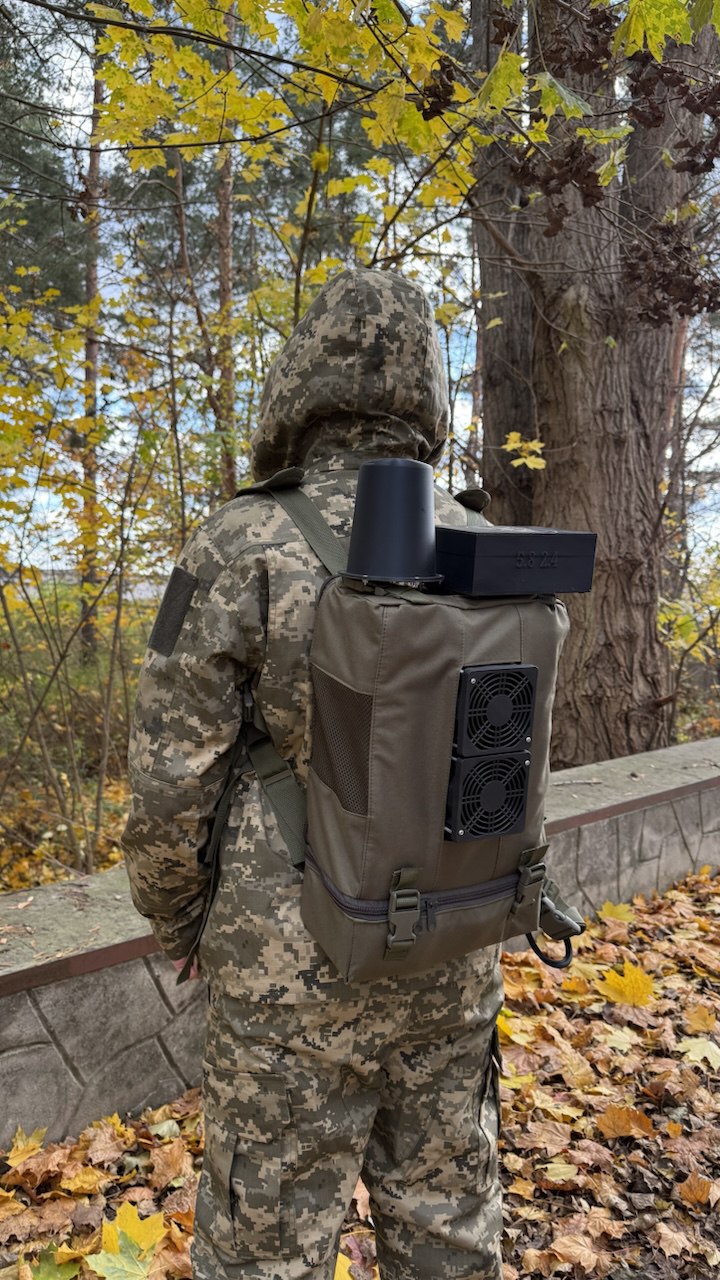
There is a very wide range of EW systems. These may include, for example, vehicle-mounted systems that protect a vehicle and a certain area around it, backpack-format systems for dismounted groups, or ground robotic systems that accompany a group or transport valuable cargo and prevent drone strikes.
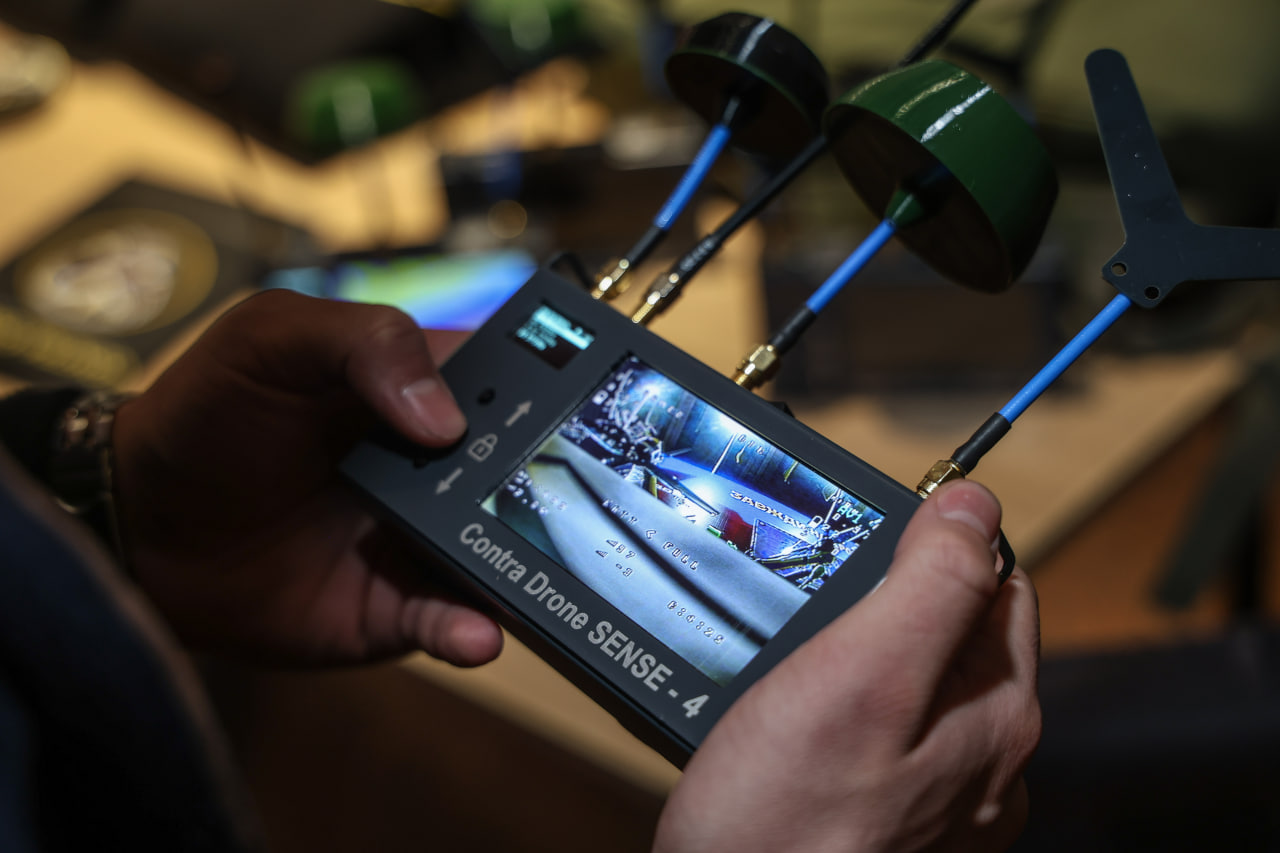
No less important are ELINT systems, or electronic intelligence systems. These may include systems that detect an FPV drone’s video feed. A soldier who sees himself in the drone’s camera can react to the threat moving in his direction. They can also include systems that detect an FPV at the launch stage. A signal is then sent to EW systems to attack the drone’s control link or suppress its video feed.
– So it’s like a kind of dome: a drone flies into its radius, shuts down, and falls?
– Roughly speaking, yes. But you cannot say that an EW system has a 100-meter radius and that is the end of it. Since this is physics, an EW system’s effective range is not static. If the UAV operator’s position is 10 km away, the transmitter power is minimal, and the antenna is pointed with minimal gain, then a standard vehicle-mounted EW system may jam such a drone from 2 km away. But if we are talking about a distance of 4-5 km and a directional antenna with 10x or 100x gain, then the range may be just 50-60 meters.
In other words, there is an effective range under the protocol, because there is a relevant testing protocol for EW systems. It specifies in advance the antenna, gain, transmitter power, distance, and so on. That is what is meant when people talk about the effective range of an EW system. In reality, however, it may be either much greater or much smaller.
– And what affects it? Concrete buildings, for example, trees, and weather conditions?
– If there is no direct radio horizon between the UAV operator and the drone itself, and especially if there are obstacles such as concrete or metal structures, the UAV may crash even without EW.
– By the way, Ukrainians are increasingly being geolocated to fairly exotic places, such as Lima or the Arctic Ocean. Is that because of EW?
– That is due to spoofing systems, which are a subtype of EW. But they do not work like conventional systems that simply create interference for a signal. They generate their own signal, which the GPS antenna in a phone or a UAV perceives as genuine. In other words, spoofing is signal substitution. Usually, this is done with a stronger signal. In the conventional EW model, it simply disables GNSS: GPS, GLONASS, BeiDou, Galileo, all possible options, in short.
– How important is the EW component in our air defense system?
– Extremely important. Take the Shaheds: they use mesh networks among themselves, resembling a web stretched between drones. Thanks to such a network, an operator even a thousand kilometers away, if there is a continuous chain of Shaheds, can control the lead drone that is already entering Kyiv, hypothetically from Moscow.
And when we disrupt the mesh link between the Shaheds, we deprive the operator of the ability to manipulate the drone and manually guide it to the strike point. If the GNSS system is completely disabled, the operator can still identify the target via camera and hit even a moving object, such as a train or a truck. If you jam even one Shahed in the middle of this web, the connection between the operator and the far-end drone is lost.
It is no less important to disable their GNSS systems in time. Spoofing is currently less effective than it used to be. CRPA antennas have already become quite "smart." They understand that they could not have moved to Peru in 20 seconds, since they are equipped with a barometer, compass, gyroscope, clock, and so on. So a Shahed no longer turns around and heads back home; it continues flying, but with degraded positioning.
That is why, at present, it is more effective to fully suppress GNSS and the mesh network in advance. Under such conditions, the Shahed becomes "blind," with no ability to correct its course using satellite navigation systems. It will simply fly in a straight line, making it easier to shoot down based on its trajectory, including with interceptor drones. In addition, the operator will have no ability to control it or maneuver it after detecting the threat of interception.
So, once GNSS and the mesh network are jammed, the drones become easier to shoot down. Even if they are not destroyed, the error will keep accumulating. The target it was heading for will most likely not be hit, but the Shahed will crash somewhere. In the absence of wind, that deviation is a couple of percent. In other words, if we jam it at a distance of 10 km, the margin of error would be within roughly 200 meters. If there is wind, that already becomes kilometers.
Unfortunately, this does not protect the city itself, because when a drone is over the city center, a deviation of 200 or even 1,000 meters is not enough for it to fall somewhere "in the fields." Such a UAV can, unfortunately, hit a civilian infrastructure facility, a residential building, a kindergarten, and so on. So even if enemy drones are fully suppressed, people still need to think about shelters and make sure to go there during an air raid alert.
– So am I right in understanding that physically destroying a Shahed is better than suppressing it with EW?
– That depends on the conditions. If it is clear that after early suppression, say, by the first EW ring around Kyiv, the drone is moving away from the city because of strong wind or inertia, then a decision may be made not to shoot it down and not to waste air defense resources or ammunition. Such a drone will crash somewhere in a field on its own. But it still has to be tracked and shot down if it poses a threat to populated areas.
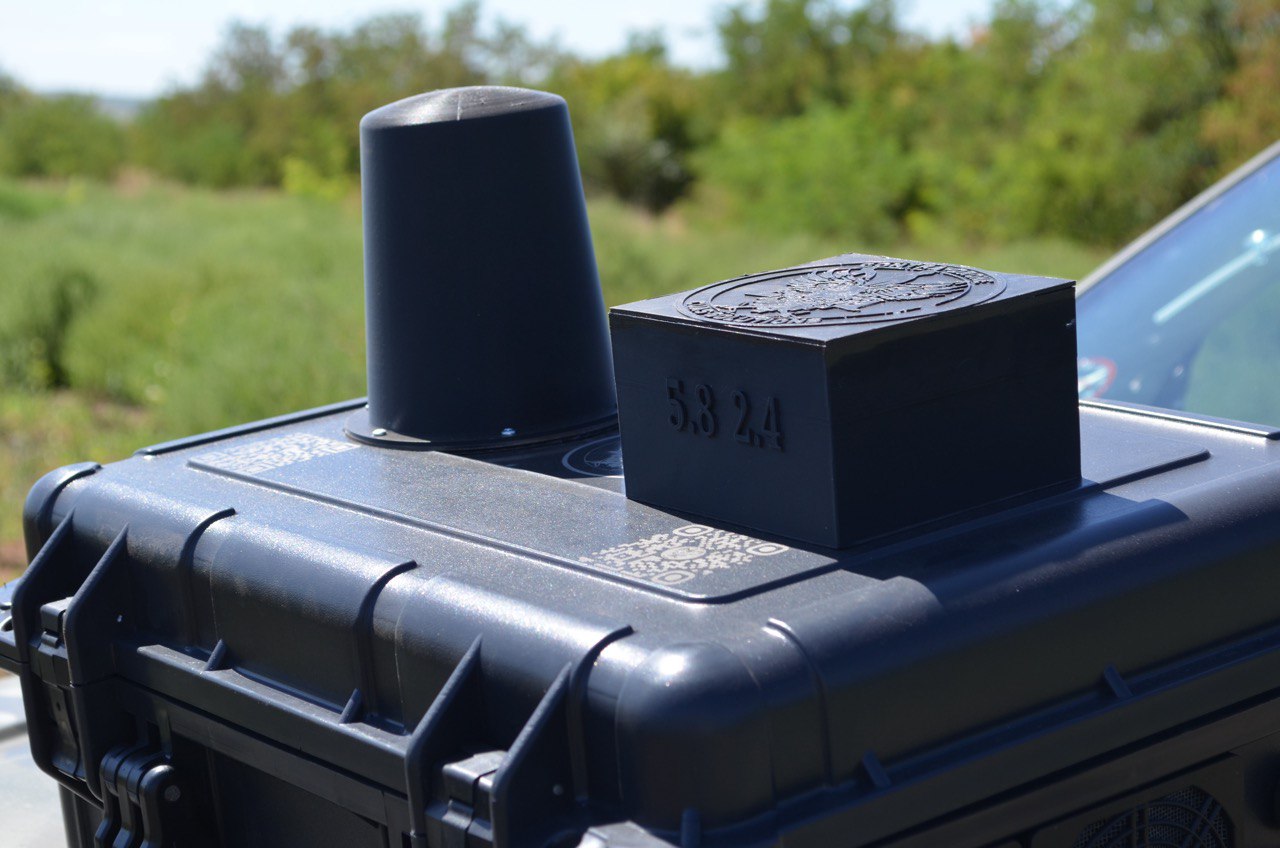
There are also situations in which our systems manage to completely knock out a Shahed’s "brain," or the UAV enters loitering mode because of a system malfunction. It circles around itself while trying to regain a connection, either a GNSS signal, because the drone has completely lost its position, or a connection to the mesh network. Quite often, the Shahed never finds that connection, flies around for 45 minutes, and simply crashes. That is the ideal outcome, because we do not waste ammunition, and the UAV falls in a field on its own after running out of fuel. But that does not happen every time.
So the first stage is to jam it so the Shahed does not hit its target, and the second is to shoot it down. Suppression is also important because the mesh network allows the drones to determine where they are being intercepted. When a Shahed "sees" this, it signals the others to route around that area. In this way, they look for a gap they can slip through to strike the target. As soon as such a gap is found, the rest of the group will follow through it.
– It was recently reported that Ukraine managed to take out the relay transmitters for Shaheds that had been installed in Belarus. Can you explain what that means?
– I know of cases where so-called radio beacon towers were used. These are essentially positioning transmitters for Shaheds. Say there are 20 towers, each emitting a high-power signal capable of covering hundreds of kilometers. And the Shahed, knowing the approximate location of those towers, can determine its position even without GNSS.
But even that kind of signal can be jammed with high-quality EW systems. It is more difficult, but it is possible. The power of GPS, for example, is lower because the satellite is thousands of kilometers away, so its signal is easier to overpower. The towers are closer and have more energy to generate a stronger signal that is harder to jam, but it can still be done.
– Is it possible to suppress 100% of drones?
– It is possible, and that is where things are heading. But this would require an enormous number of EW systems, thousands, perhaps up to 10,000 per city. Still, if they operate in a coordinated way within a single system together with radars and radiolocation assets, it would be possible to jam all UAVs: Shaheds, Gerans, Orlans, ZALAs, and so on. In that case, there would be a chance to suppress all mesh networks between them and work against GNSS as well. So it is realistic; we just need more systems.
The only major problem EW manufacturers have faced is Starlink. It operates at extremely high frequencies that can, in fact, be suppressed, but doing so requires very expensive components.
For example, if we are talking about an EW system capable of suppressing mesh networks, that would conventionally mean an amplifier with an SDR component. Two or three such EW systems would be enough. Each system would cost around $10,000.
But when we talk about a system capable of jamming 11-12 GHz, the SDR component alone would cost roughly from $40,000. The amplifier would then cost $100,000.
So these would no longer be systems costing $10,000, but about $200,000 each for the state. And that creates a major funding problem, because one system per city is not enough. Hundreds are needed. So thank God the Starlink problem disappeared on its own.
– Thousands of systems per city to suppress all drones, what does that amount to in monetary terms?
– In my view, there should be 1-3 EW systems on every building taller than 10 stories. And they should be capable of suppressing anything: Wi-Fi, GSM, 5G, 4G, 3G, and 2G. But it has to work as a system; suppression must be directed at a group of UAVs or a specific drone.
In other words, cutting off communications across the city during an air raid alert, when debris is falling, is not an option because it is dangerous. But selectively taking down a group of UAVs or individual drones, including those using mobile communications, is quite realistic.
So, roughly speaking, several thousand latest-generation systems, like those made by our company and our colleagues, would be enough to jam all of the enemy’s existing UAVs except those operating via Starlink. In monetary terms, that means hundreds of millions of dollars. For Kyiv, it would be around $300-400 million.
– If I, say, own a building and want to protect it from possible attacks, can I buy EW systems and install them on my roof?
– With UAV systems that use a CRPA antenna, you have to work comprehensively from several directions. In other words, even if you had two or three EW systems on your building, you would not jam a CRPA antenna from a single direction. For example, a CRPA antenna with 16 GPS elements would need to be jammed from 17 directions. So a large-scale, integrated solution for the entire city is needed.
If we are talking about protection from any direction, closing all possible gaps in Kyiv and building several echelons of EW systems, that means hundreds of millions of dollars. But no other city-protection system like the one we could have in Ukraine would exist anywhere else in the world.
It should be understood that such EW systems are of a directional type: they rotate and change their angle and antennas. In other words, they can affect targets above, below, and even on the ground. For example, in the event of a terrorist attack threat or some kind of planted explosive device. With such a system, all communications in a specific location could be shut down within seconds.
So this would provide ultra-strong protection both against Russian aggression and as counterterrorism protection for Kyiv itself.
– But there is another side to this: if some dictator came to power, such a system could be used against, say, protest rallies.
– One hundred percent. But every weapon has both a positive and a negative side. In good hands, it will do good; in bad hands, it will do harm. Unfortunately, there is no getting away from that.
– How do EW systems affect human health? People are known to protest even against 4G towers, and here we are talking about much more serious equipment.
 – Negatively. But not as negatively as a Shahed falling on your head. Besides, if we are talking about systems of a directional type, the main beam of such a system will be aimed directly at the target.
Of course, there will be electromagnetic field exposure, but if a person is indoors, for example, behind 20-30 cm of concrete, it will be reduced by a factor of 100. So there will be an effect, but it will not be stronger than that of a cellular tower standing outside your window or on the roof of a building. And nowadays, no one is even asking permission anymore about where to put those towers.
– So a tin foil hat will not be needed?
– Definitely not in the near future.
Those who are genuinely affected very badly by EW systems are military personnel. They are constantly around them. These are dome-type systems rather than a concentrated beam directed away from a person. The health impact is very severe, especially in the case of backpack-type systems, where the antenna is near the head, so the effect is as bad as it can get.
Our company has developed protective clothing that shields against 98% of exposure to electromagnetic waves. But unfortunately, it is not in great demand. We do sell it, but only volunteers seem to buy it. For some reason, the military leadership does not appear to be thinking about this.
– Perhaps there are simply no relevant studies, aren`t they?
– There are studies on the harmful effects of radio waves. The WHO, for example, has studied this and found that the minimum permissible distance between a person and a 50-watt emitter is 90 meters. When an EW system emits a kilowatt, that mathematically already means about a kilometer, and such systems are mounted on vehicles, right above people’s heads. So imagine the effect.
I know it from personal experience. I used to attend tests quite often, personally checking next-generation systems and overseeing the process, and after each such trial I would spend several hours feeling dizzy, nauseous, and suffering from an unbearable headache that even painkillers would not relieve.
Armor almost completely offsets the impact, so those riding in armored vehicles are a bit luckier in this regard. But those in pickups, especially canvas-covered ones, suffer. The worst-case scenario is backpack systems, when there is literally nothing between the head and the radiation. The same applies when an EW system is positioned near a trench and operates continuously.
– You have already mentioned Starlink, so let us return to it. It is great that it was switched off for the Russians, but it could also be switched off for us, given that the "keys to access" are concentrated in the hands of one rather eccentric person. Are there any alternatives to Starlink?
– There are currently no high-quality alternatives. Only Starlink now has enough satellites to provide internet access from any point on the planet without significant latency.
If we are talking about internet access at fixed positions, then of course there are alternatives. There are certain other systems that make it possible to get online from a position without Starlink. They are significantly worse, but they do exist.
– Tell us more about your company’s products. For example, SENSE-4. How often do you have to update your EW systems lineup overall, given how dynamic the situation on the front is?
– We update both our EW and ELINT product lines very frequently. It happens just as quickly as new frequencies begin to appear. About four months ago, video signal systems operating at 7-8 GHz started to emerge. These were isolated cases, not yet widespread, but we understood that we had to start working on a solution. Because by the time it becomes widespread, the military must already have an answer.
That is why we started working on SENSE-4 back then. Development took about three months. The bureaucratic part is still ongoing, with documentation being finalized for submission for codification. Overall, bureaucracy doubles the time needed for a product to make it into the military.
There is already a long queue for SENSE-4, but we still cannot sign contracts precisely because of the bureaucracy.
– That said, the bureaucracy is still better than it was, say, in 2023.
– Absolutely. But compared with last year, there have been no major changes. Besides, there are different procurement tracks. For example, a brigade may agree to the terms of joint departmental trials. We send them the products, they use them, and we take part in the testing together with the brigade.
During the trials, we confirm or refute the declared technical specifications. Our stamp as the manufacturer is affixed, along with the brigade’s stamp, and on the basis of that document alone, they can already purchase our products.
But not all brigades have the time or a training ground to conduct such tests. Nor do all of them agree to this type of procurement, because for a brigade it is riskier than when there is codification, and the testing has been conducted at the ministry level. That serves as a quality guarantee.
– And if anything goes wrong, the backlash will fall on the Defense Ministry rather than on the brigade or the manufacturer.
– Yes. But we have not had any problems arise under this procurement model. Still, it is many times more complicated than when there is a codification code.
– Exports are a painful issue for all defense companies. The situation in the Persian Gulf showed that our products would have been useful there. Is there any movement in that direction?
– Such movement has been promised since late 2024, but so far, everything has been sluggish. I agree with the view that fully opening exports would pull the top manufacturers out of the Ukrainian market, since in Europe, prices for the same systems our company makes, for example, are five to six times higher.
What is more, given our extensive combat experience, if this were purely about money, our company would have been relocated to Europe very quickly. But the goal of our business is not just finance; that is secondary. Above all, it is about saving lives and providing the military with high-quality systems. So we would not move. Still, there are many companies that are dying for the chance to shift their sales abroad when the opportunity arises. There are no price caps there, and much more money can be made. Abroad, essentially, there is no market that has access to a real war. We are constantly invited somewhere to demonstrate things and talk about them.
Certain permits have already been granted to some companies. But it is all an extremely complicated process. If all the relevant authorities approve it, you may be allowed to have one contract with one specific country. It is very difficult.
At the same time, I can see that everything is moving toward the opening of limited exports, which we as manufacturers are strongly pushing for. There is seasonality, after all: in certain months, the number of orders declines not because there is no demand, but because of a lack of funding. In such periods, if I were making the decision, I would allow foreign sales to open up, on condition that a certain export levy be collected, 5-10%, so that the state could earn revenue and build up funds in the defense budget.
First and foremost, this concerns the summer. By then, funding for the first half of the year has already been exhausted, while funding for the second half has not yet come in. Or there may be an inter-quarter period.
But I would completely shut down export sales at the end of the year, when all brigades are making purchases, and everyone has funding. Or at the beginning of the year, in March-April, when money becomes available again, and there is an urgent need to receive products from manufacturers.
By the way, if we look at some of our manufacturers, their lead time for supplying products to our military runs to two years.
– Why does it take so long?
– Good question. They are fully contracted. I tend to think this is due to the manufacturer’s unwillingness to expand production. They have reached a stable production level that continues month after month. In other words, they have a certain annual output, and they sign contracts two years in advance. That significantly reduces production costs.
Our company, for example, tries to guarantee delivery times of up to one month, so even in the most difficult periods, we keep a large number of people on the production line. We were literally feeding employees out of our own pockets and operating at a loss. And when orders started pouring in, we fulfilled them quickly, broke even, or made a small profit.
We chose this model so that we could deliver any quantity of systems the military needs in the shortest possible time. Other manufacturers do not want to operate the way we do, do not want to sacrifice anything, or reinvest their earnings into components so that they are available when needed.
– You are talking about the need to invest in components, so does that mean procurement? How much of Ukrainian EW is actually Ukrainian?
– It varies from company to company. I know firms whose product is entirely Chinese. On paper, they order a kit for assembly, but in reality, a finished product arrives. There is not even an assembly stage. We have been to a factory where several manufacturers source their products, and we saw Chinese workers engraving "Made in Ukraine" on an already finished system. The system is entirely Chinese, yet "made in Ukraine" — a paradox.
Our company is not like that. We have a separate antenna production line, more than 15 types, with another 30 in development. It is the most powerful in Ukraine. The total value of our machine tools exceeds $3 million. In addition, we have top-tier equipment for testing antennas and EW systems: a vector analyzer, interference-step analyzers, and signal analyzers. All of it comes from well-known German, American, and Swiss brands of the highest level. We also manufacture some types of connectors ourselves.
We have established the assembly of frequency-generator modules. The components in them may be Japanese, Korean, Chinese, or European. Yes, we do not manufacture every component ourselves, but we do make a finished product that performs as well as possible.
Making an EW system and making an EW system that is actually effective are two different things.
– Is there any possibility that 100% of the components could one day be made in Ukraine?
– Unfortunately, no. There are certain types of transistors that are produced by only seven or eight plants worldwide, including in Taiwan, China, Japan, South Korea, the United States, and Finland. A plant specializing in such transistors would cost tens, if not hundreds, of millions of euros. In my view, during a war, no one is going to invest that kind of money in it. It would require very strong state support. And the enemy would destroy such a plant within days.

– What problems do you face in your work as a manufacturer, and what solutions do you see?
– First and foremost, funding reaches military units irregularly. And when it does arrive, it has to be turned into systems as quickly as possible. That is understandable, because these systems save lives, and there is a constant shortage of them on the front line.
If these funds were disbursed on a regular basis, so that orders could be forecast, it would be much easier and cheaper for manufacturers. There would be no need to keep excess staff on payroll, or conversely, to hire a large number of people before the New Year only to later either lay them off or keep paying them out of pocket.
The second problem is logistics. Transporting components is difficult and requires special licenses in Europe, while getting them out of mainland China is extremely hard in general. Customs in Hong Kong may even confiscate certain components that are banned from export from China because they are dual-use items. So we have to look for workarounds.
After Hong Kong, the orders are shipped to Poland. A company must have a special license to transport and sell either military or dual-use goods.
The easiest stage is already the Ukrainian border itself. We usually do not have problems there.
The third issue is a shortage of personnel, especially highly qualified specialists. Some of our developments are extremely complex technically. And there are very few specialists who understand the physics involved, for example, how radio waves propagate, and are also programmers at the same time. Even ordinary programmers, including experienced ones, when they join our company, do not understand what is required of them. In essence, we need a physicist-programmer. People with that qualification are few and far between; they are worth their weight in gold.
And because of that, many headhunters abroad are literally hunting for them. They are offered huge sums, $10,000-$15,000, which few in Ukraine can match. Some companies even help them leave the country, including illegally.
If the funding problem can be solved at the level of our government, what to do about the other two is hard for me to say.


