



Nearly 30-fold drop: How strikes on logistics affected metals exports
Steelmakers are under no illusions: they say the industry no longer exists. The country’s largest steelworks are at a standstill. The strikes on production facilities were preceded by a prolonged summer campaign of Russian attacks on logistics.
BusinessCensor obtained exclusive data on metals exports from the State Customs Service and examined how and when shipments of metal products dwindled, month by month and by mode of transport.
Why the steel industry came to a standstill
The country’s three largest steelworks are currently idle: Metinvest’s Zaporizhstal and Kametstal, as well as ArcelorMittal Kryvyi Rih. Together, they accounted for around 90% of Ukraine’s steel production.
In an interview with Forbes, Metinvest Chief Operating Officer Oleksandr Myronenko said the steel industry’s share of Ukraine’s GDP had fallen from 7% before the war to "almost zero," and that the industry had "no margin of safety left". Speaking at the Economic Resilience Forum in Kyiv, Oleksandr Vodoviz, head of the company’s CEO’s office, said there was a week in September when, for the first time in 100 years, Ukraine did not produce a single tonne of steel.
"Every single plant has been wrecked. That includes Arcelor, Metinvest, the Petrovskyi plant (Yaroslavskyi’s DMZ) and Interpipe. They have been hit several times. Many people have been killed. We are not operating. I know Arcelor is not operating. As far as I am aware, the Petrovskyi plant has also shut down. And Interpipe, as far as I know, has not repaired its transformer either," Vodoviz said.
Although the destruction of major steelmaking facilities in September made headlines across Ukraine, the strikes on the plants were effectively the culmination of a prolonged campaign of attacks over the summer. Before targeting the plants, Russia had spent months striking the logistics networks used to ship metals out of the country.
We obtained exclusive figures from customs officials on how metals exports changed in the first half of 2026 and compared them with the timeline of strikes. The data allow us to pinpoint the exact moment when metals shipments fell to zero.
June: the figures were still stable
The data provided by the State Customs Service cover June–August of this year. The dataset therefore includes the first strikes on Zaporizhstal (August 11) and ArcelorMittal Kryvyi Rih (August 16), but ends before September, when Kametstal shut down, and Russian forces struck ArcelorMittal and Zaporizhstal again.
In June, exports of metal products (Chapter 72 of the Ukrainian Classification of Goods for Foreign Economic Activity, or UKT ZED — pig iron, ferroalloys and rolled products) totalled 524,700 tonnes.
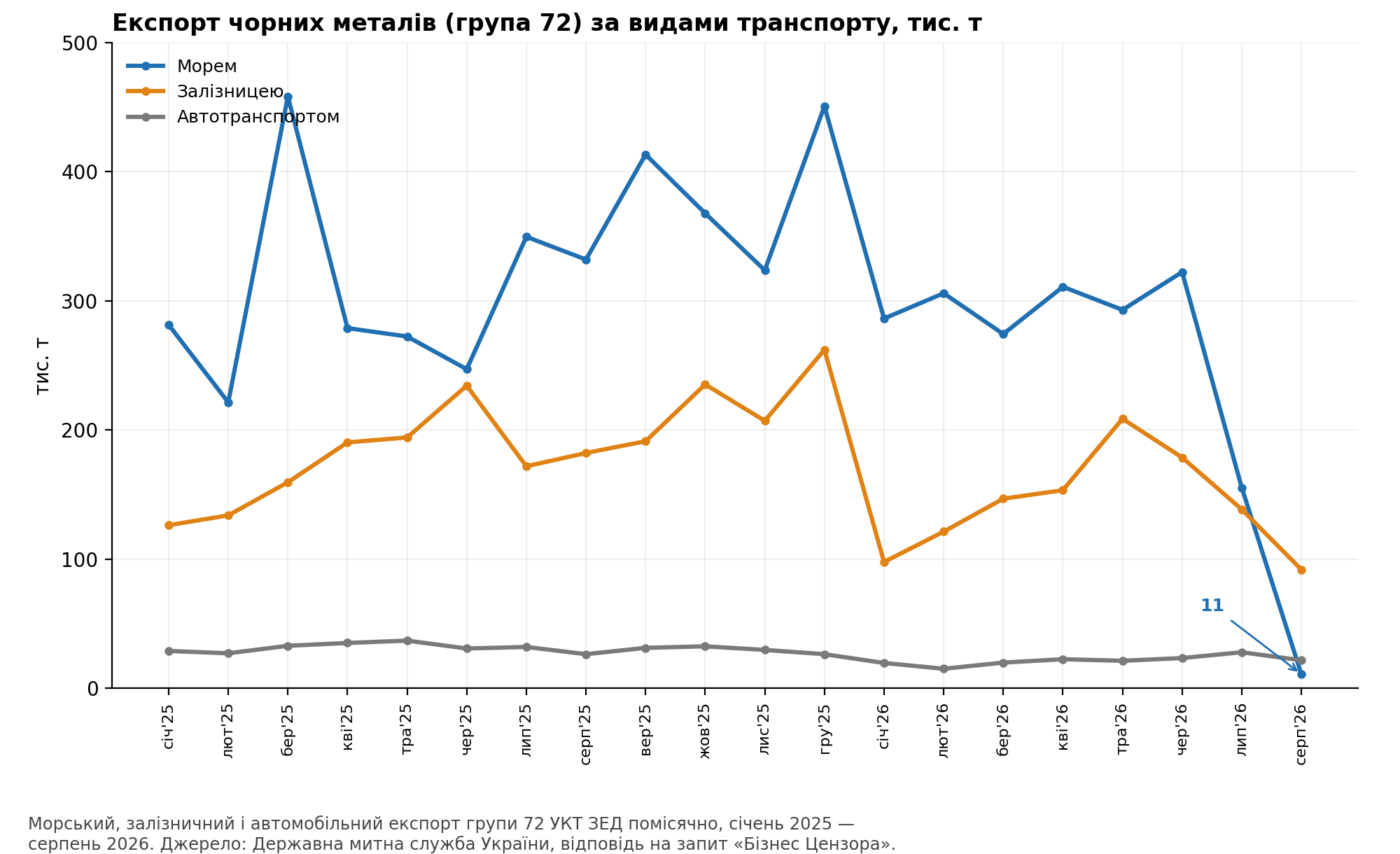
Seaborne exports even rose compared with May, from 293,100 to 322,400 tonnes (+10%). Rail exports, however, were already falling — from 208,800 to 178,800 tonnes (-14%). Road shipments also increased slightly, from 21,400 to 23,500 tonnes (+10%): road transport had apparently already begun taking over some freight flows, although its share remained tiny.
The decline in rail shipments came as no surprise: in the first quarter of 2026 alone, 541 strikes on Ukrzaliznytsia infrastructure were recorded. Ports had also already come under attack: overnight on June 12, Russian forces struck port infrastructure in Odesa and Chornomorsk. But volumes were still holding up — June saw 222 vessel calls, compared with the usual 230–320.
July: the month the sea disappeared
In July, exports of metal products fell to 322,200 tonnes, down 39% month on month. Seaborne shipments saw the steepest decline, falling to 155,500 tonnes, down 52%.
In its response to BusinessCensor, the State Customs Service explained: "The suspension of maritime transport in July 2026 due to intensified Russian attacks led to a redistribution of freight flows."
According to the export breakdown provided by customs, the share transported by sea fell from 61% in June to 48% in July and 9% in August, while rail’s share rose from 34% to 43% and 74%, and road transport’s share increased from 4% to 9% and 17%.
The escalation at sea began around July 10, when the intensity of Russian strikes on ports and vessels rose sharply, according to observations by the US-based Institute for the Study of War. According to data from Ukraine’s Ministry of Recovery, Infrastructure and Transport, July alone saw 67 strikes on seaport facilities and 57 attacks on civilian vessels. Vessel calls fell to four or five per day, and on July 22, no vessels entered the ports. Maersk and Hapag-Lloyd suspended operations at Chornomorsk, followed by CMA CGM.
Rail and road transport did not make up for the loss. Rail exports totalled 138,600 tonnes in July, compared with 178,800 in June, the second consecutive monthly decline, following a peak in May of 208,800 tonnes.
Over the 20 months from January 2025 to August 2026, combined rail and road exports never exceeded 289,000 tonnes per month, just over half the volume shipped by all modes of transport combined in June.
In response to a BusinessCensor request, Ukrzaliznytsia confirmed that mining and metals shipments were being redirected away from the ports of Greater Odesa towards land border crossings and the Danube route.
The company attributes this to the combined impact of strikes on production facilities, rail infrastructure and port infrastructure, which reduced output and, consequently, rail freight volumes. Ukrzaliznytsia did not specify exactly when this rerouting began.
Meanwhile, the overland route became more expensive: effective August 1, Ukrzaliznytsia raised freight tariffs by 30%, the first revision since 2022. Steelmakers publicly criticised this policy throughout the summer. In June, Ukrmetalurgprom warned that higher tariffs would hurt the economy, estimating losses of nearly UAH 100 billion in GDP and $2.4 billion in foreign currency earnings. In early August, when the tariffs were raised despite these objections, the association urged the government to reverse the decision entirely, proposing instead a gradual increase of 8–14% over 2026–2027 and only after shipping resumed at Black Sea ports.
In its response to BusinessCensor, Ukrzaliznytsia said that "the producer price index has risen by more than 250%, fuel and energy costs have increased severalfold, while railway workers’ pay has fallen to a historic low," meaning the actual increase represents only partial indexation.
It therefore describes the increase of 30%, rather than 45%, as a compromise: "In response to criticism from Ukrainian businesses, including steelmakers, JSC Ukrzaliznytsia made some concessions," the response states.
The company says tariff indexation is not a matter of profit but a necessary step for survival: "JSC Ukrzaliznytsia is facing a critical liquidity situation and a real threat of rail operations coming to a halt." Such a shutdown would also be critical for the steel industry, which, according to the carrier, "depends entirely on rail" because of the volume and nature of its cargo.
August: the US, Turkey and Italy vanished as export markets; seaborne exports plunged 97%
In August, exports fell to 124,800 tonnes, down 76% from June. Seaborne shipments totalled just 11,000 tonnes, a 97% collapse compared with June. In value terms, exports shrank from $293 million in June to $92 million.
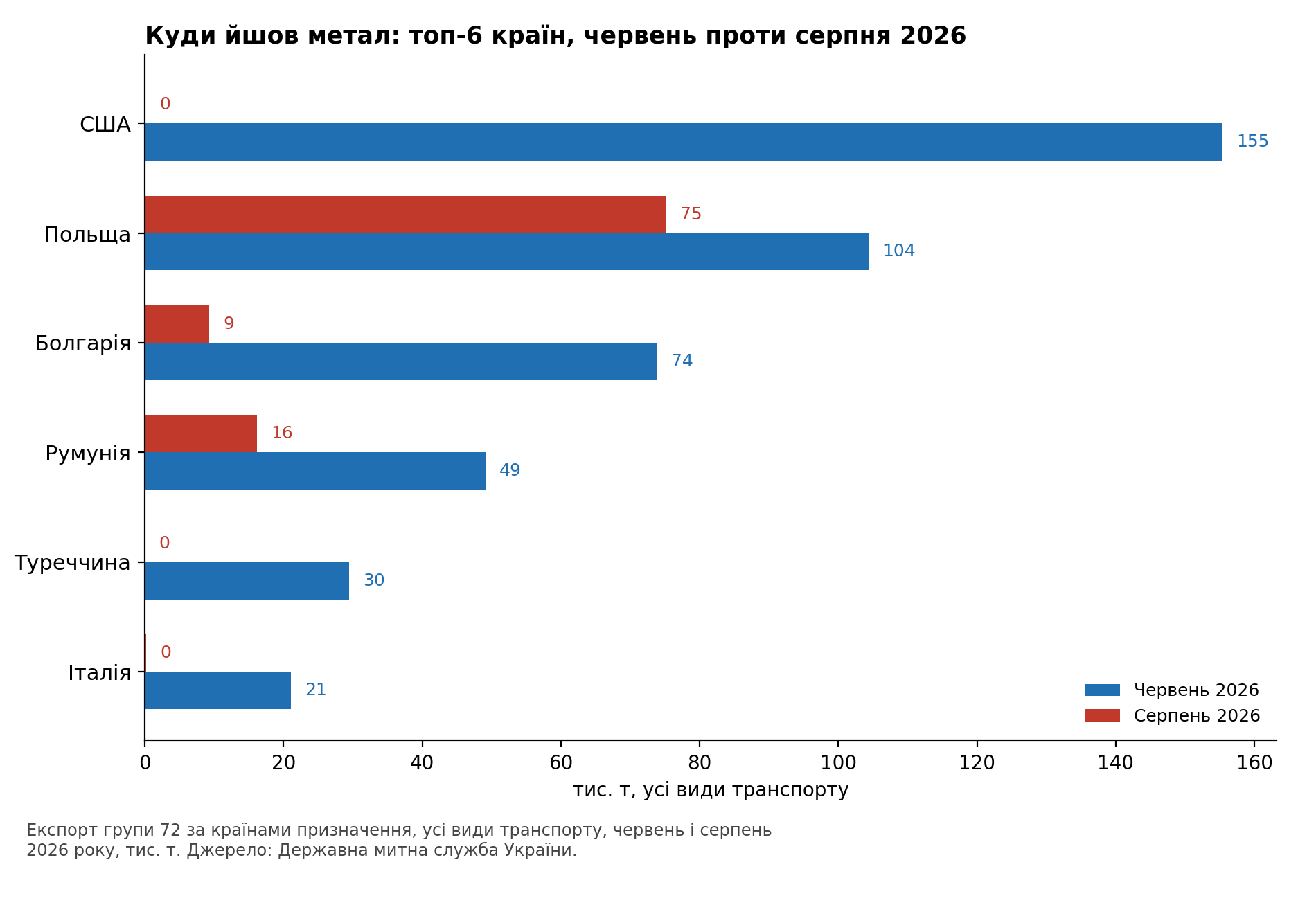
Most of the 125,000 tonnes exported in August followed a single route: 60% went to Poland by rail.
Ukrzaliznytsia also confirmed the trend in a letter we received in September: "At present, most mining and metals exports are handled through land border crossings, while the share of shipments heading to the ports of Greater Odesa has fallen substantially."
The US, Turkey and Italy, countries that had received tens of thousands of tonnes every month in the spring, received virtually nothing from Ukraine.
In effect, exports of Ukrainian metal products were grinding to a halt even before the strikes on the plants, a decline that continued for three consecutive months: 524,700 tonnes in June, 322,200 in July and 124,800 in August. The first strike on a plant, Zaporizhstal on August 11, came after export volumes had already fallen substantially.
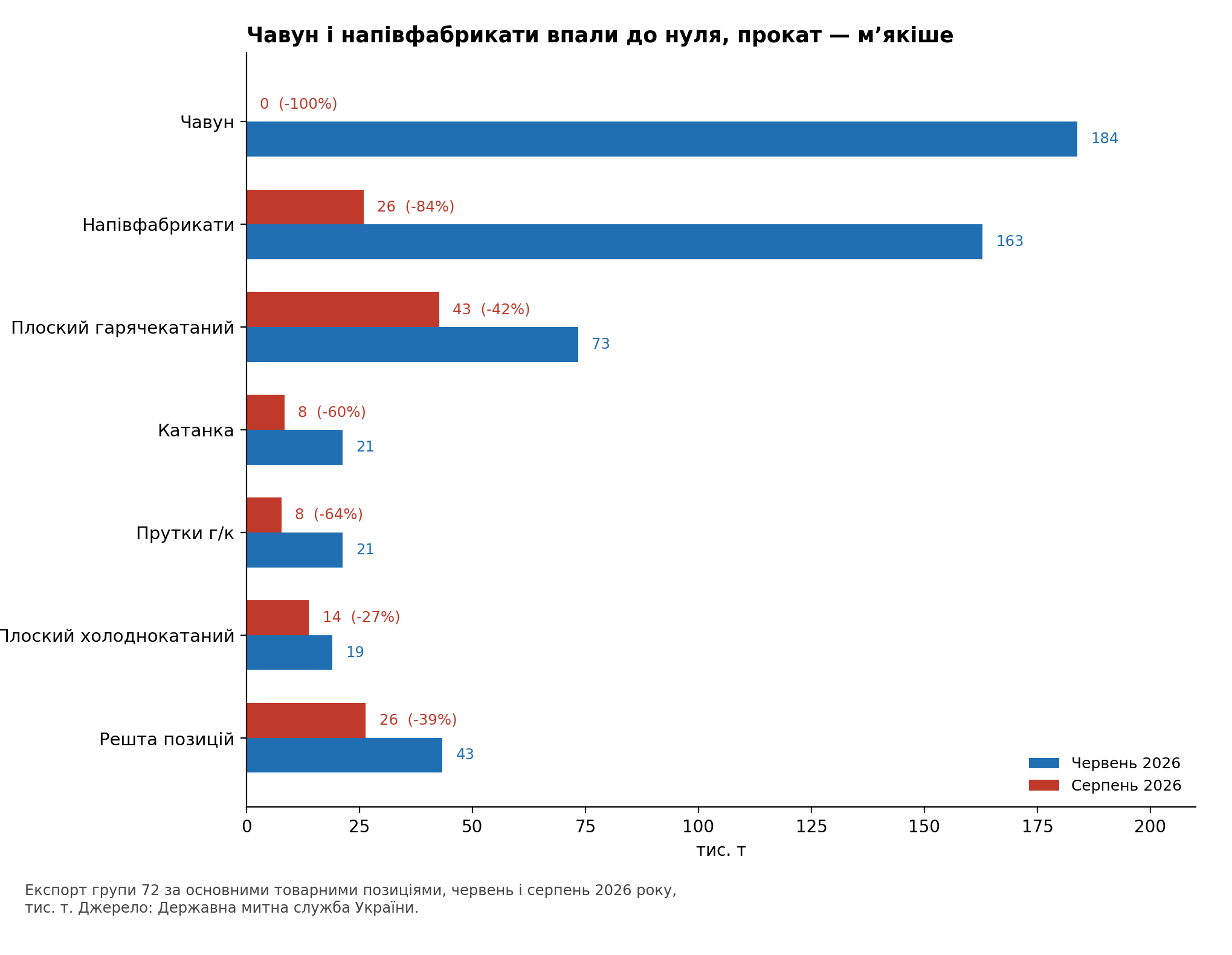
The mix of remaining exports also changed. Pig iron and semi-finished products, which had been shipped almost entirely by sea, accounted for 80% of the overall decline in tonnage between June and August. Exports of rolled products, which have higher added value, fell less sharply than those of pig iron and semi-finished products. The average export price per tonne also rose, from $559 in June to $739 in August.
In effect, exports of Ukrainian metal products were grinding to a halt even before the strikes on the plants, a decline that continued for three consecutive months: 524,700 tonnes in June, 322,200 in July and 124,800 in August. The first strike on a plant, Zaporizhstal on August 11, came after export volumes had already fallen substantially.
The mix of remaining exports also changed. Pig iron and semi-finished products, which had been shipped almost entirely by sea, accounted for 80% of the overall decline in tonnage between June and August. Exports of rolled products, which have higher added value, fell less sharply than those of pig iron and semi-finished products. The average export price per tonne also rose, from $559 in June to $739 in August.


