


Infantryman Yurii Kim on fighting near Kyiv: "I knew I would die soon. I wasn’t going to run away – my goal was to make the enemy pay as dearly as possible for my life"
The music producer and entrepreneur chose to serve in the 72nd Brigade in 2020. In late February 2022, he was serving with the brigade on the outskirts of Kyiv, defending Moshchun, where he rescued wounded civilians. In 2023, he was discharged from the army following the death of his son, who had joined the National Guard. This year, he returned to military service and now serves in Khartiia.
What drove him to return, and what challenges do the country’s defenders face in civilian life? These were the questions Yurii and I discussed.

"A music producer and a tax official were sitting in a trench in Moshchun, smoking English cigarettes, that’s how a very funny joke ought to begin," Yurii Kim joked in March 2022 at a hospital in Kyiv’s Obolon area, where I was visiting him. He and Roman Kovalenko, call sign Revizor, commander of the 5th Company of the 72nd Brigade’s 2nd Mechanized Battalion, told me how the Russians had tried to break through our infantry’s defenses in Moshchun and enter Kyiv. An article about this was published on Censor.NET at the time.

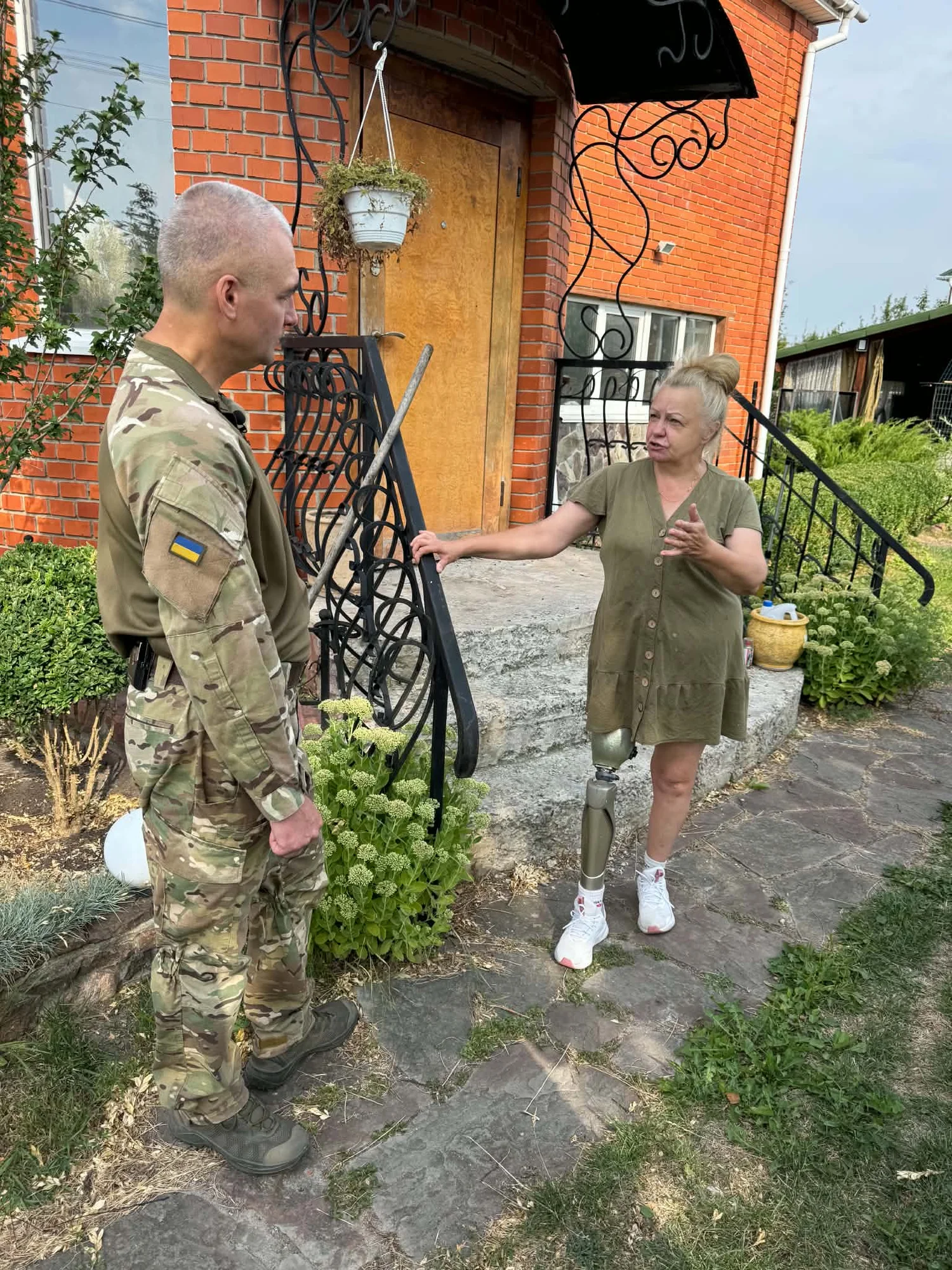
At the end of this summer, Yurii and I met in Moshchun and walked along the lanes between summer houses – some rebuilt, others still in ruins – recalling the events of 2022. We filmed that walk as one of the testimonies for the documentary "Moshchun.72". Yurii was particularly keen to find out whether the woman who had lost a leg during shelling and to whom he had applied a tourniquet was still alive. He pointed out the house where a shell had pierced the roof and, despite failing to explode, wounded people on the ground floor. Yurii had seen a man run out into the street calling for help and rushed over to him. "When I ran into the house, the dust inside was thick. I couldn’t see anything," Yurii recalled. "When it cleared a little, I saw a small crater, with people lying around it. An older woman... Both her legs were gone above the knees. Shreds of skin hung like a skirt. Her head had been torn into tiny pieces. Her brains were all over the room. A little girl was sitting nearby. She was conscious. A boy of about the same age was shouting, ‘Mom, Mom.’ Another woman was lying there. Her leg was missing from the shin down. Torn off. Her foot was on the other side of the room. I applied a tourniquet. Only when I started working on her did she feel pain. That was a sign I was doing everything right. I explained that it had to be done this way; otherwise, there would be no point in trying to help. People were carried out of the room one by one. I bandaged the girl as well. Her foot was also injured; what looked to me at the time like a bone was sticking out of her sock. But she wasn’t screaming. She just sat there and watched. And the woman even managed to ask me, ‘Maybe we should put some peroxide on it?’" Yurii also helped load the wounded into the car belonging to the man who had called for help and explained where best to take them, where there were medics.
Since then, Yurii had heard nothing about what had happened to those people. He kept replaying the situation in his mind, worrying about whether he had done everything correctly and whether the woman and the girl were alive. As we stood outside that house, now covered by a new roof, a woman came out of the house opposite and told us that Halia, whom he had saved, was not only alive but back home. She went to fetch her. The emotional reunion was captured on video and will be available to watch later. Halyna told Yurii about her treatment, how she had learned to use a prosthesis, and that her young relative was alive and had undergone repeated operations on her leg. You could see Yurii’s relief. Later, he repeated several times: "Phew, I did everything right. I was so worried about whether I had applied the tourniquet correctly and stopped the bleeding. Now I know I did what I should have."
After recalling 2022, Yurii and I sat down by the memorial in the forest at the minibus terminus in Moshchun and talked about why he had returned to the army. Of course, we also revisited 2022...
"I DIDN’T HAVE TO STAY IN MOSHCHUN"
– Do you remember when and how you arrived in the Kyiv area in February 2022? How did the full-scale war begin for you personally?
– On the evening of February 23, 2022, I was in Bila Tserkva and, as usual, went to a hotel for the night — I would either stay at a hotel or rent an apartment by the day. I had only just arrived and was about to get on with my own things when the duty officer called: "Kim, where are you? Get back immediately!" I was back within 15 minutes. Everyone at the unit was already running around, issuing orders... I was responsible for collecting NLAWs and Javelins for the 2nd Battalion. We got into a Ural truck and drove to the unit’s No. 7 site. On the way, we found out that the weapons weren’t there. We turned around and went back to the warehouse at the No. 5 site. We collected the weapons and loaded the truck. Then everything went quiet. Everyone was waiting for something, sitting on their beds...
There was no order to move out. Then an order came to hand in the weapons, pack everything into crates, and load them onto a separate truck. I asked my platoon commander: "What the hell?.. What are you doing? The weapons need to be issued to the men, along with their kit. We’re about to move out. We may have to go straight into combat on arrival. How do you think that’s going to work?" He said it was an order from the chief of staff and the battalion commander. I argued about it, but we handed in the weapons. In the end, in the middle of the night, the men were loaded onto one truck, the weapons onto another, and the equipment onto a third.
– Did you know where you were going?
– I assumed it would be Kyiv. There had already been talk that our area of responsibility would be the north of the capital. We set off. We couldn’t see anything along the way because we were sitting in the back of a canvas-covered Ural. We drove for a long time, all night. By the time it was light, and everyone was already seeing news of missile strikes on their phones, we stopped somewhere along the Zhytomyr highway, among some abandoned ruins. It turned out that the truck carrying the weapons had broken down on the way, and the equipment wasn’t there either, so we were left with nothing, no kit and no weapons. The brigade’s deputy commander came to meet us. He took the men to Moshchun and to the right of Moshchun, opposite the village of Chervone. They started setting up positions and digging trenches there. Eduard Safronov, the 5th Company’s chief sergeant, and I stayed behind to wait for the weapons. By the time they arrived, it was already dark. We sorted everything out and transferred it all to another truck. It turned out my body armor was missing. I couldn’t find it...
It was already dark when we set off for Moshchun with the weapons. We made our way through civilian traffic that filled all six lanes, both out of Kyiv and toward it. When we reached Moshchun, we unloaded the weapons for the reconnaissance troops, started looking for the 5th Company and... got lost. There were no communications, it was dark, and navigation wasn’t working. Nobody knew where to go. We got lost among the pine trees near the minibus terminus; I only now realize where we were driving around back then. Somehow, we found our way back into Moshchun. There was a tractor driver ahead of us, and he led us to the 5th Company. We unloaded the weapons for the soldiers, and I stayed at that unit’s positions.
– Could you have left?
– Of course. I didn’t have to stay because I wasn’t from the 5th Company. At the time, I was serving as a gunner in a machine-gun platoon and could have returned to my own unit, which was in Horenka then, if I’m not mistaken.
– Why did you stay?
– I can’t say. Something told me this was where I needed to be. I had an NLAW, after all, and had completed the operator training course. There’s a small bridge in that area, and we expected tanks and armored vehicles to cross it.
– You realized you could be useful?
– Yes, yes, of course. Back on the Zhytomyr highway, I had approached the battalion commander, Dzeryn, and asked him to give me the men who had also completed the training and put all the NLAWs under my command, so I would have all the launchers we had been issued, rather than just one. My argument was that we all needed to be on the stretch where vehicles might advance. He said the weapons had to be distributed along the front. Well, I disagreed with that... (Laughs.)
– How many NLAWs did you have?
– Five. That’s very few. The British use three per tank. And we spread five across the whole front...
– By then, it was the night of February 24–25. Where did you spend the night, or where did you take up positions?
– In the forest opposite the village of Chervone. There’s a small bridge there, and that’s where we were setting up positions. There weren’t many troops in Moshchun: a reconnaissance platoon and some mobilized soldiers. Most of the 5th Company’s men were opposite Chervone, expecting the enemy there. For two days, the 25th and 26th, we waited there, dug in and prepared. Columns were moving toward Hostomel; we could hear them. Fighting was already underway there – aircraft, artillery, small-arms fire.
"FROM FEBRUARY 24 TO 27, I KNEW FULL WELL THAT I WOULD DIE SOON"
– When did you first see enemy aircraft with your own eyes?
– Personally, on February 27. Something big with wings was burning and falling out of the sky.
– Was that in the Chervone area?
– No. On the 27th, we were heading to Moshchun in three infantry fighting vehicles, and I saw it to our right, above the forest. I thought it was a plane. Now I’m beginning to think it might have been a drone that had been shot down. Or perhaps it was a plane after all. I saw the aircraft attacking us later, probably in the first few days of March. That time, a plane was carrying out a strike. Otherwise, they would fly over us toward Kyiv, so low that I thought I could see the face, the head of the pilot in that ground-attack aircraft. I saw one turn and strike the center of the village. Most of the time, I only heard the explosions. Once, I was at the Slavutych position with a machine gun when I heard a plane, then an explosion. I thought the roof would collapse, but the unfinished house held up. The blast was some distance away, not right beside us. But the houses close to the explosion were blown away. And the crater immediately turned into a pond — the water rose instantly. Aircraft were carrying out strikes when fierce fighting was already underway in Moshchun. In those days, everything was firing at once. You could no longer tell whether it was artillery or something else.
– When did you first use an NLAW?
– That same day, February 27, when we went in three infantry fighting vehicles to stop a column of Russian vehicles that had crossed the bridge opposite Moshchun. It was the first and last time. But I think we were effective. I don’t think I hit anything, but the shot itself made the enemy flee. They stopped firing, hit the gas, and went back across the little bridge.
– But one vehicle remained on the Moshchun side...
– Yes, it had been knocked out before we arrived. It had either stalled or been hit, but not by us. Perhaps the first two infantry fighting vehicles had engaged it. I didn’t see that. What I saw was a sniper firing and preventing the katsaps from getting out of the vehicle. That sniper did a great deal.
– Why was that also the last time you used one — was there no further opportunity?
– There wasn’t. We had NLAWs. Later, in the Donbas, I, how do I put this politely, managed to get hold of some more NLAWs when we were relieving the 30th Brigade. They had taken a beating there and lost some advantageous positions. During the rotation, the men were terribly exhausted. They had been hit very hard. So they left us a few "gifts", including NLAWs, as a thank-you for carrying their things, weapons, and a radio out from under fire. The guys were in a daze because they were exhausted and, in their minds, already in the rear recovering. I understand them perfectly. Compared with them, we were relatively fresh.
– After the Russians tried to cross the bridge, part of the 5th Company moved to Moshchun from the positions opposite Chervone. Why did that happen? Did you realize the main attack would come here?
– It wasn’t me who realized it; it was the commanders. The first engagement took place on the 27th. After that, Revizor, the company commander, concluded that this was a likely breakthrough point. Subsequent events proved him right. We spent the night of February 27–28 opposite Chervone, then picked up a few more men and one or two infantry fighting vehicles in the morning and came here. On the 28th, the village came under artillery fire for the first time. Civilians were hurt.
From the 24th to the 27th, I felt fear and terror unlike anything I had experienced before or have experienced since. It was the greatest fear of my life. I can’t even describe it. I couldn’t eat or drink... I knew full well that I would die soon. I had no doubts. I wasn’t going to run away; I was going to fight. My goal was to make the enemy pay as dearly as possible for my life. But I was absolutely certain I would die soon. Perhaps it was the propaganda taking effect, "the Red Army is the strongest of all" and so on. I don’t know. It was terrifying. But on the 27th, once I was firing at Russian paratroopers and using the launcher against their vehicles, I completely reset. Completely — no fear, no terror, nothing. It all vanished.
– On March 5 or 6, the company had to relocate its command post. Were you at the Slavutych position then?
– Yes, I was there until March 5. That day, Revizor ordered me to report to him because there had been a breakthrough on the right flank and the katsaps were closing in. He called me in as reinforcement. The command and observation post was lost the following day, March 6. At first, they said it was an air strike, then artillery, but that doesn’t matter. The post was destroyed. The concrete ceiling slab saved Revizor and the other men inside. They withdrew.
– Was there a moment when it seemed you would be pushed back after all and would have to retreat even further? How aware were you personally that Kyiv was behind you?
– When stress and tension reach their peak, I don’t think anyone is thinking about Kyiv. Once the situation stabilized, of course, everyone here understood that the capital was behind us. That was one of the motivations that helped us hold the enemy back. That’s what I think. And I want to say this, I’ve said it before, and I’m repeating it because it matters to me: I have never, anywhere, met people like those in the 72nd whom I was fortunate enough to serve alongside here in Moshchun and later in the Donbas. They are a different kind of people.
Heavy fighting for the Donbas was already underway. Even then, men were allowed to go home for a week, unofficially, on their word. They would go, spend time with their families, and return. They knew and understood what they were returning to, and a few days later they would be killed. How do you explain that... These were people who understood perfectly well what was happening and what could happen to them. And when they went home, there was no need to monitor them, keep calling them, guard them, drag them back, or "bundle them into recruitment vans". These were people who were given a chance to spend time with their families, then returned, fought their last battle, and died. That’s the kind of people they were. Knowing these people, having the honor of standing beside them, is the greatest, most important achievement of my life.
Before 2022, during a deployment to the east, we had a position where several soldiers from the 2nd Battalion were stationed. We became friends, got along very well, and made plans to start businesses together after the war. We were very close. And they were all killed after 2022. Every one of them! When I talk about incredible people, they are the ones I mean. I remember how they went home, how they called me, and how they died. To me, these people matter most. And I want to tell people about them, about the heroism of the people I knew.
Things varied in Moshchun. Nobody behaved perfectly. But I don’t remember a single person who failed to go out to the positions, even though there was no supervision. Nobody dragged anyone there; nobody watched anyone or counted heads. And I can’t name a single person who ran away. That’s what I’m talking about. That’s what I want people to know.
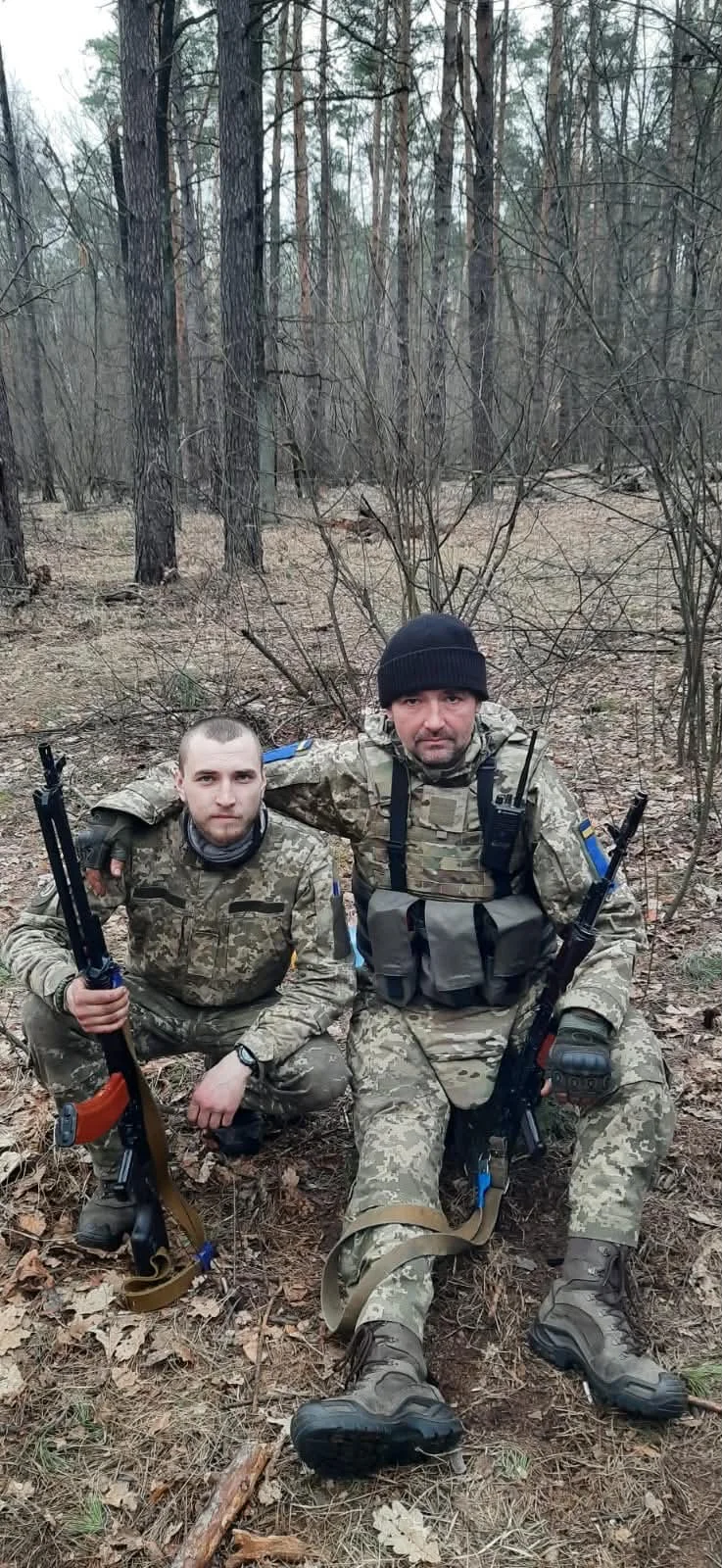
In the photo: "When the Russians had retreated from Moshchun, and the fighting was over, I decided to have a photograph taken with Ivan Soroka," Yurii Kim explains. "Here, he still has his eyes"... Ivan would lose his sight during the fighting in the Donbas.
"I SAW WAR, TANKS, RUINS IN MY DREAMS... THAT’S WHY I WENT TO THE MILITARY RECRUITMENT OFFICE AND CHOSE TO SERVE IN THE 72ND BRIGADE"
– Why did you sign a contract specifically with the 72nd Brigade in 2020?
– I liked the patch...
– Why did you decide to join the army? And why in 2020 specifically?
– I wanted to catch the last train. Let me explain. When the Anti-Terrorist Operation began in 2014, I was living in Kharkiv. I saw Russians being brought into the city by bus and entering on foot past checkpoints. I saw them coming into the city. VKontakte was still operating then, and there was a page about Right Sector. I called the Kharkiv branch. They explained that we needed to prepare; there would be a war. I asked what exactly I should do. And when the Anti-Terrorist Operation began, I went to the military recruitment office. That was in late April. About 30 to 40 of us turned up. They took down everyone’s details and phone numbers and said, "We’ll call you back." I waited for a year. Now I understand that I shouldn’t have waited; I should have gone out and looked for a unit to join, as others did. But that’s how it turned out.
– Well, you had a job, other things keeping you busy, didn’t you?
– Yes. In 2015, my friend Ihor from Kyiv said, "Maybe you’ve waited long enough? We have things to do. Move to the capital." So I moved. I lived a peaceful life. That friend and I had our own recording studio. I understood that something was happening, but somehow distanced myself from it. I comforted myself with the thought that I had done everything: I had gone to the recruitment office, and they had taken down my details. Now I understand that was nonsense: if you want to act, you have to act. But back then, I came up with that excuse so I could get on with my life. By the winter of 2019–2020, I could no longer work. Nothing interested me, and I couldn’t sleep. When I fell asleep, I saw war, tanks, ruins, armored vehicles running over me, myself running somewhere and shooting. I would wake up from all that, drink some water and go for a smoke...
– Why do you think you were having those dreams? Were you watching films or taking in a lot of information about the war?
– I don’t know. Perhaps the news was affecting me that way. I remember clearly: when there were reports about Crimea, about water supplies being cut off and the Russians wanting to establish a land corridor, I understood that something was about to start from Crimea. So I wanted to be armed and dangerous, as well prepared as possible, and to do something. Because I imagined myself sitting on a bench at 70 or 80, with nothing to say about myself, nothing to look back on. (Laughs.) I was having such a midlife crisis that I actually began to panic. I remember going out to get water with two large plastic bottles, then looking at my watch: the recruitment office was still open. I went there, walking straight in with those bottles. They were already getting ready to go home, and I said, "Wait." "What did you want?" "You need people, don’t you?" And that was it. They laid out the options as if I were at a travel agency: there’s this option, you can go here, or you can go there... "First, take a look at the kind of people serving there. You might not like it." I said, "Give me the hottest option." They said, "The soonest is in a day or two, to Poltava, to the special communications institute." I went, spent a month there, and passed every exam with top marks. I decided I would sign a contract and become a signaller. I gathered the documents, went through all the required assessments, arrived in Poltava, and was... told to get lost. I wasn’t suitable. They didn’t like me. I went home upset and started looking through recruitment ads on social media. And I found one. I saw the 72nd Brigade’s patch... I am a creative person, after all, and it was minimalist, clear, recognizable from any distance. I called. Sulim answered the phone, and he took me into the army.
– Here, you were a good fit.
– Yes. Straight away, too.
"I WAS DISCHARGED ON THE GROUNDS THAT MY SON WAS MISSING IN ACTION, BUT THE REASON WAS DIFFERENT — I COULD NO LONGER SERVE. I WAS PHYSICALLY FALLING APART"
– As I understand it, your son also volunteered to fight?
– Yes, he joined the army on April 1, 2022.

– How old was he?
– Twenty-eight.
– How did you find out? Did he call you?
– He didn’t call. We weren’t in touch. These things happen... Since I’m talking about myself, I want everyone to understand: I joined the army knowing exactly why I was doing it. I didn’t want to miss this war. I absolutely had to do something. This is very important; it really is... Some people don’t believe me. They think I’m just saying it for effect. But that is my motivation, exactly as it is. I can’t call it pure patriotism — that’s not what it is. When Crimea was annexed, I took it very hard. I felt a sense of injustice, and later I began to feel that it would all pass me by... That is my truth. I have no other motivation.
Do I enjoy killing? No. Am I a true Ukrainian through and through? No. That just isn’t there. I have plenty of grievances with Ukrainians. But Crimea, the Donbas — all of that is ours, our own... It tears me up inside, makes me shake. I understand that professional soldiers are much more effective than I am. Somehow, they take a clearer-headed view of it all. But I want to drive all these occupiers off our land by any means possible and restore the country to its 1991 borders. Otherwise, there is no point in fighting.
– When did you find out your son had gone to fight?
– When he went missing in action. My son volunteered for mobilization into the National Guard’s 5th Brigade in Kharkiv. A year later, he went missing during a battle near Kreminna. The position was lost, and when it was retaken, they couldn’t find him. He is not among the prisoners of war. There is no information at all. That was in March 2023, three and a half years ago.
– Who told you he was missing?
– A friend of mine, also a serviceman, who acted as a go-between with my ex-wife. We weren’t in touch, and if something needed sorting out, my friend helped us communicate. I was in the combat zone at the time, and when I had the opportunity, I asked him to contact my ex-wife to sort out some personal matters. That was when I learned my son was missing. By then, four months had passed since his disappearance.
As soon as I found out he was missing, I found a way to get to Kharkiv. I tracked down the unit, the commanders, and the brigade’s deputy commander. I spoke to them, and they gave me all the documents. They had no doubt he had been killed, but they hadn’t found his body — no body, no weapon, nothing. Another year passed before I began legal proceedings to have my son declared dead. The case dragged on for a year and a half, almost two years, and the court did not grant my application.
– Why is it important to you to have your son declared dead?
– First of all, I’m a serviceman myself. I could have been killed or listed as missing in action. I consider that status... (Pauses to think.) I don’t know how to put it. Unethical, wrong. A person has been killed — their fellow soldiers know it, it happened in battle, but the body cannot be recovered. Those who have been killed remain listed as missing in action. That’s wrong. It shouldn’t be that way. Sometimes something changes through the courts, but very rarely. In May this year, Kyiv’s Podilskyi District Court left my application without consideration. I appealed, and my appeal was upheld in September. The Podilskyi District Court’s ruling was overturned, and the case was sent back to the court of first instance for further consideration. The appellate court confirmed my assessment of the judge who had refused to consider my application. This judge had also tried Maidan protesters, yet for some reason she continues to work, displaying cynicism of the highest order! None of my arguments were taken into account. Yet the appellate court quotes me word for word in its decision. So I was right to stand my ground. In its decision, the appellate court states that the court of first instance made an error. And now I’m very interested: what happens to judges for errors like that? Nothing, apparently? So they do this deliberately — drag things out, mess people around. And they face no consequences. An error is just an error. These judges receive enormous salaries, then pensions. They bear enormous responsibility, yet they can calmly, cynically make mistakes. The case has been sent back to the very same judge. Is she going to put me through all that stress again?
– Was it your son’s death that led you to leave the army and spend some time out of service?
– I was discharged on August 25, 2023, on the grounds that my son was missing in action. But that was the legal basis for me — the basis, not the reason. The reason was that I could no longer serve. I couldn’t cope physically. Everything hurt.
– Do you mean physically or mentally?
– Physically. Mentally, I could have kept fighting for another 200 years... But physically, I was simply falling apart. Everything was going: my eyesight, my hearing, my lower back, my knee.
"I KNOW HOW TO WIN: NOT EVERYONE NEEDS TO FIGHT, BUT EVERYONE NEEDS TO BE AGAINST RUSSIA"
– But you’re serving in the army again now.
– Yes, because I recovered.
– How long did it take you to recover?
– Perhaps six months would have been enough, but I spent two years in civilian life. I’ll say it as it is: I had no intention of returning to the system.
– How did you support yourself?
– I opened a coffee shop in Vynohradar, but it didn’t stay open long. It’s not as simple a business as it seems, especially now. Here, too, the state reminded me how things work. When I closed the coffee shop, I went to deregister as a sole proprietor, and at the administrative services center they said, "So you’re a combat veteran? Apply for assistance. Everyone does."
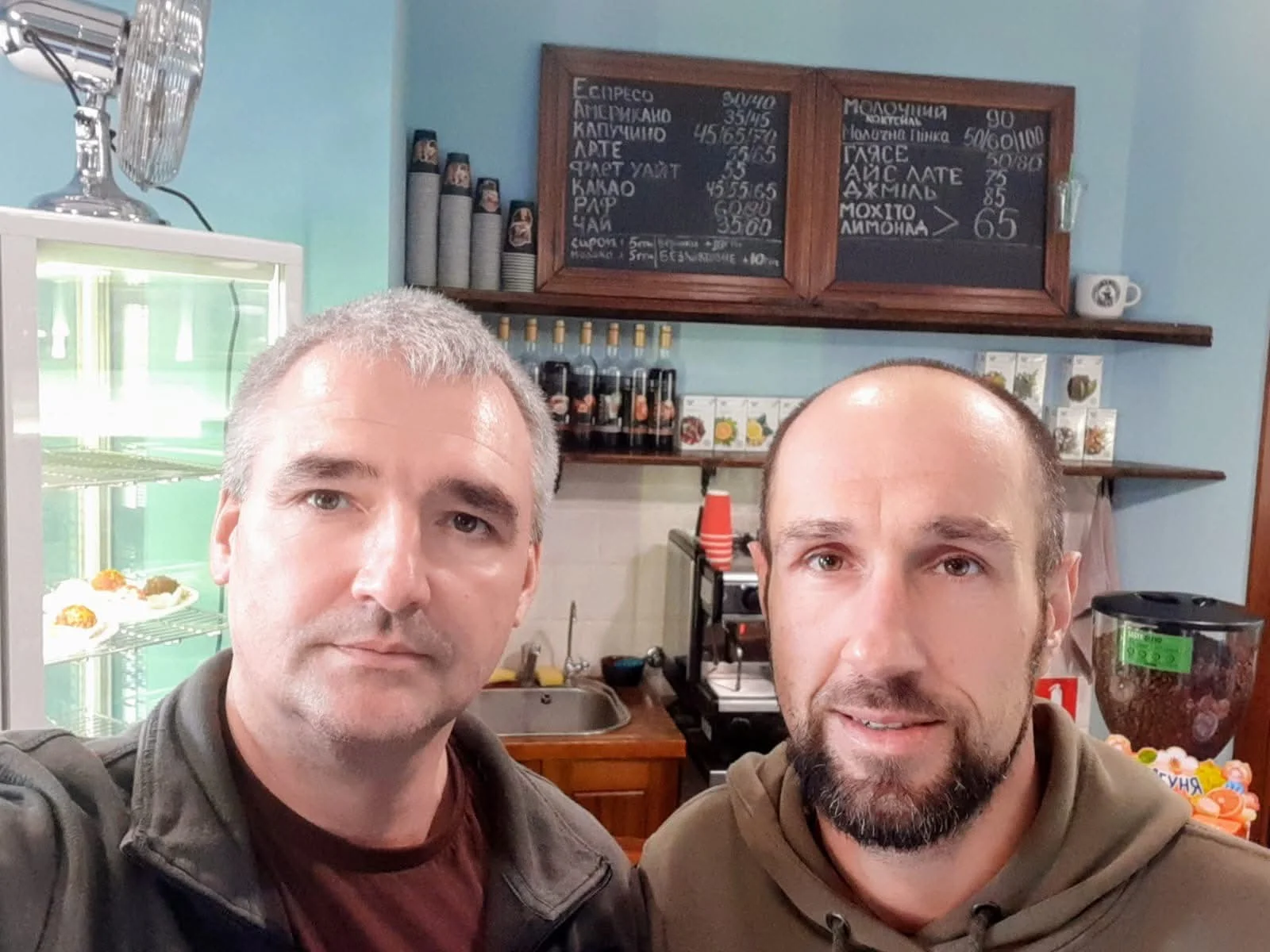
In the photo: Yurii Kim at the coffee shop he opened in Kyiv, with 5th Company commander Roman Kovalenko, call sign Revizor, alongside whom he fought in Moshchun. Censor.NET recently published an interview with him.
– Was it a substantial amount of assistance?
– I have no idea. I never received it. But they advised me at the time: "Apply! This is the capital, the payments here are the highest." I got talking to the woman at the administrative services center and jokingly boasted: "They named a street in Kyiv after me." There is a Chornykh Zaporozhtsiv Street in the capital, after all! And she said, "Then you definitely need to apply." So I did. But my application was rejected. I keep a photograph of that piece of paper so I won’t forget the wording of the rejection.
– What made you return to the army?
– Nothing made me. Yura Butusov simply called and asked, "What are you doing?" I said, "Nothing important. Just living, going here and there." "I need you. Come." So I went.
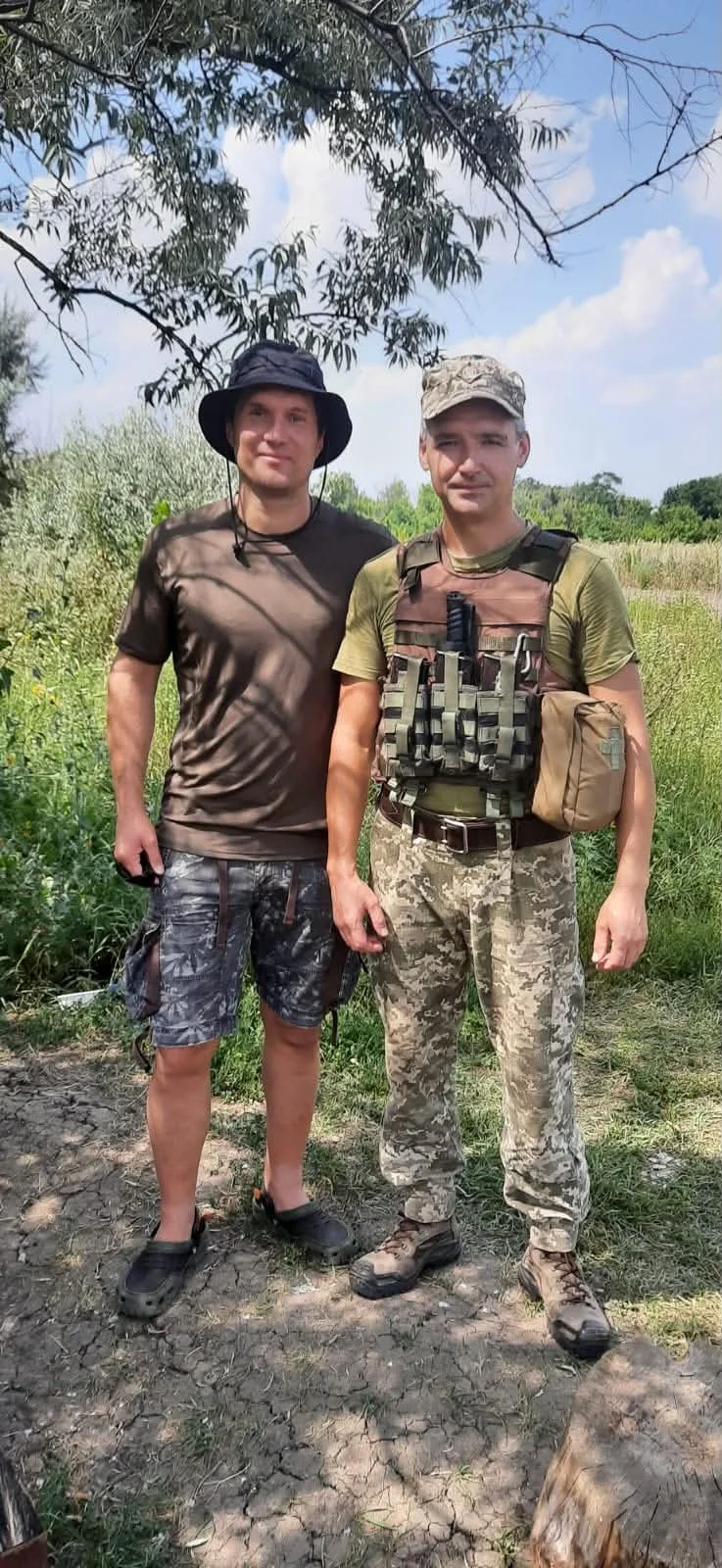
I returned to service solely because of Yura. It has always mattered to me that someone should see me as the person they call and say, "I need you. Come." That’s all. If psychologists in the Armed Forces of Ukraine did their jobs properly, the situation with personnel and mobilization would be different. That’s what I think. It isn’t difficult to work out what will motivate each person. I wouldn’t have left the army, even when I was physically falling apart. I would have found some strength within myself to keep going. We don’t know how to use the tools available – awards, incentives – even though it isn’t difficult. You need to talk to a person and understand their motivation. For some, money matters; for others, awards; for others, "wide-open fields"; and for some, all of it at once. And that needs to be put to use.
– You say you recovered in six months. What exactly helped you put yourself back together after such exhaustion, after physically falling apart? What did you do: go away somewhere, spend time in silence, avoid people, get treatment, go swimming?
– It’s very simple – doing something different. Serving in the infantry puts an extreme strain on you. Perhaps I could have served somewhere, in some other unit, but the infantry is physically very demanding. That’s all. There are no secrets here. People need to recover. That matters. You need to take a person out of the war for a while and let them rest. There’s no secret to it, as far as I’m concerned.
– Because we aren’t putting up enough resistance?
– Of course! At best, 20 percent of Ukraine’s citizens are resisting. It was the same near Kyiv. What happened here happened against the odds. We are by no means great warriors. A combination of factors came together. Even nature helped us. Above all, some of the best people on the planet came together in one place. And I had the honor of standing beside them. That’s how we held out. We were firing at them, and they were firing at us. A relentless exchange of fire. At that point, it came down to who would outlast whom. They were the first to withdraw. They couldn’t take it. Because they wanted to live, while we wanted to hit them more than we wanted to live, I think. There are no unique tactical secrets. Just keep firing until you hit them or they withdraw.

This will sound presumptuous, but I know how to win. Not everyone needs to fight. Everyone simply needs to be against Russia. How can you conquer a country if the entire population is against you? Yet the attitude of "what difference does it make which flag flies?" persists among us. That’s why I say we ourselves are to blame in many ways. Of course, we were attacked, but we also bear some responsibility for how long this has dragged on.
Violetta Kirtoka, Censor.NET


