



Since beginning of March, Defense Forces have hit more than 20 targets providing enemy air defense, - Ministry of Defense
From March 1 to 15, the Ukrainian Armed Forces struck more than 20 targets supporting Russia’s air defense system, including anti-aircraft missile systems, radar stations, and major electronic warfare facilities.
This was reported by the Ukrainian Ministry of Defense, according to Censor.NET.
Strikes on the air defense system
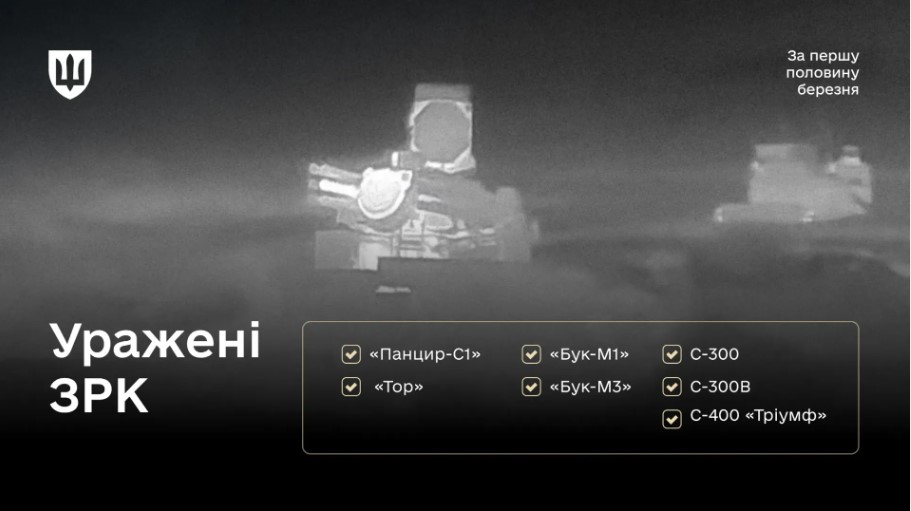
According to the General Staff of the Armed Forces of Ukraine, during the first two weeks of March alone, the Defense Forces destroyed the following anti-aircraft missile and missile-gun systems:
- "Pantsir-S1" (Yakymivka, Zaporizhzhia region, and Novoozernoye, Crimea) – provides air defense against low-altitude air attacks;
- "Tor" air defense system (Volnovakha, Donetsk region, and Balashivka, Zaporizhzhia region) – an all-weather, short-range system designed to protect troops on the move;
- Tor-M1 air defense system (Korobkyne, Luhansk region) – a modernized version designed to counter high-precision weapons and capable of engaging two targets simultaneously;
- S-300 air defense system launcher (Strilkove area, Kherson region) – the primary medium- and long-range air defense system;
- "Buk-M3" and "Buk-M1" (Lymanchuk, Luhansk region, and Bahativka, Zaporizhzhia region) – mobile systems designed to engage maneuvering aerodynamic targets;
- S-300V air defense missile system launcher (Borovenky, Luhansk region) – designed specifically for missile defense;
- S-400 "Triumph" air defense missile system launch site (Dalne, Crimea) – the most advanced long-range air defense system in the Russian military.
The Ministry of Defense notes that such losses are very significant for Russia. The destruction or damage of air defense systems reduces the enemy’s ability to shoot down missiles, leaving the occupiers’ rear bases less protected.
Damage to the radar

Since early March, the following Russian military radar stations have been hit:
- Radar stations for the S-300 and S-400 systems (Mangush, Sadove, and Chervone – Donetsk region; Novokrasnivka – Luhansk region; Sevastopol – Autonomous Republic of Crimea; Novorossiysk – Krasnodar Krai, Russian Federation) – the "eyes" without which the systems cannot detect targets;
- "Podlot-K1" (Vinogradnoye, Crimea) – detects air targets at low and extremely low altitudes;
- "Kasta 2E2" (Lubime – Luhansk regionand the Autonomous Republic of Crimea) – a 360-degree surveillance station for detecting low-visibility targets;
- "YASTREB A-B" (Topol, Luhansk region) – the most advanced artillery reconnaissance system in the Russian army;
- "Sopka-2" (Crimea) – an airspace monitoring system;
- "Nebo-U" (Gvardeyskoye, Crimea) – provides long-range detection of aircraft and missiles;
- "Opponent" and "Password" (Libknechtivka, Crimea) — mobile stations for issuing targeting instructions to aircraft;
- "Valdai" (Primorskoe, Crimea) – a specialized radar system for detecting and countering ultra-small drones.
Without operational radar systems, the enemy’s air defense becomes "blind," making it harder for the occupiers to respond in time to incoming weapons.
Destruction or damage to electronic warfare equipment
During this same period, the Defense Forces also managed to strike major enemy electronic warfare and communications facilities:
- ground relay station (Chornomorske, Crimea) – provided communication and control for attack drones;
- communications tower (Primorsk, Zaporizhzhia region) – a critical hub for coordinating the occupying forces’ units;
- Electronic Warfare Station (Donetsk region) – used to jam GPS and navigation signals from our assets.
Striking these targets disrupts the enemy’s coordination and clears the airwaves, allowing Ukrainian strike UAVs and precision-guided weapons to operate more effectively.
"Every air defense system, radar, or electronic warfare system that is destroyed or put out of commission creates a 'gap' in the enemy's air defense, opening up opportunities for our missile strikes and air operations," the Ministry emphasized.
The Ministry of Defense also noted that during January and February 2026, the Ukrainian Armed Forces struck three major Russian defense industry facilities, as well as one of the key missile testing ranges and two large ammunition depots.


