Opening up of medicines market and authorisation to sell medicines at petrol stations in line with EU rules will have positive impact on sector, — media

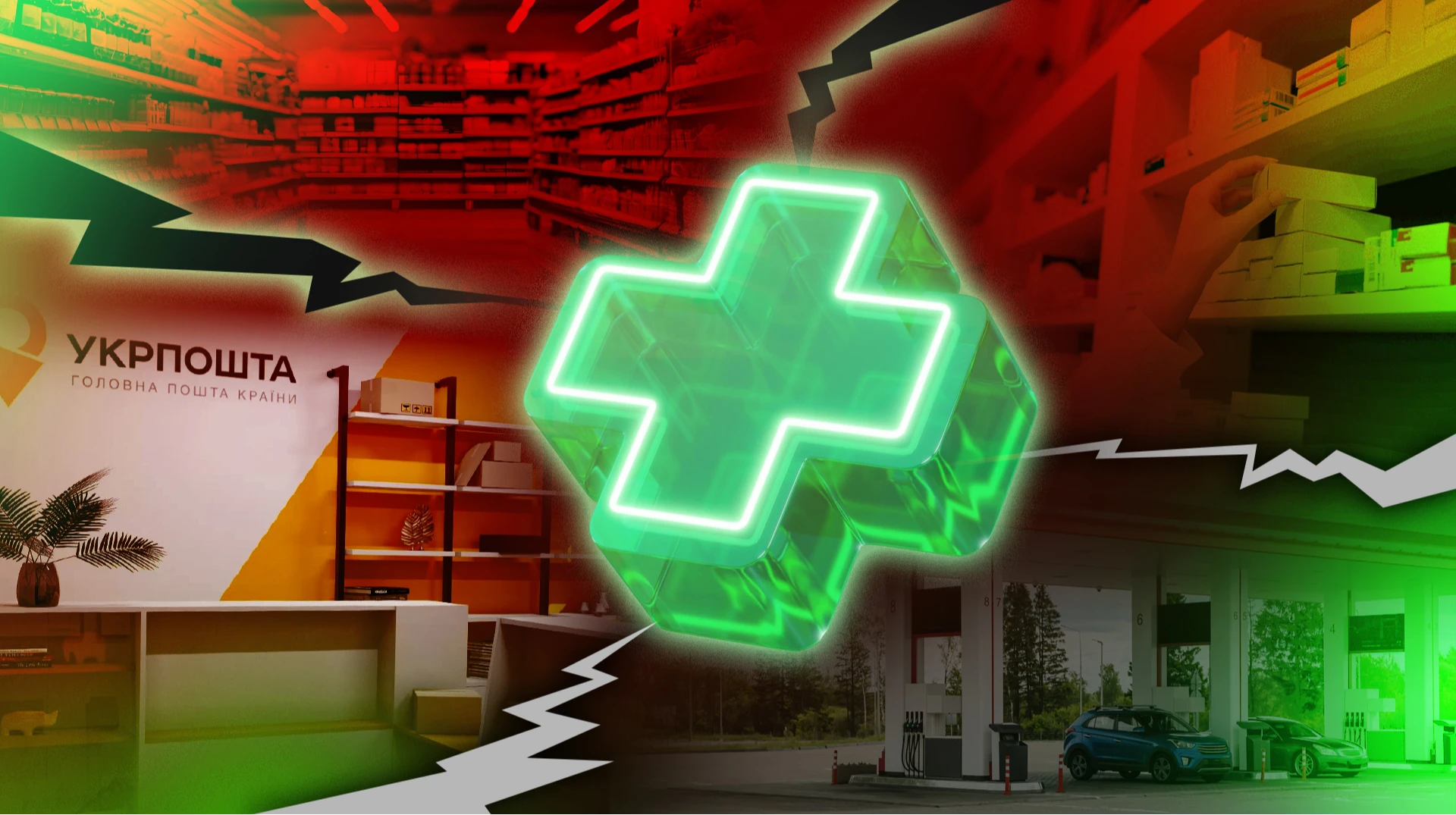
The government is breaking up one of the most closed-off sectors: the sale of medicines. Does allowing gas stations, Ukrposhta, and possibly supermarkets to enter the pharmaceutical retail market spell the end of the monopoly held by pharmacy chains?
The government continues to open up the pharmaceutical market to new players. This includes Ukrposhta and gas stations. Supermarkets have also begun to show interest in selling medicines, according to Censor.NET.
The pharmaceutical market was closed to outside players due to excessive regulation, which was justified on the grounds of patient safety. Now, the Ministry of Health (MOH) acknowledges that the global trend is moving toward the sale of medicines not only in pharmacies.
Pharmacy chains and pharmacists are protesting government decisions, arguing that lowering regulatory standards is dangerous for consumers. Some industry representatives say that pharmacies themselves have long since stopped following all the rules. How is the market reacting to the decision to allow gas stations to sell medications, and will medicines start appearing in supermarkets?
Context: How it all began
Over the past three months, the pharmaceutical market has seen more changes than in the past few years. This is despite the fact that in 2025, a "war" broke out between certain drug manufacturers (Darnytsia, Interchem) and the five largest pharmacy chains.
The status quo remained in place for nearly a year until the government intervened. The state allowed gas station chains to sell over-the-counter medications. For decades, the pharmaceutical market had been closed to outsiders, which led to the emergence of a unique economic sector characterized by high profits and heavy regulatory burdens.
Medicines could only be sold by individuals with pharmaceutical training in specialized facilities that met temperature requirements. At the same time, their status as the sole point of sale allowed pharmacies to dictate terms to manufacturers, who had to pay marketing fees to increase sales of their drugs.
This is how a monopoly of the five leading chains (ANC, "Dobryi Den," "9-1-1," "Podorozhnik," and "Bazhayemo Zdorovya") took shape, the influence of which was the stuff of legend. Officials and market players described pharmacies as giants capable of blocking any regulatory changes and even agreements between large businesses in order to keep competitors out.
In January 2026, representatives of the pharmaceutical market and gas station chains expressed skepticism to EP about the prospect of selling medicines at gas stations. This was especially true given that the changes to the licensing requirements had been adopted in haste. The draft of the relevant government resolution was submitted to the State Regulatory Service (SRS) on December 25, 2025—one day before its adoption. The SRS had not issued a conclusion even after the amendments were adopted.
The document does not clearly define the rules for licensing gas stations; in particular, it is unclear whether gas stations, like pharmacies, are required to have a pharmacist at every point of sale for medications. Furthermore, the government resolution was not consistent with the "On Medicines" law, which defines a pharmacy as the sole establishment authorized to sell medications.
According to sources in the pharmaceutical market, this document was a "stick" the Cabinet of Ministers intended to use to rein in pharmacies. "It looked as though the message to pharmacies would be: we can allow gas stations into the pharmaceutical market; they will make concessions, and that will be the end of it," says an EP source in the government.
Some representatives of the pharmaceutical market told EP that this tone was also present at meetings held throughout 2025 and chaired by Iryna Vereshchuk, deputy head of the Office of the President. "The Minister of Health raised the issue of allowing other players into the pharmaceutical market. I’m not saying these were threats to pharmacies, but that’s how it sounded," says one of the participants in most of those meetings.
However, skepticism about whether the rules would actually become permanent was dispelled in early March, when the government formalized them and clarified certain inconsistencies with the law. In a conversation with EP, Deputy Health Minister Yevhen Honchar asserts that the decision regarding gas stations is purely pragmatic.
"We are the regulator of the pharmaceutical market, not a negotiator. I don't think that can be taken as an argument. That is our position; we have stated it and put it into practice," Honchar said.
Simplified rules for gas stations
Under the version of the rules dated December 2025, a pharmacist responsible for ensuring compliance with standards of conduct regarding medications could be held accountable for all gas station pharmacies in a single region.
The updated regulations have simplified the requirements for registering gas stations as retail outlets for medicines. Now, a single person with a degree equivalent to at least an associate’s degree in Pharmacy may be responsible for all such outlets. Such a person may, but is not required to, provide pharmaceutical care (medication counseling) remotely.
Unlike gas stations, pharmacies are still required, under licensing regulations, to have a separate qualified employee on duty at each location.
The Ministry of Health stated that the person responsible for medications at gas stations will not perform the same role as a pharmacist does in a pharmacy. "Since gas stations will sell only over-the-counter medications—which consumers can decide to use on their own—the salesperson at the gas station is not required to provide any advice," says onchar.
"Our approach was two-pronged: it's unrealistic to station a pharmacist at every gas station, but at the same time, we wanted to ensure patient safety," the Ministry of Health adds.
In addition, the new rules effectively acknowledge that the sale of medicines at gas stations constitutes an exception to the law and include a corresponding provision in the licensing terms. All these simplifications have not gone unnoticed by the Antimonopoly Committee (AMCU).
In response to a request from the Ukrainian Pharmacists Association, which supports pharmacies’ position against the sale of medicines at gas stations, the committee stated that it did not endorse the government’s initiative. The committee believes that gas stations have an advantage over pharmacies in the medicine sales segment due to simplified licensing requirements.
The Ministry of Health states that the goal of the changes is to improve access to medicines. They explain that gas stations are permitted to sell only over-the-counter medications, which preserves the status of pharmacies as unique players in the pharmaceutical market. "The AMCU’s position is understandable; they are focused on competition issues. We, on the other hand, are primarily focused on the accessibility of medicines, which is why we are adapting the requirements. Our goal is to increase accessibility," says Honchar.
While the debate continues, the first gas stations have received permits to sell medicines. The State Service of Ukraine on Medicines and Medical Devices told EP that as of March 11, the "Ukrnafta" and OKKO gas station chains had applied for such licenses. Five gas stations belonging to these chains have already received them.
The Ministry of Health says that gas stations entering the pharmaceutical market could lower drug prices, but clarifies that the priority is accessibility, not price reduction. However, few believe that gas stations will become full-fledged market players. It is unclear how interested they will be in selling over-the-counter drugs, since the markup on them is limited to 35%.
Will Ukrposhta sell medicines?
In line with gas stations, its program for delivering medicines, Ukrposhta plans to expand its operations. Going forward, it aims to sell medicines nationwide. Ihor Smilianskyi, CEO of the postal operator, noted that the company will be able to sell medicines at 26,000 locations.
Almost all of the pharmaceutical industry professionals surveyed by EP are skeptical of this figure. "I don't know where the figure of 26,000 locations comes from, but I'm certain it has nothing to do with the actual number of premises that can be used to sell or even dispense medications," says an EP source in the pharmaceutical market.
According to "Forbes Ukraine," over the past two years, "Ukrposhta" has invested approximately 40 million hryvnias in its pharmacy division. These funds were used to launch an automated sorting and packaging line for medicines, set up a certified warehouse, develop an IT system, and ensure the cold chain (bags, batteries, refrigerators, loggers).
The operator has signed agreements with 20 manufacturers. However, it is unclear how many warehouses for storing medicines and specialized vehicles Ukrposhta has. The company states that it will begin delivering medicines to all of its locations in April. "As soon as we establish a temperature-controlled supply chain, we will be able to deliver medicines," said Smiliansky.
One of EP’s sources among drug distributors noted that the Ukrposhta facility where medicines are sorted could handle deliveries to the designated locations on a weekly basis. It is also unclear how the operator will be able to store medicines at its distribution points, most of which lack the necessary temperature-controlled conditions.
Smilianskyi says that the facility will be equipped with temperature and humidity control systems. Initially, the operator will deliver medicines that can be stored at temperatures up to 25 degrees; later, those that can be stored at temperatures up to 8 degrees. According to Smilianskyi, the latter account for 7% of the total.
Another source at the regulatory agencies told EP that to deliver medicines to the number of locations mentioned by Smilianskyi, it would be necessary to have at least one warehouse each in the west, south, and center of the country. An investment of 40 million hryvnias is not enough for this.
Supermarkets want to sell medicines, too
While the new regulations for the pharmaceutical market are still in a trial phase, one of the international business associations has sent a letter to the Cabinet of Ministers requesting permission to sell medicines not only at gas stations but also in grocery retail chains. The Silpo chain has expressed interest in selling medicines, according to sources speaking to EP.
In the letter, the association notes that supermarkets will ensure greater access to medications than gas stations. However, the Ministry of Health maintains that, in the near future, it will not permit the sale of medications in supermarkets or other locations other than gas stations. Although the ministry acknowledges that the market is moving toward the entry of new players.
At the same time, almost none of the major drug manufacturers are engaging in public debate over the new regulations. This silence is understandable, given that, in the context of the "war" with pharmacies, the emergence of new players in the drug retail market works to their advantage. For example, at Darnitsa, 30% of all products manufactured are over-the-counter.
However, the strategy adopted by pharmacy chains in response to these new challenges is not aimed at criticizing Darnitsa. The chains’ main argument boils down to the fact that selling medicines at gas stations poses a risk to patient health and undermines the profession of pharmacist.
It seems this strategy is working, as most pharmaceutical industry representatives surveyed view the changes either negatively or neutrally. "This whole thing will end with the first death on the road caused by the purchase of medication," one of the officials in the field told EP.
"In adapting the licensing requirements for gas stations, we have made some simplifications, but these do not compromise drug safety. We are referring exclusively to over-the-counter medications, and this is supported by the experience of 16 EU countries," the Ministry of Health concluded.