



"Kronstadt" base, arsenal and oil infrastructure in Leningrad Region have been hit, - General Staff
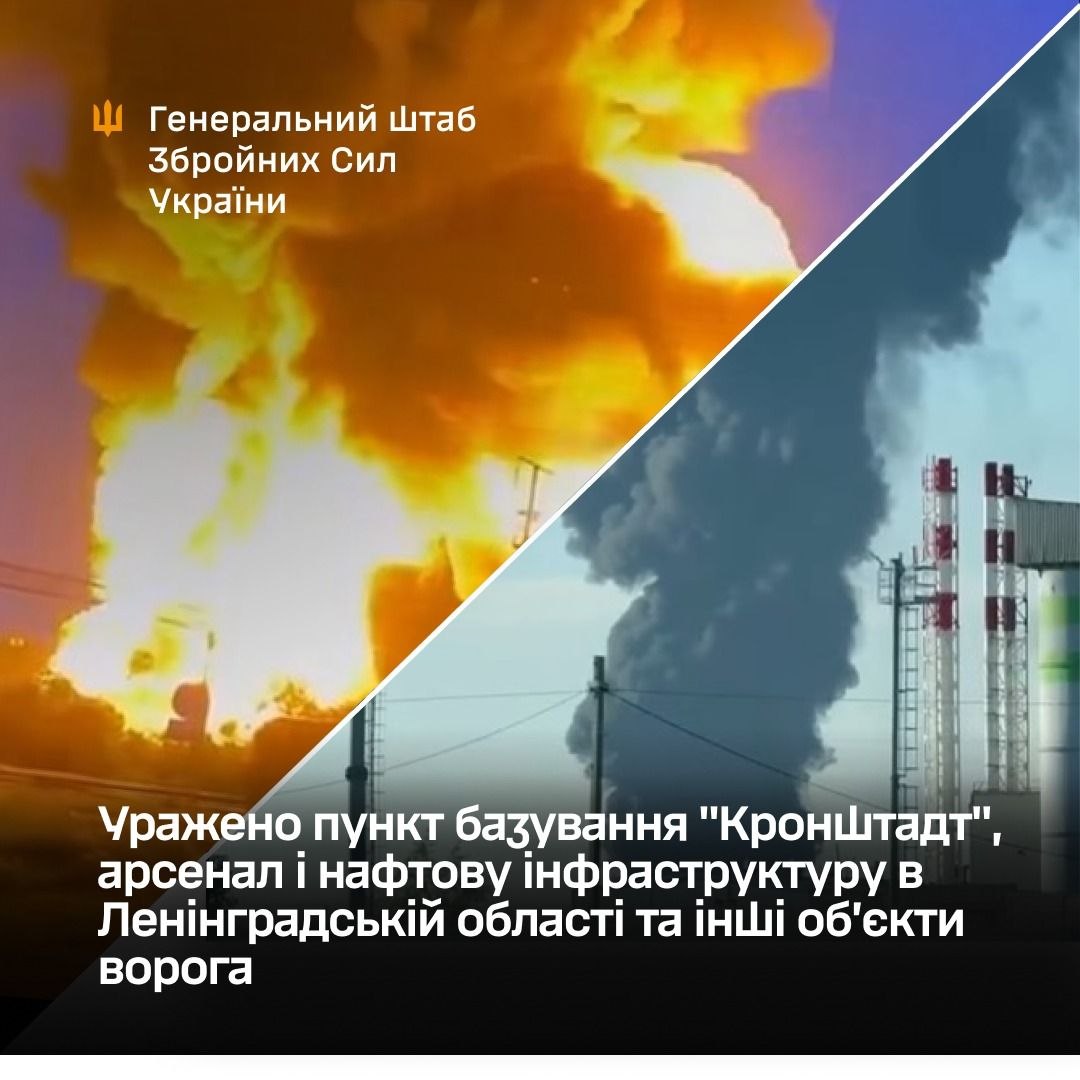
On June 5 and during the night of June 6, 2026, units of the Ukrainian Defense Forces struck a number of key military and logistical facilities belonging to the Russian occupation forces.
This was reported by Censor.NET, citing the press office of the General Staff.
Attacks on the Leningrad Region
As reported, the "Kronstadt" naval base (St. Petersburg, Russia) in the Leningrad region of the Russian Federation has been struck. Explosions have been reported on the base; the extent of the damage is being assessed.
"Kronstadt" serves as the main base for the stationing, repair, and support of Baltic Fleet ships in the eastern part of the Baltic Sea, and also guards the sea approaches to St. Petersburg.
- The "Peterhofskaya" oil depot (Lomonosov, Leningrad region, Russian Federation) has also been hit. A direct hit, an explosion, and a fire at the facility have been reported.
- In addition, the "Neste" oil terminal (Lomonosov, Leningrad region, Russian Federation) was struck. A fire has been reported in the vicinity of the terminal; the extent of the damage is being assessed. The terminal is a key distribution hub for petroleum products (gasoline, diesel) in the northwestern region of Russia. Its storage capacity is 40,000 cubic meters of light petroleum products.
- The arsenal of the 1060th Logistics Support Center (Bolshaya Izhora, Leningrad region, Russian Federation), which stores missile weapons, ammunition, and military equipment, has been hit. Explosions, secondary detonations, and a fire have been reported on the facility’s grounds.
Other lesions
- Among other targets, the Ust-Labinsk oil depot (Krasnodar Krai, Russian Federation) has been hit—a fire has been reported on the premises. The extent of the damage and the losses incurred are currently being assessed.
- The Ust-Labinsk oil depot is a key logistics hub for the storage and distribution of fuel and lubricants. Through the railway infrastructure of the Krasnodar Krai, it plays a direct role in supplying fuel to Russian military units in the southern and eastern sectors.
- Ukrainian troops also struck an enemy unit’s command and observation post near Malinovka (Belgorod region, Russian Federation) and a logistics depot near Karaichne in the Luhansk region.
- Enemy UAV command posts in the areas of Voskresenka and Odradnoe in the Donetsk region, as well as Novofedorivka and Zaliznychne in the Zaporizhzhia region, have also been struck.
- Strikes were carried out against areas where enemy personnel were concentrated near Pokrovsk and Rodynske in the Donetsk region, Petropavlivka in the Kharkiv region, as well as Tyotkino and Anatoliivka in the Kursk region (Russian Federation).
"The Ukrainian Armed Forces continue to systematically undermine the Russian aggressor's ability to wage war against Ukraine," the General Staff emphasizes.
What happened before?
- Earlier reports indicated that on the night of June 6, drones attacked Russian regions and occupied territories. Following the massive drone attack, oil depots caught fire in the Krasnodar Krai and in the occupied Donetsk region.
- There are also reports of strikes on port infrastructure.
- One of the main targets of the attack was the Leningrad region. Local residents reported seeing attack drones flying at low altitudes in the area of Saint Petersburg and nearby towns.
- It was later reported that a fire had broken out at a Russian Ministry of Defense facility in the Leningrad Region, and a partial evacuation is underway.


