



Fedorov’s dismissal will raise questions in EU, it is important not to disrupt defense projects worth €60 billion, - Kubilius
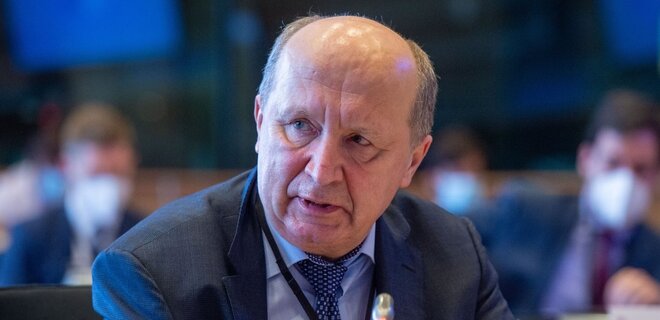
The possible dismissal of Defense Minister Mykhailo Fedorov will raise questions among Ukraine’s partners as to why the decision was made to replace an official with whom the EU has already established effective cooperation. At the same time, it is of fundamental importance to Brussels that these personnel changes do not disrupt the €60 billion defense programs, drone production, the development of Ukrainian ballistics, and the "Freya" anti-ballistic system.
According to Censor.NET, European Commissioner for Defense and Space Andrius Kubilius said this in an interview with "European Truth."
Kubilius called Fedorov's possible dismissal a surprise
The European Commissioner noted that the news of the government's resignation and the likely replacement of the defense minister came as a great surprise to him.
According to him, the European Union worked closely with Mykhailo Fedorov both before his appointment as defense minister and after he took office.
"My personal opinion is that this will raise the question of why such a person is being replaced," Kubilius said, responding to a question about the EU's possible reaction.
At the same time, he emphasized that, at the time of the interview, the final composition of the new government was not yet known, so it was too early to draw any definitive conclusions.
The EU is preparing a new tranche of aid for Ukraine's defense
Kubilius said that a package of European aid for Ukraine, which includes 60 billion euros for defense, is being processed by the agencies under his authority.
According to him, Ukraine and the EU have already approved the first list of weapons and a timeline for using the funding to produce drones. The first funds have already been received, and the next tranche is expected shortly.
"It could be used for missiles, fighter jets, and some other equipment that is very important for Ukraine," the European Commissioner noted.
Kubilius added that not only Fedorov but also Deputy Defense Minister Sergei Boev are participating in the cooperation. In his assessment, the agreements and procedures on both sides are working effectively.
Ukraine's "Freya" could become the backbone of European anti-ballistic defense
Kubilius named the Ukrainian anti-ballistic system "Freya" as one of the key joint projects. According to him, the newly formed anti-ballistic coalition will, in fact, be responsible for it.
The European Commissioner said that during his visit to Kyiv, he met with representatives of Fire Point and discussed the system's technical specifications.
According to data the company provided to the European side, Ukraine has the potential to produce about 3,000 FP-7.x anti-ballistic missiles per year. By comparison, Kubilius estimated the total annual production of American PAC-3 missiles for Patriot systems at 700–800 units.
At the same time, he emphasized that missiles alone are not enough for a fully-fledged missile defense system. Modern radars, data processing capabilities, and command and control systems are needed, some of which can be provided by European partners.
Europe is developing its own alternative to Starlink
The European Commissioner identified the development of European space capabilities—in particular, the IRIS² secure satellite communications system—as another strategic priority.
According to the European Union's plans, the system is scheduled to become fully operational in 2029, and its development is expected to be completed in 2030–2031.
"Experts are now saying that it might even be better than Starlink," Kubilius said.
He also said that Ukraine is working on its own satellite communications system. In his view, Kyiv and Brussels need to agree in advance on the interoperability of the Ukrainian and European systems.
Ukraine should be integrated into Europe's defense architecture
Kubilius stated that Europe should integrate Ukraine’s defense industry and combat capabilities into its own security system.
"Failing to integrate Ukraine into the European defense architecture would be a big mistake. It is in our best interest," he emphasized.
The European Commissioner agreed with the assessment that the Ukrainian army is the best in Europe and spoke in favor of Ukraine's inclusion in the future European Defense Union.
According to him, such a platform could bring together EU member states seeking deeper cooperation in the field of security, as well as pave the way for Ukraine, the United Kingdom, and Norway.
The EU's mutual defense policy could be extended to Ukraine
Separately, Kubilius spoke about Article 42.7 of the Treaty on European Union, which obligates member states to assist an EU country in the event of military aggression.
According to him, the article is already formally in effect, but the European Union needs to establish clear procedures for providing military aid.
Kubilius expects the discussion on its practical application to pick up significantly in the fall, following the presentation of the new European Security Strategy.
He also recalled the position of German Chancellor Friedrich Merz, who had proposed extending the scope of this article to Ukraine even before its full accession to the EU.
The occupied territories should not block Ukraine's accession to the EU
The European Commissioner does not consider the existence of temporarily occupied territories to be an insurmountable obstacle to Ukraine’s European integration once peace is established.
He noted that there have already been instances in the history of the EU where countries joined the union while having occupied territories.
At the same time, Kubilius warned Europe against normalizing relations with the Kremlin after the war potentially ends.
"It would be a big mistake for us Europeans to agree to what I call a 'reset' or normalization of our relations with Putin," he said.
According to the European Commissioner, the restoration of normal relations with Russia is possible only after it changes its aggressive behavior and the issue of the occupied Ukrainian territories is resolved.


