



Defence Forces strike 14 bridges and dozens of Russian military facilities in July
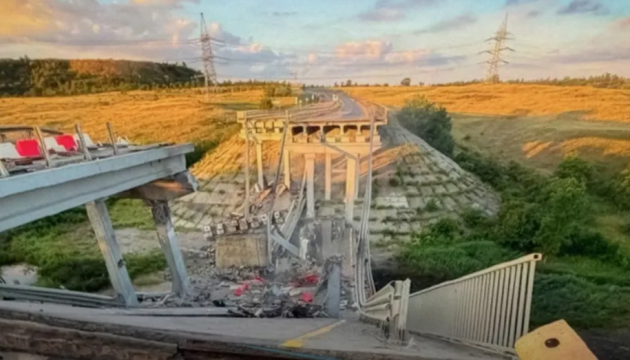
Throughout July 2026, the Defence Forces of Ukraine continued to strike the operational rear and logistics infrastructure of Russian troops. Their main targets were supply routes, air defence facilities, drone bases, and the enemy’s aviation and fuel infrastructure.
As Censor.NET reports, the Ministry of Defence of Ukraine announced this.
"The focus was on disrupting supply routes in the Donetsk, Luhansk, Kherson and Zaporizhzhia regions, as well as in temporarily occupied Crimea," the ministry noted.
Fourteen bridges and crossings struck
One of the main objectives in July was to disrupt Russian logistics. During the month, Ukrainian forces struck 14 railway and road bridges, overpasses and pontoon crossings used by Russian troops for military purposes.
In particular, bridges over the Malyi Kalchyk, Kalka, Hruzkyi Yalanchyk and Kalmius rivers in the Donetsk region were struck, as were crossings near Novoekonomichne and Vyselky.
In the Luhansk region, railway bridges over the Tepla and Siverskyi Donets rivers, as well as an overpass near Dovzhansk, were targeted.
In occupied Crimea, Ukrainian forces struck railway bridges over the Krasnohvardiiskyi Canal, near Rozdolne and Ichki, as well as the Syvash Bridge near Chonhar.
Strikes also hit a road bridge over the Henichesk Strait in the Kherson region, a bridge near Prymorsk in the Zaporizhzhia region and a bridge near Kozyne in Russia’s Kursk region.
The Ministry of Defence noted that strikes on transport arteries complicate the movement of Russian troops, weapons and ammunition to combat zones.
Ukraine weakens Russian air defence and electronic warfare systems
Russian air defence, radar and electronic warfare systems were another focus of strikes in July.
The targets struck included an S-400 surface-to-air missile system and a Nebo-U radar near Kerch, a Buk surface-to-air missile system in the Zaporizhzhia region and a Pantsir-S2 system near Simferopol.
A Bussol-S radar, an early-warning station, Murmansk-BN and Pole-21 electronic warfare systems, and other electronic warfare assets were also struck.
According to the Ministry of Defence, destroying such systems should weaken the Russian army’s ability to control the airspace and create additional opportunities for further Ukrainian strikes.
More than 10 UAV command posts struck
Russian unmanned systems were another priority. More than ten UAV command posts, drone training and launch bases, and drone operator deployment sites were struck in July.
Ukrainian forces destroyed ground-based repeaters for Geran and Gerbera drones in Crimea and the Kherson region. Repeaters for Orion UAVs at Dzhankoi Air Base were also struck.
Infrastructure and hangars at the Saky airfield in Crimea were damaged. According to the Ministry of Defence, at least seven Su-30, Su-30SM and Su-24 aircraft were destroyed or damaged in the strikes.
Two hangars containing Shahed attack drones and aviation equipment were struck at the Hvardiiske airfield.
In addition, a base for high-speed boats near Mizhvodne and a Project 10410 Svetlyak patrol ship in Kerch were struck.
In the Luhansk region, Ukrainian forces struck a UAV warehouse near Chervonopopivka, while an FSB coordination centre was hit in the Kherson region. A production workshop at an aircraft plant in Yevpatoriia was also struck.
Strikes on fuel infrastructure and warehouses
In July, Ukrainian forces also attacked Russian fuel and logistics infrastructure.
In particular, the TES-Terminal-1 oil terminal in Kerch, an oil depot in Shakhtarsk and Chornomornaftogaz facilities in Crimea were struck. A fuel train near Tokmak and a Russian tanker in the Black Sea were also hit.
In addition, the Defence Forces struck dozens of warehouses containing ammunition and logistical supplies.
"Combined strikes against logistics routes, air defence and electronic warfare systems, fuel infrastructure and military warehouses are gradually reducing the ability of Russian troops to sustain and conduct offensive operations," the Ministry of Defence emphasised.


