



Drapatyi has published the Principles that will guide Ukrainian Armed Forces: People are our greatest asset
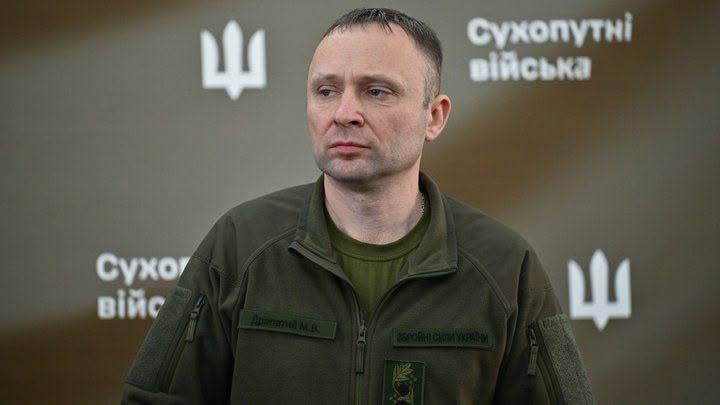
Commander-in-Chief of the Armed Forces of Ukraine Mykhailo Drapatyi has set out the principles by which he will lead the Armed Forces of Ukraine.
This was reported by Censor.NET.
The document in question is entitled ‘Principles of Leadership for the Commander-in-Chief of the Armed Forces of Ukraine and the Development of the Armed Forces in Wartime’, which sets out the intention, eight priorities, fourteen requirements for commanders at all levels and eight expectations of headquarters.
People are the most valuable combat capability
"The most valuable combat capability of the Armed Forces is our people, and every commander is obliged to protect them," he noted.
This gives rise to specific duties for a commander: to properly prepare service personnel for combat, to protect them from unnecessary risk, to care for the wounded, to honour the memory of the fallen with dignity, and to support their families. This is formulated as a requirement, not a mere suggestion: "Caring for our people is not separate from combat effectiveness – it is its very foundation."
The document requires commanders to distinguish between resolve and recklessness: "War demands resolve, but never recklessness." "Every unjustified loss weakens the Armed Forces."
It is also noted that support does not end with military service. Those who have defended Ukraine must be provided with appropriate assistance, rehabilitation, recognition and opportunities. The Armed Forces will carry out this work in conjunction with the Ministry of Defence, the Ministry of Veterans’ Affairs, government bodies, local authorities and voluntary organisations.
The priority is to protect people, towns and villages
At the top of the list of priorities is the defence of the country and its people. Stabilising the front line, maintaining and building up combat capabilities, seizing the initiative where possible, and preventing the enemy from achieving its objectives – these are actions aimed at strengthening the defence of Ukraine’s population, its towns, villages and critical infrastructure against enemy attacks.
Military service must become predictable
This concerns the issues that servicemen and their families ask about most frequently: terms of service, rotation and the procedure for discharge. The document sets out the intention to reform the system of recruitment, training, service, rotation, retention and discharge of servicemen – so that it ensures the combat readiness of the armed forces whilst taking into account the needs of the servicemen themselves and of society.
"To ensure conditions under which military service is predictable, fair and professional, and where personnel decisions are based on the needs of the armed forces, professionalism and performance."
The policy on recruitment, service and discharge will be shaped by taking into account the lessons of the past.
The truth makes us stronger
The document requires commanders and staff to provide honest assessments: they must not allow optimism, fear or personal ambition to distort reality.
"Problems that are ignored only grow." "Healthy professional discussion strengthens decisions; silence weakens them."
The code of conduct is equally binding on generals, officers, sergeants and civilian leaders: there is no place in the Armed Forces for corruption, abuse of power, harassment, discrimination or injustice. A specific requirement for every commander is the responsible use of state resources.
Headquarters exist for the troops
For headquarters at all levels, the document sets out a single guiding question: "Does this enhance our ability to fight and succeed?" If the answer is no, it must be changed. Every report, briefing, meeting and staff process must have a clear purpose; duplication is to be eliminated and unnecessary reporting reduced.
The headquarters must "be smaller where possible, faster where necessary, and become more useful every day".
Learning faster than the enemy – for the sake of those on the front line
A separate priority is accelerating adaptation and the implementation of innovations. The purpose of this work, as set out in the Principles, centres on people: technology is needed where it enables tasks to be carried out with fewer casualties and less risk for those directly holding the front line. The source of change is not limited to headquarters: commanders are required to create an environment in which "good ideas can come from any service member, regardless of their rank or position".
The document also calls for joint operations: "No single service, branch of the armed forces or individual brigade is capable of winning on its own."
Drapatyi’s statement
The Commander-in-Chief emphasised that he took up his post "realising that the next stage of this war demands more of us: to command the Armed Forces of Ukraine in the war today and, at the same time, to ensure that they emerge from this war stronger".
"In war, mistakes can cost lives. But a mistake that has been acknowledged, analysed and corrected becomes a lesson. That is why I expect every serviceman to be honest, courageous enough to speak out about problems, and willing to work together to find solutions.
We must achieve a lasting and just peace and build the Armed Forces of Ukraine in such a way that, in the future, no aggressor will have any grounds to consider an attack on Ukraine an acceptable means of achieving their goals," concluded Drapatyi.
The full text of the document is available via this link.


