



More than 30 air defense systems, radar stations, and electronic warfare systems, as well as more than 40 command posts: results of middle strike in September, - Ministry of Defense
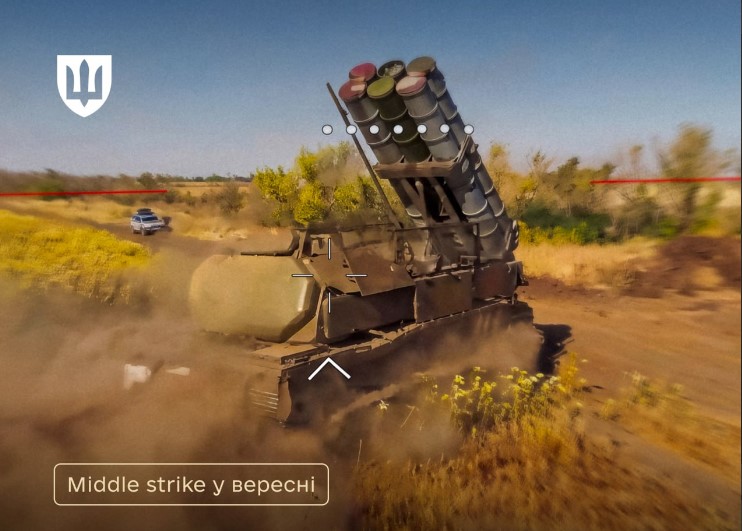
In September 2026, the Ukrainian Defense Forces continued their systematic campaign to strike the enemy’s operational rear and military capabilities using middle-strike capabilities.
The Ministry of Defense outlined the main results of the use of middle-strike capabilities, according to Censor.NET.
As noted, according to data published by the General Staff, the following were struck over the course of the month:
- more than 30 air defense, radar, and EW systems;
- more than 40 command posts, including those for UAV units;
- more than 50 warehouses, bases, and other logistics and support facilities;
- more than 20 infrastructure facilities related to the storage, preparation, production, and deployment of UAVs.
The Ministry of Defense emphasizes that systematic strikes deep into enemy territory reduce the combat capabilities of Russian forces, disrupt command and control, and complicate logistical support.
Weakening Russian air defense: S-400, Buk-M3, and Krasukha-4 systems destroyed
One of the priorities remains the destruction of Russian air defense, radar, and electronic warfare systems.
In September, the Defense Forces, in particular, destroyed two S-400 air defense missile system launchers in the Bryansk region of the Russian Federation, a 92N6 multifunctional radar belonging to the S-400 system in Sochi, a "Buk-M3" air defense system in the Zaporizhzhia region, as well as "Pantsir-S1" and "Pantsir-S2" air defense systems.
Among the radar systems destroyed were the "Nebo-U," "Nebo-SV," "Podlyot," "Kasta," and P-18 stations, as well as other enemy radar systems.
Electronic warfare and technical reconnaissance systems were also targeted, including the "Krasukha-4" mobile electronic warfare station and "Grenader" automated technical reconnaissance posts.
Decline in the capabilities of Russian UAVs
Throughout September, the Defense Forces systematically struck the infrastructure of Russian unmanned aerial systems.
Storage, preparation, and launch sites for "Geran" and "Gerbera" strike UAVs in the Donetsk area were struck on multiple occasions. Targets in other temporarily occupied territories and in the Russian Federation were also struck.
Dozens of UAV command centers, ground-based relay stations, and other components of the UAV control system were destroyed.
Specifically, in Petropavlivka, Luhansk Oblast, a training center for UAV operators of the "Akhmat" unit was struck; in Siverskodonetsk, a UAV production facility was struck; and near the Saki airfield, a ground control station for "Orion" reconnaissance and strike UAVs was struck.
Strikes on Russian warehouses and a logistics lockdown
Over the course of the month, the Defense Forces struck enemy warehouses containing ammunition, supplies, fuel and lubricants, as well as repair bases and storage facilities for weapons and military equipment.
In total, more than 50 such targets in the temporarily occupied territories of Ukraine and in border regions of the Russian Federation were struck in September.
Near Vladyslavivka in the temporarily occupied Crimea, a railway bridge across the North Crimean Canal—which Russian troops used for military logistics—was struck.
Attacks on Air Force, Navy, and Military Facilities: A Su-24 in Saki and boats in Sevastopol
In September, other important military targets were also struck.
A Su-24 aircraft was struck at the Saki airfield in the temporarily occupied Crimea. Also during the month, the destruction of an enemy MiG-29 aircraft and a Ka-27 helicopter was confirmed.
In Sevastopol, a BK-16 landing craft and a Project 12150 "Mangust" high-speed patrol boat were struck.
In Snizhne, Donetsk Oblast, a machine-building plant used by the Russian defense industry to manufacture military equipment was struck.


