



Businesses under fire: Prolonged power outages, costly loans and lack of insurance
Business Censor examined the main needs of Ukrainian businesses ahead of winter and the large-scale attacks on Ukraine’s energy system announced by Russia.
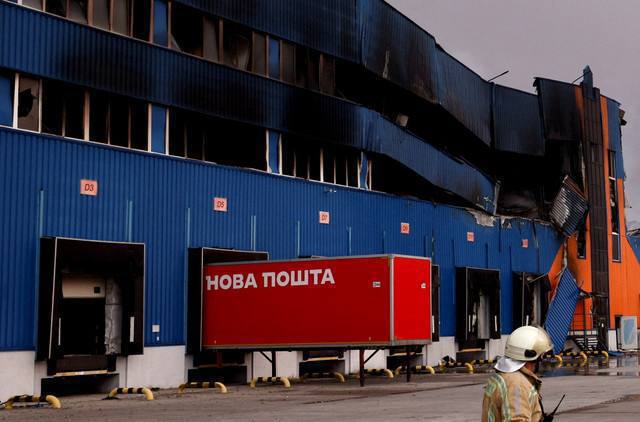
Russians are destroying Ukrainian filling stations, warehouses, and production facilities.
Ukraine’s ambassador to the United Kingdom, General Valerii Zaluzhnyi, called this approach the "roof plan." "If you see a large roof on a satellite image, strike it," Zaluzhnyi said in early August, explaining the Russian army’s tactics.
Putin has focused primarily on destroying logistics and production centres around the capital. The reason is straightforward: Ukrainian businesses remain concentrated in the Kyiv region.
As of 1 September 2026, 965,195 companies and sole proprietors were registered in Ukraine, according to the Unified State Register. YouControl data shows that 329,528 of them, or about 34% of the national total, are based in Kyiv. In other words, roughly one in three registered businesses in Ukraine is based in the capital, which is surrounded by the country’s largest sorting warehouses.
In December 2024, the European Commission designated Kyiv region a "Regional Innovation Valley." At the time, the designation gave businesses in the region access to funding from European funds.
Since August, the Kyiv metropolitan area has come under daily attack by jet-powered drones, which are destroying production facilities, warehouses, and retail distribution centres.
Insurance and loans
Since the beginning of the year, businesses have suffered approximately $10 billion in losses from Russian strikes, according to estimates by Economy and Environment Minister Oleksandr Kravchenko.
To support businesses, the minister proposes introducing a form of insurance scheme under which companies affected by Russian strikes could receive up to $10 million in compensation per legal entity.
Under the ministry’s plan, compensation would come from a special fund financed through three sources: a business insurance contribution equal to 2% of the value of the insured asset; a one-percentage-point increase in Ukraine’s value-added tax (VAT) rate, to 21%; and funding from partners.
In its proposed 2027 state budget bill, the Cabinet of Ministers proposes creating two special funds – one to insure businesses against war risks and provide other financial support, and another to protect fuel-sector companies against those risks worth UAH 58.7 billion and UAH 8.3 billion, respectively. The government plans to finance them by increasing VAT and the excise tax on fuel.
Whether Ukraine can now use its budget to cover even part of companies’ losses, which run into billions of dollars, is open to serious doubt. Last week, Finance Minister Serhii Marchenko warned that the budget deficit would force Ukraine to severely restrict spending. "As funds come in, our first priority is financing the security and defence sector," Marchenko said.
"What the Economy Ministry is proposing reminds me of statements by some lawmakers who believe that all the costs arising from Russian aggression can be covered by the state budget. But that is impossible," Viacheslav Cherniakhovskyi, director general of the Insurance Business Association, told Business Censor.
Cherniakhovskyi believes the scheme will not work in the form proposed by the Economy Ministry because the budget would never have enough money to support such a structure. The only companies likely to participate would be those facing heightened risks or located in dangerous areas where risks are concentrated.
According to Viacheslav Cherniakhovskyi, insurance against war and terrorism risks is structured differently elsewhere in the world: first, a company may cover part of the loss itself (the portion borne by the company, similar to a deductible). The next layer is commercial insurance provided by insurers, followed by international reinsurance.
"International organisations (funds and grants) come next, and only at the top of this pyramid can the state provide guarantees against very large risks," Cherniakhovskyi explains. "If we look at Britain during the Second World War, its model was a hybrid of a universal solidarity mechanism, a state guarantee and conventional insurance. For real estate, it most closely resembled a mandatory nationwide pool: all property owners (not only those who chose to participate) contributed according to the value of their property, and the state covered any shortfall."
For personal property, the state provided people with a free basic level of coverage, similar to Ukraine’s eRecovery programme. Business property was covered through a more conventional insurance mechanism involving premiums, full insured value and private insurers. Insurance companies and Lloyd’s (the insurance market) acted as agents of the state: they issued policies, collected premiums, kept records and settled claims. Their administrative costs were reimbursed, allowing claims to be paid quickly and reducing corruption risks.
"The proposed system in Ukraine seems unfair to all citizens and sole proprietors, who would have to pay a VAT rate increased by 5% but would be unable to participate in the scheme or receive compensation. For now, it all looks like a campaign to promote tax increases so that large businesses can receive money ‘as a gift’ from all taxpayers to fund their recovery, without having to repay it after the war," Cherniakhovskyi believes.
Large businesses affected by strikes, rather than the government, should be the main drivers of war-risk insurance, says Vitalii Shapran, a former member of the Council of the National Bank of Ukraine.
"Throughout the history of financial markets, mutual insurance funds have been the standard response to heightened risks. Japan is an example: maritime risks arising from tsunamis are an everyday reality there. Businesses established the Japan Ship Owners’ Mutual Protection & Indemnity Association (commonly known as the Japan P&I Club), and the problem became less pressing," Vitalii Shapran says. "There is a substantial difference between what the Ukrainian government is proposing (or discussing) and the P&I Club. Raising VAT means your ‘insurance contributions’ will not be insurance contributions at all. They will simply be taxes that disappear somewhere into the budget. Then, after an ‘insured event’ occurs (though it will not actually be an insured event), you may wait years for compensation for your damaged warehouses."
Shapran also alludes to the corruption risks of such a scheme in Ukraine: "You will have to go and bow to an official at the tax authority, whose deputy head, as we heard from the "Carthaginians" recordings, received a thick envelope of cash as a bonus on top of his salary."
At the same time, the lack of war-risk insurance is also partly holding back commercial lending, which remains limited by the high cost of borrowing. The NBU recently raised its key policy rate to 16%. Banks can place funds in certificates of deposit at 16% without taking on risk, or lend to a company trying to operate during the war.
Under favourable conditions, companies can expect a new loan at an average annual rate of 20% (banks’ market margin is usually 2–5 percentage points above the regulator’s key policy rate). Amid war risks, unstable demand, and high energy and logistics costs, that rate is too high for many manufacturers. The main driver of lending in Ukraine remains the state’s "5-7-9" programme, for which there is no money left.
Warehouses remain a pressing issue
After the first attacks on logistics hubs in Kyiv region, supermarket shelves began to empty. Alarmist claims spread on social media that Russia had destroyed 90% of warehouse space in just one week and that a nationwide food shortage was imminent. People began buying up essential goods, particularly salt, sugar and grains.
Agrarian Policy and Food Minister Taras Vysotskyi sought to reassure the public that there was no threat of hunger and that market operators would quickly shift their logistics to smaller hubs or make deliveries directly from trucks.
Small and medium-sized businesses also predominate in Kyiv region’s economy. While shelves at large chains may remain partly empty for some time after strikes, small shops have no shortage of food products. According to an analysis by the Centre for Innovation Development, large enterprises accounted for 39.1% of sales by businesses in Kyiv region, and medium-sized enterprises for 39.9%. Small enterprises accounted for 20.9% of sales, and micro-enterprises for 6.3%.
According to Nataliia Petrivska, executive director of the Ukrainian Food Retail Alliance, small warehouses meet nearly 50% of food supply needs, so no shortage of goods is expected.
"Retail chains are now switching to direct deliveries to stores and opening new food hubs. This means logistics take more time, which is why we may see empty shelves. Demand has surged for essential goods such as salt, sugar and grains. Retailers’ sales of these products are rising, and they cannot replenish stocks quickly enough," Nataliia Petrivska told Business Censor.
Moreover, the claim that 90% of warehouses have been destroyed is false, said Ruslan Shostak, founder and co-owner of the Eva and Varus chains. Since the start of the full-scale invasion, 2.1 million m² of Class A and B+ warehouse space has been destroyed in Ukraine. Of that, 1.5 million m² was in the Kyiv region. Another 900,000 m² was destroyed this year. At the start of the war, Ukraine had an estimated 4.2 million m² of Class A and B warehouse space. Since then, 800,000 m² of new space has been brought into use.
Overall, Ukraine had 5 million m² of warehouse space. Of that, 2.1 million m² has been destroyed.
"Approximately 2.9 million m² remains. That is nearly 50% of the higher-class warehouse space. And if we include the warehouses of large enterprises across the country, that adds tens of millions of square metres in various classes. At this rate, Russia would need decades to destroy 90% of Ukraine’s warehouses, assuming none were rebuilt," Shostak explained.
At the same time, we can see that Russians keep finding new ways to terrorise Ukrainians every day. Targeted strikes on filling stations, passenger trains and border crossings have been added to the endless daytime air raid alerts that bring Kyiv to a standstill.
Overall, the destruction of warehouse infrastructure and shortage of available space have turned the market into a "landlord’s market." Warehouse rents have risen by 12–13%. So although the warehouse issue has received less attention in the media, it has not disappeared from the agenda.
Prolonged power outages
After the latest strikes, the capital region has returned to prolonged power outages and been reminded that water supplies could also be disrupted.
Back in January 2026, the European Business Association surveyed its member companies about the impact of power outages on their operations.
At the time, 80% of the companies surveyed said that disruptions to the electricity supply significantly hampered their work.
The consequences cited most often were higher production costs (61%) and changes to work schedules (58%), accompanied by reduced output or service provision (50%) and downtime (48%). In most cases, this led to a 10–30% increase in product prices.
Nevertheless, most companies managed to fulfil their obligations even during prolonged outages. Only 9% said power disruptions had caused them to miss contractual commitments.
Businesses have invested heavily in energy independence. Ninety percent of the companies surveyed have their own alternative energy sources or generating capacity. By the start of 2026, almost a quarter (23%) had achieved full energy independence.
Energy storage systems (storage facilities) and solar generation remain the most widely adopted ways for businesses to secure their power supply, chosen by 35% and 26% of respondents, respectively.
Businesses most often stress the need for clear outage schedules and prompt updates from the relevant utility providers about any changes. This matters for planning production cycles.
"Power outages can damage equipment at companies with continuous production processes. Raw materials may already have been used but not turned into a finished product, leaving them unusable. That means losses. Businesses need defined periods when electricity supply is guaranteed, even if it is only for two or four hours a day," Oleksandr Chumak, an expert on micro, small and medium-sized enterprises (MSMEs) and president of the NGO Association of Private Employers, told Business Censor.
Over the previous years of the war, most companies addressed the issue of alternative power supply by installing cogeneration units and energy storage systems.
The fact that Ukrainians now own portable power stations with a combined capacity of 1.6 GW speaks for itself. That exceeds the capacity of a modern nuclear power unit (typically 1 GW), said Valerii Yakovenko, co-founder of DroneUA and the official EcoFlow distributor in Ukraine, at the beginning of the year. In effect, these devices create a vast distributed "virtual power plant" in people’s flats and houses.


