



25-year-old military man shot accurately to stop enemy landing in Hostomel and disrupted occupant's blitzkrieg: story of anti-aircraft missile commander unit Falatyuk. VIDEO
On February 24, dozens of enemy helicopters attacked the airfield in Hostomel. Junior Lieutenant Serhiy Falatyuk instantly ordered to fire to destroy and shot down the target himself.
The Antonov airfield in Hostomel became one of the targets of the Russian army on February 24. On the day of the full-scale invasion, the airfield was simultaneously attacked by several dozen enemy helicopters and hundreds of paratroopers. The first battle was fought by the National Guard. A reinforced company then held back the Russian landing force's breakthrough into Kyiv. The soldiers managed to shoot down six Russian helicopters. The first decisive shot was fired by 25-year-old Junior Lieutenant Serhiy Falatyuk, writes TSN, reports Censor.NЕТ.
The airport runway is still strewn with shell splinters and ammunition. There is wreckage of aircraft in the open air, and the flight control center, hangars and administrative buildings have been completely destroyed. It was here that the key battle for the airfield unfolded.
Serhiy, commander of an anti-aircraft missile platoon, says their mission was to cover Ukrainian aviation, and in the sky he saw ultra-modern Russian KA-52 helicopters. The soldier could not believe his eyes.
"Well, it was like, "Oh, wow, KA-52s, I didn't just see them in a picture." Fear at that moment, I think, was not, fear was when they already began to storm us, when they began to fire at us, and it was not even fear, there was some such a flash of adrenaline. With fear, well the adrenaline was exaggerated," says the fighter.
Locals filmed the movement of the attack aircraft toward the airfield from their apartment windows. The military counted at least 40 helicopters. It was the first time they encountered such an enemy. There was no time to think about it. Instantly Serhiy gave the command - fire to kill.
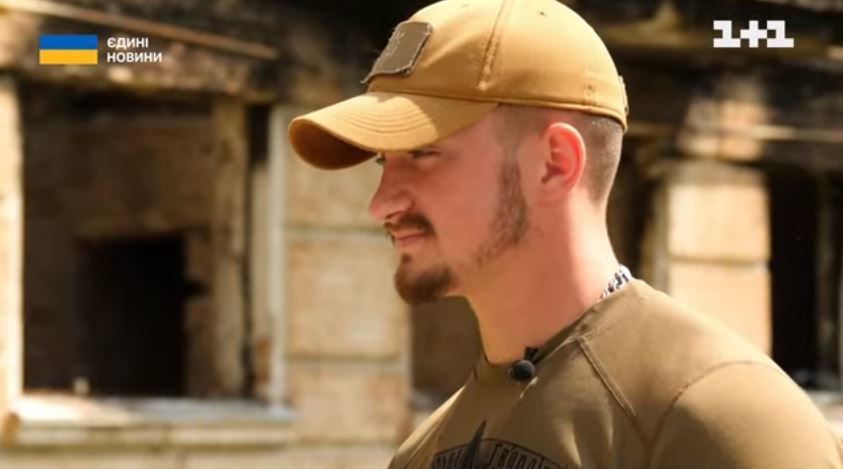
"It flew straight at us, at our position. I was 100 percent sure it wasn't our aircraft, and I instantly decided that we were going to destroy the enemy," says Serhiy.
Serhiy used a Soviet "Igla" man-portable anti-aircraft missile system. It hits targets at altitudes up to three and a half kilometers. The missile weighs 18 kilograms and is 1.5 meters long.
Although it was not his direct task, Sergei grabbed the MANPADS and stepped onto the runway. The helicopter shoved at him, the distance was up to 500 meters.
"I saw the KA-52, ran up to the missile, put it on my shoulder. Pulled back the sights, pulled back the knob and made a tip, took aim at the helicopter, saw that it was very close to me, I missed it, turned around and shot him in pursuit," says the junior lieutenant.
The wreckage of the same KA-52 still lies on the territory of the airfield. In the pile of scrap metal it is hard to make out the ultramodern helicopter. Completely charred and broken blades hang over the destroyed craft. As a result of the explosion and detonation of the shells, almost everything was burned up.
"There was an opinion that we would not be able to destroy them the way Russia describes them, as they write about them, that he "has no analogues", he will not get down, not from anything. But the chassis and a piece of their armor left, did not save it. The "Igla" portable anti-aircraft systems proved to be stronger than their armor," says Serhiy.
That successful rocket launch really boosted the morale of our brothers.
At 14.53 I shouted at once - guys, they're burning, let's work. Everything will work out well for us. "When we heard on the radio that the first helicopter had been shot down, to be honest, there was such joy, like, everything, this is cool, class. We didn't expect it at all, we didn't expect this to happen. All at once such a fighting spirit. The excitement was that everything was over, they were dead," says infantry unit commander Dmytro.
He also says the downed helicopter not only added motivation to the fighters, but also bought them some time. "We understood that if it wasn't for him, we would have been rather put down here, you could say, but this way he reacted.
We fought back and they couldn't come up, we had some time to deploy our forces, to take more advantageous positions for us, to meet them on the approaches already, and while it worked, we had time to do that, to keep them out here, when the zushka works, they cannot land normally and cannot fly up," the commander explains.
Serрiy got his first combat experience in the Donbass. He left for the front in 16. He decided he was going to be in the army when he was 18. However, he was not accepted for military service because of his health condition. He signed a contract. He finished the university by correspondence. He felt that if the country was at war, it should be at the front line: the Svitlodarskaya Bulge, Mariupol, Lugansk direction.
"I must have been in the JFO zone for three years, half of my service. I just want to liberate my country, and to have peace and quiet in our state. And maybe then I'll say that's it, that's enough. But as long as we have a war going on in our country, I'll probably continue as long as I can," the fighter says.
Four years ago he was lured into the anti-aircraft defense force by a friend, and now the chief of staff of the anti-aircraft missile division of the National Guard, Oleg Protsyuk, on the pseudo "Harbuz". Oleg spent the last 110 days fighting for Rubizhne and Severodonetsk, there he experienced a contusion. The military man had just been discharged from the hospital. It was to his friend Oleg that Serhiy rushed to tell about the apt shot after the battle, because once during the service he joked that he had never fired a man-portable air defense system for real.
"I used to poke at it so much at times that we had troops. Since I've been in the service and he's been in the service and nobody, not once have I ever had to work for real. Never had to work for real. And I told him we should transfer to the infantry somewhere, or the artillery, because they work more often than we do. And he said, 'No, not when it is our finest hour, too,' - the soldiers say.
In the absence of missiles we fired on a simulator, and even in those conditions the commander knew how to prepare soldiers for real combat.
"Serhiy had it embedded, he had a professional interest. He's a real military guy. I set the task, I had them do a march of about 100 kilometers. In the daytime, 50 to one and 50 to the other. So they would go out to the point, we had a weight model of 18 kg, they would take it with them and they would leave," says the commander.
For the helicopter shot down the first time, Serhiy received the Order of Courage. His brother says he never doubted his skills, was proud that he took responsibility and decided to open fire.
"There was no doubt that he would shoot down, I knew that he would definitely be shot down. I knew it would be okay, but I was more worried and thankful to him that he led the troops out. He actually saved a lot of guys' lives. He's a beauty here, that's what I'm proud of, because these guys are back in action and can shoot down planes again," says Oleg.
"It's not like I did anything special, I did the best I could, not like my grandmother, who told me that she shot down a drone with a three-liter jar of cucumbers. Grandma was a hero. I knew everything about her, and I shot down a helicopter with the standard weapons I had studied for four years. It was my task and my grandmother was a hero, grandmother threw down the can and shot down the copter," laughs Serhiy.
That day the forces were finally unequal: the airport defenders were running out of ammunition and the fighters were ordered to retreat. Artillery opened fire on the runway to prevent enemy military transport planes from landing. Fighting for the airfield continued for several days. The blitzkrieg was not successful for the enemy.


