



At talks in March 2022, Russia offered Ukraine surrender terms - media found out how agreements to end war changed

The draft entitled "Agreement on the Settlement of the Situation in Ukraine and the Neutrality of Ukraine," dated March 7, 2022, was offered by Moscow to the Ukrainian delegation on March 7, 2022, during the third round of negotiations in Belovezhskaya Pushcha in Belarus. Its terms meant Ukraine's surrender.
As Censor.NET informs, Radio Liberty writes about this in its publication, analyzing a draft received from a Ukrainian source familiar with the negotiations.
As noted, at the beginning of the negotiations, which began a few days after the Russian army launched an offensive, Russia proposed an agreement whose unilateral terms meant Kyiv's surrender.
"If the Ukrainian government had accepted these conditions, it would have turned Ukraine into a puppet state, with a fictitious neutral status, a tiny toothless army, no protection from NATO countries and no chance to regain control of Crimea or Donbas, and it would have had to recognize the independence of Donetsk and Luhansk regions as a whole, as well as large areas that were still under Kyiv's control at the time," the publication says.
The beginning of the negotiations
The publication recalls that some rounds of negotiations took place at the same table with the physical presence of representatives of the parties, while others were held online.
The Ukrainian delegation, led by the leader of the Servant of the People faction in the Verkhovna Rada , David Arakhamia, arrived in Poland and then flew by helicopter to the residence of Belarusian President Alexander Lukashenko, Lyaskovichi, near the Polish-Belarusian border. There, Ukrainian negotiators met with Russian delegates led by Putin's aide Vladimir Medinsky.
The process stalled in late April as the parties disagreed over the main provisions of the draft agreement and Russian troops retreated from northern Ukraine after failing to capture the capital or force Ukraine to surrender.
The facts of atrocities committed by Russian soldiers in Bucha also came to light.
What did Russia offer Ukraine?
The Russian proposal proposed conditions for Ukraine's neutrality.
The March 2022 document contains six pages of the main agreement and four pages of annexes. Eighteen articles cover various areas: the parameters of Ukraine's neutrality (military and international obligations), border issues, humanitarian issues (language, religion, history), and the lifting of sanctions against Russia.
- The project envisaged that Ukraine would reduce its army to 50,000 people, including 1,500 officers (five times less than Ukraine had by 2022). Had this wish been realized, Ukraine would have been left with only four ships, 55 helicopters, and 300 tanks. As of 2022, this was less than the army of neighboring Belarus (which at that time had almost five times fewer people than Ukraine).
- Ukraine was offered "not to develop, produce, purchase, or deploy on its territory missile weapons of any type with a range of more than 250 km". This is the distance, for example, that separates the Crimean bridge from Ukraine-controlled Gulyaypol, located near the front line. Moreover, Russia reserved the right to ban Ukraine in the future "any other types of weapons that may be developed as a result of scientific research."
- Russia's plans called for Ukraine to "recognize the independence of the so-called Donetsk and Luhansk 'republics' within the administrative regions of Ukraine(as of February 24, 2022, Russia controlled only a part of these regions and has not conquered them completely even now, at the end of 2024).
- The authors of the Russian document believed that it was Ukraine that should bear the costs of rebuilding the Donbas infrastructure destroyed since 2014.
- Russia also demanded the lifting of all sanctions - both Ukrainian and international - and the withdrawal of all international lawsuits filed since 2014.
- In addition to this, Russia insisted on granting Russian the status of an official language and restoring all property rights of the Ukrainian Orthodox Church (Moscow Patriarchate).
- Finally, the authors of the draft demanded "to abolish and no longer introduce any bans on symbols associated in states with the victory over Nazism," meaning that Soviet and communist symbols would in fact be legalized in Ukraine again. The document is accompanied by a list of Ukrainian laws that the authors called examples of "Nazification and glorification of Nazism." It is noteworthy that this category includes the laws "On the Perpetuation of the Victory over Nazism" and "On the Rehabilitation of Victims of Repression of the Communist Totalitarian Regime."
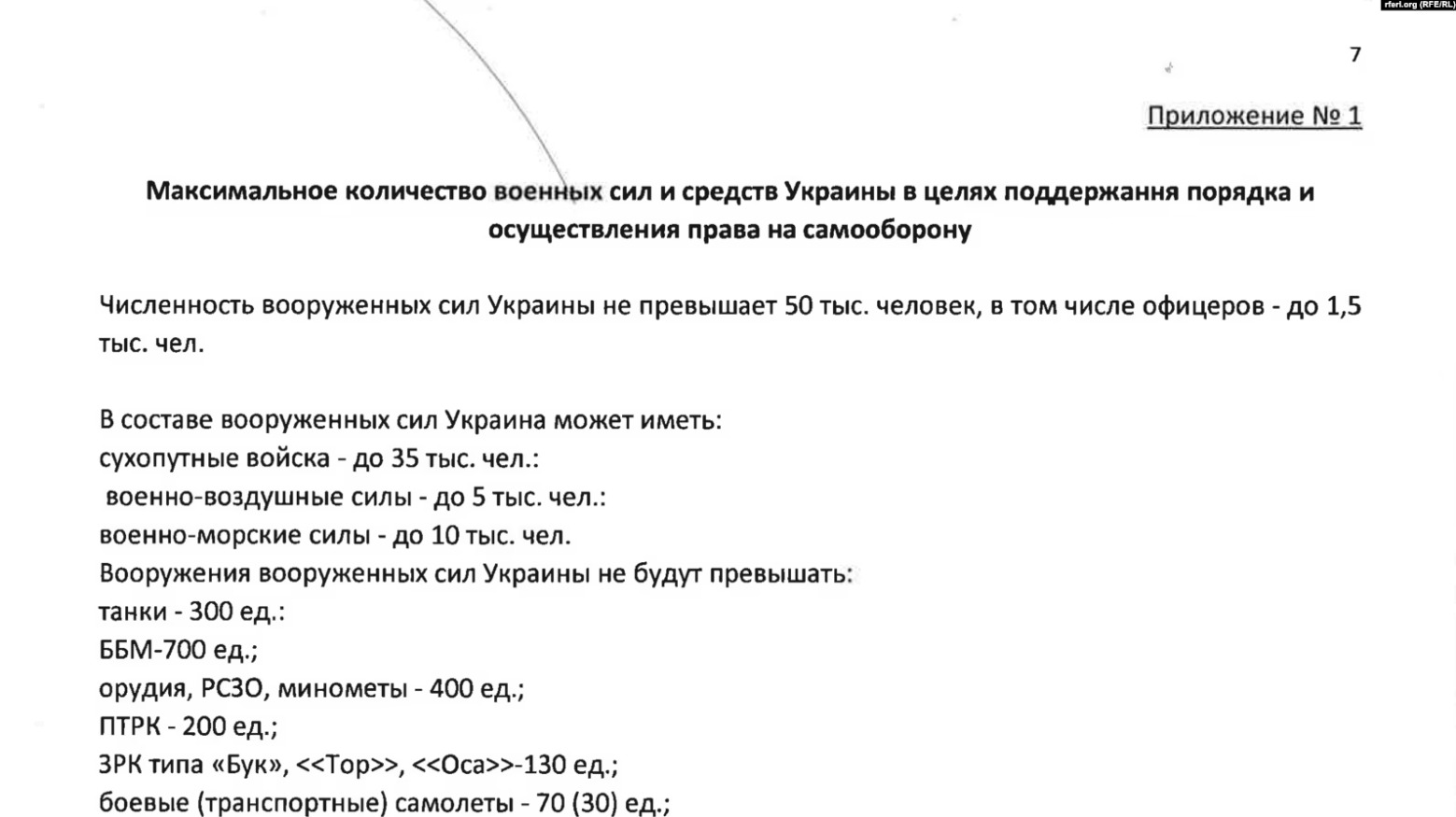
"The deal would have left Ukraine very vulnerable, as Russian troops would have remained in place, and Kyiv would have had no way to defend itself or seek security support from the West. Kyiv would have had to pay for the restoration of Donbas," the article says.
How have the agreements changed?
Documents from subsequent stages of the negotiations, including the March 17 and April 15 drafts published by The New York Times earlier this year, show that the two sides converged on some issues during the talks - at a time when Ukraine was fighting back against Moscow's forces in the north.
For example, the status of Crimea would be left for future negotiations, and Russian demands for changes in language laws and bitter historical disputes would be put on the back burner. Importantly, the parties discussed security guarantees for Ukraine that would include Western countries, although how they would work was a major bone of contention.
According to the latest version of the treaty, the Ukrainian and Russian delegations still disagreed on the size of the Ukrainian army. Ukraine insisted on 250,000 troops (about the same number as before the full-scale invasion), while Russia proposed to limit it to 85,000.
During the negotiations, deliberately unrealistic conditions sometimes arose. Once, the Russians tried to include in the draft agreement a requirement that Ukraine resume water supplies to Crimea (the Ukrainian authorities cut off the North Crimean Water Canal back in 2014), says a source familiar with the negotiations.
This idea was rejected by the Russian negotiators themselves: in this case, Russia, which controlled the territory around the canal, would have to leave it so that Ukraine could "return water to Crimea."
As noted, Russia demanded that Ukrainian troops lay down their arms and return to their barracks. In response, the Ukrainian side put forward a symmetrical demand: Russian troops should lay down their arms and return to their permanent locations.
Russian Assistant Prime Minister Vladimir Medinsky, who read the proposal, was quite surprised, according to one of the negotiators:
"He said it felt as if it was Ukrainian troops standing on Red Square, and the Russians should throw the white flag out of the Kremlin. He was told: "We are simply asking you to do what you are asking us to do."
The subsequent drafts still included some key Russian demands, such as a permanent ban on Ukraine's membership in NATO, which neither Kyiv nor the Western alliance is willing to accept. NATO has repeatedly stated that Ukraine will eventually join, and President Volodymyr Zelenskyy has been pushing for a quick invitation as part of a "victory plan" he has presented to Ukrainians and supporters abroad in recent weeks.
To recap, on June 14, 2024, Russian dictator Vladimir Putin said that the Ukrainian military should allegedly withdraw from the temporarily occupied territories within the administrative borders for "peace talks" with Russia. Then Russia would "immediately cease fire".


