



Large-scale strikes against Russia: deep strike hits oil refineries, ships and airbases. INFOGRAPHICS
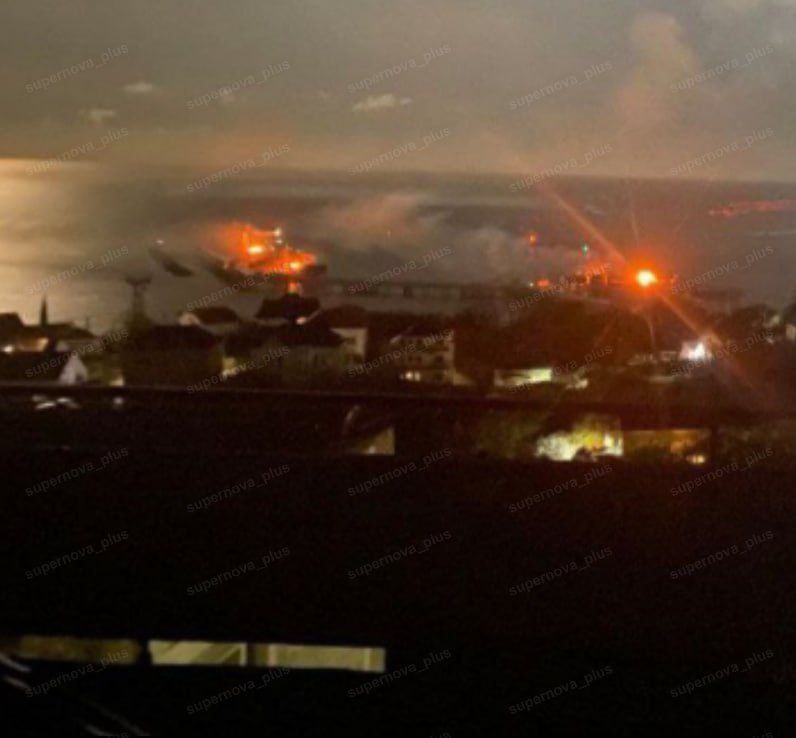
In April 2026, the Ukrainian Defence Forces launched strikes against oil refineries, port infrastructure, the navy and the defence industry of the Russian Federation at ranges of up to 1,700 km, causing widespread fires and significant damage.
According to Censor.NET, this was reported by the Russian Ministry of Defence.
Strikes on oil facilities
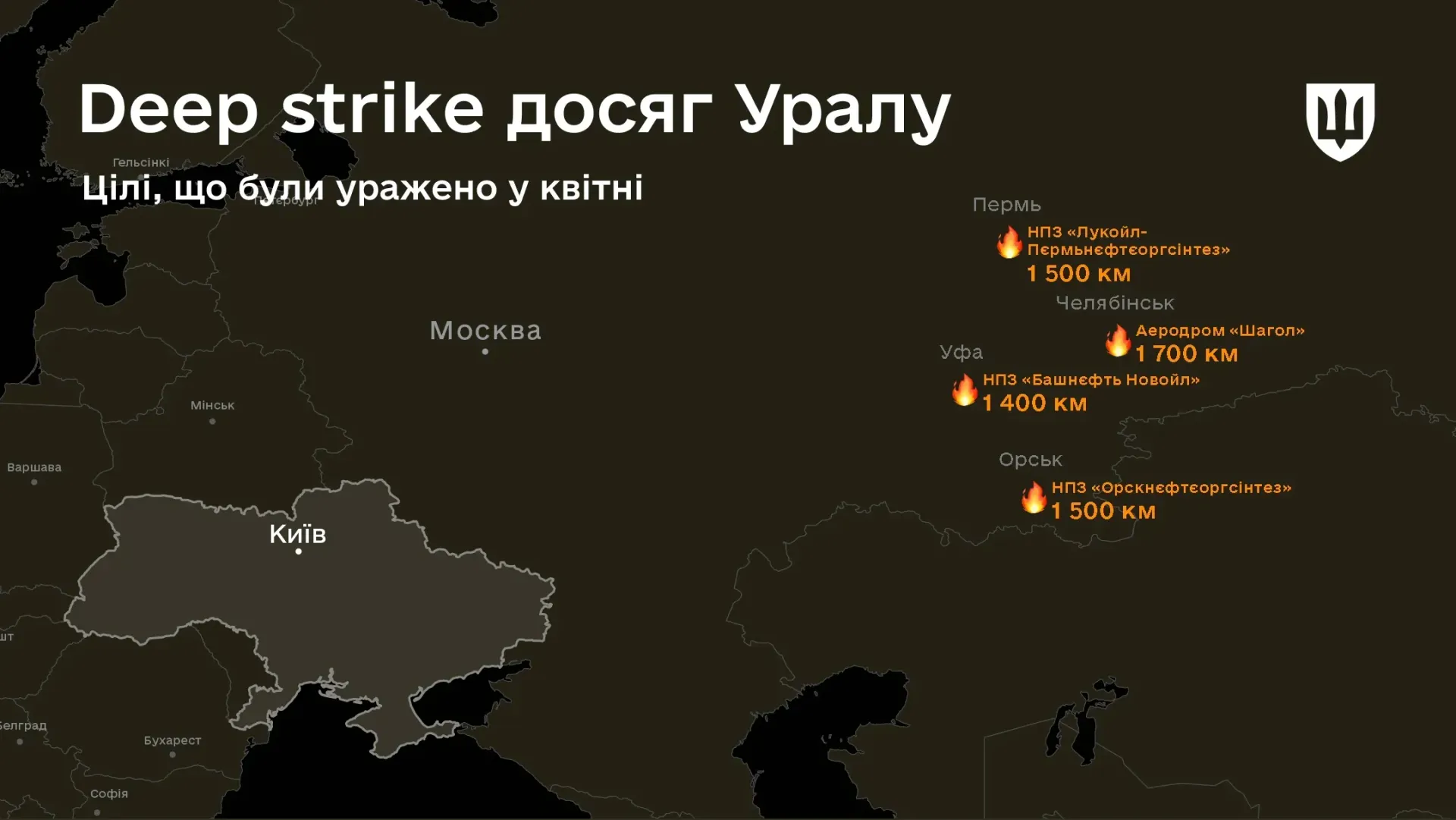
- Fire at the "Bashneft-Novoyl" oil refinery, Ufa (Bashkortostan), ~1,400 km. Damage to the plant followed by a fire has been confirmed. The strike range was approximately 1,400 kilometres from the border.
- Lukoil-Nizhegorodnefteorgsintez oil refinery, Kstovo (Nizhny Novgorod Oblast), ~800 km. A large-scale fire broke out following the strike on Lukoil-Nizhegorodnefteorgsintez. The AVT-6 and AVT-1 primary oil refining units were damaged, as well as unit 19/6, used in the production of petroleum bitumen. The AVT-2 process unit and the LCh-24-7 diesel fuel hydrotreating unit were put out of action.
- Three strikes on the Tuapse Oil Refinery, Tuapse (Krasnodar Krai), ~1,500 km. The Tuapse Oil Refinery was struck on 16, 20 and 28 April – the highest frequency of strikes among all targets that month. During the first strike, the AVT-12 primary processing unit and RVS-10000 tanks were damaged, with fires breaking out. Following the second strike, the destruction of 24 tanks and damage to 4 others was confirmed. After the third strike, a fire broke out again. The plant’s capacity is 12 million tonnes per year (4.4% of Russia’s total refining capacity). It produces a wide range of Euro 5-standard petroleum products, including fuel for the army.
- Novokuybyshevsk Oil Refinery, Novokuybyshevsk (Samara Oblast), ~1,000 km. To strike the Novokuybyshevsk Oil Refinery, the Defence Forces launched a strike from a distance of approximately 1,000 km. Explosions were heard at the strategic facility, which has a capacity of 8.8 million tonnes per year, followed by a fire.
- A massive attack on the "Syzran" oil refinery, Syzran (Samara Oblast), ~900 km. The "Syzran" oil refinery was hit as part of a coordinated massive attack. A fire broke out at the facility.
- A distillation unit at the Yaroslavl Oil Refinery, Yaroslavl (Yaroslavl Oblast), ~750 km, was damaged. A fire broke out as a result of the strike. Damage to the vacuum oil distillation unit has been confirmed.
- Orsknefteorgsintez oil refinery, Orsk (Orenburg Oblast), ~1,500 km. A fire broke out at the facility following the strike.
- SSU strike on the Lukoil-Permnefteorgsintez oil refinery, Perm (Perm Krai), ~1,500 km. The AVT-4 unit – a key component of the primary oil refining process – was hit. The vacuum and atmospheric rectification columns caught fire, effectively putting the unit out of action. The "Perm" linear production and control station, which supplies crude oil to the same refinery, was also hit again.
Damage to port terminals and transport infrastructure
Key Russian oil hubs, which provide both export revenues to the aggressor’s budget and directly meet the needs of the occupying forces, have come under attack.
Strikes have been carried out on the following port terminals and transport infrastructure:
- Port of Prymorsk, Leningrad Oblast, ~850 km – a fire and damage to three RVSP-20000 tanks with a total capacity of 60,000 m³ have been confirmed;
- "Ust-Luga Oil" terminal, Leningrad Oblast, ~900 km – damage to three "Transneft-Baltika" tanks confirmed;
- "RPK-Vysotsk Lukoil-2" oil terminal, Leningrad Oblast, ~950 km – fire confirmed;
- "Tikhorezk" oil pumping station (Krasnodar Krai), ~300 km – fire confirmed;
- "Sheskharis" oil terminal, Novorossiysk, ~420 km – a large-scale fire at a key Black Sea oil transhipment hub.
Meanwhile, oil depots in Feodosia and Hvardiiske, as well as oil pumping stations in Crimea and the Krasnodar Krai, have been struck as elements of the tactical supply of fuel and lubricants to Russian forces.
- Drilling platforms in the Caspian Sea have been struck for the first time. On 10 April, the Defence Forces struck oil production infrastructure in the open sea for the first time. A drilling platform in the Caspian Sea has been hit. The ice-resistant fixed platforms LSP-2 at the Graifer field and LSP-1 at the Korchagin field have been damaged. The facilities are located approximately 1,000 kilometres from the front line.
On 29 April, a unit of the Ukrainian Navy struck the sanctioned vessel ‘MARQUISE’ in the Black Sea – 210 kilometres from Tuapse. Two maritime kamikaze drones (UMS) struck the stern in the area of the propeller-rudder assembly and the engine room.
The tanker (with a deadweight of over 37,000 tonnes, flying the Cameroonian flag) is subject to sanctions imposed by Ukraine, the EU, the UK, Switzerland, New Zealand and Canada, and was being used for the illegal transport of petroleum products as part of the ‘shadow fleet’.
Strikes on the Russian military-industrial complex
In April, the defence forces struck two factories on the aggressor’s territory.
- The "Strela" plant in Suzemka (Bryansk Oblast) has been hit
The facility was struck on 1 April. It manufactures components for cruise missiles and has fulfilled over 120 state contracts for the Russian defence industry.
It is subject to Ukrainian sanctions.
- Strike on the Atlant Aero plant, Taganrog (Rostov Oblast)
On 19 April, the Ukrainian Navy delivered a precision strike with Neptune missiles on the production facility of "Atlant Aero".
- The "Atlant Aero" plant under attack
The plant carries out the full cycle of design, manufacture and testing of the "Molniya" strike and reconnaissance UAVs, and is also a manufacturer of components for the "Orion" UAV – a multi-purpose drone weighing around a tonne, capable of carrying up to 250 kg of payload, including KAB-20 guided bombs and Kh-50 missiles.
The Black Sea Fleet and the Coast Guard under attack
April saw the systematic destruction of the Russian Black Sea Fleet’s naval assets in Sevastopol and the Kerch Strait.
On 19 April, the ‘Prymary’ unit of the Main Intelligence Directorate of the Ukrainian Ministry of Defence disabled two large landing ships directly in Sevastopol Bay: the Project 775 landing ship ‘Yamal’ (built in 1988, displacement 500 tonnes, estimated value over $80 million) and the Project 1171 landing ship "Nikolai Filchenkov" (1975, displacement 1,000 tonnes, value over $70 million) are key assets for the Russian Federation’s amphibious operations and the supply of its forces in Crimea. Both ships have been put out of action. Total losses exceed $150 million.
Strikes on the same ships were repeated on 20 and 26 April by the SSU.
- Damage to Project 11356R frigate "Burevestnik"
On 5 April, two strike UAVs struck the Project 11356R frigate "Burevestnik" – a carrier of "Kalibr" cruise missiles. The extent of the damage was being assessed.
- Comprehensive attack: the reconnaissance vessel "Ivan Khurs", the "Lukomka" training centre and the EW headquarters
On 26 April, as part of Operation Alpha, the SSU simultaneously struck a radio-technical reconnaissance vessel, the Black Sea Fleet’s training centre, and the headquarters of the air defence forces’ radio-technical reconnaissance unit.
A MiG-31 at Belbek airfield (a potential carrier of the hypersonic "Kinzhal") and the airfield’s maintenance unit were also struck.
- FSB Project 22460 patrol vessel damaged
On 22 April, damage to the conning tower of an FSB Border Service vessel in Sevastopol was confirmed.
- Destruction of the "Sobol" and "Grachonok" boats, Kerch Strait
On 30 April, the Ukrainian Navy destroyed the FSB patrol boat "Sobol" and the anti-sabotage boat "Grachonok" in the Kerch Strait area. The enemy suffered irreparable and medical casualties.
- Defence forces destroyed two Russian Federation boats
Both boats were guarding the Kerch Bridge and carrying out counter-sabotage tasks.
Several Su-57s and Su-34 were hit, Shagol airfield (Chelyabinsk Oblast)
On 25 April, at Shagol airfield in the Chelyabinsk region of the Russian Federation, the Ukrainian Armed Forces’ Unmanned Systems Forces struck two Su-57 fighters, one Su-34 fighter-bomber and another aircraft of an unidentified variant.
This is one of the most distant operations carried out by Ukrainian deep strike assets – the targets were located approximately 1,700 km from Ukraine’s state border. Furthermore, the Urals have always been considered the Russian Federation’s deep and reliable rear. Ukraine has shattered this myth.


