



54.9% of Ukrainians support formation of national unity coalition and government of national salvation, - poll. INFOGRAPHICS

The majority of Ukrainians support the formation of a national unity coalition and a government of national salvation.
According to Censor.NET, this is evidenced by the results of a Sociopolis poll.
What is known?
Indeed, 54.9% of respondents view the idea of forming a national unity coalition and a government of national salvation—which would represent a broad coalition of patriotic forces both inside and outside parliament—favorably.
27.3% of respondents expressed a negative attitude toward this initiative.
At the same time, only 14.3% view it negatively, while another 3.5% of respondents were undecided.
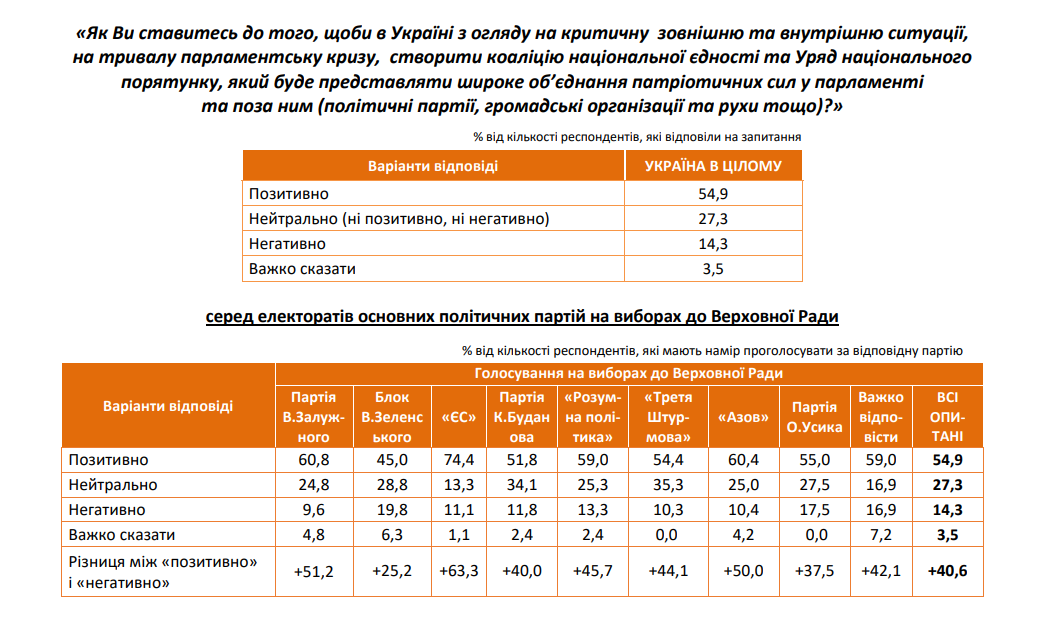
Sociologists noted that the formation of a national unity coalition and a government of national salvation is supported by a larger proportion of supporters of all major political forces—as assessed in the context of current electoral ratings for a hypothetical election to the Verkhovna Rada of Ukraine—than it is opposed by them.
"At the same time, this level of support is highest among supporters of "European Solidarity," Valery Zaluzhnyi’s potential party, and the "Azov" party. Support for this initiative is relatively lower among supporters of the hypothetical "Volodymyr Zelenskyy Bloc" than among all respondents: although positive attitudes also outweigh negative ones among them, the corresponding balance of assessments is the lowest among the electorates of the main political forces," the report states.
Sociologists attribute this level of support to the public’s expectations of greater consolidation among the country’s main political forces and increased accountability on the part of the ruling elite during this period of crisis for the state.
Methodology
The survey was conducted from May 24 to 29, 2026. A total of 1,002 respondents were surveyed.
The theoretical statistical error in the representativeness of the proportion of a characteristic, with a confidence level of 0.95 and without accounting for the design effect, does not exceed:
- 3.1% – for data close to 50%;
- 2.7% – for data points close to the 25th and 75th percentiles;
- 2.5% – for data close to 20% and 80%;
- 2.2% – for data points close to 15% and 85%;
- 1.9% – for data points close to 10% and 90%;
- 1.4% – for values close to 5% and 95%;


