



"Zaluzhnyi’s Party," "European Solidarity," and "Fedorov’s Party" lead Ukrainians’ electoral preference ranking – poll. INFOGRAPHICS

"Zaluzhnyi’s Party," "European Solidarity," and "Fedorov’s Party" have the highest support among Ukrainians in parliamentary elections.
This is indicated by data from a sociological survey conducted by Active Group jointly with the Politarena media outlet, according to Censor.NET, citing the survey results.
Details
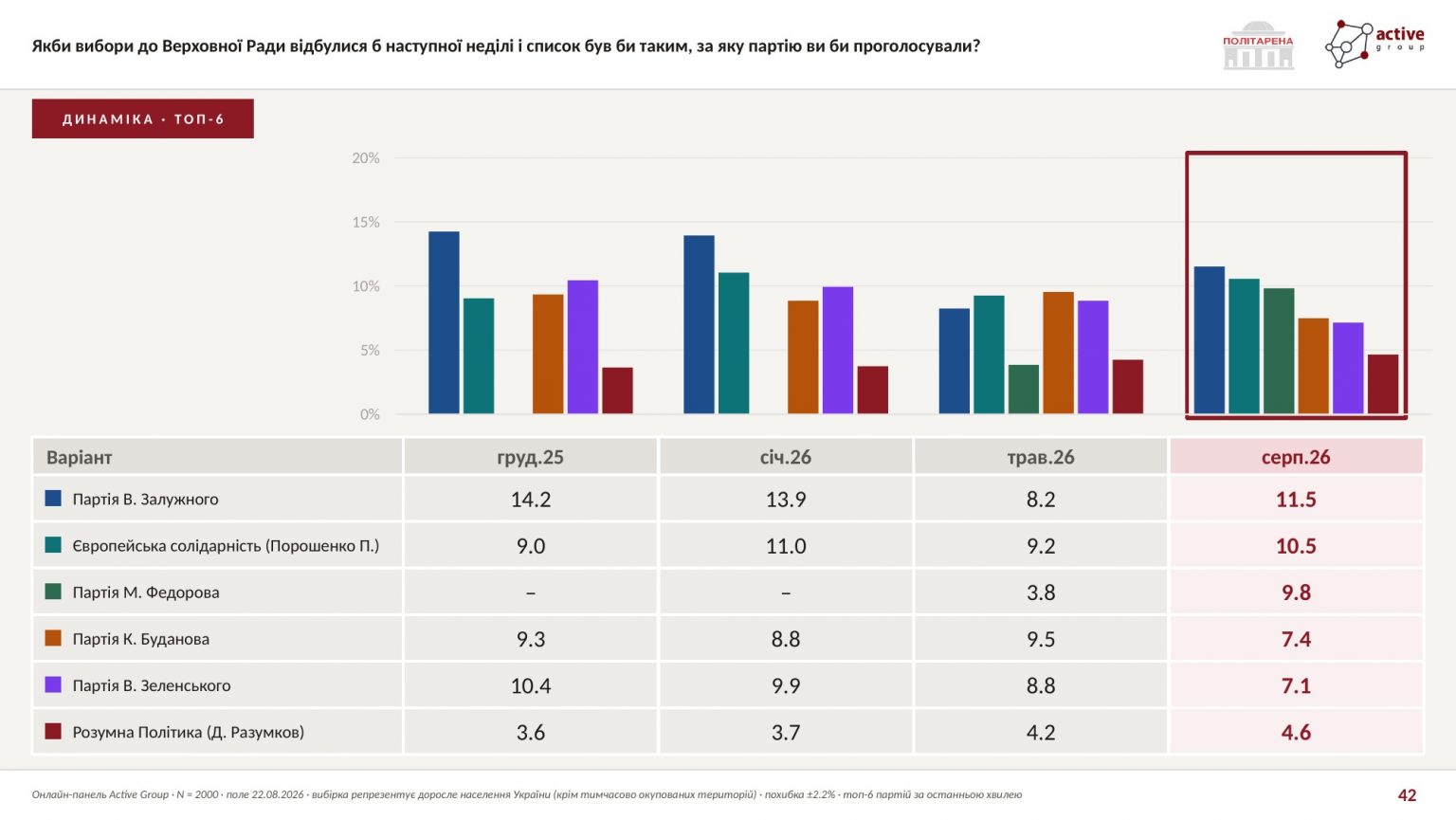
The hypothetical "Zaluzhnyi’s Party" ranks first in the poll with 11.5%. It is followed by "European Solidarity" (10.5%), "Mykhailo Fedorov’s Party" (9.8%), "Kyrylo Budanov’s Party" (7.4%), and Volodymyr Zelenskyy’s party (7.1%).
Dmytro Razumkov’s "Smart Politics" receives 4.6%, "Batkivshchyna" 4.4%, the "Azov" party 4.3%, "Third Assault" 4.2%, Serhii Prytula’s party 4.1%, "Holos" 0.7%, and Yurii Boiko’s party 0.4%.
A total of 9.8% would not vote, 6.4% would vote against all parties, and 14.8% remain undecided.
Among decided voters
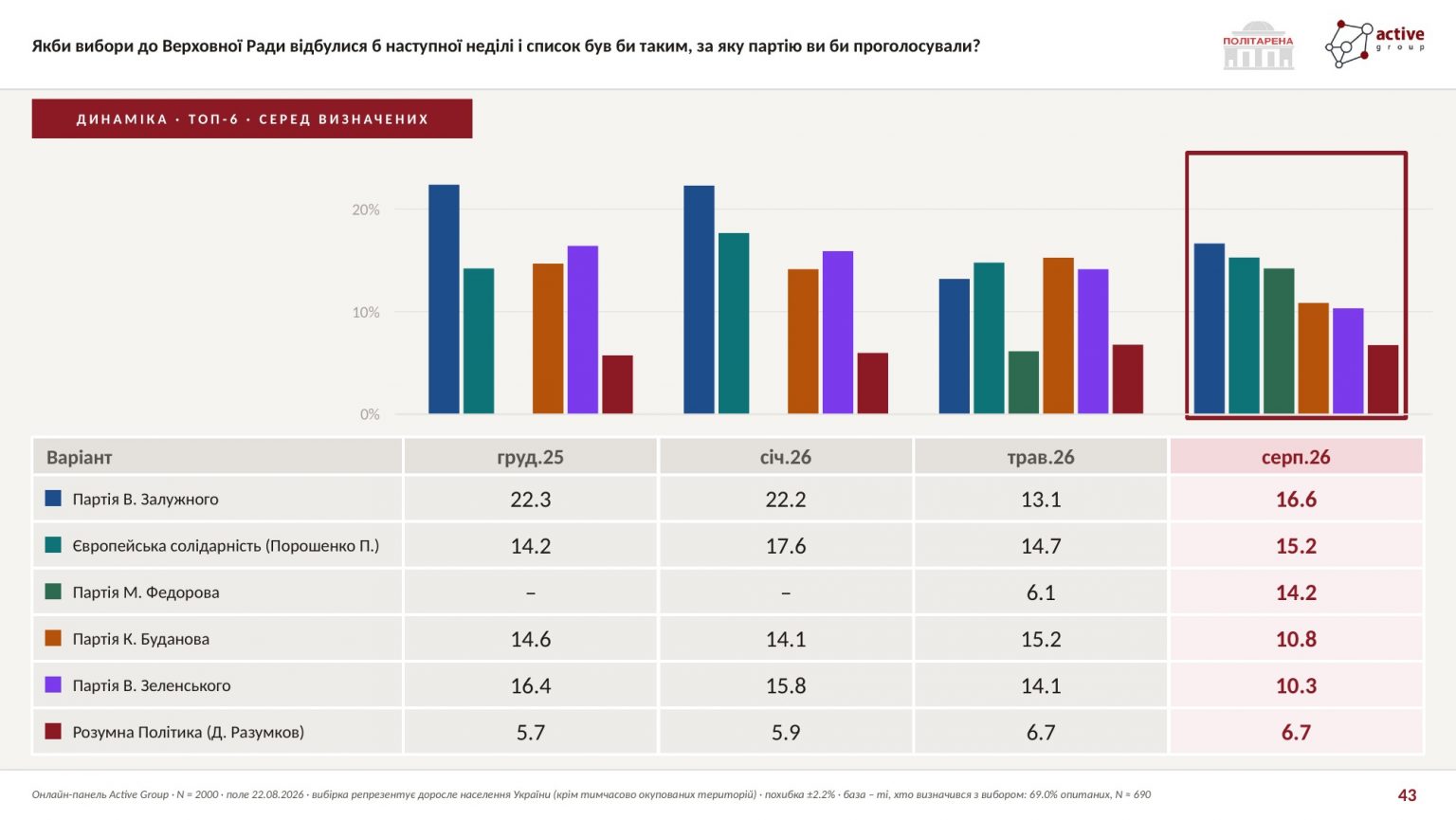
"Among those who have decided, the distribution of votes is as follows: Zaluzhnyi’s party, 16.6%; European Solidarity, 15.2%; Fedorov’s party, 14.2%; Budanov’s party, 10.8%; Zelenskyy’s party, 10.3%; Smart Politics, 6.7%; Batkivshchyna, 6.4%; Azov, 6.2%; Third Assault, 6.1%; Prytula’s party, 6.0%; Holos, 1.0%; and Boiko’s party, 0.7%," the sociologists noted.
The study noted that three party projects which do not yet exist—the parties of Zaluzhnyi, Fedorov, and Budanov—together command 28.7% of the vote.
Fedorov’s party rose from 3.8% to third place over three months, while Zelenskyy’s party lost some support over the same period, falling from 10.4% in December 2025 to 7.1% in August 2026.
Methodology
The survey was conducted on 22 August 2026.
Method: self-administered questionnaires completed by Ukrainian citizens aged 18 and older.
Sample: 2,000 questionnaires (representative by age, sex, and region of Ukraine, excluding the temporarily occupied territories).
The theoretical margin of error at a confidence level of 0.95 does not exceed 2.2%.


