



Russia copies "Bohdana" self-propelled gun, - media. PHOTO
Russia is trying to strengthen its artillery not by creating fundamentally new systems, but by modernising its Soviet legacy. At the same time, the aggressor country is seeking to create its own analogue of the French CAESAR or Ukrainian "Bohdana" self-propelled gun.
According to Censor.NET, this is reported in an analytical article prepared in cooperation with the Consortium for Defence Information (CDI) and published by espreso.
Modernisation of Russian "Giatsints"
As noted, the Russian "Giatsint-K" cannon is a motorised version of the old Soviet 152-mm 2A36 "Giatsint-B" towed cannon.
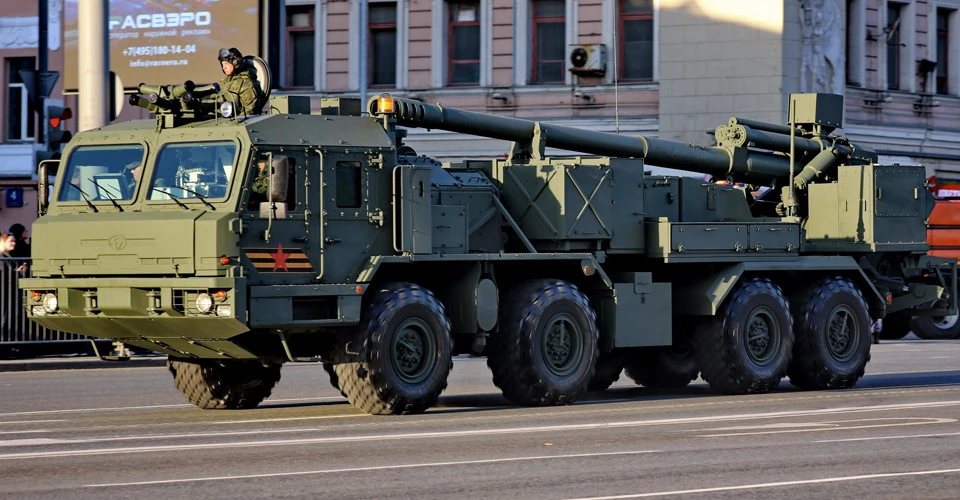
"Giatsint-K"
"The Russians removed the artillery part (barrel, recoil devices and guidance mechanisms) from the wheeled carriage, which was pulled by a truck, and installed it directly on the BAZ-6910-027 cargo chassis. Thus, the Hyacinth-B, i.e. the one being towed, became the Hyacinth-K, i.e. the wheeled one," the publication says.
"Giatsint-B" took a long time to deploy, while "Giatsint-K" operates on a hit-and-run principle: the crew can open fire within minutes of stopping and leave the position just as quickly. This is achieved through technological "rejuvenation." Although the gun itself (152 mm calibre barrel) remains the same design from the 1970s, the "K" version adds an automated fire control system. An on-board computer and digital communications allow it to receive target coordinates directly from drones and automatically calculate firing data. Satellite navigation has also been added for precise positioning of the gun on the ground.
In other words, the "Giatsint-K" is not a fundamentally new gun with new ballistic capabilities, but a way to make the old but powerful "Giatsint-B" gun mobile and modern for the conditions of modern counter-battery warfare.
"Since Russia does not produce new barrels for "Giatsints" (production was discontinued in 1993), they decided to take old guns from storage and mount them on new chassis. This was an attempt by the Russian Federation to quickly obtain an analogue of the French CAESAR or Ukrainian 'Bohdana', " the publication notes.
Differences
Both guns, the Ukrainian 2S22 "Bohdana" and the Russian 2S44 "Giatsint-K," are wheeled artillery systems. But they differ fundamentally.
Caliber and ammunition.
- "Bohdana" uses the NATO 155 mm calibre. This gives it access to a wide range of Western high-precision shells (Excalibur, SMArt 155) and cluster munitions.
- "Giatsint-K" remains in the Soviet 152 mm calibre. Although it uses the powerful 2A36 gun, it is limited to Soviet/Russian types of shells, including the "Krasnopol-M" guided shells.
Firing range
- "Bohdana" provides a range of up to 40–42 km with conventional bottom-burst shells (NE-VV). Special versions (e.g., the towed Bohdana-B) have a range of about 30 km.
- 2S22 Bohdana self-propelled gun, photo: 47th SAB.
- "Giatsint-K" fires conventional shells at a range of 30.5 km and active-reactive shells at a range of 33-40 km. Thus, "Bohdana" has an advantage in range when using standard long-range ammunition.
Chassis and mobility
- "Bohdana" is mounted on various chassis (MAZ-6317, Tatra T815-7). The latest series of 200 units, due to be delivered in 2026, uses the German Mercedes-Benz Zetros chassis.
- "Giatsint-K" is based on the Russian eight-wheeled BAZ-6910-027 Voshchina chassis. It is heavier (the total weight of the installation is about 32 tonnes).
Automation and origin
- "Bohdana" was developed as a modern digital system with an automated guidance system and (in newer versions) an automatic loading system.
- "Giatsint-K" is a "hybrid" system, where the old 2A36 towed gun was mounted on a truck. This is done to quickly replenish losses, but the system has a lower level of automation compared to full-fledged modern self-propelled guns.


