



Public finances in 2027: "War budget" with deficit of over UAH 1.5 trillion
BusinessCensor reviewed the main economic provisions of the draft budget for next year, which the Ministry of Finance submitted to parliament for consideration. Sources of funding for nearly a quarter of the planned expenditures remain uncertain. Some of the revenues projected in the 2027 budget depend on changes to tax legislation that parliament has not even considered yet.
An "astronomical" deficit
On September 15, the Cabinet of Ministers submitted the draft Law "On the State Budget for 2027" to parliament for consideration.
The government projects revenues for next year at UAH 5.6 trillion ($120 billion). This is almost 10% less than it planned to collect for the budget this year (UAH 6.2 trillion, or $139 billion).
The opposite is true of expenditure: spending in 2027 is planned at UAH 7.3 trillion ($155 billion), 13% more than the expenditure in the 2026 budget (UAH 6.4 trillion, or $145 billion).
Who will cover this gap, and how, remains an open question.
The budget assumes that the war will continue throughout next year. Real GDP is expected to grow by 1.3%, below the 1.6% projected for 2026 and the actual growth of 1.8% in 2025.
At a press conference during the "Carpathian Eight" summit, Volodymyr Zelenskyy described next year’s budget deficit as "astronomical". This comes against a backdrop of existing budget problems. To recap, in a single day, without warning or discussion, the Ministry of Finance halted funding for capital expenditure across the country because of a lack of funds. Read more here.
The Economist considers Ukraine’s economy to be "on the brink". Meanwhile, the Ukrainian outlet Dzerkalo Tyzhnia, in its analysis of next year’s budget, effectively writes that our economy is dying, "hooked up to the ventilator of international financial support".
"Ukraine on the brink"
Each year, the Ministry of Finance bases its draft state budget on a macroeconomic forecast prepared by the Ministry of Economy several months before the budget is drawn up, usually using data for January–July of the current year. Following the September attacks, which inflicted massive losses on entire sectors, the forecast data used in the government’s calculations probably do not reflect the current situation.
Indeed, in virtually a single day, Ukraine lost one of its main manufacturing industries: metallurgy. Oleksandr Vodoviz, chief of staff to the CEO of Metinvest, told the Financial Times that Russian attacks had destroyed the last three major steel plants, located in the Zaporizhzhia and Dnipropetrovsk regions. They accounted for 90% of Ukraine’s steel production.
At the beginning of 2026, GDP growth turned negative for the first time since the first quarter of 2023, according to the explanatory note to the draft Law "On the State Budget for 2027".
The document’s authors attribute this economic hardship to the "most difficult" winter since the start of Russia’s armed aggression, with unusually cold weather, temporary electricity shortages, "more subdued domestic demand (including government demand) and delays in external financing".
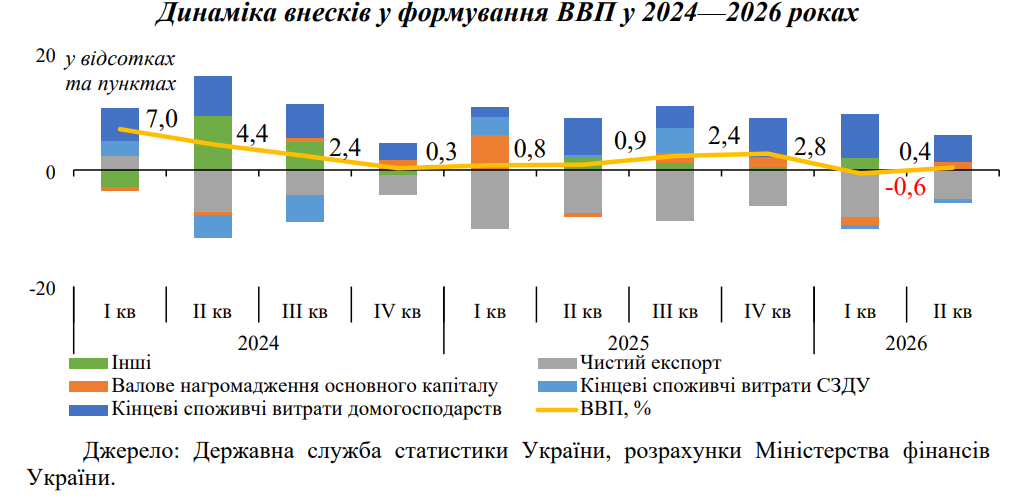
In the second quarter of 2026, real GDP grew by 0.4% compared with the same quarter of 2025, according to the State Statistics Service of Ukraine.
However, growth was concentrated in a narrow range of industries primarily serving the domestic market and those operating in the security and defence sector.
Nominal GDP in 2026 is expected to reach UAH 10.10 trillion, UAH 204 billion below the figure projected for this year (nearly UAH 10.31 trillion) that was used in drafting the 2026 budget.
Trade balance
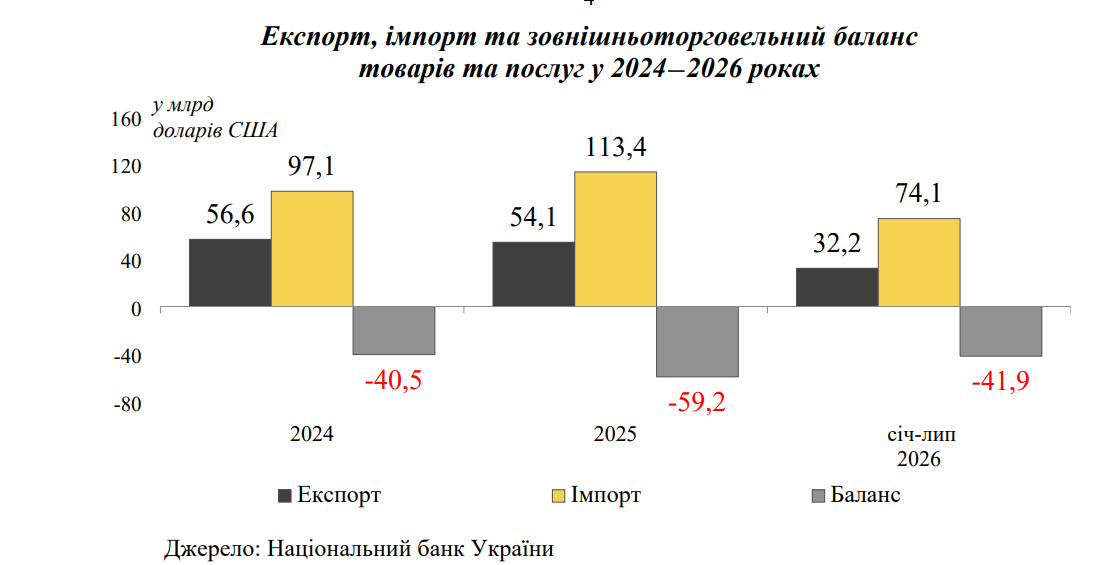
According to preliminary data from the National Bank of Ukraine, goods exports totalled $22.6 billion in January–July 2026, up 2.8% compared with the same period of the previous year.
Exports of food products and raw materials for their production (mainly agricultural commodities) increased by 8.9% and accounted for 62.4% of total goods exports. Meanwhile, exports of machinery, equipment, vehicles and instruments fell by 25%.
In January–July 2026, agricultural output exceeded the previous year’s level by 17.2%, with crop production up 28.5%, providing grounds to hope for an increase in food exports.
However, deep-water ports ceased operations in July because of Russian attacks, effectively halting wheat sales to foreign markets indefinitely.
Meanwhile, goods imports rose to $59.6 billion in January–July 2026, an increase of 23% compared with the same period of the previous year.
Imports of mineral products increased by 44.1%, while imports of machinery, equipment, vehicles and instruments rose by 40.7% (this group’s share of goods imports reached 41.9%).
The increase in imports is primarily driven by defence and energy supply needs.
Prices are rising
Exchange rate losses and production losses are affecting prices.
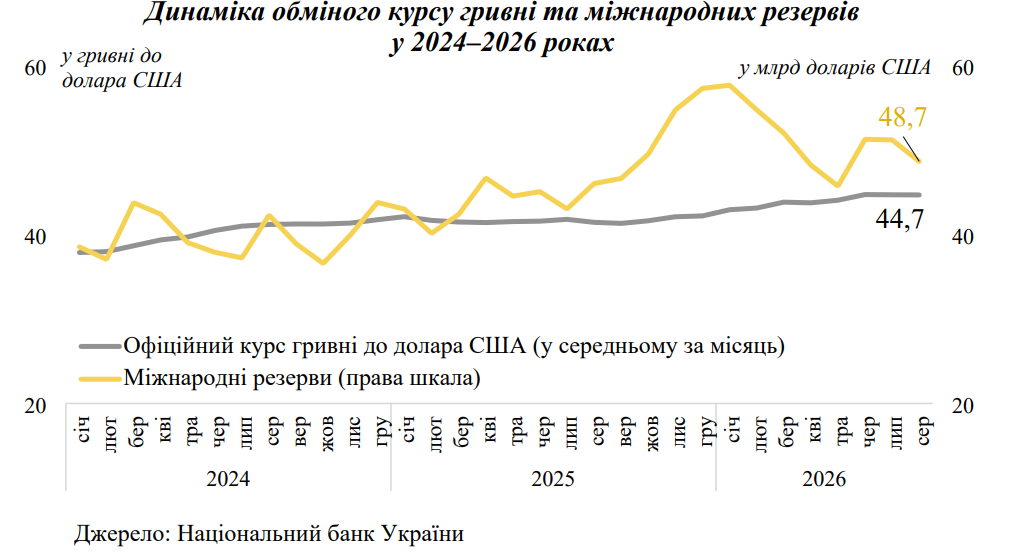
In August, food prices rose by 5.9% compared with August 2025. Meanwhile, the cost of water supply increased by 77.6%, transport services by 35.9%, including road passenger transport by 39.1%, and fuel by 38.7%.
The fastest price increases are concentrated primarily in transport and housing and utility tariffs.
Forecast for 2027
To calculate the figures for the draft state budget for 2027, the Ministry of Finance used the key projections under pessimistic scenario No. 2 of the government-approved Forecast of Ukraine’s Economic and Social Development for 2027–2029. It assumes that the war will continue throughout next year.
Under this scenario, consumer prices will rise by 8% in 2027, while industrial producer prices will increase by 16.2%.
The average exchange rate is assumed to be UAH 47.1 per US dollar, reaching UAH 48.3 at the end of the year.
The state budget deficit in 2027 is projected at 15% of GDP, comprising 14.1% of GDP for the general fund and 0.9% of GDP for the special fund.
The draft state budget for 2027 provides for a minimum wage of UAH 9,546 from January 1, 2027 (10.4% higher than this year).
Meanwhile, the subsistence minimum for January 2027 is set at UAH 3,559, even though, according to official information from the Ministry of Social Policy, the actual subsistence minimum at July 2026 prices is UAH 8,876 per person per month.
The general fund of the state budget is to be financed in 2027 through government borrowing totalling UAH 2.275 trillion.
Budget revenues
State budget revenues for 2027 are planned at UAH 2.86 trillion.
The largest amounts are expected to come from VAT on imports at UAH 859.3 billion, personal income tax and the military levy at UAH 689 billion, domestic VAT net of refunds at UAH 384.9 billion, and corporate income tax at UAH 338.5 billion.
Planned revenues cover around 78% of budget expenditure. Under the Ministry of Finance’s plan, for the budget to balance, we need to secure over EUR 50 billion in international financing. However, the amount confirmed by partners currently stands at around EUR 20 billion, meaning that the remainder, around UAH 1.5 trillion, still needs to be found.
Financial support from the EU is tied to meeting structural benchmarks under the Ukraine Facility programme. Key requirements include reforming the State Bureau of Investigation (SBI) and introducing transparent competitive selection procedures, including for the post of prosecutor general. The implementation of these reforms in Ukraine is being sabotaged.
Additional revenues
The 2027 budget is based not on the current tax framework but on provisions that parliament has yet to vote on. Nevertheless, its authors are building next year’s draft budget around these hypothetical additional revenues. Specifically, they expect to collect the following in 2027:
- UAH 14 billion in personal income tax from taxing income earned through digital platforms. The Verkhovna Rada passed the relevant law back in June, but the president has yet to sign it.
- UAH 38.5 billion in corporate income tax from banks for the reporting (tax) periods covering the first three quarters of 2027, provided that Ukraine’s Tax Code is amended to extend the application of the 50% tax rate for banks.
- UAH 11.8 billion in VAT from taxing goods in international parcels and express shipments, provided that Ukraine’s Tax Code is amended to tax goods in such shipments. The relevant bill has passed only its first reading.
- UAH 58.7 billion if the VAT rate is increased to 21%. These funds are to be allocated to the special fund of the state budget, including for war risk insurance. However, Roksolana Pidlasa, chair of the Verkhovna Rada’s Budget Committee, told BusinessCensor that "a vote in favour of raising VAT in the Rada is extremely unlikely".
- UAH 8.3 billion in excise tax, provided that excise tax rates on petrol, diesel fuel and liquefied petroleum gas are increased further.
- UAH 64.9 billion from improved performance by the reformed State Customs Service through a reduction in evasion of customs duties and taxes.
The supporting documents accompanying the draft budget contain no calculations of the additional revenues expected from improved customs performance. Danylo Hetmantsev, chair of the Verkhovna Rada’s Committee on Finance, Tax and Customs Policy, previously estimated budget losses from smuggling and tax evasion at around UAH 1 trillion.
Armed Forces
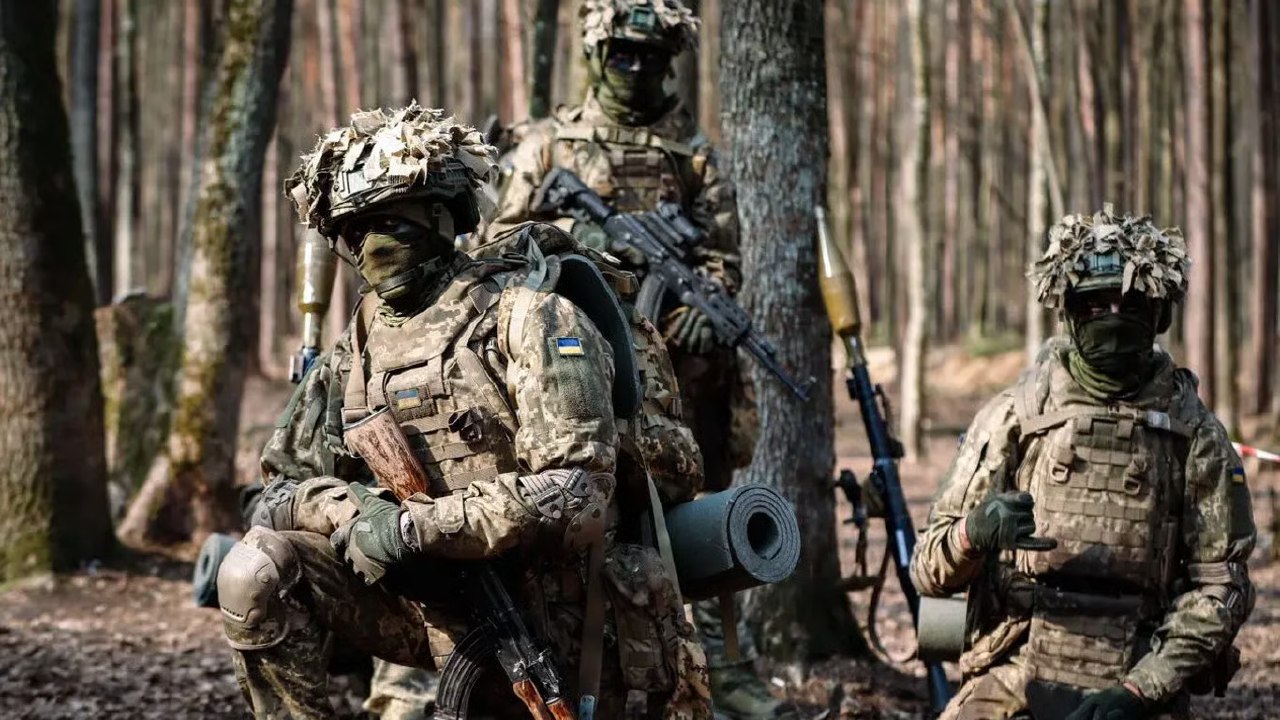
The draft state budget for 2027 allocates UAH 4.884 trillion, or 43.8% of GDP, to national security and defence. This is a record amount, 1.5 times the 2026 figure.
The planned spending is broken down as follows:
- development, procurement, modernisation and repair of weapons and military (special-purpose) equipment – UAH 2.393 trillion;
- military pay and salaries (including employer contributions) – UAH 1.79 trillion;
- fuels and lubricants, clothing and other supplies – UAH 122.24 billion;
- medicines and dressing materials – UAH 3.066 billion;
- food products – UAH 56.02 billion;
- utilities and energy – UAH 23.40 billion;
- other expenditure – UAH 495.16 billion.
The budget line for military salaries in the draft has increased by 173.5 billion UAH compared with 2026. This year, the government highlighted a shortfall in funds for military pay. MPs estimated this shortfall at between 100 and 190 billion hryvnias. The proposed increase of 173.5 billion for next year will most likely cover the existing financial ‘gap’, but is unlikely to allow for a real increase in military salaries. MPs are even speaking openly about this.
Law enforcement agencies
Funding for law enforcement agencies will increase. The largest increase in spending is planned for the National Police. Its budget will rise by 30%, from UAH 122.7 billion to UAH 159.1 billion, primarily to increase personnel pay. The National Anti-Corruption Bureau of Ukraine (NABU) will receive the smallest increase, at 12%, from UAH 2.55 billion to UAH 2.86 billion.
According to calculations by the NGO Anti-Corruption Centre "Mezha", spending on other law enforcement and oversight agencies will increase as follows:
- Economic Security Bureau of Ukraine (ESBU): +48%, from UAH 2.19 billion to UAH 3.25 billion.
- Asset Recovery and Management Agency (ARMA): +45%, from UAH 430 million to UAH 624 million.
- State Financial Monitoring Service: +44%, from UAH 197 million to UAH 283 million.
- National Agency on Corruption Prevention (NACP): +27%, from UAH 1.48 billion to UAH 1.89 billion.
- Security Service of Ukraine (SBU): +26%, from UAH 45.8 billion to UAH 57.6 billion.
- Specialised Anti-Corruption Prosecutor’s Office (SAPO): +21%, from UAH 369 million to UAH 446 million.
- State Customs Service: +19%, from UAH 8.87 billion to UAH 10.59 billion.
- State Bureau of Investigation (SBI): +17%, from UAH 4.71 billion to UAH 5.51 billion.
- Prosecutor General’s Office: +13%, from UAH 18.25 billion to UAH 20.7 billion.
- National Anti-Corruption Bureau of Ukraine (NABU): +12%, from UAH 2.55 billion to UAH 2.86 billion.
Despite talk of the need for strict austerity and spending cuts wherever possible, the draft state budget for 2027 proposes increasing expenditure on the operation of the Presidential Office by 22%, from UAH 878 million to UAH 1.072 billion.
Healthcare and education
Next year, salaries for doctors providing specialised medical care are proposed to increase by 11.9%, to UAH 30,000.
Overall, the 2027 draft budget allocates UAH 292.5 billion to healthcare. Of this, UAH 225 billion is earmarked for the Medical Guarantees Programme, UAH 33.5 billion, or almost 15%, more than this year.
The 2027 budget plans to allocate UAH 10 billion to the "Health Screening 40+" programme. The same amount was allocated to the programme this year, but applications were submitted at a slower rate than expected, leaving funds unspent. A decision was therefore made to reallocate around UAH 2.5 billion to other needs, including the "Affordable Medicines" programme.
A record UAH 21.7 billion is proposed for "Affordable Medicines" in 2027, an increase of 60%, or UAH 13 billion, over the previous year. This will expand the list of medicines that patients can receive free of charge or with a partial co-payment.
The 2027 draft budget allocates a total of UAH 328.5 billion to education and science. This is 18.3% more than was allocated last year.
The Ministry of Finance promises a salary of UAH 27,300 for an experienced teacher. Teachers received a pay rise this year, meaning that their salaries in 2027 will remain at the 2026 level.
In July this year, the government decided to provide free meals to all pupils in municipal schools. As a result, the subvention for school meals will increase by 34.5% next year, to UAH 19.4 billion.
School meals currently account for the largest increase among all education transfers.
The 2027 state budget also introduces, for the first time, a subvention to improve access to preschool education, amounting to UAH 768.7 million. Of this, 80% (UAH 614.9 million) is allocated to preschool infrastructure projects.
Subventions for the New Ukrainian School programme, at UAH 3 billion, school buses, at UAH 2 billion, and school kitchen equipment, at UAH 1 billion, remain at their 2026 levels. Adjusted for inflation, this amounts to a cut, as the All-Ukrainian Association of Amalgamated Territorial Communities notes in its analysis: communities will be able to buy less equipment and fewer buses with the same money.
Funding for equipment for workshops and laboratories at vocational and professional pre-higher education institutions is being reduced from UAH 1 billion to UAH 0.7 billion, despite the ongoing reform of specialised upper secondary education, which requires modern facilities for practical training.
The subvention to support children with special educational needs will increase by 10.1%, to UAH 495.4 million.
Business support: Is cashback here to stay?

One of the new business support programmes (which requires significant changes to tax legislation) is the UAH 58.7 billion "Support for Business Entities" programme. These funds are to be raised for war risk insurance (the Ministry of Economy proposes increasing VAT from 20% to 21% as a potential source of funding). Another UAH 8.3 billion will be allocated to support fuel sector companies (through a possible increase in fuel excise tax).
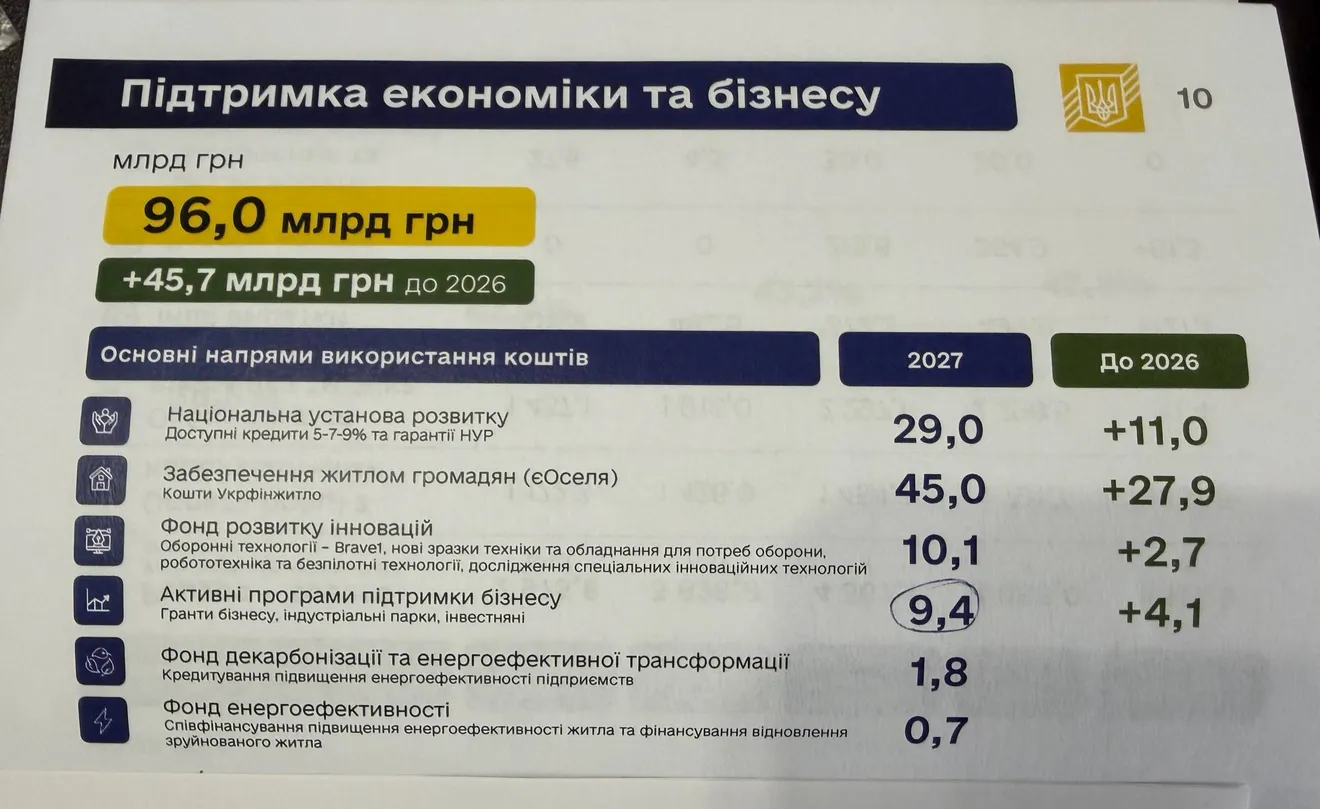
The government has earmarked UAH 9.415 billion in the 2027 budget for state support for manufacturing and entrepreneurship.
These funds are to be used for:
- helping businesses establish, develop and restore manufacturing operations in the processing industry;
- compensating for the cost of domestically produced machinery, agricultural machinery and equipment;
- establishing industrial parks;
- "stimulating the production of Ukrainian goods and services by providing state cash compensation to buyers of Ukrainian-made goods and services". According to MP Nina Yuzhanina, this is actually the official description of the "National Cashback" programme, which the government has apparently retained in next year’s spending plans despite public criticism.
Since its launch in 2024, the cashback programme has cost the state budget around UAH 20 billion. The programme was launched at the end of 2024 without prior planning. It was therefore financed from various sources not provided for by law. Cashback was partly funded from the Reserve Fund, which is intended primarily to address the consequences of emergencies and hostilities. In other words, it should fund urgent measures rather than popular government decisions to hand out money to the public.
For next year, spending on a programme resembling "National Cashback" has already been included in the budget’s special fund as one of the business support programmes.
The government also plans to allocate UAH 19 billion to the National Development Institution, which administers the "Affordable Loans 5-7-9" and "Affordable Leasing 5-7-9" programmes, used primarily by agricultural producers.
Housing
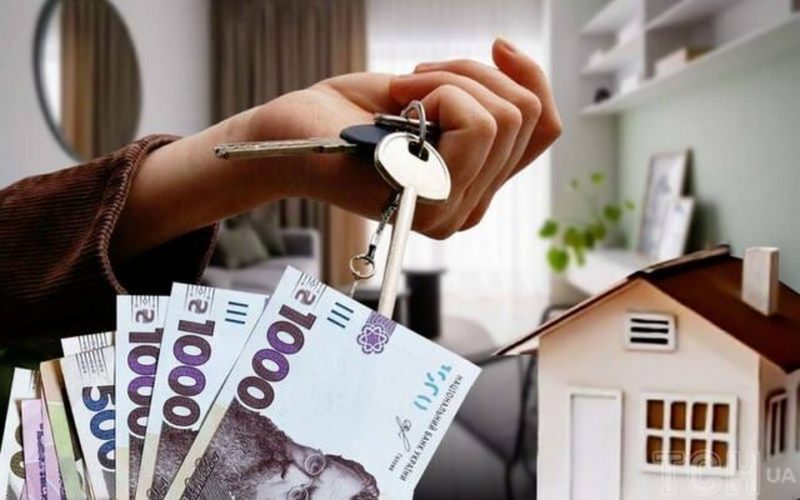
The draft budget for 2027 allocates a total of around UAH 85 billion to housing programmes and compensation.
Funding for housing programmes is distributed as follows:
- UAH 3.4 billion is allocated specifically to routine and major repairs of damaged property through the "eVidnovlennia" service.
- UAH 11.5 billion is earmarked for compensation for completely destroyed property (housing certificates).
- UAH 5.5 billion is allocated to compensation for destroyed housing under the "HOME" project, implemented jointly with international partners.
Energy
UAH 680.7 million is allocated to the Energy Efficiency Fund, which runs energy efficiency programmes for the housing sector. The fund provides reimbursements and grants for installing energy meters in residential buildings, insulation and thermal modernisation, fitting heating boilers, installing alternative energy sources and other measures.
Overall, state support for the energy sector is planned at UAH 2.043 billion. This expenditure will be distributed as follows:
- maintenance and logistical support for units responsible for the physical protection and security of nuclear facilities, and maintaining their combat readiness, financed from the general fund – UAH 104.9 million;
- protecting the financial reserve for decommissioning nuclear facilities against inflation by investing the funds in domestic government bonds, financed from the special fund – UAH 792.1 million;
- payment of the Cabinet of Ministers’ award to 100 energy sector workers for their significant contribution to energy resilience – UAH 16 million;
- additional monthly state assistance of UAH 20,000 to workers in emergency repair crews at fuel and energy sector companies – UAH 650 million;
- repayment of debts on the electricity balancing market – UAH 480 million.
US–Ukraine Reconstruction Investment Fund
The government has separately allocated UAH 960.3 million under the programme to establish the US–Ukraine Reconstruction Investment Fund. Few specifics about this cooperation are available so far. The funds are to be spent on "preparing and supporting investment projects" and "implementing mechanisms to attract investment into priority sectors of the economy".
Conclusions
Year after year, the share of the budget covered by financing from Western partners grows, while revenues generated by the Ukrainian economy keep shrinking.
"Almost 70 kopecks of every hryvnia come from resources provided by our partners. We must understand this, appreciate it and do everything we can to ensure Ukraine succeeds," said Verkhovna Rada Speaker Ruslan Stefanchuk.
The speaker described the draft budget for 2027 as another "war budget", with the bulk of spending to be directed towards supporting the Armed Forces of Ukraine.
Meanwhile, opponents of the government criticise the draft for its enormous UAH 1.5 trillion funding gap, with no clear indication of how it will be covered.
"The first thing to do is shut down corruption schemes and stop squandering money on the Presidential Office’s populist projects, redirecting it to support businesses. But the authorities are once again choosing easy solutions: milking the cow," said MP Dmytro Razumkov, head of the "Smart Politics" cross-party parliamentary group.
He criticises the government’s proposal to increase VAT to introduce state war risk insurance for businesses. "An additional VAT charge shifts the financial burden onto the end consumer. Ukrainians will pay, not the president or ministers," Dmytro Razumkov wrote on social media.
"The draft state budget for 2027 cannot be adopted in its current form. This document is fundamentally anti-Ukrainian: it contains numerous loopholes for corruption, while its provisions for supporting the Armed Forces of Ukraine are very weak," said Artur Herasymov, co-chair of the European Solidarity faction. "On paper, they are increasing spending on weapons procurement by just over UAH 1 billion. Meanwhile, they are allocating almost UAH 2 billion to the telethon, which is a propaganda outlet that the European Union has repeatedly asked Ukraine to shut down. More than UAH 5 billion is allocated to ‘Tysiachovesna’. I am not even mentioning cashback programmes and other spending unrelated to its intended purpose," Herasymov said indignantly.
MPs are currently preparing and discussing amendments to the government’s proposals. Some lawmakers oppose abolishing tax exemptions for international parcels worth up to EUR 150 and criticise a possible VAT increase for microbusinesses and individual entrepreneurs, stressing that it would harm economic activity.
The Verkhovna Rada’s Budget Committee must review all proposals submitted by MPs and compile them into a single table by October 15. After that, we will be able to see the final list of amendments to the draft budget to be put to a vote at the first reading.


