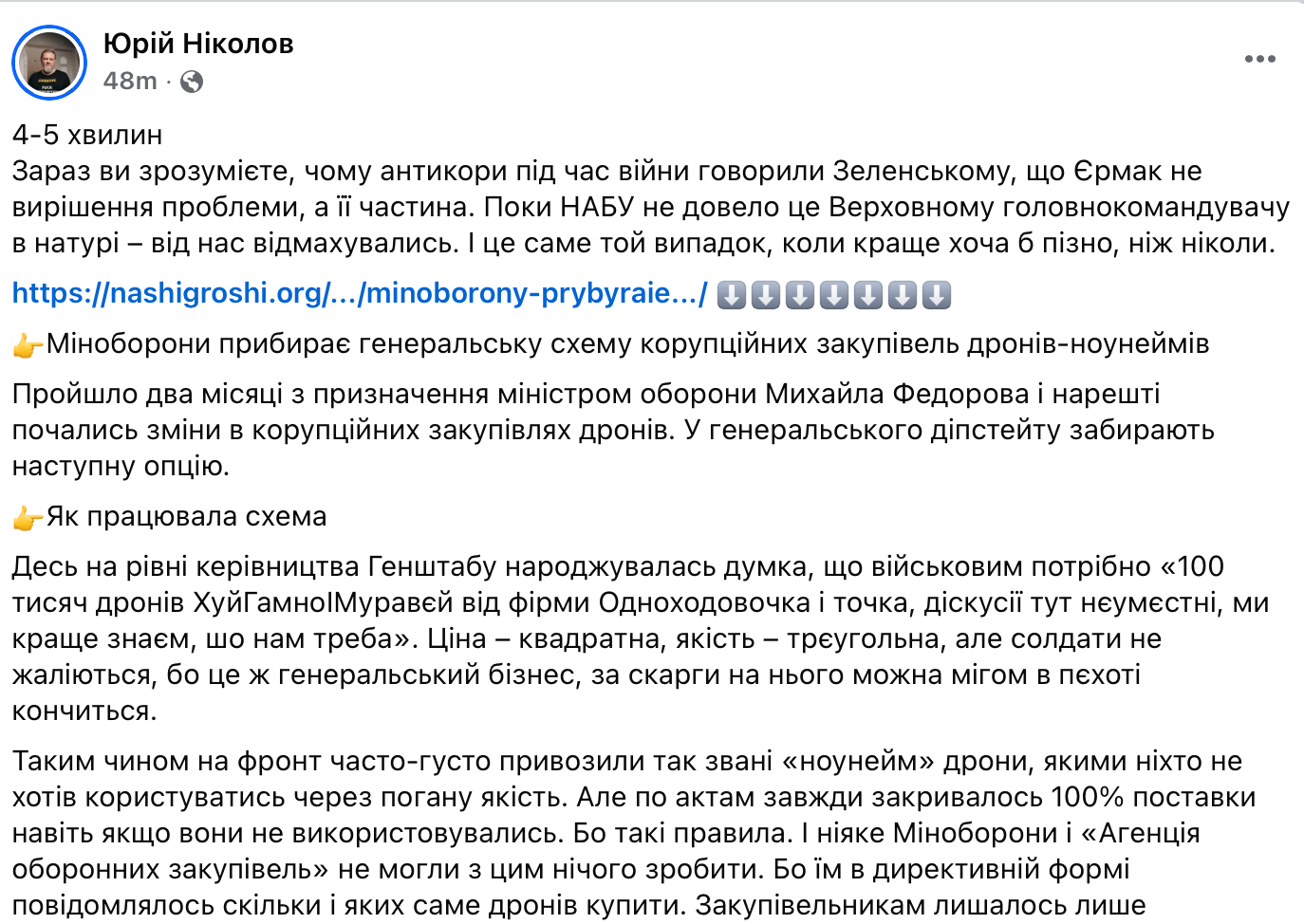
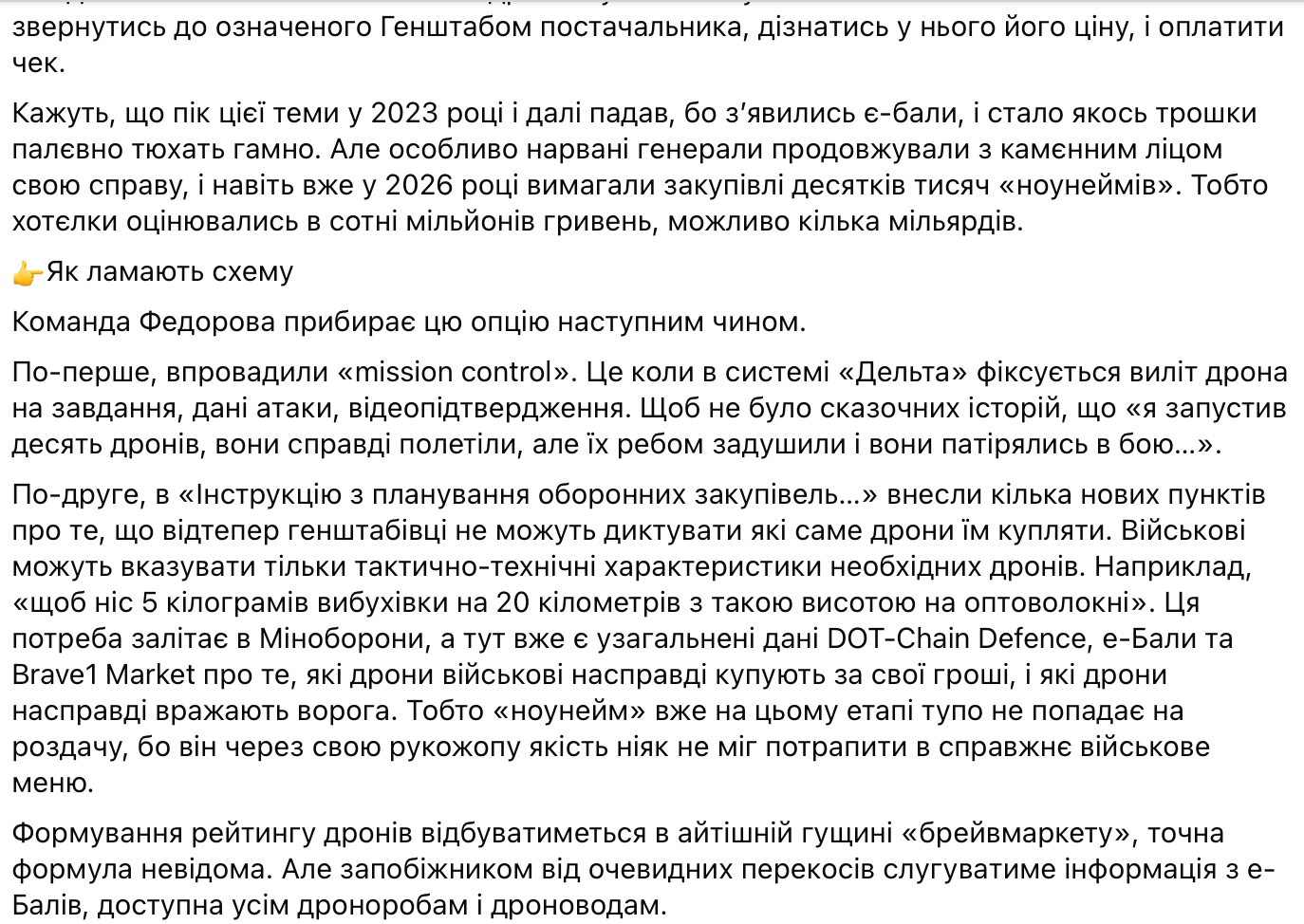
Defense Ministry is removing "general’s scheme" for corrupt procurement of no-name drones, Nikolov says
Drone Industry
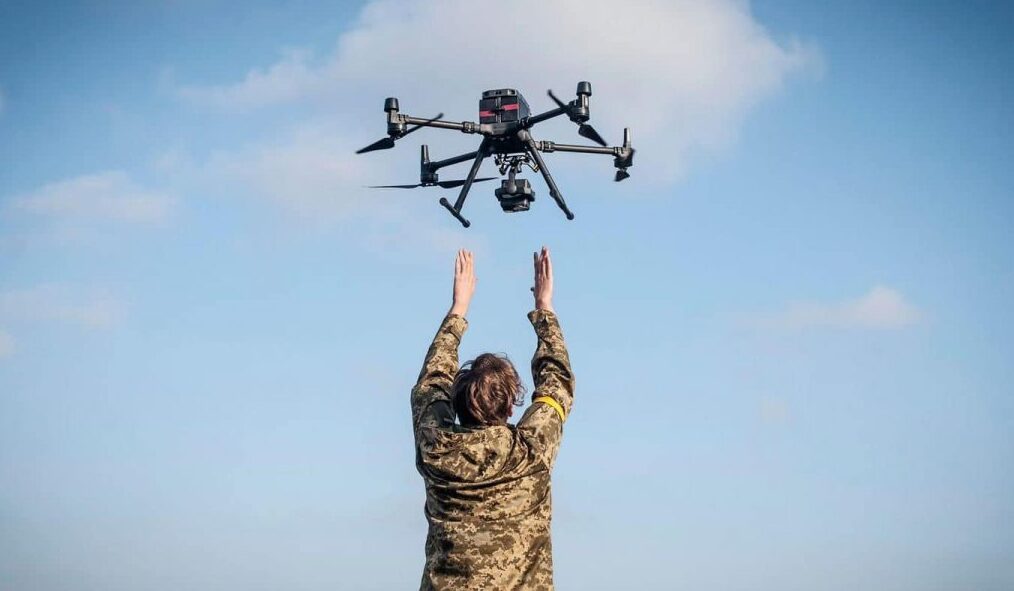
Ukraine’s Defense Ministry is changing the rules for drone procurement in order to curb schemes for supplying low-quality "no-name" drones at inflated prices under a "general’s scheme." To do so, it is introducing a new combat-use tracking system and changing the procedure for forming orders through the Defense Procurement Agency (DPA).
This was reported by journalist Yurii Nikolov, Censor.NET informs.
How the "general’s scheme" worked
The journalist recalled that before Mykhailo Fedorov’s appointment to the Defense Ministry, certain procurement decisions could be shaped at the level of the General Staff leadership.
In such cases, procurement officials were effectively dictated specific drone models and suppliers. Because of this, so-called "no-name" drones sometimes reached the front, which troops were reluctant to use because of their poor quality. At the same time, the deliveries were fully closed out in the paperwork.
"And neither the Defense Ministry nor the Defense Procurement Agency could do anything about it. Because they were told in directive form how many drones to buy and exactly which ones. Procurement officials were left with only one option: contact the supplier designated by the General Staff, find out the price, and pay the bill.
They say this peaked in 2023 and then started to decline because e-points appeared, and it became a bit more obvious to foist junk on the military. But especially brazen generals kept at it with a straight face and were still demanding the purchase of tens of thousands of ‘no-names’ even in 2026. That means these wish lists were worth hundreds of millions of hryvnias, possibly several billion," Nikolov said.
How is Fedorov breaking the scheme?
- The Defense Ministry is now introducing new control mechanisms. In particular, the DELTA system is introducing a Mission Control tool that will record the use of drones in combat missions, including attack data and corresponding video confirmation.
In addition, changes have been made to the Instruction on Defense Procurement Planning. From now on, the General Staff will no longer be able to demand the purchase of specific drone models. Instead, it must specify only tactical and technical characteristics, such as flight range, payload capacity or type of communications link.
"This requirement lands at the Defense Ministry, and here there is already consolidated data from DOT-Chain Defence, e-points and Brave1 Market showing which drone troops are actually buying with their own money and which drones are actually hitting the enemy. So the ‘no-name’ gets cut out at this stage because, with its lousy quality, it simply could not make it onto the real military menu," Nikolov explained.
After that, the Defense Procurement Agency will survey manufacturers that made it into the ranking regarding their capacity to produce the required number of drones within a certain period. Based on that data, a list of models available for contracting will be formed.
What corruption risks remain?
At the same time, Nikolov pointed out that the issue of drone pricing has not yet changed. Manufacturers prepare their own cost estimates, "add 25% and get them approved by the Kyiv Scientific Research Institute of Forensic Expertise." Because of this, the price gap between different drone models may remain significant.
The new system also does not yet cover certain categories of drones, including naval drones and long-range strike drones, which fall within the area of responsibility of special services.