



Review of Alkmaar-class mine-clearing minesweeper, which Ukraine will receive from Netherlands - Ministry of Defense. INFOGRAPHICS
Ukraine will receive the Alkmaar-class minehunter Zr.Ms. Makkum from the Netherlands. Once commissioned into the Navy, the vessel will be named "Henichesk"—in honor of the ship lost while on a combat mission in June 2022 near the Kinburn Spit.
The Ministry of Defense of Ukraine provided details about its specifications, according to Censor.NET.
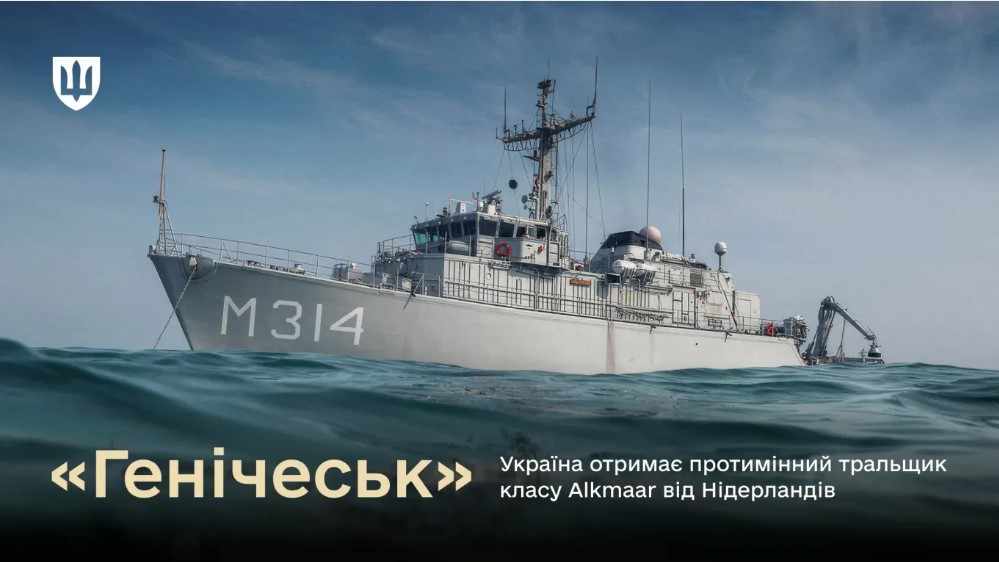
The Role of Alkmaar-Class Minesweepers
As noted, the primary mission of the Alkmaar-class minehunters is to ensure the safety of the sea, coastal waters, and harbor entrances from sea mines, as well as to protect naval formations in areas where there is a risk of mines.
In addition, these vessels can also be used to support land operations from the sea, particularly for clearing coastal areas of mines prior to an amphibious landing.
They can also be deployed to search for sunken ships and lost containers that pose a threat to navigation.
Technical Specifications

The Alkmaar-class minehunters have the following specifications:
- crew: 28–38 people;
- displacement: 543 tons;
- Length: 51.5 m;
- width: 8.9 m;
- draft: 3.8 m;
- Maximum speed: 13 knots (~24 km/h).
It is reported that the propulsion system includes a diesel engine for long-distance travel, as well as a system of auxiliary thrusters that enable precise maneuvering during mine-clearing operations.
Underwater acoustics and underwater drones
The Ministry of Defense stated that the ships are equipped with a hull-mounted sonar system designed to detect underwater objects, including mines.
In challenging hydrological conditions, remotely operated underwater vehicles and towed or variable-depth observation systems are also used to refine the characteristics of detected objects.
The command and information system integrates data from sensors, controls mine-clearing equipment, and coordinates the crew's actions.
How are mines neutralized?
Yes, the ships are equipped with light small arms, including large-caliber machine guns, for self-defense.
The primary means of mine clearance are remotely operated vehicles (ROVs), particularly those of the SeaFox type. They are used to identify underwater objects and, if a threat is confirmed, to destroy them using an explosive charge delivered directly to the target.
Divers may also be called in to perform specialized demolition work.
What is the case made of?
The hulls of the ships are made of non-magnetic materials (polyester-based fiberglass), which minimizes the risk of triggering mines with magnetic detonators. The superstructure is made of lightweight alloys.
The use of such materials is standard practice for mine-hunting vessels, as steel hulls generate a magnetic field that can trigger mine detonators.
The significance of the minesweeper "Henichesk" for Ukraine
The "Henichesk" will be the fifth vessel among those to be received by Ukraine. The four previous vessels were provided by the United Kingdom, Belgium, and the Netherlands: the "Cherkasy," "Chernihiv" (Sandown class), "Mariupol," and "Melitopol" (Alkmaar class).
The new ship is scheduled to participate in the Sea Breeze exercises in 2027.
"For now, all five vessels will be based in the United Kingdom. Once the war ends, they will participate in mine clearance operations and significantly enhance the capabilities of the Ukrainian Navy," the Ministry of Defense added.
What led up to
It was previously reported that the Netherlands would train a crew consisting of Ukrainian military personnel and, in June, transfer an Alkmaar-class mine countermeasures vessel.


