



Russians have set up network of 29 torture centres for civilians in temporarily occupied territories of Kharkiv region: people were moved between them and deported to Russia. PHOTO
In the temporarily occupied territories of the Kharkiv region, the Russians have established a system of unlawful detention of civilians, comprising transit and main torture centres. Human rights activists have documented 29 such locations and identified around 800 people who have passed through them.
According to Censor.NET, citing ZMINA, this was revealed by Ashot Agayan, a representative of Project Expedite Justice, during the presentation of the report ‘Organised Brutality: The Russian Network of Illegal Detention and Torture Centres in the Kharkiv Region’.
According to him, the Russian occupiers systematically converted buildings of various forms of ownership into sites for the unlawful detention of civilians, where people were interrogated and tortured.
Although such sites were located in different parts of the region, with the distance between some of them reaching 150 kilometres, they shared common organisational characteristics. In most cases, active or former police stations were used for this purpose.
"Typically, the torture centres had at least two zones – one for holding civilians and one for interrogating them," noted Agayan.
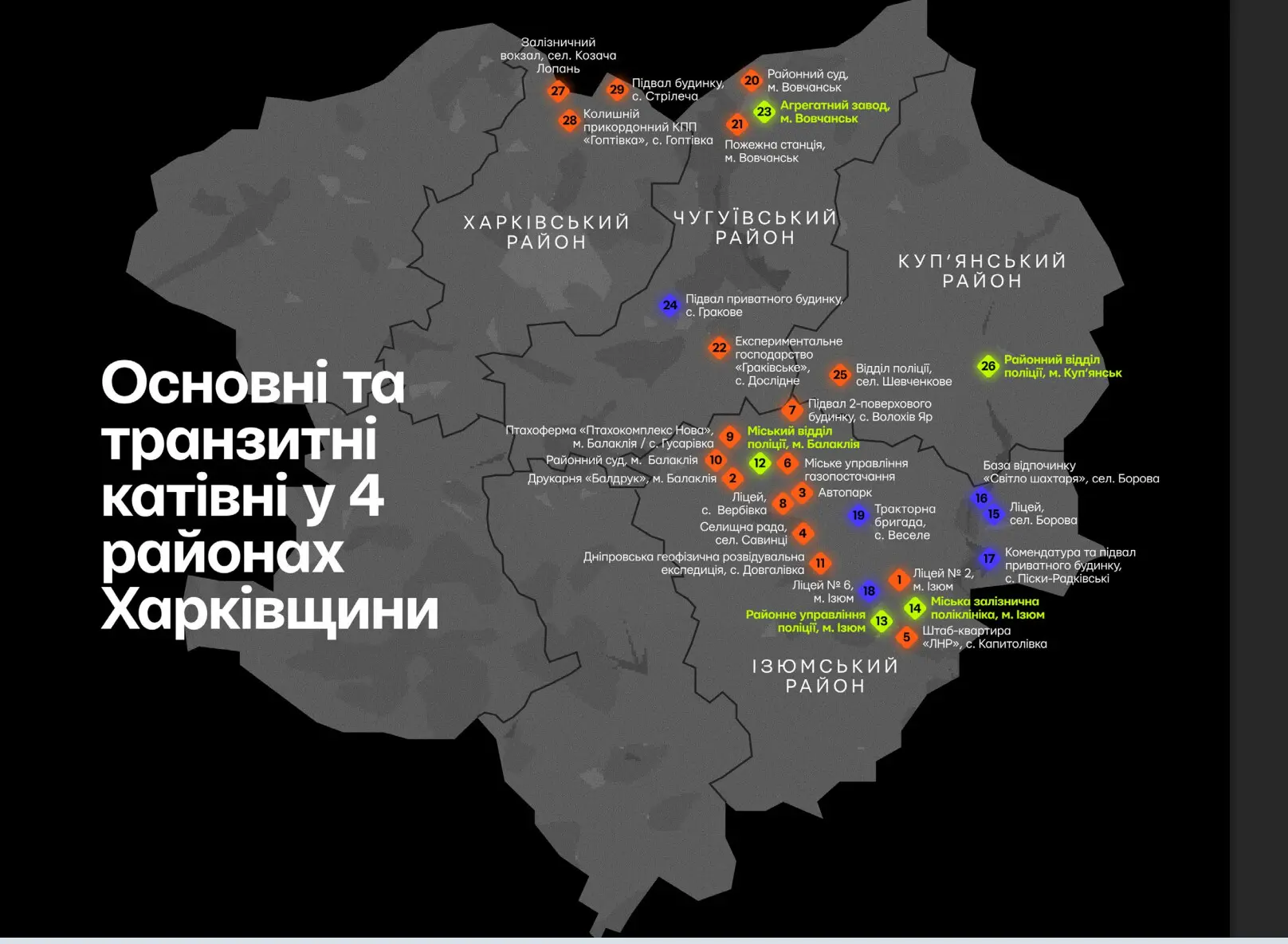
Transit and main torture centres
According to human rights activists, transit torture centres were used for the initial detention and so-called ‘filtering’ of civilians. People were detained, interrogated and tortured there.
"After that, the Russians might release the person – although this was less common – or transfer them to the main torture centre or deport them to Russia," said the representative of Project Expedite Justice.
Main torture centres were used for the long-term detention of civilians. The movement of people between different locations, according to the researchers’ findings, indicates that these centres were interconnected and operated as a single system.
The division of responsibilities between Russian agencies also points to the organised nature of this system. According to human rights activists, FSB representatives were responsible for deporting detainees or issuing relevant orders, whilst representatives of the so-called ‘L/DNR’ and the Russian National Guard guarded the torture centres and transferred people between them.
The Russians concentrated most of these sites in strategically important centres – Izium, Balakliya, Kupiansk and Vovchansk. During the occupation, these towns were used as administrative or logistical hubs.
Who was targeted by the occupiers
According to eyewitness accounts, Russian military personnel deliberately targeted men of conscription age, veterans and their family members, State Migration Service staff and law enforcement officers, volunteers, people displaying Ukrainian symbols, as well as those suspected of "sabotage" or deemed to be "informants".
Civilians were also taken to torture centres after being denounced to the occupiers by their neighbours.
The human rights defenders’ report is based on 114 testimonies from victims and witnesses, documented facts and materials from open sources. In total, the investigators carried out around ten missions to the Kharkiv region and identified approximately 800 people who had been held in places of unlawful detention.
Truth Hounds carried out their first mission to the de-occupied Kharkiv region on 20 September 2022. In just five days, they recorded around 80 cases of unlawful detention, disappearances and torture.


